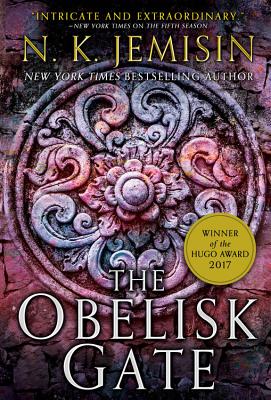
The Obelisk Gate

by N. K. Jemisin
First sentence: “Hmm. No. I’m telling this wrong.”
Support your local independent bookstore: buy it there!
Others in the series: The Fifth Season
Content: There is swearing, including many f-bombs, and violence. It’s in the Science Fiction/Fantasy section of the bookstore.

Again, it’s super hard to talk about this one without giving too much away. Let’s just say it’s about magic, and community, and the end of the world, and forgiveness and how all that fits together.

Things I really liked: the language. Jemisin KNOWS how to spin a story. And this one is super intimate, it’s one character telling it to another, which is why the second person (which usually drives me nuts, but doesn’t in this one). The storytelling is just effortless, even when dealing with tough and complex things.

I liked that Jemisin was fearless about what the end of the world means. Communities will run out of supplies, there will be starvation and cannibalism. It’s refreshing that she’s so frank.

I liked one character, Nassun, who is 10, though I thought she was much like most 10-year-olds in fantasy novels written for adults: super precocious, and not at all believable as a 10-year-old. Even so, she was smart and intuitive and I enjoyed her as a character.

One more book to go in this trilogy! I can’t wait to see how the story ends.

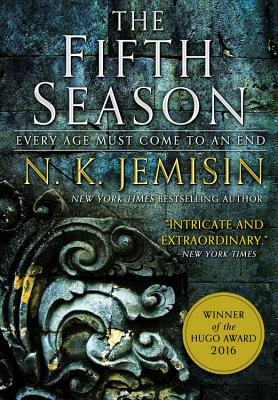
The Fifth Season

by N. K. Jemisin
First sentence: “Let’s start with the end of the world, why don’t we?”
Support your local independent bookstore: buy it there!
Content: There is some tasteful sex, and a lot of f-bombs. It’s in the science fiction/fantasy section of the bookstore.

As I was reading this, I know I thought at one point that there really is NO way to summarize this book without giving it all away. And it was so delightful — mostly, at first it was a bit confusing — not knowing what was going on and slowly discovering it for myself, that I think I’m going to spare you the plot summary. Let’s just say this book is about a world — the Stillness — that sometimes has catastrophic events they call Fifth Seasons, and at the beginning of this one, a Fifth Season starts. It’s about what happens before and after.

Which really doesn’t give you a sense of this book at all. At one point, early on, I wasn’t sure I liked it, but the writing kept drawing me in — Jemisin is a fabulous writer — and I was intrigued, which really was enough. By the end, though, I was blown away and, of course, I need to read the rest just to see what happens with these characters I’ve come to really enjoy. There are also layers and layers to this book — it was chosen for a book group (actually, they ended up doing all three), and I can see why. There’s a LOT to talk about with people who have also read it.

Which is to say: if you enjoy a good, complex fantasy, you ought to be reading this series.

5 Worlds: The Red Maze

by Mark Siegel, Alexis Siegel, Xanthe Bouma, Matt Rockefeler, and Boya Sun
Support your local independent bookstore: buy it there!
Review copy provided by the publisher.
Others in the series: The Sand Warrior, The Cobalt Prince
Content: There is some fantasy violence. It’s in the middle grade graphic novel section at the bookstore.

Oona failed to light the blue beacon, mostly because there’s an order they need to be lit, and red comes before blue. So, it’s off to Moon Yatta, where the red beacon has been harness to power the world. It’s the most technologically advanced of the five worlds, but harnessing the power of the beacon is also draining the world faster. Ooona, Jax, and An Tzu need to find their way through the maze of pipes and machines surrounding the beacon in order to light it, but the Nanotex corporation — who basically run Moon Yatta — is against them.

There’s a nice subplot, too, about the shapeshifters who have been collared so they can’t shapeshift or else they’re banished to the desert to live in isolation and Jax’s role as a starball superstar comes into play as well. The authors are dealing with a lot here: capitalism, and the hero worship of celebrities, as well as the prevalence of misinformation through the media. But, mostly, it’s still an engrossing story that kept me entertained and captivated as Oona and her friends figured out the next step in their overall goal to light the five beacons and save the universe.

It’s a smart, fun series, one that readers of Amulet and Zita are sure to love.


Finale

by Stephanie Garber
First sentence: “Scarlett Dragna’s bedroom was a palace built of wonder and the magic of make-believe.”
Support your local independent bookstore: buy it there!
Others in the series: Caraval, Legendary
Review copy provided by the publisher.
Release date: May 7, 2019
Content: There is some violence, some mild swearing, and some off-screen sex (plus a bunch of passionate kissing). It will be in the teen section (grades 9+) of the bookstore.

Spoilers for the other two, obviously.

The Fates have been released from their cards, Legend is set up to be emperor, and all Scarlett and Tella want is for their mother to wake up. But when she does… she sets off a series of events that lead Scarlett and Tella into their most dangerous game yet: the game for their lives.

All the characters are back: Julian, Legend, and Jacks of course, and there are a huge number of new characters — the Fates — that come into play. On the surface, its a lush, magical, dangerous romp. But, underneath, I think Garber has always been exploring what people will do for love, and the difference between love and obsession. It’s especially clear in this book, and I think it’s stronger for it. I wasn’t terribly impressed with the second in this series, but I think Garber has pulled it together and put out a strong, fascinating, good conclusion.

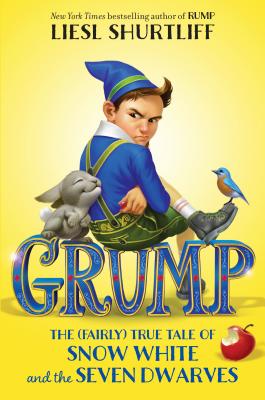
Grump

by Leisl Shurtliff
First sentence: “I was born just feet from the surface o the earth, completely unheard o for a dwarf, but it couldn’t be helped.”
Support your local independent bookstore: buy it there!
Content: It’s got a longer chapters, and some challenging words, but nothing too outrageous. It’s in the Middle Grade (grades 3-5) section of the library.

Borlen is a very unusual dwarf: he was born near the surface and is more curious about the human world than digging for gems. He carries around a pet bat, and spends his time reading about the human world and trying to go above and see it. His Fate Stone — the stone that all dwarves get when they come of age — is a mirror, which is unheard of. And so, when he’s placed as a Seventh (the worst position) on a mining team and there’s a chance for him to see what the humans are like, he takes it. 

Once above ground, Borlen stumbles into the clutches of Snow White’s power-hungry stepmother, the Queen Elfrieda Vronika Ingrid Lenore (let’s see if you get it), who unfortunately mis-interprets the word “fairest” to mean most beautiful instead of most fair. That creates a problem for Borlen, when he’s tasked with seeing Snow White killed.

The rest of the plot follows the fairy tale pretty closely, and I enjoyed it. I’m not entirely sure why giving Borlen — Grump of the seven dwarves (I recognized Sneezy, Bashful, and a couple others in the mix) — a backstory was necessary to retell Snow White, but it did make for an entertaining little book.

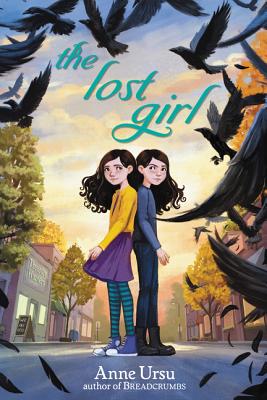
The Lost Girl

by Anne Ursu
First sentence: “Once upon a time, there were two sisters, alike in every way, except for all the ways they were different.”
Support your local independent bookstore: buy it there!
Review copy provided by the publisher.
Content: There are some scary moments. It’s in the middle grade (grades 3-5) section of the bookstore.

Iris and Lark are identical twins. And they’ve always been together, from the very start. They’re stronger together, and even though they are different, they help each other out. That is, until this year, their 5th grade year, when their parents (darn them!) decide that it would be better if Iris and Lark are in two different classes. That shakes both girls to their core, but Iris, who’s nominally our main character, is really having a tough time of it. And things get a lot more complicated when she starts frequenting a strange new antique store in town with an odd owner who says there is magic in the world.

I swear I read a tweet by Anne Ursu (who, if you don’t follow on Twitter, you should!) that this book was about girls and friendships and smashing the patriarchy, and I am totally here for all of that. It’s a seriously good book; the parents create conflict by being good parents (which is incredibly unusual) and by trying to stretch their twins in new ways. And it’s uncomfortable (do I really listen to my kids the way they want to be listened to?) and challenging and amazing and wonderful all at the same time. I adored Iris’s loud strength and courage and prickliness and Lark’s whimsical nature and quiet strength. But what I really loved was the way the girls banded together to overcome the conflict. Seriously. Usually in middle grade fiction, it’s the main character Facing the Challenge and Overcoming (maybe with a little help), but very rarely is it a group of kids who work together and are Awesome. Don’t underestimate the power of kids working together.

It’s such a fantastic, wonderful, gorgeous middle grade book.

The Boneless Mercies

by April Genevieve Tucholke
First sentence: “They say dying makes you thirsty, so we always gave our marks one last drink.”
Support your local independent bookstore: buy it there!
Content: There is a lot of death and some drinking. It’s in the Teen sectiong (grades 9+) but it’d be appropriate for younger kids as well.

Frey and her companions — Ovie, Runa, Juniper — are Boneless Mercies: women who roam the country performing mercy killings for payment, such as it is. They’re shunned by society, even while they’re treated with respect. But the girls — and they are all girls, ranging from 15 to 19(ish) — are tired of the death trade. Frey, especially, longs for something More out of life. So, when they here of a monster — a giant — who is terrorizing the Blue Vee area of Vorseland, they head out to perform that impossible task.

There’s more to it, of course. And it’s very much an Epic Tale in the tradition of the Odyssey, or (more accurately) one of the Norse myths. In fact, it’s deliberately Norse (without being explicitly so): the Boneless Mercies worship the goddess Valkree, and others follow Obin. It’s Vorse and Finnmark and Dennish. Warriors die and go to Holholla, and they believe in Hel. This bugged me, at first, because why be Norse without really being Norse? But, eventually, I settled in and it didn’t bother me as much.

It’s a very feminist book, without hitting the reader over her head: it’s female-centric (there are about five male characters in the whole book), it’s a world where while females don’t have power (there are references to the way women and girls are kept down), they search out the power they do have and wield it to the full extent, while working for change. But, mostly, it’s beautifully written. Tucholke has a gift for words in the same way Laini Taylor and Maggie Stiefvater do: she keeps the story going, while painting beautiful word pictures.

It’s a lovely epic story, and one I’m very glad I read.

Beasts Made of Night

by Tochi Onyebuchi
First sentence: “I make sure to sit where they can’t see me.”
Support your local independent bookstore: buy it there!
Content: There are a couple of mild swear words, some violence, and a bit of kissing. It’s in the YA section (grades 6-8) of the bookstore.

The world that Onyebuchi created is fantastic: purity means everything to the people of this city, and so to remain pure from sin and wrongdoing, the rich and powerful hire Magi to call the sin from them, in the form of shadow beasts. Then sin-eaters, called aki, destroy the beasts, and swallow the sin, which appears in the form of a tattoo on their bodies. The aki are considered the lowest of the low, because their impurity is visible on their bodies, and so they are shunned and cheated and die early.

But, unfortunately, that’s as far as the book got. There isn’t much of a plot — first our main character, Taj, is in the slums, and then he’s in the palace, and then he’s sent to train new aki — and it never really seemed to go anywhere. There’s a rebellion and a resistance and who is really the “bad guy” (was it the head Magi? Or the royals?) and the princess Taj was kissing HAD to be at least old enough to be his mother, which just creeped me out.

So, while I adored the world that Onyebuchi created, the book just didn’t do it for me.

Bruja Born

by Zoraida Cordova
First sentence: “This is a love story.”
Support your local independent bookstore: buy it there!
Review copy provided by the publisher for the Cybils.
Content: There is some mild swearing and a few f-bombs. There is also a lot of violence. It would be in the Teen section (grades 9+) if the bookstore had it, but I think a 6-8th grader who was interested could read it. 

I’ll be forthright: this is a second in a series. And no, I haven’t read the first one (yet). But this one worked as a stand alone; Cordova gives enough information that it kept me in the loop with the backstory (though I do wonder if it was too much, if you’ve already read the first one?) but didn’t really get in the way of this story. 

Lula has been growing distant from her boyfriend, Maks, for many reasons (most of which have to do with book 1, but also because she’s a bruja – a witch) and he decided that he was done trying to make this work. So, on the way to a soccer game — he’s a player, she’s part of the cheer/dance team — he did. And then the bus got into a fatal accident. Lula’s family — who are all brujas — was able to save her through magic, but Maks, well, died. Except Lula, when she recovered, wasn’t able to accept that. So, she and her two sisters — Alex and Rose — performed a canto (a spell) to save him. Which… worked. Sort of. What it actually did was trap Death (the Lady de la Muerte) in between realms and created a whole hoard of casimuertos — zombies who eat hearts instead of brains — that quickly took over Brooklyn. 

What Lula (and Alex and Rose by extension) need to do is figure out how to get the Lady back to her realm and figure out a way to stop the casimuertos before they kill everyone. 

I’ve already addressed how nice it was that this was its own story rather than a continuation of a story that began in the first book, but it’s also a lot of fun. I enjoyed the Latinx flair that Cordova brought to witches (and zombies) and I thought the story was just a lot of fun. There was romance gone wrong, consequences to choices, some fun sidekicks, and a great family relationship. 

I’m going to try and go back and get my hands on the first book in the series. It’s really a LOT of fun. 

Beneath the Citadel

by Destiny Soria
First sentence: “Four people were supposed to die at sunrise.”
Support your local independent bookstore: buy it there!
Content: There’s multiple instances of one swear word, and some violence. It’s in the YA section (grades 6-8) of the bookstore.

Things I really liked about this book:

  1. The time frame was super condensed: most of the action took place (shock) beneath the citadel, where the council of Eldra has been hiding, listening to prophecies, and determining the Fate of the citizens of their country.  Likewise, the entire book took place over four days. 
  2. Even though there was shifting perspectives (I really am kind of over that) between the five characters, Soria kept the action propelling forward, and I never found myself losing interest in the story. 
  3. Which is to say: Soria really knows how to write. No, the sentences weren’t lyrical and lovely all the time, but the characters and dialogue popped, and she kept me guessing throughout the whole book. And she doesn’t hold back any punches. 
  4. I really liked the world Soria built, and the conflict between prophecy and free will. It was a nice tension, and the fact that who the “bad guy” was kept shifting was pretty impressive as well. 

In short? I really enjoyed this one.