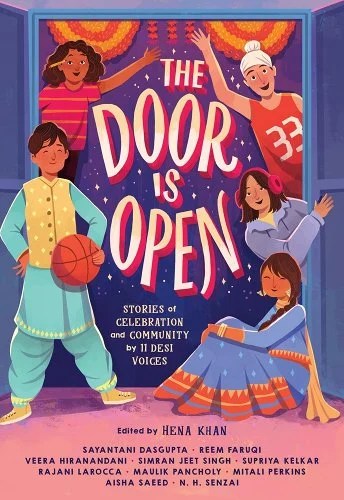
The Door is Open

Edited by Hena Khan
First sentence: “I pick up the queen and twirl her between my forefinger and thumb.”
Support your local independent bookstore: buy it there!
Content: There is some talk of domestic abuse and racism. It’s in the Middle Grade (grades 3-5) section of the bookstore.

In this series of interconnected short stories, we get a portrait of the Maple Grove community center and some of the people who use it. There are chess tournaments and spelling bees, basketball games and cooking classes, and celebrations, including festivals and banquets. It is very much the heart of the city, especially the Desi community, and when it is proposed to be knocked down instead of renovated, the community – especially the kids who find value in having it be a community meeting spot.

I liked this collection a lot. I liked getting the perspectives of a number of children; it helped emphasize just how diverse the Desi community is. I liked the role the center played in the lives of all the kids; in Wichita, the budget for the Parks & Rec department and the community centers have been slashed, so we don’t have anything like that here. But, I respect it, and am glad that the authors of these stories portrayed the community center as a vibrant and vital part of the community. I liked how all the stories connected; characters and situations in one would appear in another.

It’s a solid short story collection.

YA Graphic Novel Round-up 3

M is for Monster
by Talia Dutton
Support your local independent bookstore: buy it there!
Content: It’s raising a body from the dead, and dealing with issues of identity. it’s in the graphic novel section of the bookstore.

M is Maura, Dr. Frances Ai’s sister, brought back to life. On the one hand, M wants to continue living, so she pretends to be Maura. (Dr. Francis is so desperate to get her sister back that if this didn’t work, she would take M apart and try again. For obvious reasons, M doesn’t want that.) On the other hand, M is bad at being Maura; she doesn’t care about science, hates Maura’s clothes, and doesn’t laugh at Francis’s jokes. She wants to explore fashion and sewing, and just be herself.

This is a really clever twist on Frankenstein, looking at the monster’s point of view, and an exploration of identity and what it means to be a “person”. It’s sweet and charming and absolutely delightful.

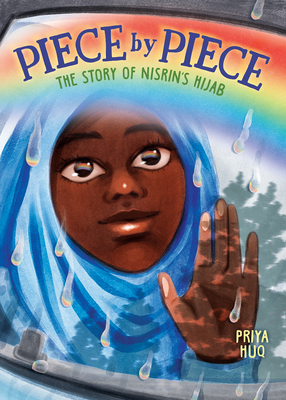
Piece by Piece
by Priya Huq
Support your local independent bookstore: buy it there!
Content: There is a hate crime to start the book, and Islamaphobia, as well as some abusive statements by an adult.

Nisrin is attacked on the way home from school – she was wearing a head covering, part of a Bangladeshi traditional costume. She is told that she needs to go back “where she came from”, and that “her kind” are not welcome. She is injured in the attack. The summer passes, and she can’t leave the house. But when school starts again in the fall, Nisrin decides to wear hijab to school, which doesn’t sit well with her mother and grandparents. They don’t understand her decision, and she has some challenges dealing with it. She does, however, find her tribe, and makes up with her best friend, who she had a falling out with after the attack.

It’s a good story, one that I think needs to be told. I appreciated that Nisrin was Bangladeshi, because isn’t a usual nationality for stories about Islam. However, while I felt it was important, I felt like it was missing something I’m not entirely sure what, but it wasn’t quite,, something. Still, I’m glad that it’s out there.

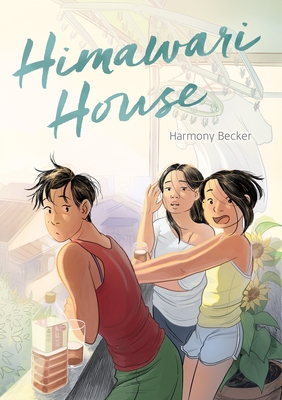
Himawari House
by Harmony Becker
Support your local independent bookstore: buy it there!
Content: There is some smoking and drinking, but the kids are all of age. It’s in the graphic novel section of the bookstore.

Nao was born in Japan but basically is raised in America. She learned to fit in, but she has often wondered what it would be like to find her roots, and go back. So, she takes a year between graduating high school and going to college, and heads to Japan to find out. She moves in to Himawari House and meets Tina – a young woman from Singapore – and Hyejung – a young woman from Korea – who are both learning to find their way in Japan. There are two boys in the house as well, though they are Japanese. The three girls become close friends, ashring in their successes and sadnesses, ads they figoure out who they are and what they want for their future.

Oh, this one was delightful. I loved that Becker captured the challenges and joys of learning to live in a foreign county, and the challenges of being biracial and trying to a way to fit in. Becker gave us the inner lives of all the characters, which was delightful. I also liked that she pulls illustrating styles from manga – there were many frames that strongly reminded me of the manga I’ve read. It was a smart story, compelling, and beautifully drawn. I loved it.

YA Graphic Novel Roundup 2

Squire
by Sara Alfageeh and Nadia Shammas
Support your local independent bookstore: buy it there!
Content: There is violence, including suggestions of genocide. It’s in the graphic novel section of the bookstore.

Aiza dreams of becoming a squire for the knights of the kingdom, even though she is an Ornu, a people that has been conquered and oppressed by the kingdom. It’s her heart’s desire, though, and eventually, her parents let her go. What she finds when she gets there, however, is not what she was expecting. She hides her heritage – Ornu get tattoos on their arms and she hides that — and makes some friends. She fails her first exam, and starts trainging with the caretaker in the camp. But when she and her friends are out on a routine patrol, and they are attacked by Ornu villagers, Aiza needs to decie between her dreams and her people.

Oh, I loved this one so much. I loved that the authors are Jordanian- and Palestinian-American, and while this book isn’t explicitly Muslim, they are pulling on the cultures of the area. I loved that you have a girl who is learning and using her spunk to improve and gain respect from other people. I loved that they deal with prejudice and colonialism and war. It was an engaging story, with great art, and absolutely a joy to read. Don’t pass this one up.

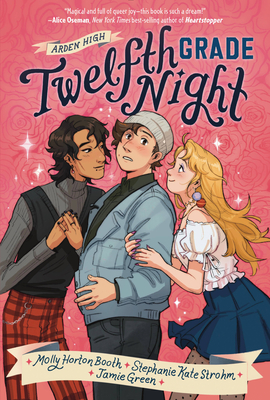
Twelfth Grade Night
by Molly Horton Booth, Stephanie Kate Strohm, and Jamie Green
Support your local independent bookstore: buy it there!
Content: It’s super lovey-dovey, but not really anything else. it’s in the graphic novel section of the bookstore.

Vi same to Arden High for a fresh start – she wasn’t really jiving any more with the uniform of the private school anymore, and she needed a chance to be more expressive. Her twin brother, Sebastian, has decided to stay in the private school – which means he’s away at bearing school. Vi finds it all a bit disconcerting to be in school without her twin, but she eventally makes friends. There’s a dance coming up – and (especially if you’re familiar with Twelfth Night) shenanigans enuse.

I am a sucker for a good Shakespeare retelling, and this is a really good Shakespeare retelling. I liked that Vi is leaning toward non-bineary (though she still uses she/her pronouns) and defies the stereotypes of nonbinary characters. But there is a definite LGBTQIA+ element to this, which is a nice touch. I loved the way they set the play in a high school, and it follos the play pretty much beat for beat. I liked the addition of the faeries from A Midummer Night’s dream to the high school, and how it’s just a delight to read. I loved the art, and thought it was all a lot of fun.

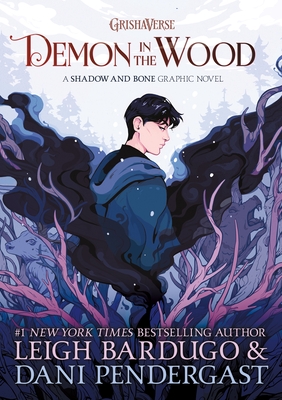
Grishaverse: Demon in the Wood
by Leigh Bardugo and Dani Pendergast
Support your local independent bookstore: buy it there!
Content There is violence, including suggestions of genocide, and some murder. It’s in the graphic novel section of the bookstore.

While this isn’t the story of how the Darkling became the Darkling, it is a story about the Darkling before he truly came to power, and gives some of the reasons behind what he did that led him down the path to becoming the Darkling. He and his mother are wondering Grisha, and they find a village to shelter them. Aleksander is supposed to keep his powers quiet, especially the fact that he is an amplifier. But things go awry, and he ends up murdering a couple of the villagers.

It’s not a deep story, though it’s an interesting exploration of the “bad guy” as the main character. It’s slight, but the art is beautiful, and it serves as both a good interoduction ot the Grishaverse and a nice addition for someone who has been immersed in the world. Not bad at all.

Two Graphic Novels about Belonging

Huda F Are You?
by Huda Fahmy
Support your local independent bookstore: buy there!
Content: There are instances of racism and Islamaphobia. It’s in the Graphic Novel section of the bookstore.

In this loosely autobiographical graphic novel, Fahmy tells of the time in her childhood when her parents moved the family to Dearborn, Michigan just so they could be a part of a bigger Muslim community. Huda went from being the only Muslim to one of many hijab wearers. She talks about the struggle she had to figure out who she was, in relation to her friends, her family (and sisters), and her religion. There is an incident with a teacher who grades Muslims harsher after 9/11 and a slight bomb “scare” at the high school, that brought Huda’s conflicts within herself to a head. Can she stand up for herself, especially in the face of Islamaphobia?

I adored this one. I think everyone can identify with the feeling of being an outsider, but I can empathize with identifying with a religion where you are in a place where your religion (mostly) is in the minority, and then moving somewhere where it is the majority religion. It messes with your head and identity. I loved the humor of this book and the way it treats religion as something that can be a big part of a teenager’s life, without it seeming all-encompassing or something the teen needs to “grow out” of.

Smart, fun, and worth reading.

The Tryout
by Christina Soontornvatillustrated by Joanna Cacao
Support Your local independent bookstore: buy it there!
Content: there are some instances of racism and bullying. It’s in the Middle Grade Graphic Novel section of the bookstore.

Also loosely autobiographical, Soontornvat reflects upon 7th grade and the way trying out for the cheer team affected her. She grew up in a small town in Texas, and her parents – a mixed-race couple (her mom is white, her dad is Thai) – ran a Chinese restaurant in town. She reflects on how har it is to make and keep friends in middle school, and the ups and downs of friendship. But the central challenge is Christina’s desire to try out for the cheer team. It’s a challenge becasue her best friend Megan is trying out as well and Christina fears that it wil negatively affect their friendship. They encounter racism (Megan is Iranian) at their small-town school – none of the teachers can pronounce Christina’s last name, and some kids are blatantly racist to her and Megan. Christna works hard, though, and finds value in trying out for the team, and along the way, makes and strengthens friendships.

This is another good one about finding where you belong. Middle school is rough, and I think Sontornat recognizes that. THis one reminde me a lot of Real Friends, centering navigating female friendship in the heart of the book. But I also like how it debunked some of the cheer stereotypes and reminded me (again) that cherlieading isn’t just a fluff thing that popular girls do. I really appreciated the author’s note at the end.

Really soild.

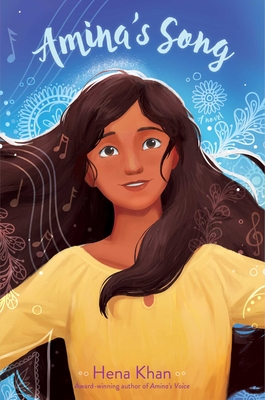
Amina’s Song

by Hena Khan
First sentence: “As I reach for a pair of silver earrings that my best friend, Soojin, might like, Zohra smacks my hand away.”
Support your local independent bookstore: buy it there!
Others in the series: Amina’s Voice
Content: There is some talk of “liking” boys. It’s in the middle grade (grades 3-5) section of the bookstore.

Amina has spent the last month or so in Pakistan visiting her family. She’s enjoyed her stay, though there are frustrating things: she doesn’t speak Urdu well, and everyone would rather practice their English than let her practice her Urdu. And, even though her family is Pakistani, she feels, well, too American.

But when she gets back home and starts seventh grade, no one seems interested in her trip and her stories. On top of that, for her history project, she chose to research Malala Yousafzai, but her classmates only want to focus on the negative parts of the story How is Amina going to keep her promise to her uncle to champion the good things about Pakistan?

Amina struggles with balancing the two parts of her life: the side that loves Pakistan, and her family and her faith; and the side that feels American and loves living here as well.

I love how Khan balances the conflict within Amina; it must be what many children of immigrants feel. I liked that there was a boy that Amina was friends with, and in spite of her friends thinking there was something “more”, all it was is friendship. It was refreshing to read about a seventh grader who wasn’t looking for a boyfriend. I was thoroughly charmed by this sone, and by Amina. I hope there are more stories of hers to tell.

Love from A to Z

by S. K. Ali
First sentence: “On the morning of Saturday, March 14, fourteen-year-old Adam Chen went to the Museum of Islamic Art in Doha.”
Support your local independent bookstore: buy it there!
Review copy provided by the publisher.
Content: There’s some mild swearing, including a couple of f-bombs. It’s in the YA section (grades 6-8) of the bookstore.

Zayneb is a senior in high school in Indiana, and she’s dealing with an Islamophobic teacher. He’s constantly bringing up ways in which Muslims are backward and how the religion is repressive, even though he’s white and doesn’t know nearly as much as Zayneb, who is actually a practicing, hijab-wearing, Muslim. Which makes her a target. So, one day, right before spring break, she’s had enough: and starts passing notes with a friend about the teacher and needing to take him down. He intercepts the note and reports her to the principal, and gets her suspended.

Which leads her to spending time with her aunt, who is a teacher at an international school in Doha. And that’s where Adam comes in. His father is the director of that school, and Adam’s home from spring break at college in London. Except he’s dropped out: he just got a diagnosis of Multiple Sclerosis, which his mother had and died from complications connected to, and he’s determined to make as much art as he can, while he still can. He’s also Muslim: his father, who is a Chinese-Canadian, converted to Islam after the death of his wife, and Adam and his younger sister Hanna soon followed.

Adam and Zayneb have an instant connection, and while this book is dealing with heavier stuff like racism, people’s perceptions of Islam, and dealing with a diagnosis of MS, it is, at its heart, a rom-com. There’s a meet-cute in the airport, there are several meetings, a setback or two, and eventually, they fall in love and are super happy together. It’s a good Muslim story: they don’t actually hold hands or stay out all night, or even have sex in the back of a car. They enjoy talking and connecting and do everything properly and by the book. And the physical stuff doesn’t happen until the Epilogue, after Zayneb graduates from college and they get married. It’s really quite sweet.

I loved seeing a really religious rom-com, because there isn’t many of those out there. And because I’m an outsider to Islam, I appreciated the glimpse into that religion. There’s this one scene where Zayneb is face-timing with a friend, who has another friend (who is a white girl) with her. Zayneb says something to the effect how white feminists want to free Muslim women from wearing the hijab, because it will free them from oppression, and that’s not what it means. I have to admit that I was one of those white feminists for a very long time, but I’m coming to realize that it’s just an expression of their religion, and just because it’s different from me, doesn’t mean it’s oppressive or wrong. I appreciated that reminder.

In short: it was a unique YA romance, and I really enjoyed reading it.

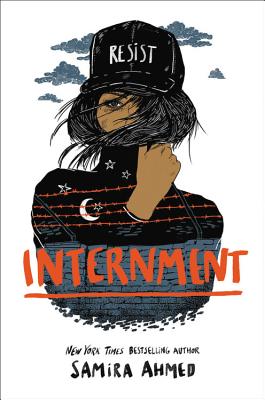
Internment

by Samira Ahmed
First sentence: “I strain to listen for boots on the pavement.”
Support your local independent bookstore: buy it there!
Review copy provided by the publisher.
Content: There are instances of mild swearing, plus a handful of f-bombs. It’s in the Teen section (grades 9+) of the bookstore, but just because of language. The themes are good for anyone, really.

It’s in the near future, and the U. S. government has decided that Muslims are a threat to the country. It started with a registry, with everyone declaring their religion. And then Muslims began to be discriminated against (well, they probably were already), and now they’re being rounded up and taken to internment camps. To keep the rest of America safe from them.

Layla and her parents are among those rounded up and sent to camp Mobius in the California desert. It’s a harrowing experience: being arrested at home and then shipped on a train to an isolated “camp” (read: prison; there aren’t cells, but they’re kept in with an electric fence) where they were expected to comply to rules and are constantly watched over by drones and guards.

Layla, however, is not okay with all this. (Fair.) In spite of her parents’ pleas to just get along, Layla decides that she needs to Do Something. So, she smuggles out articles she’s written about conditions in the camp — the Director using intimidation and force and the disappearances of other internees — to be put on blogs. She organizes protests. She makes friends with sympathetic guards on the inside who help her along with her boyfriend on the outside. They stand up for what they believe in, and resist.

I think that was the thing that was most striking to me: that resistance to authority comes from the teenagers. It probably always has. Adults get complacent, and are conditioned to not make waves. But teenagers? They’re often idealistic and want a better world. And have the courage to make it happen. And Ahmed captured that perfectly.

Yes, this book is heavy-handed: Ahmed hammers the idea that This. Is. Wrong. home in so many ways, but I think this book is meant for White People. Seriously. I am sure that so many of the themes of racism and exclusion and mistrust of the Other are already known to Muslim (and Black and Asian and Native) people. The people who need to see this are White. And probably middle class. And comfortable in their lives. (Like me.) We need to remember that inaction is the same as action. And that just because we don’t see or experience the problems doesn’t mean they’re not there.

In the end, the question I thought this book was asking was: What kind of White Person will you be? (Granted, I’m coming at it with this perspective. I’m sure others will get something different out of it.) And that’s a good question to be asking right now.

Love, Hate, & Other Filters

by Samira Ahmed
First sentence: “Destiny sucks.”
Support your local independent bookstore: buy it there!
Content: There’s some talk of sex, but none actual. There is also swearing, including some f-bombs. It’s in the Teen section (grades 9+) of the bookstore.

Senior Maya Aziz has one goal in life: to go to NYU (she’s been accepted!) and get a degree in filmmaking. However, her parents — even though they’re on the liberal end of the Indian Muslim scale — would rather she go close to home — University of Chicago or Northwestern — and get a degree in something practical. It also doesn’t help that they’re trying to set her up with a nice Indian Muslim boy… even if they don’t want her to get married just yet.

Maya just wants to live her life the way she wants to, and she was starting to make headway (even with the super popular white football player who’s interested in her!) when there’s a hate crime in a nearby city, and suddenly her small town isn’t safe — for her — anymore. And things just escalate when her parents’ dental practice building is vandalized Now her parents are refusing to let her go anywhere, let alone to New York to go to school.

Oh this was SUCH a good debut! Ahmed tackles conflict in a religious family, not with just culture but with belief, and she tackles the differences between parents and children — Maya’s parents aren’t bad or controlling; they just feel they know what’s best — and tackles the differences between immigrants and their first-generation American children. But she also addresses racism and prejudice all while wrapped up in a very sweet love story.

She’s definitely a writer to watch.

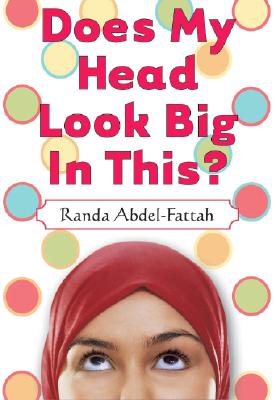
Does My Head Look Big in This?

by Randa Abdel-Fattah
First sentence: “It hit me when I was power walking on the treadmill at home, watching a Friends rerun for about the ninetieth time.”
Support your local independent bookstore: buy it there!
Content: There is some mild swearing. It would be in the YA section (grades 6-8) of the bookstore, if we had it.

Amal is an Australain-Muslim-Palestinian girl attending a prep school for her 11th grade year, and she has just made a big decision: she is a faithful Muslim, and she wants to express that faith by wearing the hijab full time. Except. She’s the only Muslim in her school, it’s right after 9/11, and, well, let’s say that people, even in Melbourne, aren’t that open-minded.

But Amal is determined to make it work. She faces down the disapproval of her headmistress, the questions of her (non-Muslim) friends, the bullying and badmouthing of the close-minded, and she comes out much better for the experience.

It’s a simple plot; no massive twists or turns, no real huge conflict with a tear-jerker reveal. Just a simple, true-to-life story about a religious girl trying to live her life. And I loved it. I loved Amal and the way she made the decision, but the way she kept having to reaffirm the decision to herself. Being religious in a secular world isn’t always easy, and Abdel-Fattah reflected that. I also loved how she wrote about Amal’s faith. It’s hard to put into words, but I felt that she got what it means to be religious. (I’m sure she does.) The book did feel a little dated; it’s set in 2002 and was written in 2005, but I think it’s still necessary. And it’s really a charming story.

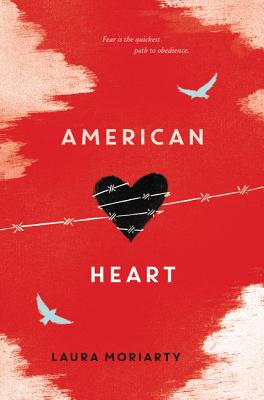
American Heart

by Laura Moriarty
First sentence: “One thing someone just meeting me might want to know is why I have two first names.”
Support your local independent bookstore: buy it there!
Review copy provided by the publisher.
Release date: January 30. 2018
Content: There are some disturbing situations, including an almost rape and violence against minorities. It will be in the YA (grades 6-8) section of the bookstore.

Sarah-Mary and her younger brother are living with their aunt in Hannibal, Missouri, because their mother is one of those Bad Mothers who can’t take care of her children. Her younger brother is okay with this (except for the missing mom part), but it chafes with Sarah-Mary. She has a limited amount of freedom, which chafes. And then, she and her brother meet an Iranian woman, whom Sarah-Mary ends up calling Chloe, who is  on the run, avoiding the mandatory Muslim registry that has been implemented for “our safety”. Her brother begs Sarah-Mary to help get Chloe to safety in Canada, and of course Sarah-Mary promises. And thus begins the adventure.

It’s not a pleasant one, either. Moriarty attempts to focus on the wrongness of profiling people by race or religion (there’s this scene where Sarah-Mary witnesses a raid on a house where the person was harboring Muslims) and touches on prejudice and discrimination. She also make sure that the dangers of two women hitchhiking are amply described.  Nothing “bad” ever happens, but the novel brushes up against it several times, and it’s only through luck, wit, and technology that Sarah-Mary and Chloe get away.

And along the way Sarah-Mary learns the one great lesson that we all need to learn, especially right now: people are people. They all have hopes, dreams, and stories. And that judging a whole religion or race by one person’s actions not only is not fair, it’s wrong. However, the Muslim registry doesn’t miraculously go away at the end of the book, nor does Sarah-Mary’s actions have a larger Meaning, so maybe Moriarty missed the mark on something big here.

Perhaps, though, that’s also the problem with the book. That Sarah-Mary (read: white people) needed a Muslim woman (read: any diverse person of color) to Show Her the Way. As a concept, it’s clumsy, and I’ve read some responses on the book that lead me to think that it might be harmful, reinforcing White Stereotypes of Islam and Muslims, and just the White Savior narrative. I did enjoy this while reading it, but in retrospect, I’m not sure it was the best idea for a white woman to tackle something like this.