The Blackthorn Key

by Kevin Sands
First sentence: “I found it.”
Support your local independent bookstore: buy it there!
Review copy provided by the publisher.
Content: There’s some violence, but it’s not grisly and mostly off stage. There’s a lot of white space and fairly large print, so even though it appears long, it goes fast. It’s in the Middle Grade section (grades 3-5) of the bookstore.

Christopher Rowe has a good life, especially considering he was brought up in an orphanage. He’s apprentice to an apothecary, he has a best friend, and he’s given a bit of freedom. Until the Cult of the Archangel strikes, killing off apothecaries one by one. And finally, they reach Christopher’s master.

Suddenly Christopher’s stable life is turned upside down: the Guild, the King’s men, and the Cult are all after him. And he’s got to figure out the cryptic note that his master left in the ledger before they catch up.

It’s a simple premise, and yet it’s SO much fun. Seriously, people: So. Much. Fun. And no magic, which is really refreshing these days. It’s historic fiction — set in 17th century London — and I loved that it didn’t get too bogged down in history. Sands keeps a balance between historical tidbits and action so that it feels like it’s 17th century London, but it moves like a modern book. There’s a mystery of who is in the Cult, and who is behind all the murders. Sure, it’s pretty much white boys (I think there was two female characters, and no people of color), which means it’s same-old in that respect. But, I can forgive it for that because it was SO much fun. (I’m just going to say it again. You want some fun action/adventure/mystery? This is it!)

I couldn’t put it down.

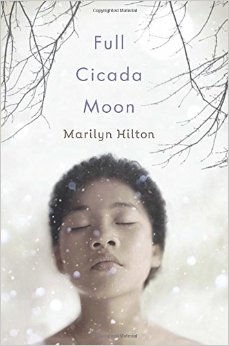
Full Cicada Moon

by Marilyn Hilton
First sentence: “I wish we had flown to Vermont instead of riding on a bus, train, train, bus all the way from Berkeley.”
Support your local independent bookstore: buy it there!
Review copy sent to me by the publisher rep.
Content: There isn’t anything objectionable, and it’s a novel in verse so it’d be appropriate for the younger readers. Good for conversation as well. It’ll be in the middle grade (grades 3-5) section of the bookstore.

Mimi Yoshiko Oliver is obsessed with space. It’s 1969, the height of the space race, and she wants to be an astronaut. The problem? She’s a girl. No one takes her desire seriously, especially in her school in Vermont. It also doesn’t help that she’s Afro-Asian, one of the only people of color in an all-white community.

As she goes through seventh grade and the beginning of eighth, Hilton gives us Mimi’s struggles and triumphs, from her attempts to get into shop class — there are some pretty strong gender norms in the late 1960s —
to her struggles to make friends. There are lots of stories about racism in the south in the 1960s. It was actually quite refreshing to be reminded that even northerners had issues with civil rights.

It’s a lovely novel in verse, as well. Hilton captured Mimi’s sense of wonder an awe at the world around her as well as her desire to go into space. It wasn’t overly detailed, something which might bother some readers but I found I didn’t mind. Perhaps it’s because I’m older, and I remember what it was like (sort-of). But, I also think it was a conscious choice on Hilton’s part to make it more accessible to those reading it. So, on the one hand, it’s historical fiction. But the other, it didn’t really feel all that much like it.

Even so, I thoroughly enjoyed spending time with Mimi and her family, as they adjust to a new home, broaden their horizons, and have a memorable year.

Gone With the Wind

by Margaret Mitchell
First sentence: “Scarlett O’Hara was not beautiful, but men seldom realized it when caught by her charm as the Tarleton twins were.”
Support your local independent bookstore: buy it there!
Content: There’s mild swearing, and a LOT of the n-word. Take it for what you will. It’s in the adult fiction section of the bookstore.

I first read this when I was 15 or 16. I don’t remember why I picked it up, just that I did. I don’t remember what I thought of it, but it couldn’t have been much, since I really had no desire to ever visit it again. (I think I’ve seen bits of the movie.)

We picked this one for my in-person book group, partly because no one had read it in a long time, and partly because Samantha Ellis wrote about it in How to Be a Heroine. And so I began the slog.

Because it was a slog. It’s so sexist and racist, I couldn’t stand to read it for long periods of time. It really is Old South — and there’s still a lot of the Old South in the south — and that’s just hard for me to understand. Eventually, I took to looking at it as a sociological study: why was the Old South the way it was. Why couldn’t they shake their prejudices and adapt? Why were they still stuck in the Way Things Were and that’s they way They Always Should Be?

And Scarlett… on the one hand, she’s an incredibly feminist character: a person who is willing to do what needs to be done, in the face of the Patriarchy and Public Opinion; a person who flies in the face of convention. It’s amazing how modern she is.

But she’s also mean and cruel and opportunistic. And hung up on a fantasy that she needed to move past.

Maybe, though, that’s the point? That only the cruel people are successful? I don’t know.

In the end, I didn’t like it, not just because of the content, but because it was SO LONG. Seriously: knock 700 pages off of this book and maybe it’d be a decent story.

There will at least be a lot to discuss.

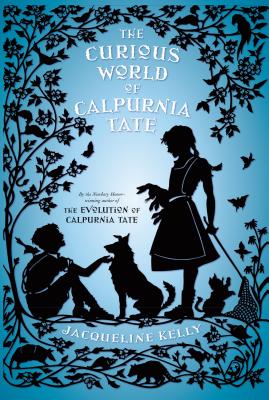
The Curious World of Calpurnia Tate

by Jaqueline Kelly
First sentence: “To my great astonishment, I saw my first snowfall on New Year’s Day of 1900.”
Support your local independent bookstore: buy it there!
Review copy snagged off the ARC shelves at my place of employment.
Content: It’s a bit old-fashioned and there are a lot of scientific words, but if you’ve got that sort of 9 year old reader, it’d be perfect for them. It’s in the middle grade (grades 3-5) section of the library.
Others in the series: The Evolution of Calpurnia Tate

I was super excited to find out that my favorite scientific Texan was back in a second installment. I really adored Calpurnia the first time around, and was very excited to spend more time with her. It’s 1900, and Calpurnia is doing her best to keep up with her scientific studies with her grandpa. It’s hard, especially with pressure from both her parents to be more ladylike. Calpurnia would much rather be tromping around the forests and swamps near their central Texas home, collecting specimens. Or studying the stars and weather.

Then a hurricane hits Galveston (a fact which sent me to Google to find out if it was real. It was.), and Calpurnia’s life changes. In to town blows an older cousin (who is, understandably, distraught) and a veterinarian. All of a sudden, Calpurnia has found a calling. The problem? She has to fight to let people even consider the idea of her wanting to be a vet.

Much like the first one, the charm in this is in the narration. Calpurnia is such a delight to spend a book with. This time, I felt her frustration and pain at being a second-class citizen, in her school, in her house, around the town. It seems that everyone, except grandpa, decided already that girls can’t do anything non-girly, and it was a wall Calpurnia kept banging up against. I admired her perseverance in breaking down barriers.

Also, like the first one, I thoroughly enjoyed all the science and the little historical details that Kelly uses to make Texas in 1900 come alive.

Delightful.

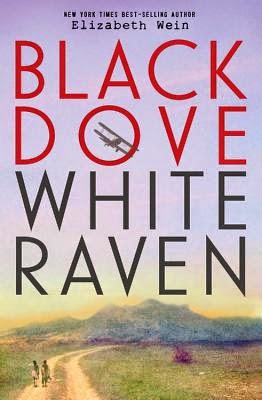
Black Dove, White Raven

by Elizabeth Wein
First sentence: “Sinidu told me I should aim for the sun.”
Support your local independent bookstore: buy it there!
Content: There’s a smattering of violence, and some insinuations, but it’s not nearly as intense as Wein’s other books we have in the store. I’m torn between leaving it where it is (in Teen, grades 9+) and moving it to YA (grades 6-8), where it really fits better, subject and content-wise. Thoughts?

I know Wein has written other books about Ethiopia, but I didn’t know they existed, really, until this one came out and I started hearing the buzz. And so I really didn’t know what to expect with this one.

Many of the elements I have enjoyed about Wein are there: women pilots, in this case two: a white woman, Rhoda, and her black friend, Delia,  learned to fly in France and go around the States in the late 1920s/early 1930s with their barnstorming act. There is also World War II: after Delia’s accidental death, Rhoda takes their two children, her daughter Emelia and Delia’s son Teo (whom Rhoda has taken as her own) to live in Ethiopia, which was Delia’s dream.

The book is a long letter written to the emperor of Ethiopa by Emelia. It’s in the middle of World War II, and the Italians have invaded Ethiopia. Because of their precarious legal situation: Teo is not legally Rhoda’s son, they’re not really legally in the country, and because Teo’s father was Ethiopian, it means that their position in the country, especially with the Italians there, is a precarious one.

Emelia recounts history and how their little family ended up where they are. Teo contributes some, writing journal entries and flight logs — Rhoda eventually teaches both children to fly — and so you hear his voice as well as Emelia’s.

There’s a lot going on in this book, and yet, I felt like the conflict didn’t really pick up until the last third. It’s a quieter book than her previous two WWII books, one that felt more vignette-driven as well. (Though typing that, and thinking back to Code Name Verity and Rose Under Fire, I’m not sure that’s true.) The characters were definitely younger in this one, and perhaps that’s what I’m feeling. I did like how Wein rounded out most of the characters in the book, but especially the female ones (the male ones, aside from Teo, were basically set dressing, there to move the plot along). Wein also touched on a lot of cultural issues for the time: segregation in the US, slavery in Ethiopia, the war, the limitations of women at the time. Even though it didn’t feel like much, plot-wise, there was enough to hold my interest and carry the book.

I’m not sure I love it as much as I do the other books I’ve read by Wein, but I did thoroughly enjoy it.

Audiobook: Keeping the Castle

by Patricia Kindl
Read by Biana Amato
Support your local independent bookstore: buy it there!
Content: There’s nothing objectionable, but my 8-year-old was quite confused while listening to it. So, it’s probably not for the younger set, just because of intricate plot lines and needing at least a working knowledge of Regency England. It’s in the YA section (grades 6-8) of the bookstore.

Althea Crawley has always known that she needed to marry well. Her father died shortly before her younger brother (and her father’s heir), Alexander, was born. The castle — in the north of England, on a cliff, and their home — her great-grandfather built is slowly falling apart (well, maybe not so slowly). And so when Lord Boring (yes, that really is his name) shows up in the neighborhood, Althea knows what she must do: get him to marry her. Unfortunately, his crass, merchant, cousin, Mr. Fredericks, keeps getting in the way.

The jacket compared this one to I Capture the Castle and Pride and Prejudice. The Capture the Castle part of it is silly: the only things those two books have in common is a young heroine and a castle. However, the book read like a spin on all of Austen’s books. There were elements of Emma and Sense and Sensibility as well as P&P. It’s a more practical Austen, however: Kindl gives us a more confident and curious and modern heroine than Austen ever did. And Kindl gives us more blatant class divisions than Austen did, as well. The love interest is a merchant, and falling in love with a merchant, even a  wealthy one, is something which a landed gentry in Austen’s world just wouldn’t do. In fact, there’s quite a few interesting elements that probably existed in Austen’s time but didn’t overtly make it into her books. As we were listening to it (Hubby quite liked it, too), it occurred to me that this is Jane Austen-lite: an Austenesque books for kids who are curious but can’t quite make it through Pride and Prejudice.

The back did have this right: it is frothy and light as a champagne cocktail. It’s not deep — we were discussing all the ways in which Kindl could have made it more complex and darker than it was — but it sure is fun.

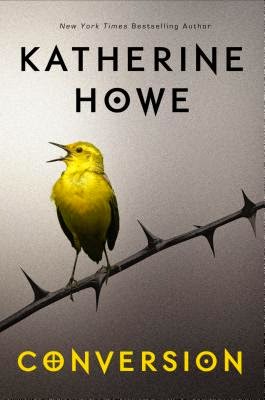
Conversion

by Katherine Howe
First sentence: “How long must I wait?”
Support your local independent bookstore: buy it there!
Review copy downloaded from Edelweiss
Content: There is some mild swearing, and talk of sex, but nothing actual. It’d be happy in the YA section (grades 6-8) of the bookstore, but I might put it in Teen (grades 9+) so I can get the adult crossover.

Colleen Rowley is a senior at St. Joan’s Academy, a high-profile, all-girls school in Danvers, Massachusetts. Everything is going great… mostly. Colleen is a tenth out of valedictorian position, something which stresses her out because her college acceptance to Harvard (only one of many Ivy League schools that have wait-listed her) is hinging on her senior year academic performance. She’s not the only one under pressure; all of her friends and many of her classmates are as well.

And then something strange happens: Colleen’s classmates, one by one, succumb to a mysterious illness that pulls them out of school. Some develop Turette’s Sydrome-like tics, others loose the use of their legs; still others’ hair is falling out. It’s an epidemic. Except Colleen, spurred on by some anonymous texts, is suspicious. And when she starts looking into the real events behind The Crucible, which they’re studying, especially Ann Putnam’s story, she finds that there is possibly a connection to what’s happening in Danvers now, and what happened in Salem back then.

Told in alternating storylines, Howe gives us both the story of the girls of St. Joan’s and Ann Putnam’s confession about the incident that began what came to be called the Salem Witch trials. She doesn’t spell things out for the reader; instead, she trusts our intelligence and in our ability to draw parallels between the two stories. And although the characters — especially Colleen and her friends — are quite sympathetic, it’s finding the parallels and solving the mystery that fascinated me most about this book.

Unfortunately, the ending didn’t hold up to the rest of the book. Howe kind of goes off into muddle-land, and doesn’t hold up to the suspense that the book built. Even so, it wasn’t enough to completely kill the book for me (it was more of a “HUH?” moment). And it’s made me curious about Howe’s adult books, which is a good thing.

The Riverman

by Aaron Starmer
First sentence: “Every town has a lost child.”
Support your local independent bookstore: buy it there!
Content: There’s some alcohol usage and talk of murdered children. Also, it feels really adult in its sensibilities. It’s in the middle grade (grades 3-5) section of the bookstore, but I’m not happy with that. On the other hand, it’ll languish in the YA (grades 6-8) section too, so I might just leave it where it is.

Alistair Cleary  is the kind of kid who blends in. He’s not popular at his middle school, but he’s not reviled, either. His best friend is a gamer — which is quite unusual, since it’s the fall of 1989 — but Alistair has managed to escape certain geek doom. He’s content to slide through life. Until Fiona decides that it’s Alistair who needs to write her sad tale down.

And what a tale: Fiona insists that she’s been going to this imaginary land, Aquavania, which is absolutely real. She’s added months to her life in her trips (which become years later in the book). And that her friends in Aquavania — who also happen to be real people in the Solid World — are disappearing because someone called the Riverman is sucking their souls away.

I had Issues with this book. It compelled me enough to finish it, sure, but it was one of those books that I threw across the room when I was done. I’ve been trying for days to figure out how to write about my issues, and to boil my problems with the book down into a neat, concise package, but I don’t think I can. There will be spoilers.

My initial problems come from the incongruity between the cover and the book itself. The cover screams middle grade, but the content is very… adult. On some level, I feel like Starmer should have gone all the way, made this incredibly dark and sinister, used the metaphor that he was building — that Aquavania is a crutch for Fiona, who uses it to escape horrible things in her life — and made it an adult book.

But, even though that is the set up for most of the book, Starmer doesn’t follow through. He pulls what I have come to think of as a bait-and-switch, a “HA! It’s Really REAL” moment. For which he has given us no basis in the rest of the book. Our narrator, Alistair, believes Fiona is making it up. He believes in the dark understory, so I do too. And so it’s incredibly unsatisfying (for me as an adult; would an older kid?) to have the rug pulled out from underneath you.

I’m sure there I have other complaints (did it really need to be set in 1989? REALLY?), but that’s the main one. Going in, I didn’t know what to expect, but by the end I hoped for a lot more than what I got.

The Road Home

by Ellen Emerson White
First sentence: “On Christmas morning, Rebecca lost her moral virginity, her sense of humor – and her two best friends.”
Content: This is a book about war, and doesn’t pull any punches. There’s language (with a couple of f-bombs), talk of sex (none actual) and lots and lots of violence. It’s also more emotionally mature. It’d be in the teen section (grades 9 and up) of the bookstore, if it were in print.

This was thrown at me by my wonderful friend Laura, without me knowing much else besides she thought it was really great.

This is the last book of a series about a family (I gathered, not having read any of the others), focusing on the daughter, Rebecca. Her long-time boyfriend was killed in Vietnam and her brother fled to Canada to avoid the draft. So she did the only logical thing: she signed up for a tour. Because it was the 1960s, and because women weren’t allowed to be on the front lines, and because Rebecca has an interest in medicine, she signed up to be a nurse. To say she didn’t know what she was getting into was an understatement. The book follows the second half of her tour in Vietnam, after a horrific event she was involved in, through to her coming home.

It’s taken me quite a while to get through this book, not because it was bad or I was disinterested — neither were true –but rather because it was so emotionally taxing. White knows how to write war. The mundane elements of being out in the field, the stress of the ER when helicopters full of wounded and dying soldiers come in. And then the PTSD of coming home. Especially in the 1960s, when there was so much anti-war sentiment at home. She captured Rebecca’s increasing despair, the difficulty she had in making it through so well, that I was drained each time I picked it up.

That’s not to say there wasn’t hopeful elements to the story: there were. Rebecca makes friends and even has a bit of a relationship But it’s not some miraculous recovery or some “ah-ha” moment. It’s very real, almost brutally so, and very honest.

I found it worth reading (once at least), and while I didn’t love it, I appreciated it. I appreciated the depiction of the soldiers and of Rebecca, and especially of her coming home. It’s not an easy read, but it’s definitely worth the time.

Wanderville

by Wendy McClure
First sentence: “Jack didn’t notice the smoke until there was far too much of it.”
Support your local independent bookstore: buy it there!
Content: There’s a some bullying and a fire that kills a family member of a main character, but that’s about it. It’s short enough to be a beginning chapter book, but it might be too challenging for most 1st and 2nd graders. Definitely belongs in the middle grade (3-5th grade) section of the bookstore.

Jack lives in a walk up in New York City in 1904. Their family is poor, but making it. That is, until a fire takes both their building and the life of Jack’s older brother. Frances and her younger brother Harold are orphans and living off the charity of one of the many orphanages in the city. Both find themselves on a train headed west, as part of the efforts of the Society for Children’s Aid and Relief Office. But, as all three find out, the best intentions of adults don’t always translate into good things for kids.

Faced with being separated from her brother, and looking forced labor in the eye, Frances, Harold and Jack decide to jump off the train before they reach their final destination. They’re wandering the Kansas prairie when they find Alexander, another orphan train escapee. He’s decided to start his own town, called Wanderville, and while it doesn’t look like much (or anything, really) it’s not his own. Unfortunately they way they get supplies is by “liberating” them from the nearby town. Which, obviously, is going to lead to trouble.

I wanted to like this one. It’s got a good idea — exploring the world of the orphans from the orphan train — and it’s set here in Kansas. I was hoping that it’d be a good contribution to historical/Kansas middle grade fiction. But it’s not. Perhaps it was me, but I didn’t like the characters, and felt the text itself was too condescending and predictable. I felt that if I had a checklist I would have ticked every single cliche off.  Bully on the train? Check. Evil man exploiting the system for his own gain? Check. Rugged and slow cop? Check. Sisterly figure who always knows better than the boys? Check. Adorable 7-year-old who is Wiser Than His Years? Check.) That’s not to say that kids won’t like it. I’m sure many will.

I just didn’t.