First Sunday Daughter Reviews: March 2014

It turned out to be an enormously busy month (which made it go by quickly), so the girls spent most of the month reading the same book, trying desperately to finish them. Well, maybe not desperately, but not a lot of free-time reading got done.

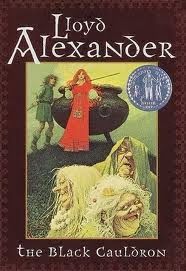
K did move on to this one with Hubby:

and has decided that her favorite characters are Gurgi and Eilonwy. She’s become so enamored with the books that she’s rereading The Book of Three on her own for a book report for her reading tier at school. She is a bit stressed about what project to do — it vacillates between drawing a scene or dressing up as Gurgi (as a mom, I’m praying for the former…) — but, for the most part, she’s enthralled with Prydain. The only one of our kids to become such, I might add.

Between her book report and our busy schedule, A pretty much spent the month trying to finish Fablehaven: Rise of the Evening Star.

A as Joan of Arc.

That said, she finally finished on Friday, and was looking for something else to read while we waited for the third Fablehaven to come in at the library. She found this ARC of mine

and has been happily reading it. Her thoughts so far: “Mom, you HAVE to read this one.”

And C had an experience we don’t think she’s ever had before: she’s become so enthralled with a book that she eschewed TV and all other social interaction and read a book in a single day. That’s not unknown around here for the bookish people, but C — while she likes reading — has never really been “bookish”. She’s much more a social person. But the series that captured her imagination?

She says it’s kind of a dystopian feminist Bachelor, and she loved the characters and the world the author created. And she’s dying for the third one to come out. I think she found them through a flow chart she discovered on Tumblr. (I got them in at the store because of the pretty dresses on the cover and I think we’ve even sold a few.) I’m just glad she’s found a series to love with all her heart.

As for the book group: it was just A and me (hopefully I can work with our marketing manager to spread the word; I really don’t want my book group to die. We NEED things like this for kids) but we both really loved The Westing Game. (It’s because it’s a good book.) Our March book is

but A picked it up, read the first chapter, and declared it “boring”. And, after reading the first chapter, I kind of have to agree. We’ll see what happens. (If no one shows, it’s going to be a pretty lame discussion.)

Have your kids read any good books lately?

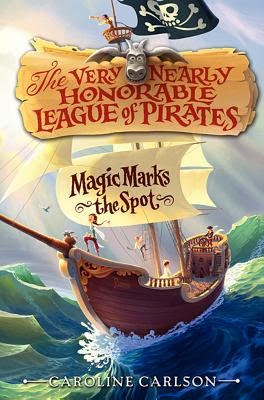
Magic Marks the Spot

The Very Nearly Honorable League of Pirates, Book 1

by Caroline Carlson
First sentence: “Ever since the letter had arrived from Miss Pimm’s, Hilary had spent more and more time talking to the gargoyle.”
Support your local independent bookstore: buy it there!
Review copy provided by the publisher for the Cybils
Content: There’s a couple of swordfights where no one gets injured. For a pirate book, it’s really quite tame. It’s shelved in the middle grade (3-5th grade) section of the bookstore.
Hilary Westfield has one dream: to become a pirate. Unfortunately the league of pirates in Augusta has one rule: no girls. Girls are sent to Miss Pimm’s finishing school, because that’s Where Girls Go. Thankfully, Hilary has Pluck and Determination and doesn’t let the Rules stop her. (This book insists you talk about Things in Capital Letters.) As soon as she gets a chance, she runs away from Miss Pimm’s and finds a pirate — Jasper, the Terror of the South Seas — who doesn’t care that she’s a girl. 
There’s more to this book — magic and treasure and an Enchantress and a Wicked Parent — but really, what I loved most about this book was that Hilary set out to be a pirate and succeeded ON HER OWN TERMS. No dressing up like a boy. No bowing to Tradition. No Resigning Oneself to her Fate and Making the Best of It. Nope. Not for Hilary. She (and her talking gargoyle, whom I really loved) decided that they wanted to be pirates, and Dang It, they became pirates. 
I liked this one an awful lot, mostly because of the above reason. But — aside from the unnecessary letters that were written in cursive, which is a real turn-off for kids These Days; the book got much better after I started skipping them — I really enjoyed all of it. There was humor (Miss Greyson, the governess/chaperone, was hilarious), sword fighting, a wee bit of romance (but not overstated; it was between the adults), and most of all Hilary being Awesome.
Yeah, it was a bit slow at the start, and I really don’t like that it’s yet another one in a series, but I thought the story wrapped up well enough, and I’d be willing to see where Hilary’s piratical adventures take her. 

(Just for the record: because this is a Cybils nominee, I’ve been asked to make sure y’all know this is my opinion only, and not that of the panel.)

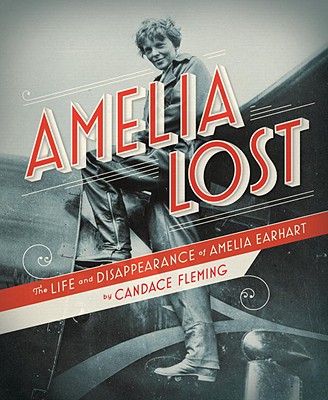
Amelia Lost

The Life and Disappearance of Amelia Earhart
by Candace Fleming
ages: 9+
First sentence: “On the morning of July 2, 1937, the coast guard cutter Itasca drifted on the Pacific Ocean, waiting… listening…”
Support your local independent bookstore: buy it there!

Like many people, I think, what I knew about Amelia Earhart was limited to her legend: she was the first woman pilot, and her plane was lost on her attempt to fly around the world.

What I didn’t realize was how much more there was to the story.

Fleming is a brilliant non-fiction writer for kids; she keeps the information simple without being simplistic, and manages to capture the nuances of her subject without ever wandering into territory that a 9-year-old couldn’t comprehend.

Which means that this book was absolutely fascinating. The chapters alternated between Amelia’s past and that fateful day when her plane was lost. Fleming really did her research, pushing past the legend and the fame to come up with a different portrait of Amelia Earhart. One of the things that most fascinated me was how, well, unqualified she was. She flew not really because of skill — often she didn’t take the time to learn things thoroughly — but because of determination. She was a feminist: she believed that just because she was a woman didn’t mean she shouldn’t do whatever she wanted to do. Including flying. She resisted the boxes that the time period wanted to put her in, and literally soared. No, she wasn’t the most talented, or even the most skilled, but she was determined, and that made up for a lot.

The other thing that fascinated me was how much she was famous for just being famous. She and her eventual husband, George Putnam, worked really hard at keeping her name in the papers, keeping her on the lecture circuit. Being famous was a full time job for them. I also didn’t realize how much of her image was done on purpose to create her image. She hid many things, and re-imagined others. I guess it goes to show that nothing is ever quite what it seems.

An excellent introduction to the life and legend of Amelia Earhart.

The Good, the Bad, and the Barbie

by Tanya Lee Stone
ages: 11+
First sentence: “When I was six, I wanted a Barbie more than I can remember ever wanting anything in my life.”
Support your local independent bookstore: buy it there!

First a confession: my mom wouldn’t let me have Barbies, and even though I played with them at friends’ houses, I never really wanted one (or at least I don’t have a lingering memory of that). Then I went to college, and became my own brand of feminist, and swore my girls would never have Barbies.

Then M turned three. And she desperately wanted one. After several rounds of fighting and discussion and saying no, we gave in on her birthday, and gave her one. Which was much loved. Then, Barbie multiplied. For, it seems, that one cannot have just one Barbie. They multiplied until I was sick of them and they stopped playing with them, so I tossed the whole lot when we moved to Kansas 5 years ago. Since then, they’ve multiplied again (it seems that you can’t give a young girl a birthday present that isn’t a Barbie), and while they don’t get played with often, I have made my peace with them and keep them around for the times when they are needed.

It seems my story isn’t unique.

I enjoyed this book for the history of Barbie, and Mattel, and how they came to be. There was a part of me that wished for more detail (the fact that Barbie’s inspiration was a German sex toy was glossed over here), but the book was geared toward the younger crowd. However, Stone did to an admirable job balancing the two sides of Barbie: those who love her and those who loathe her. I think I understand better now her appeal, not just to girls, but to women as they grow older. And while I still think there’s downsides to Barbie and her appearance, I admit that they’re more societal and less the fault of the toy. It was interesting, and well-written, full of lots of vintage (and otherwise) pictures.

Recommended.

Sunday Salon: Post-Vacation Catching Up

We arrived home safe and sound last week, only to be pummeled by snow! On the upside, we were all quite grateful for the first two snow days as it allowed us to get used to our own time zone again. That’s the hardest part of traveling, I think: adjusting to local time.

That said, we had a lovely time in Hawaii; so much so, that I don’t think any of us really wanted to come home!

These were all taken on our last full day there; I have more, but this is a book blog, not a travel blog!

I didn’t check anything while we were on vacation, though I did read (though not as much as I was planning to) and write reviews (they’ve already gone up). The one thing I did miss that’s worth mentioning is that my favorite March competition, The Battle of the (Kids) Books announced their contenders for this year. It’s a good list of books (of which I’ve read half; woot!), but I think I’m going to join Charlotte in her cheer: Go Bartimaeus!

There were other things that I missed, or only caught on the perifery, most notably the Bitch magazine kerfuffle. The two best things I read on that were at Chasing Ray (who basically gives you a play-by-play) and Scott Westerfeld (who explained why it was a kerfuffle in the first place). I acutally found it kind of interesting watching things blow up, even if I was a bit muffled in the first place: they were books for feminist readers, and admittedly I could see how a lot of them would appeal. But I did wonder how they determined what went on the list in the first place….

One last thing: Clare Vanderpool is going to be at our local indie bookstore tomorrow night. I cannot tell you how excited I am; at last I’ll get my copy of Moon Over Manifet signed! (Hopefully, I’ll be brave enough to get pictures too!)

Happy reading!

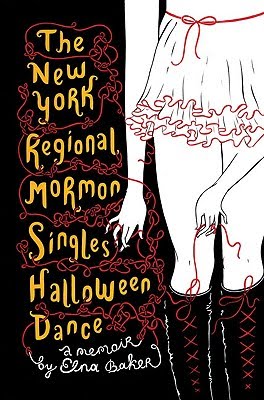
The New York Regional Mormon Singles Halloween Dance

by Elna Baker
ages: adult
First sentence: “I am at the New York Regional Mormon Singles Halloween Dance.”
Support your local independent bookstore: buy it there!

This book was: Sometimes funny. Often self-indulgent. Also, quite pretentious. But then, what memoir written by a 27-year-old isn’t?

I found Elna to be: overly obsessed with her body. And overly obsessed with finding a boyfriend. The first, I find worrisome, which probably says more about me and my reaction to our culture than it does about her. She loses 80 pounds, starting at 250, and is obsessed with controlling her weight. She doesn’t dwell on her obsession with her body, but it comes out; and when she does, she has justifications for it. From the “pretty points” to her eventual decision to get plastic surgery; I’m trying not to judge (it’s not my life, after all), yet finding myself concerned that a person would do that to their body. On the other hand, the second — the boyfriend (though not marriage) — made the feminist in me growl. I’m a hypocrite, though: when I was single, I rarely went without a boyfriend. And I did the “right” thing and got married at age 20 — almost 21! — to another member. Still. Her quest to find the “perfect”, “right”, “best” man drove me bonkers. I wanted to shake her and say that there is no perfect, right, best (I almost cheered when her mom told her that), and that perfect, right, best is what you make of it not what you find.

In addition, I have no idea who would read this book. It’s not written for Mormons, specifically; she goes through pains to describe our beliefs, not in excruciating detail and not everything, but enough to get her points across. That, and I’m sure there are many members of our church who would judge her much more harshly for some of the decisions and choices she makes. And yet, I’m not sure what the appeal of the book would be to a person not of her faith. Yes, it’s a general coming-of-age discovery story, but it’s one seeped in Mormonism — faith, practices, customs. Yes, it’s kind of a wink-wink look: like she’s saying “look at us Mormons! Aren’t we so silly?”, but at its heart it’s a thoroughly Mormon book. Perhaps others are interested in it — for curiosity’s sake — but I wonder if they’ll connect with the book or if they’ll just find it an oddity.

But… there was something in her story, in her journey that I found fascinating. Not just because I’m Mormon, though that’s part of it, partially because I can empathize with her inner spiritual life, her doubts and questions. And, yes, partly because Elna’s is an interesting, if pretentious and self-absorbed, journey. She’s lived a fascinating, unusual (privileged, yes) life, and she can be a funny and observant writer. Even if, in the end, the book was only just okay.

Lady Macbeth’s Daughter

by Lisa Klein
ages: 12+
First sentence: “The nameless baby lay on the cold ground, wrapped in a woolen cloth.”
Support your local independent bookstore: buy it there!
Review copy sent to me by the publisher.

The one thought that kept running through my mind while reading this was: Lisa Klein is to Shakespeare as Marion Zimmer Bradley is to King Arthur. This book is not as complex or involved as Mists of Avalon, but it has the same proto-feminist/mystical feel. That, and Klein takes the Shakespeare play (Macbeth, if you didn’t already figure it out), and weaves a story through it that takes the original in new and fascinating directions.

Albia has grown up without a knowledge of her father. She believes her mother is one of three strange sisters, ones that can fortell the future, or so others believe. She’s happy in her life: taking the sheep out to pasture, playing in Wychelm Wood. Then, one day, Macbeth comes to the Wyrd sisters, seeking news of his future. It is then that Albia becomes entangled in Macbeth’s fate, both because she is his daughter, and because she is gifted with the Sight. As she fights against her fate, and eventually works to change it, she learns to harness her power — both her physical power as well as the Sight — and become the woman she and Scotland need her to be.

It sounds mystical, and in many ways it is. But, like Mists of Avalon, it’s not so much a hocuspocus kind of magic as it is that natural, earth-and-sky driven, Druidic magic. Albia fights the gift at first, as she fights her own heritage. Then again, the Macbeth Klein has created is worth fighting against. He’s more than ambitious, he’s power-hungry and ruthless. He’s so superstitious that he’d kill his own daughter when she was an infant — that’s how Albia ended up with the Wyrd sisters in the first place — because she wasn’t the son the oracle had prophesied. He holds no remorse; he’s full of lust and darkness, and deserved to die. Lady Macbeth is only slightly better; she gives herself over to Macbeth because she knows no other way, and the motivations Klein gives her for encouraging Macbeth in his road to destruction evolve out of her feeling cornered in her life. In fact, Klein gives us an interesting dichotomy with her women characters: Lady Macbeth is what one would think is very traditional, very husband-bound; while Albia, on the other hand, is very modern and feminist, choosing her own path without being bound by men’s expectations.

I think this book could also bring up the question of fanfiction: is what Klein is doing a form of fan fiction? Possibly. (Then again, it could also be a form of historical fiction.) Klein takes the original Shakespeare play and works it in its own direction. True, if you are familiar with the play, you will recognize it wandering in and out of chapters. But, on the other hand, Albia is her own character almost wholly separate from the original play. And while she interacts with characters from the play, their story is not wholly hers.

Which makes this something more.

Sunday Salon: Unsung YA Books

I’m a little late to this party, but since Kelly at YAnnabe made the suggestion that I throw my hat into the ring, I haven’t been able to stop thinking about it. So, my two cents about the best YA books you’ve probably never read.

The Order of the Odd-Fish, James Kennedy: I keep plugging James’s book, but you aren’t reading it. Why? Seriously, people, read this book.

Nothing But Ghosts or House of Dance, Beth Kephart: if you haven’t experienced the lyricism that is Kephart’s writing, you really ought to.

Flygirl, Sherri L. Smith: a quietly feminist book, one that makes you want to stand up and cheer!

Secret Keeper, Mitali Perkins: a book about love, a book about India, a book about sisters. Almost perfect.

Two Parties, One Tux, and a Very Short Film about the Grapes of Wrath, Steven Goldman: Clever, snarky, and geeky extraordinaire. Can’t go wrong with that.

Saving Juliet, Suzanne Selfors: Yeah, it’s fluff. But it’s fun fluff, and it’s fun to see how it works with the Shakespeare.

Fly By Night, Frances Hardinge: Fuse #8 loves Hardinge, and for good reason: she’s a fabulous writer.

There you have it: my thoughts. What’s the best unsung YA book that you’ve read recently?

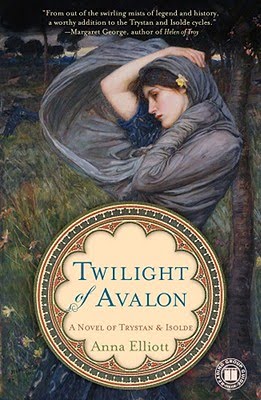
Twilight of Avalon

by Anna Elliott
ages: adult
First sentence: “So I say to call the visions into the scrying bowl.”
Support your local bookstore: buy it there!

When the lovely Kailana and I discovered we were both reading this book, we thought it would be fun to do a buddy review. Below are some questions she asked me about the book (as well as a couple I asked her, that I wanted to answer myself!)… Enjoy!

Twilight of Avalon takes two ancient myths — Arthur and Tristan and Isolde — and fuses them together into one story. The story picks up after Arthur was betrayed by his bastard son, Mordred, who also happens to be Isolde’s father. Isolde was made high queen, married to King Constantine, but seven short years after their crowning, Constantine is dead and Isolde fears for her own life. Especially since she knows that Constantine was murdered by Lord Marche, who is scheming for the high kingship himself. It’s only through her own wits, abilities, and the help of a half-Saxon prisoner named Trystan, that she’s able to escape and find a way to prove to the court the truth about Lord Marche.

What lead you to pick up this book? Will you be reading the rest of the trilogy?
I was sent it by the author (or a publicist; I can’t remember), but it was Trish’s review gave me the push I needed to pick it up. And yes, I will be reading the rest of the trilogy.

Do you have a favorite character?
I think I like Isolde best: she’s strong without being overly modern, and yet she had doubts and fears and insecurities. Though, it may just be that she was one of the few female characters in the book, and I needed someone to relate to.

What was your favorite scene?
Hmmm… it’s been a while since I’ve read it (bad memory…), but I think the scenes that stand out in my mind are the ones where Isolde is being a healer. I especially liked the one near the end when she’s helping Heneric recover from some serious wounds. Very touching.

What do you think of the mixing of fantasy and historical fiction? Was it believable?
I read in the material that was sent with the book that the author was going for a Mary Stewart feel — not exactly magic, but more than realistic. And I think, while it’s not as fluid as Stewart’s books, it works well. When you’re dealing with something as far removed from us as mid-6th century Britain, it’s easy to view it as fantasy. Which is perfectly okay with me!

What are your thoughts on the cover and the title?
Hmmm… first reaction: too Marion Zimmer Bradley. Which means I went in with a bit more feminist-mysticism expectations, which really isn’t what I thought the book is about.

What did you think of the “romance”?
Um… I expected something more. Truthfully, from the jacket flap, and the cover and the title, I really thought that there’d be some sort of hot and heavy romance… and there wasn’t. It was a more political book than I was expecting, and while I think Trystan and Isolde work well together, there really wasn’t much chemistry there. Maybe in the next book…

Secret Keeper

by Mitali Perkins
ages: 13+
First sentence: “Asha and Reet held their father’s hands through the open window.”
Support your local independent bookstore: buy it there!

First and foremost, Asha and Reet are sisters.

Their dad — Baba — has lost his job in 1974 Delhi India and decides to see if he can find a job in America. Since they don’t have enough savings to send the entire family, Asha, Reet, and their mother go to live with Baba’s family in Kolkata, in West Bengal. It’s not a happy time for any of the women: the sisters are not only forced to stop attending their school in Delhi, but are increasingly pushed into more traditional roles than they were previously. And their mother — whom her in-laws have never approved of — is constantly under the influence of what the girls call her “Jailor”: a black depression that is hard to shake.

It’s more Asha’s story than Reet’s; Reet in many ways felt inaccesible to me as a reader: she’s the perfect model of a traditional Indian woman, and although she’s sympathetic, she’s just not all that interesting. Asha, on the other hand, is a fascinating mix between the need to be traditional and please her family, and her desires — in part fueled by the feminist movement in the US — to be her own woman. It’s Asha’s secrets we are privy to, and care about, as well as her desires: whether it’s her desire to be a psychologist (unheard of at this time in India) or to play tennis and cricket, or — more importantly — her growing fondness for the boy next door. And the decisions she makes, as well as the secrets she ends up keeping, are unexpected and yet make perfect sense.

Perkins has written a compelling tale that works on so many levels: it’s a love story, it’s a story of sisters, it’s a story of tension between old and young, it’s a story of second chances. And, because of this, it’s a story will be treasured.