Bayou Magic

by Jewell Parker Rhodes
First sentence: “My name is Madison Isabelle Lavalier Johnson.”
Support your local independent bookstore: buy it there!
Review copy provided by the publisher in conjunction with the ABA Children’s Institute.
Content: It’s a pretty basic story, and aside from some French scattered through, it’s pretty basic in its vocabulary. I’d give it to anyone 2nd grade and up. It’s in the middle grade (grades 3-5) section of the bookstore.

Not-quite-ten-year-old Maddy is the youngest of five sisters in New Orleans. She’s the one that is always the tag-along, never quite fitting in with her sisters. She is often teased, and the only time she feels comfortable is when she’s cooking with her mom. Then, her turn to spend the summer in Bon Temps, in the Louisiana bayou, with Grandmère comes around. At first, Maddy doesn’t know what to expect: her sisters all spent summers with Grandmère and came back with horror stories. But Maddy is different: she likes the quiet, earthy nature of Grandmère and the bayou. She wants to learn the old ways. And she finds friends and adventure there. And magic.

Rhodes simple, lyrical style was really well suited to this story. I loved the earthy feel of the book, and the connection to old stories and family roots. I loved the mix of African and French, of Creole and magic and modern. The environmental crisis aspect of it wasn’t as important as the back blurb led me to believe — it was really just tacked on at the end — but the theme of caring for and connecting to the earth was prominent and important for the story. At first, I thought that this could pass for “realistic” fiction, that maybe the mermaids Maddy saw were just dreams and imagination, but no: this is speculative. And it worked for me. I loved seeing Maddy grow and learn and develop, and yet she was still a 10-year-old girl with all the concerns and abilities of that.

I haven’t ever read Ninth Ward, but I think I need to, now. I’ve come to really love Rhodes simple style.  

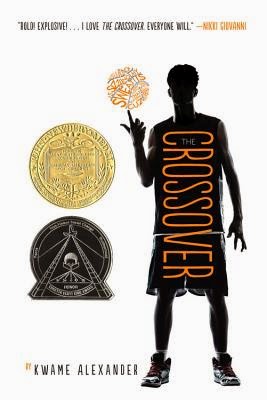
Crossover

by Kwame Alexander
First sentence: “At the top of the key, I’m MOOVING & GROOVING, POPping and ROCKING — “
Support your local independent bookstore: buy it there!
Content: It’s poetry, which is a plus and a minus: plus, because it means it’s a quick read. Minus, because you have to convince kids that it’s okay to read poetry. There’s some kissing, but I’d give this to kids ages 10+. It’ll be in the Newbery section of the bookstore (yes, we do have one!).

I really didn’t know what to expect going into this. I’m sure it would be good — it won the Newbery, after all — but is it one of those good books that are just all style and no substance?

Because this book does have style. You can tell that right from the first page. Alexander’s not only writing a novel in verse, he’s playing with form. There’s style to these poems, it’s not just words on a page; they sometimes (like in the opening poem) leap right off the page. (There’s one poem, about 2/3 of the way though, that can be read in two different directions. I love that!) But, there’s also substance as well.

Twins Josh and Jordan Bell are inseparable, both in life and on the basketball court. Sons of a retired (due to injury) Euroleague player, basketball is their Sport. Their Religion. Their Life. But, during their 8th-grade year, things change. They drift apart, mostly because Jordan — JB as he wants to be known — starts going out with a girl. And their dad has serious heart problems. All of this weighs on Josh, and he lets it interrupt his game.

It’s a simple story, but one with tremendous amounts of heart. Josh is a complex character, who worries about his parents, misses the connection with his brother, and wants to be the top of his game. And yet, he has a temper, one that gets in the way of his wants and desires sometimes. There’s a depth to him that makes him real, which I appreciated it.

I did have a couple of complaints… I didn’t like the portrayal of the girlfriend, but I do understand it’s from Josh’s point of view, and he didn’t really like her intrusion into the relationship with his brother. So, I can understand why she was a bit of a caricature.) The other thing I didn’t really care for — and this is a spoiler — was the dad dying in the end. I did like that there wasn’t a “neat and tidy” ending, but it was a bit, well, Dramatic.

But aside from those two little complaints, I loved this one. I loved the style and the characters and just immersing myself in this world. For the Bells, the highest compliment is that they are Da Man. And this book is definitely that.

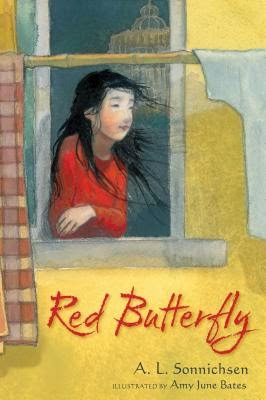
Red Butterfly

by A. L. Sonnichsen
First sentence: “Mama used to have a piano
with an on/off switch
and a dial to make drums beat.”
Support your local independent bookstore: buy it there!
Review copy snagged from the ARC shelves at my place of employment.
Content: It’s pretty long, which will turn some readers off, though it’s in verse, which makes it easier to read (but also might turn readers off). The Chinese words, while spelled phonetically, might also be a deterrent. It’s in the middle grade (grades  3-5) section of the bookstore.

Kara was abandoned at birth, and in China, that generally means certain death. Especially since she is a girl and born with a deformed hand. But a kind, elderly American woman living in Tianjin took Kara in. Now, eleven years later, Kara is wondering why Mama never leaves the house, why she has never gone to school, and why they can’t leave to go join Daddy in Montana.

It takes a while for things to spill out: Mama is always telling Kara to be content with what she has, and not long for something more, but things do eventually come to light. In China, one needs papers to be a legal resident. Kara, because she was abandoned and rescued, has none. And so, they’ve been in hiding all these years.

On the one hand, I enjoyed this peek into China, especially the lives of those children who are neglected and abandoned to the orphanages because of the one-child laws. It’s told in verse, which suits Kara’s contemplative nature and her desire to figure out who she is and where she belongs.  I liked the people Kara met and her interactions in the orphanages.

However, while I got to know Kara and her story, it felt, well… too American. An American pulled her off the streets when she was a baby. She befriended a New Zealander worker in the orphanage (not American, but English-speaking/Western). She ended up in Florida with a second adoptive family. There were Chinese characters, but they were almost afterthoughts in Kara’s life. And while I understood why, I was sad not to get to know China or the Chinese.

It wasn’t bad, overall, but it wasn’t my favorite either.

Fish in a Tree

by Lynda Mullaly Hunt
First sentence: “It’s always there.”
Support your local independent bookstore: buy it there!
Content: The chapters are short, and while there are some bigger words, there’s nothing that a 3rd grader couldn’t handle. It’s in the middle grade (grades 3-5) section of the bookstore.

Ally doesn’t like school. Part of that is the result of her moving so much — her dad’s in the military, currently deployed in Iraq/Afghanistan (it didn’t say; I’m assuming this) — of it is because Ally can’t read. It’s a fact she’s hidden by becoming a troublemaker and through her art, but whenever she tries to read, the words swim, her head hurts, and she just. can’t. do. it.

Enter in Mr. Daniels, the permanent sub for her regular sixth-grade teacher who’s off on maternity leave. He picks up on Ally’s defense mechanisms, and realizes that there’s more going on than meets the eye. He espouses the believe that not everyone’s smart in the same way (yay for that!), and draws on Ally’s strength, giving her the confidence to make friends — Albert, the science geek, and Keisha, a baker extraordinaire — and to stand up to the classroom bully, Shay.

There are some nitpicky things that bothered me throughout that kept me from loving this as much as I wanted to. First, why did the teacher have to be male? I’m torn on this one: on the one hand, it’s showing a man doing things that are “normally” reserved for women. He’s concerned about his students, he’s caring, and he reaches out. Not to mention that he’s a man in a female-heavy profession. However, it seems to me in books like this — where a teacher saves a struggling student — the teacher is always male. It’s the men who get to think outside the box, who find ways to connect with the struggling students, who make changes within the system. And that bothered me.

Additionally, there’s a point when Albert comes out of his shell to fight back against his bullies, in order to protect Ally and Keisha from them. Perhaps that was in character for Albert, but it bothered me deeply. Why did he need to protect them? I initially thought it was because they were his friends — maybe he’d do the same for boys who were his friends — but then he says something about “never hitting a girl”and I cringed.

On the other hand, I was glad that Hunt included a broad spectrum of personalities and classes: there are people who are hyper, middle of the road kids, rich kids, kids on free lunches. The usual suspects — drugs, bad parents, etc –aren’t anywhere to be seen. The focus, really, is on celebrating our differences, and recognizing that intelligence isn’t tied to doing well on tests. And that’s worth celebrating.

So, while it’s an uneven book, I’m glad it’s out there.

The Penderwicks in Spring

by Jeanne Birdsall
First sentence: “Only one low mound of snow still lurked in Batty Pederwick’s yard, under the big oak tree out back, and soon that would be gone if Batty continued to stomp on it with such determination.”
Support your local independent bookstore: read it there!
Review copy intercepted when opening freight at my place of employment.
Release date: March 24, 2015
Others in the series: The Penderwicks, The Penderwicks on Gardham Street, The Penderwicks at Pointe Mouette
Content: It’s a bit more advanced than the younger end of the reading spectrum can handle by themselves, but it makes a wonderful read-aloud. It will be in the middle grade (grades 3-5) section of the bookstore.

The Penderwicks are back! I can’t tell you how happy this makes me. So SO very happy. In fact, I sat down and devoured this book in one day, and then was immediately sad because I should have savored it.

It’s been four years since the last Penderwicks book, and the girls have aged appropriately. Rosalind is off at college, Skye is a senior in high school (as is Jeffrey) and Jane is a junior. That leaves Batty as a fifth grader, the oldest of the younger Penderwicks, her step-brother 8-year-old Ben, and their half sister, two year old Lydia. That’s a lot of responsibility for Batty, who is used to being the youngest. Add to that her beloved Hound’s death (six months prior), and Batty finds herself struggling this spring.

She does make some good discoveries. Their neighbor Nick Geiger has come home from a tour in Iraq, and he inserts himself in the lives of the Penderwicks with nothing but wonderful results. And even though Skye is having some issues with Jeffrey and Jane is surrounded by boys and Rosalind brings home an absolutely awful boy from college, Batty’s finding her own way.

The most wonderful thing about this book is that’s it’s just as good as all the other Penderwicks books. Birdsall is such a fantastic author, capturing the innocence of childhood as well as the more complex of emotions: frustration with being young, a bit of despair, a bit of helplessness. It’s a funny book — the Penderwicks are witty and wonderful — but it’s also one that tugged at my heartstrings and made me cry in the end.  It’s honest, and simple, and absolutely wonderful.

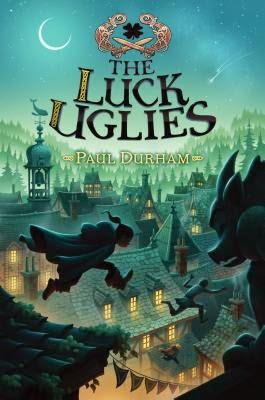
The Luck Uglies

by Paul Durham
First sentence: “
Support your local independent bookstore: buy it there!
Content: There’s a lot of death — most of it off screen — and some pretty intense moments. Throw in a lot of difficult names of places and people, and this is not for the younger set, unless they’re pretty strong readers. Even so, it’d be in the middle grade (grades 3-5) section of the bookstore.

Rye O’Chanter has spent her life roaming the streets of Village Drowning, from her home in Mud Puddle Lane to her mother’s store to her the in her friend owns across the village. It’s not been a tough childhood, even though her father has been gone for years, but life in Village Drowning under the protection of the strict, and somewhat cruel, Earl Longchance hasn’t been a walk in the park, either.

The one day, the village is threatened by a beastie that everyone thought was extinct: the Bog Noblin. It had passed into lore: beasties that will eat you if you go outside after dark. The thing is, though: they really do. And when this one brings a heap of trouble on the village (partially because of the stupid Earl), it’s up to Rye — sort of — to stop it.

But she can’t do it on her own. Thankfully, a helpful stranger she calls Harmless shows up at just the right moment.

I’ll say this to start: I ended up liking this book more than I did in the beginning. I had a lot of unanswered questions at the beginning; almost too many for my taste. It was frustrating that I didn’t know the why, or who, or what. Then again, neither did Rye (because of information her mother held back). But, once I started getting answers — almost halfway through — the book picked up for me, and I actually enjoyed the adventure. There was a moment when I was afraid that Rye wouldn’t be allowed to be the hero of her own book (and that the guy was going to Save the Day), but Durham pulled through and allowed Rye to do what needed to be done.

The other thing is that even though there’s going to be a second book, this really is a stand-alone story, and that’s refreshing. I enjoyed Rye and the relationships she had with those around her (her younger sister, Lottie, is adorable). I loved how Durham showed a happy family with caring relationships, and yet Rye was a clever and capable and brave and tough girl. That was definitely something I liked.

So, in the end, this was a really solid fantasy.

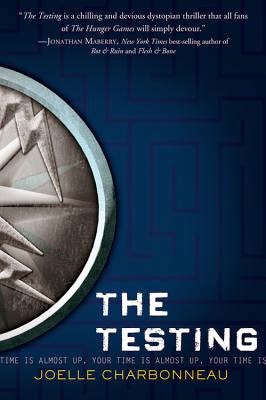
The Testing

by Joelle Charbonneau
First sentence: “Graduation Day.”
Support your local independent bookstore: buy it there!
Content: It’s violent, but not graphically so. And there’s kissing, but no sex. Which means it’s in the YA section (grades 6-8) of the bookstore. However, much like Hunger Games, I’d be wary of more sensitive readers liking it.

This book has been out for two years now, and I’ve been putting it off for just as long. Mostly because the whole post-apocalyptic/dystopian genre has been SO overdone, that I really didn’t want to read yet another one.

Then we scheduled Charbonneau to come to the store — they’ve been working on it since the first one came out and the rep mentioned it was set in a futuristic Wichita — and I was tasked with reading and reviewing the book before she gets here. And so I did, smacking myself when I finished for waiting too long to get around to this one.

Sixteen-year-old Cia Vale has just graduated from her colony’s small school near the top of her class. She’s excited: in this post-Seven Stages War America, now called the United Commonwealth, that means she’s likely to be chosen to attend The Testing in the capitol, Tosu City (aka Wichita, though it took me nearly the whole book to figure that out). Except her father — a former Testing candidate and University graduate himself — doesn’t want her to go. However, once Cia’s been chosen, she can’t say no; refusing the Testing is an act of treason, punishable by death.

So, Cia travels to Tosu City with her father’s warning — TRUST NO ONE — echoing in her ears, and discovers what he meant. The Testing is not just high-pressure and high-competition for the twenty university slots. It’s deadly.

While the plotting and writing isn’t as tight as Suzanne Collins’s, it’s still a quick, engaging read. Charbonneau sets the stakes high right away, with Cia’s roommate committing suicide, and doesn’t let up until the final pages of the book. There are twists and turns — some of which I saw, some of which I didn’t — and Cia is a good, strong narrator to carry this story on her shoulders. It’s definitely post-apocalyptic; Charbonneau cleverly gave us a brief history of how this country came to be in a series of short written test questions early on. The dystopian part is harder to see — Cia comes to hate the Testing officials, and the government as an extension, but I’m not sure I ever felt the way she did about the officials. Unlike, say, President Snow in The Hunger Games. (Yes, comparisons are inevitable.) I do think, on the other hand, that it’s a tighter, more interesting story than Divergent (yes, there’s a love interest, which I think was mostly unnecessary).

But the best thing about waiting to read this one is that the whole series is out already. And I don’t have to wait to read the second one. And I’m invested enough in Cia’s story that I’m quite curious to find out what happens next.

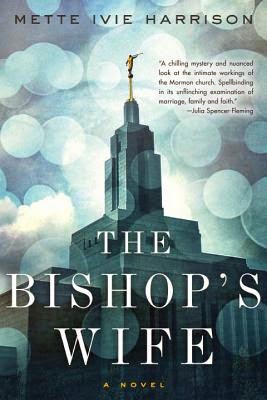
The Bishop’s Wife

by Mette Ivie Harrison
First sentence: “Mormon bishop’s wife isn’t an official calling.”
Support your local independent bookstore: buy it there!
Review copy snagged from the ARC shelves at my place of employment.
Content: There’s a few instances of mild swearing, but it is a murder mystery, and there are some pretty adult situations at the end of the book. It’s in the mystery section of the bookstore.

When this one came into the store, I knew I needed to read it. First, because I have enjoyed Harrison’s fantasies in the past, but mostly because, as the bookstore’s resident Mormon, I was interested in seeing what this one was about.

It’s published by Soho Crime, a division of Penguin/Random House, and it’s being touted as a mystery. Which, on one level, it is.

Our main character is Linda Wallheim, the wife of a bishop of a small Draper, Utah, ward. Her children are mostly grown and gone; her last boy is a senior in high school. She still hasn’t gone back to work, and so one of the tasks her husband gives her is to go visit people he feels need extra help and care. That’s how Linda gets mixed up in not one, but two tricky situations in the ward. One is the disappearance of a woman who left behind a husband and a 5-year-old girl. This is the really messy one, that doesn’t end well at all. The other is support to a woman whose husband is dying, and whose first wife died in what turns out to be a long-hidde murder. Linda is over her head, true, but she perseveres, and manages to solve both.

That’s the simple explanation. But, as mysteries go, this one is pretty pedestrian. I went through a couple of suspects before I settled in on who eventually committed the murder. And so, at the end, I wasn’t surprised, but that’s okay. See, for me, this book was a lot less about the murder and a lot more about Harrison’s portrayal of Mormon women.

Perhaps it’s because I’m the right age, the right target audience, the right sensibilities, but I was thoroughly drawn in by Harrison’s portrait of all the varying opinions, ideas, thoughts, and beliefs of members of the church. She shows that there are good people who are doing good things there are crazy people doing crazy things, there are dangerous people doing evil things. There are people who believe strongly, there are people who are questioning but still want to believe, there are people who don’t believe any more. Harrison also does a fantastic job of putting our religion (she’s LDS too, obviously) out there in a way that’s accessible to people who aren’t familiar with our faith. She’s most interested in the roles women play in the church, and in each other’s lives, and that’s what spoke the most to me.

I’m not quite sure who else would enjoy the book, though,. I tweeted Harrison when I finished, and she admitted she’s been getting a lot of flack for the book, which (unfortunately) doesn’t surprise me. But, I do hope this book finds readers and creates discussion.

Because it’s worth thinking about.

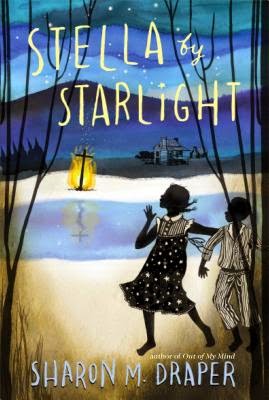
Stella By Starlight

by Sharon M. Draper
First sentence: “Nine robed figures dressed all in white.”
Support your local independent bookstore: buy it there!
Review copy snagged off the ARC shelves at my place of employment.
Content: There’s some pretty intense stuff going on in this book, by Draper never lets it get too dark. She knows her audience and (rightly) assumes they can handle anything that is thrown at them. Be prepared, however, for some discussion. It’s in the middle grade (grades 3-5) at the bookstore.

It’s 1932, North Carolina. The whole country is in the throes of the Great Depression, Franklin D. Roosevelt is running for office. For Stella and her family, this doesn’t really matter. They’re more concerned about making ends meet. And avoiding the local Klu Klux Klan.

And they’re doing a pretty good job until Stella’s dad, pastor, and a family friend decide to exercise their constitutional right and vote. Then, all hell breaks loose.

There’s actually a lot more going on than that: Draper knows her history, and paints a picture of what life was like for African Americans struggling to get ahead in the 1930s. The one-room school, with a teacher who handles all grades next to the white school where they get new books. The small houses and hand-me-over clothes. Having to enter in the back door of shops. Or, most tellingly, a white doctor who won’t come help Stella’s mother after she’d been bitten by a rattler.

And Stella is such an engaging character to go through all this with. She’s an observant, smart girl, but one who also struggles with writing in school. She’s trying to figure out her place in life, how to navigate the injustices of her situation, and still come out ahead. She’s got fantastic parents, and a supportive community. There’s so much that I found admirable about the way she deals with her situation. And so much to discuss (I know; I ended up talking to my family) when you’re done.

Mosquitoland

by David Arnold
First sentence: “I am Mary Iris Malone, and I am not okay.”
Support your local independent bookstore: buy it there!
Release date: March 3, 2015
Review copy handed to me by the publisher rep.
Content: There’s a whole lot of language, both mild and strong. There’s some creepy characters, including a serial rapist, but nothing is graphic. It’ll be in the teen section (grades 9+) of the bookstore.

Mary Iris Malone, Mim to everyone but her mother, is not happy. Her father, in a whirlwind, divorced her mother — who then disappeared — married the waitress at the local Denny’s, then relocated the three of them — Mim had no choice — to the middle of nowhere, Mississippi.

This does not sit well with Mim, who just wants her mother back, her old life back, her home back. So, when she’s called to the principal’s office and overhears her dad and Kathy talking about Mim’s mom with the principal, she snaps. She takes off from school, packs a backpack, grab’s Kathy’s coffee can stash of money, and heads to the Greyhound bus station. She’s headed back to Ohio this Labor Day weekend to see her mother, come hell or high water.

It’s not as easy as it sounds; there’s perils in them thar woods, and Mim is in for one of those life-changing adventures. There are some creepy people on the road, but she makes friends, both causal and the best-friend-types. And she discovers that maybe humanity — and Kathy — aren’t as bad as she’s always made them out to be.

I thoroughly enjoyed this one. Seriously. It started out slow and kind of awkward; Mim is a tough shell to crack and a prickly one at the beginning. But the more time I spent with her, the more I grew to love her. The more she revealed about her family and her life, the more I enjoyed spending time with her. And her adventures were fantastic. The people she met were fascinating and quirky, and I wanted to go on more adventures with them. I was almost sad when the book ended because I wouldn’t be spending more time with Mim and her friends.

I’m not sure this is a book for everyone. But for those who love good road trip adventures, and quirky characters, it’s a gem.