Proxy

proxyby Alex London
First sentence: “Even a perfect machine wasn’t built to go this fast.”
Support your local independent bookstore: buy it there!
Content: There’s a lot of violence, including several deaths that, while not graphic, are a bit shocking. There’s also some futuristic drug use. It’s in the YA section (grades 6-8) of the bookstore.

In this vision of the future, there are those who have and those who have not. Syd is one of those who have not; in order to pay for the debt in incurred by being alive, he was forced to become a proxy for the child of a rich man. It works like this: the rich man takes on Syd’s debt, and in return, Syd takes on the punishments every time the child — Knox — gets in trouble. Seems fair, right? Except, it’s not that simple. It’s people’s lives they’re casually playing with, and Knox is exceptionally reckless. And when he accidentally kills a girl and Syd is condemned to die, Syd’s had enough: he’s going to escape this hellhole. But things aren’t as straight-forward as Syd thinks, either. And soon, Syd and Knox are on the run from a lot of people, and end up way over their heads.

I liked this one. It’s a smart vision of the future — dystopian, yes, but it’s the capitalistic system that’s become the cruel overlord rather than the government. He’s playing with class and debt and the relationships between the two. There’s a bit of chosen-one-ness going on here as well, but I thought London resolved it in a unexpected way. He definitely kept me turning pages, and I found that even the more annoying characters (Knox…) had layers to them. I hadn’t read anything by London before, and this was a great starting place.

And the best thing? I don’t have to wait for the sequel to come out!
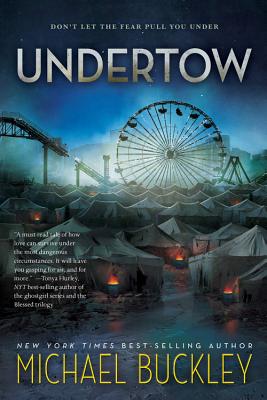
Undertow

undertowby Michael Buckley
First sentence: “You can hear them coming from blocks away, a low thrum like the plucking of a bass string.”
Support your local independent bookstore: buy it there!
Review copy provided by the publisher (I think).
Content: It’s violent. There is an attempt at a sex scene, but it doesn’t get off the ground. There is some domestic abuse. It’s in the YA section (grades 6-8) of the bookstore, but I’d be wary about the 6th grade end of the scale.

In this alternate not-so-distant future, there are these humanoid creatures called the Alpha, which have come out of the ocean and onto the shores near Coney Island, sending the community — and the country — into a tailspin. The Alpha aren’t exactly like humans — they have scales and different coloring, and sword-like things coming out of their arms. It’s not been an easy adjustment for the humans in Coney Island and the surrounding area. In fact, many of them haven’t adjusted at all, choosing instead to fight the “intrusion” of the Alphas on their territory.

For Lyric and her family, the appearance of the Alpha has caused some conflict, because Lyric’s mom is one of them. Sure, she’s been “passing” for 20 years, pretty sure her people abandoned her. But, since their appearance, the other Alphas that have been passing are being targeted. They’re outcasts among their people, and they’re outcasts among the humans as well. And things are getting more complicated: the government is insisting that select Alpha attend school, which just complicates matters more. Especially since Lyric is tapped for one-on-one lessons with the Alpha prince. Fathom.

I’m not doing a very good job describing this one. I suppose it sounds weird, but the thing that struck me most, especially in this political climate, was the whole immigration deal. You could substitute Alpha for any ethnic group, and you’d have a story that’s reflective of the way America currently reacts to immigrants. Sure, it’s exaggerated, but the hate and the discrimination are there. I found it all a fascinating way to deal with the whole issue. Buckley’s also being clever with the Atlantian myths and I thought that the whole Alpha-mythos building was quite unique and clever.

As for the rest of it, it’s a fairly typical YA dystopian. Buckley’s fairly brutal with his characters, which adds a level of intensity. And, sure, there’s a romance and the ending is sufficiently open-ended to make room for the sequel. It was a clever take on this genre, and definitely a fun read.

Monsters of Men

monstersofmenby Patrick Ness
First sentence: “‘War,’ says Mayor Prentiss, his eyes glinting.”
Support your local independent bookstore: buy it there!
Others in the series: The Knife of Never Letting Go, The Ask and the Answer
Content: It’s a violent book — it’s a violent series — and no one is safe. It’s also emotionally difficult. That, and mild swearing, puts it in the Teen (grades 9+) section of the bookstore, but I’d give it to an interested 6th grader.

This is a big, difficult book to get through. Not because of the length (though it is nearly 600 pages), but because of the emotional content of this. I’m incredibly glad I’ve had a book group to read this one with because otherwise it would have been much too difficult to handle.

I don’t want to spoil the book, so let’s just say that everything culminates in this one, and that characters you thought you knew you find out you don’t. That nothing is safe, and that (especially this) war is an awful thing and unless someone takes the higher road, there will be no end to it.

The thing that has surprised me most about this series is how relevant it still is. The best thing speculative fiction does is explore the issues in the world, and this one takes war, terrorism, and power head on. It’s brilliant in its portrayal of colonization, of the way people grab and hold on to power, and the sacrifices it takes to make it all just stop.

I’m usually disappointed with endings, but this one fit the series. Harsh and brutal, and yet hopeful, it didn’t make me cry, but I definitely respected what Ness did.

A very, very good series overall.

The Ask and the Answer

askandanswerby Patrick Ness
First sentence: “‘Your noise reveals you, Todd Hewitt.'”
Support your local independent bookstore: buy it there!
Others in the series: The Knife of Never Letting Go
Content: There’s some violence, but nothing gory, and there’s a few mild swear words. It is, however, not for the faint of heart. It’s in the Teen section (grades 9+) of the bookstore.

Spoilers for the first one. You’ve been warned.

Todd and Viola thought they were going to find relief in Haven when they got there. What they found, though, was that Mayor Prentiss had beat them there, taken over the town in a bloodless coup, and is in power. Scary.

He separates Todd and Viola, taking him under his wing and threatening her life if he doesn’t comply. He sends Viola to live with the women in the healing houses. Where she meets the leader of the resistance, Mistress Coyle, and becomes involved with them. Neither one knows, for a good portion of the book, whether the other is alive. The only thing they do know is that they can’t trust anyone.

It’s a harrowing book: there are abuses towards women and towards the alien Spackle. And I can see what Ness is doing here: how many people do what their awful leaders tell them to do just because it’s the path of least resistance. And whether or not people fighting against a dictator can be consider terrorists. Like the first one, there’s a lot to think about. And even though it’s good, I found it hard to get through. Mayor Prentiss is a despicable character (maybe not as bad as Leck, but close) who does awful things and it made this book difficult to read, emotionally.

Which means, I think, that Ness did his job. And I’m wondering where the last book will go.

The Knife of Never Letting Go

knifeofneverby Patrick Ness
First sentence: “The first thing you find out when yer dog learns to talk is that dogs don’t got nothing much to say.”
Support your local independent bookstore: buy it there!
Content: There’s the anxiety factor plus a lot of violence plus the f-bomb a couple of times (though the main character says “eff” a lot). It’s in the Teen (grades 9+) section of the bookstore.

Todd is the last boy in Prentisstown in the New World. He’s waiting for his thirteenth birthday, which will come soon, and then he will become a man and join the other men in the town (and there’s only men). It’s an interesting place, this New World — there’s a virus that makes men’s thoughts (and only men, not women) audible, so not only is there no secrets, it’s chaotic hearing everyone else’s thoughts. But, as Todd is out gathering apples in the swamp, he encounters something he’s never experienced before: silence. Quiet. A gap in the Noise which turns out to be a girl.

Viola is part of a new wave of settlers to the New World, on the initial scouting ship. Her parents died in a crash, and when she finds Todd, she’s on the run from Aaron, who is Prentisstown’s fanatic religious leader. Then Todd is sent into exile and he and Viola are on the run, one step ahead of not only the insane Aaron, but the controlling mayor of Prentisstown and his army of fanatics.

There’s way too much to unpack in this novel in a blog post. Seriously. I’m glad I’m reading this as part of a book group, because I don’t think I could even begin to process it on my own. It’s a weird sort of mix between old-timey (the book is in a sort of dialect) Western and science fiction-y futuristic. It’s a survival story with a hint of dystopian. It’s weird and wild and gave me anxiety over and over again (!) and I practically read the whole 480 page book in two sittings. It’s engrossing and there’s so much to discuss. And even though it was written eight years ago, it’s still so very relevant.

My only complaint? The cliffhanger ending. ARGH. I’m just glad I can pick the next book up and read it right away, and I don’t have to wait for it to come out.

Shadows of Sherwood

by Kekla Magoon
First sentence: “The sign on the fence said BEWARE OF DOGS.”
Support your local independent bookstore: buy it there!
Content: There’s some violence, but it’s mild, as well as some intense action. I would say the reading level is 5th grade and up, but I’d give it to a 4th grader who was interested. It’s in the middle grade (grades 3-5) section of the bookstore.

Robyn has had a good life, one of luxury living in Loxley mansion. She has loving parents — one white, one black — she has everything she needs, and she even manages to sneak out once in a while to go to the dump to look for old tech so she can fiddle around.

Then, in one night her life changes: when she goes to sneak back in from a tech run, she discovers that the MPs, under the direction of Crown who has declared himself dictator of Nott City, have taken her parents. She’s on her own.

Notice anything familiar there? Yes? Good. The re-imagining of the Robin Hood legend is one of the best things in the book. It’s basically Robyn’s origin story: she flees the house, ends up in jail, escapes, and becomes a fugitive. She meets a street girl, Laurel; a mysterious boy with a pretty sweet tree house; another tech wizard, Scarlett; and a student of religion, Tucker. She even has a friend from her days in the Crown District, Crown’s niece, Maryann. I loved seeing how it all fit in with the old legends.

But this one is so much more than that as well. While it could be contemporary, it feels vaguely futuristic and distopian, and there’s a bit of Moon Lore that deals with prophecies (but no magic yet). It’s very tech-savvy with portable pads and scanners and imbedded chips that allow the government to identify everyone.

It’s a very action-packed book, with chases and near escapes. Sure, there are moments of melancholy — it takes Robyn much too long to gather her team and figure out how to work with them — and the moon lore stuff seems kind of tacked on. But I didn’t mind it so much because I was so very tickled with the Robin Hood element of the story. It made me happy to see a bi-racial girl take center stage and have her identity mean more than just the color of her skin. It also made me happy to have a range of interests and both male and female kids playing multiple roles, none of which are tied to their gender.

It definitely sets itself up for a sequel, which I am eagerly anticipating.

(Just for the record: because this is a Cybils nominee, I’ve been asked to make sure y’all know this is my opinion only, and not that of the panel.)

The Testing

by Joelle Charbonneau
First sentence: “Graduation Day.”
Support your local independent bookstore: buy it there!
Content: It’s violent, but not graphically so. And there’s kissing, but no sex. Which means it’s in the YA section (grades 6-8) of the bookstore. However, much like Hunger Games, I’d be wary of more sensitive readers liking it.

This book has been out for two years now, and I’ve been putting it off for just as long. Mostly because the whole post-apocalyptic/dystopian genre has been SO overdone, that I really didn’t want to read yet another one.

Then we scheduled Charbonneau to come to the store — they’ve been working on it since the first one came out and the rep mentioned it was set in a futuristic Wichita — and I was tasked with reading and reviewing the book before she gets here. And so I did, smacking myself when I finished for waiting too long to get around to this one.

Sixteen-year-old Cia Vale has just graduated from her colony’s small school near the top of her class. She’s excited: in this post-Seven Stages War America, now called the United Commonwealth, that means she’s likely to be chosen to attend The Testing in the capitol, Tosu City (aka Wichita, though it took me nearly the whole book to figure that out). Except her father — a former Testing candidate and University graduate himself — doesn’t want her to go. However, once Cia’s been chosen, she can’t say no; refusing the Testing is an act of treason, punishable by death.

So, Cia travels to Tosu City with her father’s warning — TRUST NO ONE — echoing in her ears, and discovers what he meant. The Testing is not just high-pressure and high-competition for the twenty university slots. It’s deadly.

While the plotting and writing isn’t as tight as Suzanne Collins’s, it’s still a quick, engaging read. Charbonneau sets the stakes high right away, with Cia’s roommate committing suicide, and doesn’t let up until the final pages of the book. There are twists and turns — some of which I saw, some of which I didn’t — and Cia is a good, strong narrator to carry this story on her shoulders. It’s definitely post-apocalyptic; Charbonneau cleverly gave us a brief history of how this country came to be in a series of short written test questions early on. The dystopian part is harder to see — Cia comes to hate the Testing officials, and the government as an extension, but I’m not sure I ever felt the way she did about the officials. Unlike, say, President Snow in The Hunger Games. (Yes, comparisons are inevitable.) I do think, on the other hand, that it’s a tighter, more interesting story than Divergent (yes, there’s a love interest, which I think was mostly unnecessary).

But the best thing about waiting to read this one is that the whole series is out already. And I don’t have to wait to read the second one. And I’m invested enough in Cia’s story that I’m quite curious to find out what happens next.

All These Things I’ve Done

by Gabrielle Zevin
First sentence: “The night before my junior year — I was sixteen, barely — Gable Arsley said he wanted to sleep with me.”
Support your local independent bookstore: buy it there!
Content: There’s talk of sex and a lot of kissing, but nothing graphic. And there’s talk of violence, but again, nothing graphic. It’s in the YA section (grades 6-9) of the bookstore.

This one is a hard one to sum up, partially because the world Zevin created is so complex. It’s futuristic, but not exactly a post-apocalyptic or dystopian. It’s a world where things are strictly rationed, and coffee and chocolate and books are illegal. So, much like alcohol in the 1920s, there is a strong black market for those items. And our main character, Anya Balanchine (her friends call her Annie), is part of the Balanchine mafia family that has a strong presence in the chocolate market. Her father was the head of the family until he was shot and killed (in front of her) when she was 9. Annie and her older brother, Leo (who is slightly mentally disabled due to another hit meant for her father that killed their mother and disabled Leo) and younger sister Natalya have been raised the past 7 years by their grandmother, whose health is slowly failing.

Over the course of the year, things spin out of control for Annie. Her ex-boyfriend, Gable, ends up poisoned by chocolate, and Annie ends up in juvenile prison because of that. She falls for and dates the son of the assistant DA, in spite of the extreme pressure to break it off. She stresses about Leo, especially since he begins working for the family. And her grandmother finally passes away.

All that managed to fill up the book, which I wanted to like very much. But, aside from world creation, there really isn’t much there. Annie is a fascinating character, but I got tired of her waffling. I wanted her to step up and take charge. It’s not good when the most interesting character is the head of the Japanese mafia family who shows up for probably 10 pages. I hoped for more out of this one, and was disappointed.

I might give the second one in the series a try, just to see if it gets any better.

Slated

by Teri Terry
First sentence: “I run.”
Support your local independent bookstore: buy it there!
Content: It’s a pretty intense book, and I think the plot would be a bit difficult for younger readers to understand. But there’s nothing “objectionable” it. It’s in the YA section (grades 6-8) of the bookstore.

Kyla has no memory beyond the past six months she’s been in the hospital in London. See, she’s been Slated by the government: a process done to criminals and terrorists to remove their memories. It’s most effective the younger you are — Kyla is only 16 — and after the process, they tie your consciousness to a device called a Levo, which monitors your endorphin levels. If you get too low, you black out. And die. Obviously, it’s supposed to reform the people who have it done, make them happy, productive members of society.

Except it didn’t quite work on Kyla.

While she doesn’t have any memories of her former life, she has nightmares. And she’s not as compliant as she should be. And so, back with her “Mom” and “Dad” in their small village outside of London, she starts noticing things. Noticing things which leads to questions. And we all know that in books like this, questions are never good.

This is a much less futuristic dystopian fantasy than most, and that’s one of the things, I think, that make it stand out. (The other being that it’s set in London. It’s nice to know that Big Brother is happening over there, too!) Sure, it’s set in the future — roughly 30 or 40 years — but there’s a lot that ties it to contemporary culture. The anti-terrorism movement, which leads to a really broad definition of “terrorist”. A government that seeks to control their population. The other thing that made this one unique for me is that Kyla wasn’t (for this book, at least; it might change) a lynchpin on which the Revolution of the Evil Government resides. She’s a girl who’s lost her memory but retained her consciousness. And it’s not until her friends start disappearing that she feels she needs to take action.

That lack of action is also a downside. I’m hoping that this is mostly just a world-building book, and that there’s more going on in the next one. While I did find the situations Terry put her character in fascinating, by the end of the book, there was more unanswered questions then there were answered ones. Additionally, I think the love interest was a bit forced; there was no need for her friendship to end up as a romance, and because of that, there was no underlying chemistry between the two of them.

That said, it was unique enough to hold my attention, I am curious to see where the next book goes.

Landry Park

by Bethany Hagen
First sentence: “Two hundred years ago, America found itself at a crossroads.”
Support your local independent bookstore: buy it there!
Review copy snagged from the ARC shelves at work.
Content: There’s some talk of violence, though it’s all offscreen; a few mild swear word; and an illusion to an affair. It’s in the YA section (6-8th grade) of the bookstore, but I’d have no problems giving it to a younger child if they were interested.

Madeline Landry has grown up in a luxurious world: she’s the only child of an elite family and surrounded with opulence. She’s not particularly happy: she has struggles with her father over her education. She wants to got to university; he (and his will, not to mention the law) wants her to stay home, get married, run the estate, and pop out an heir. But she’s not entirely unhappy either: she loves her family and her home and the life. That is, until David Dana — the un-landed son of a gentry — comes into her life. Then, the things that have been skirting around her life — the class issues, the environmental concerns, especially with the lowest class, the Rootless — come front and center. Not to mention that David’s pretty dreamy.

In many ways, Hagen is treading the same ground as every dystopian book before her. America falls to the Eastern Empire, only managing to hang on by a thread. In the aftermath, a class system is formed — not based on race, as Hagen is so careful to point out — based on money and influence. And at the bottom are the Rootless, who handle the nuclear charges the gentry’s energy — and much of the wealth, especially the Landry wealth — comes from. And they’re getting restless. Where Hagen’s dystopian diverges from the pack is in the focus: Madeline is one of the elite, not the underclass. And when she has her eyes opened, she stands to lose everything. And I respected that.

I also really loved the world Hagen built, even though she never really gave us an explanation why the women were corseted and shoved into ball gowns and paraded around like it was Victorian England. I’m sure I could come up with some hypotheses — fancy dresses are synonymous with wealth? the women are as shackled as the Rootless? — but they are just that. No matter: Hagen is tackling issues that aren’t (readily, I think) usually seen in dystopia. Also, she doesn’t have a Romeo & Juliet love story going on here: both Madeline and David are from the gentry, and have to come to terms with their increasingly dissenting opinions.

It’s not a perfect beginning, but it is an intriguing one. I’m going to be curious to see where the rest of this series goes.