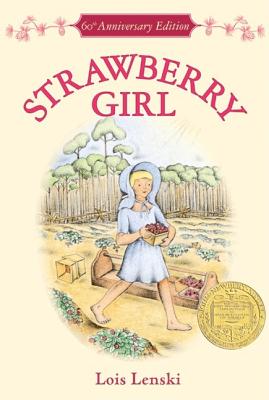
Strawberry Girl

by Lois Lenski
First sentence: “‘Thar goes our cow, Pa!’ said the little girl.”
Support your local independent bookstore: buy it there!
Content: It’s written in dialect, which might throw some readers off. It’s in the Newbery award section at the bookstore.

I remember reading this one when I was really young, maybe 2nd or third grade, when I was going through my pioneer stage. I was fascinated with old fashioned life, and the way settlers lived, and this one, though set in the early 1900s, fit that bill.

Birdie and her family have bought a house and land in mid-Florida, intending to start a strawberry farm and orange orchard. Their neighbors, the Slaters, who have lived on the land for several generations (though probably squatting, technically), have issues: they don’t like Birdie’s families uppity ways, their fences, their ambition. It’s only through long-suffering, hard work, and kindness that Birdie and her family make it through their first year,

Honestly, I think this one holds up pretty well. Lenski interviewed a lot of “Crackers”, original white settlers in Florida, and used their stories as a basis for this book, which gives it an understanding that would be missing if she hadn’t. I liked Birdie, her fire and her determination, and I was surprised at just how spiteful the Slaters were towards these outsiders. There’s also a strong class division running through the book — one I’m sure I didn’t pick up on as a kid — with Birdie’s family being able to afford nice things because they were disciplined. This plays into the “American dream” narrative — if you just work really hard, you’ll be rich — which I’m not sure is a good narrative to have around anymore. And the ending was surprisingly religious: you find God, you can be saved and change your evil ways. Even so, it was a sweet little book.
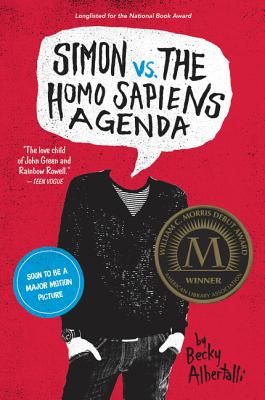
Simon Vs. The Homo Sapiens Agenda

by Becky Albertalli
First sentence: “It’s a weirdly subtle conversation.”
Support your local independent bookstore: buy it there!
Content: There’s quite a bit of swearing, including a lot of f-bombs, and some teenage drinking. It’s in the Teen section (grades 9+) of the bookstore.

This one is a difficult one to sum up plot-wise. Simon is gay, but he’s not out. He’s being blackkmailed by another student who found out (accidentally) about Simon’s gayness, because Simon is emailing and flirting with a boy, Blue, online. Their relationship is entirely online, even though Simon knows that Blue is a student at his high school… Blue is just more comfortable with the anonymity.

As the book goes on, Simon juggles being blackmailed, and making and keeping friends, and high school drama, as he falls in love with Blue, and tries to figure everything out.

It’s not a deep or complex plot, but I thoroughly enjoyed this book. I loved Simon and his loveable awkwardness as he tries to figure everything out. (Being a high school junior is hard.) I loved his relationship with Blue, and once he figured it out, their in-person relationship. I liked Simon’s  family — it’s always nice to see a good, functional family in a YA novel — and his friends, and liked that there was conflict between them, but not of the sort that went against their fundamental relationship. It was sweet and wonderful and just happy-making. Which is what I would call this book. Maybe not perfect, but definitely very very wonderful.

Me and Marvin Gardens

by Amy Sarig King
First sentence: “There were mosquitoes.:
Support your local independent bookstore: buy it there!
Content: There’s some bullying, a kiss, and a lot of talk of scat. It’s in the middle grade (grades 3-5) section of the bookstore.

Obe (pronounced like Obi-Wan Kenobi) Devlin’s family has lived on their land for generations. But his great-grandfather was an alcoholic (never explicitly stated, but heavily implied) and mortgaged their land away to support his habit. Years later, the land is no longer being farmed but has been sold to developers, and it was then that Obe, now in 6th grade, began losing the life he’d always known.  And it isn’t just the change in landscape; with houses come new kids, who have different priorities and tend to tease (nay: bully) Obe. And with housing, comes pollution.

Obe’s really concerned about the environment (as is K; she’s the one I thought about most while reading this) and on one of his trips to clean up the creek by his house, he finds this creature. A creature that eats plastic. Maybe this is the solution to the Obe’s environmental concerns? It’s not that simple (it never is), but Obe’s finding of this creature, whom he names Marvin Gardens, changes his life.

It was a nice, quiet little book, this.  A bit about being conscious about how you treat the world. A bit about friends. A bit about toxic masculinity. A bit about science. A bit about history. And maybe, in the end, that was why I didn’t connect terribly well with it: it was trying to be too many things. New species (is it an alien? Where did it come from?), friendship, neglectful parents, history…. Decide already.

I can see some people — K, among them — really liking this one, though.


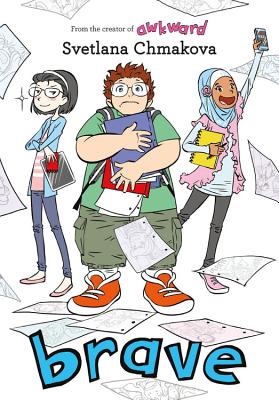
Brave

by Svetlana Chmakova
Support your local independent bookstore: buy it there!
Review copy provided by the publisher.
Content: There’s some bullying, but it’s really appropriate for 4th-6th graders. It’s in the Middle Grade graphic novel section.

I really don’t know what inspired me to pick this up; perhaps it was lack of time, and a graphic novel is easy to get through… I’ve not read Awkward, but that didn’t stop me from enjoying this one.

Jason is a 6th grader, and in his dreams he’s got big plans to be an astronaut at NASA and help figure out sunspots. In real life, however, he’s not so great. He’s bad at math, his friends (such as they are) are constantly poking fun at him, he’s often left out of groups, and he’s got two bullies on his tail. But, as the story progresses, things start to look up for Jason. Because he’s left out of the art club planning, he gets to help out at the newspaper. He makes a friend in Jorge, with whom he has nothing in common, but who is kind and interested in what Jason has to say. And, perhaps most importantly, he realizes he’s being bullied (not just by the kids on his tail, but also by his “friends”), and stands up for himself.

It’s that last thing that made this book so good for me. It’s easy for adults to say “stand up to bullies”, but honestly, not many kids realize they’re being bullied. (I sure didn’t, when I was in middle and high school. Neither did C when she was bullied in middle school) A lot of people brush it off as “jokes” or “criticism” but, honestly, it’s just plain bullying. I loved that Chmakova addressed that, that Jason had to REALIZE he was being bullied in order for him to take ownership of his own world. It makes me want to give it to all kids — because maybe those who are doing the bullying don’t realize they are hurting other people — just to get a conversation going.

I really enjoyed this one.

Posted

by John David Anderson
First sentence: “I push my way through the buzzing mom and freeze.”
Support your local independent bookstore: buy it there!
Review copy provided by the publisher.
Content: There’s some bullying and some mild swearing. It’s in the Middle Grade section (grades 3-5) of the bookstore, though it’s probably better for the upper end of that age range.

Eric Voss has found his “tribe”, the people in middle school that he would literally die for. There’s four of them, all of them with nicknames — Wolf, the piano prodigy whose nickname comes from Mozart; DeeDee, an Indian fantasy nerd, whose nickname comes from (you guessed it) D&D; and Bench, who gets his nickname from, well, sitting on the bench on all the sports teams he’s on. Eric himself is Frost, because he wrote an award-wining poem in 5th grade. He doesn’t mind. Frost (he goes by his nickname mostly in the book; they all do) thinks everything is good, until three things happen: 1) the school administration bans cell phones; 2) sticking post-it notes on lockers/walls/people becomes a Thing; and 3) Rose moves in and joins Frost’s “tribe”, at the invitation of Wolf and over the protestations of Bench. Then everything comes to a head, and Frost is left wondering who his real friends are.

It sounds like a simple plot, but it’s an engrossing one. I loved that Anderson caught the angst of middle school, the challenge it is to be the New Kid in the school, and the real desire to, well, fit in with everyone. I liked that the post-it phenomena when viral, and then turned negative, as many things often do. I liked that it was, ultimately, about friendship and fitting in, but there were also side issues like dealing with conflicts at home and how we perceive each other.

I’ve really liked both of  Anderson’s realistic fiction books; he’s got some chops. Definitely worth reading.

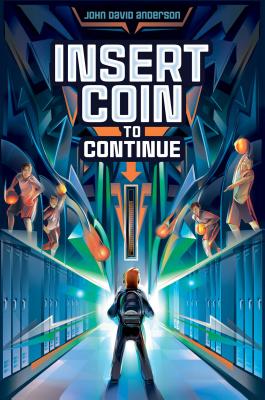
Insert Coin to Continue

insertcointby John David Anderson
First sentence: ”
Support your local independent bookstore: buy it there!
Review copy snagged from the ARC shelves at my place of employment.
Content: There’s talk of crushes, and some bullying. It’s got a quick pace, and short-ish chapters. It’s currently in the middle grade (grades 3-5) section of the bookstore, but I’d give it to the older end of that spectrum. I think 5th-7th graders might enjoy it more. (But I don’t know if it’s worth moving it.)

Bryan Biggins is a gamer. Specifically, he’s a master of the Sovereign of Darkness video game, handily beating the Demon King over and over again. It’s the best part of his day; he’s middling at school, there are a handful of bullies who call him and his best friend Oz names, and he’s got a crush on a girl that he will pretty much never get. Why not spend all of your free time perfecting this game?

Then, one day he breaks through to the secret level. He doesn’t think anything of it, until he can’t get up the next morning before feeding a coin in the slot that has magically appeared over his alarm clock. And that’s just the beginning: his life has become a video game, complete with hit points, experience points, quests, and leveling up.

It’s confusing for Bryan at first, but eventually, he figures out (sort of) how to “play” the “game”. He finds himself making decisions that he wouldn’t have before. And maybe that’s a good thing.

I’ve enjoyed Anderson’s books in the past, and this was no exception. It’s got a clever premise (a really great contemporary-fantasy blend) and Anderson has a great light, fun delivery with this. It captures the difficulty of being a 7th grader, of being someone who hasn’t quite got everything together yet, but the whole gaming element adds a level of fun that makes this one stand out. It was a unique premise, and a delightful book to read.

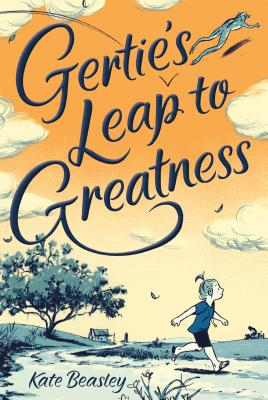
Getie’s Leap to Greatness

gertieby Kate Beasley
First sentence: “The bullfrog was only half dead, which was perfect.”
Support your local independent bookstore: buy it there!
Review copy provided by the publisher.
Release date: October 4, 2016
Content: Aside from Gertie’s tendency to say “Oh my Lord!” which drove me batty, there’s really nothing that the 3-5th grade set couldn’t handle. It will be in the Middle Grade section of the bookstore.

Gertie has a plan: she’s going to tackle 5th grade with a vengeance and going to be the Best 5th Grader in her southern Mississippi town. Maybe then her mother, who walked out on Gertie and her father years ago, will pay attention. Unfortunately, her plan is a bit thwarted by the arrival of a new girl, the daughter of a movie director and an environmentalist. Mary Sue takes the wind out of Gertie’s sails, and so what does Gertie do? Try harder. Unfortunately, that may cost Gertie not only the title of the Best 5th Grader, but her friendships as well.

It was an absolutely adorable book. Gertie is such a fun character (she reminded me of an older Clementine or Ramona), that you can’t help but fall in love with her. Sure, the plot hangs on low stakes (aside from the absent mom and the father who works on an oil rig that Mary Sue’s mother is trying to get shut down), but when you’re 10, even the low stakes seem big. It’s very much a southern story, full of southern charm and quirks. But, the real star is Gertie. She really is the heart and soul of this book, and she really makes it completely worth reading.

So much fun.

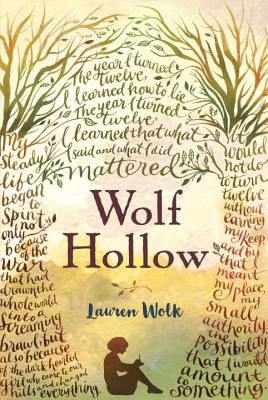
Wolf Hollow

wolfhollowby Lauren Wolk
First sentence: “The year I turned twelve, I learned how to lie.”
Support your local independent bookstore: buy it there!
Release date: May 3, 2016
Content: There’s some death and bullying and one pretty intense injury scene. Probably not for the younger set. It will probably go in the YA section (grades 6-8) of the bookstore.

It’s the fall of 1943, and Annabelle is living a happy, quiet life on her farm in Pennsylvania. Sure, the war in Germany is raging, seemingly without end, but it doesn’t really touch Annabelle’s life. What does touch her is Betty, the new girl who has moved in with her grandparents. Betty has decided that Annabelle is her target, and demands things from her. And when Annabelle refuses to give in, Betty turns her ire on bigger targets. Like Toby, the World War I veteran who Annabelle’s family has taken care of for the past few years. And so when Betty goes missing, it’s Toby who gets blamed.

On the one hand, this really grew on me. It took about 100 pages, but I finally got to where I was invested in Annabelle’s story, and curious about the direction it was taking. The writing is excellent; Wolk really does know how to spin a story. And I thought that, even though it’s a work of historical fiction, the themes of acceptance of others and defending the innocent were incredibly timely.

My problem with it? It’s not really a children’s book. Our narrator is reflecting back on her childhood, so everything is kind of infused with adult sensibilities. (At least: I thought so.) I appreciated that the parents were good parents, helping out when Annabelle confessed the bullying to them. But, it just doesn’t feel like a book I can give to a kid (maybe that special, precocious kid? The 9-year-old who likes Harper Lee, maybe.). Maybe I’m being too sensitive, dumbed down by Diary of a Wimpy Kid-like books. Maybe this is like Pax, which I had a viciously violently negative reaction to, but it turned out it was just me.

Though I didn’t have a negative reaction to this. I liked it, I thought it was well-written and the story incredibly powerful. I just don’t think it’s really a kids’ book.

The Magnificent Mya Tibbs: Spirit Week Showdown

spiritweekshowdownby Crystal Allen
First sentence: “I’m only wearing five braids to school today.”
Support your local independent bookstore: buy it there!
Review copy snagged from the ARC shelves at the bookstore.
Content: There’s a bit of mean girl-ness, and bullying, but the language is simple and the story pretty straight-forward. Give it to a strong second grade reader and up.

Fourth grader Mya Tibbs’s elementary school always has a Spirit Week competition right before the fall festival in their small Texas town. It’s always a tough competition, but this year the stakes are higher: VIP seats to the festival. Mya is sure that she and her best friend, Naomi, are going to win. Except they don’t get chosen as partners: Mya is paired with the school bully, Connie. And she won’t trade. Which makes Naomi more than mad, it means that she and Mya are no longer best friends. Period.

But as Spirit Week goes on, Mya realizes that she’s having fun with Connie, and that maybe things aren’t exactly what they seem.

This was such a charming school story.  The stakes weren’t high, but a fourth grader, they were high enough. Friendship is important, as is doing something fun and doing it well. And even though the whole pageantry of the Spirit Week felt really implausible (all the people were SO good at everything they did!), I rolled with it. I liked that Mya figured out what a real friend is like, and found out that she could stay true to her interests and herself on her own time line. It was wonderful that the main character was a person of color, as well. It’s a great early chapter book.

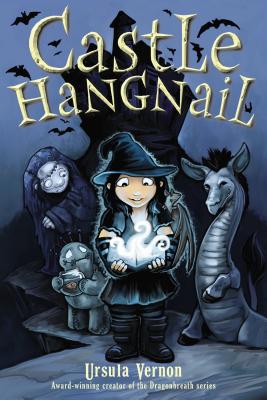
Castle Hangnail

castlehangnailby Urusla Vernon
First sentence: “It was a marvelously dark and dour twilight at the castle.”
Support your local independent bookstore: buy it there!
Content: There’s nothing in here that a third-grader (and up) wouldn’t enjoy. Plus lots of white space and illustrations for the reluctant readers. It’s in the middle grade (grades 3-5) section of the bookstore.

Molly is a 12-year-old twin with a knack for magic. So when her friend Eudaimonia gets an invite to become the Master of Castle Hangnail, a kind of small, run down castle in need of some sort of Wicked/Evil Master in the middle of nowhere, Molly jumps at the chance. Perhaps, if she can learn to become a Master of a castle, she can get the respect she’s been wanting.

However, Molly finds it’s not as easy as saying she’d do it. The Board of Magic has several tasks that she needs to accomplish (among them: securing and defending the castle, committing acts of smiting and blighting, and winning the hearts/minds of villagers by any means necessary) before she can truly be called the Master. Plus there’s the small feat of getting the minions in Castle Hangnail on her side. Not to mention that her parents (and “good” twin sister) think she’s just away at summer camp…

Oh, this book was delightful. So, so very delightful. The tone is a lot like Terry Pratchett’s Tiffany Aching series: a smart, no-nonsense girl who figures out how to be a “wicked” witch with some hilarious side-kicks and a lot of snide asides. There’s so much to love. From the goldfish who always thinks she’s dying to the steam fairy who doesn’t deal with cold well, to the plumber who  “when he knelt to work on the boiler, you sall rather more of Harry than you wanted.” The tone, the characters, even the bullying (which it was, even if it never was called that) were all spot-on and made this book absolutely enjoyable to read.

(Just for the record: because this is a Cybils nominee, I’ve been asked to make sure y’all know this is my opinion only, and not that of the panel.)