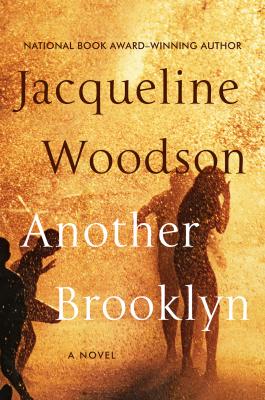
Another Brooklyn

anotherbrooklynby Jacqueline Woodson
First sentence: “For a long time, my mother wasn’t dead yet.”
Support your local independent bookstore: buy it there!
Review copy provided by the publisher.
Release date: August 9, 2016
Content: There’s some swearing, including a few f-bombs, and a lot of illusions to off-screen sex as well as drug use. It will be in the adult fiction section of the bookstore.

The death of August’s father, and her return to Brooklyn for the first time in many years, sets off a chain of memories from her childhood. When she, her brother and father left the farm down South, soon after her mother committed suicide. The friendships she had with girls her age, and the different paths their lives eventually took. The way her father and brother turned to Islam and the hope and guidance their religion gave them. It all comes crashing down on her, in a series of reflective snippets, as she tries to make sense of her childhood.

I’m not sure I fully unpacked all that this novel had to offer. In fact, I know I didn’t. It’s deceptively short and it goes quick, and I know I missed things. Not only Big Things (not that there was much of a plot; it really was a series of short, almost poetic vignettes), but the Meaning behind those Things. It’s a harsh place, Brooklyn of the 1970s, a sexist one as well as a dangerous one. And August, through Woodson, tries to unpack what it all Means. And even though I enjoyed the lyrical flow of the book, and related to the women in it, I’m not sure I understood what Woodson was trying to do.

That said, I think it’s an Important book, and one that will be great for book groups to sit and hash over. (I’d love someone to talk to about it.) And, I can’t deny the beauty of the writing; Woodson is supremely talented. I just wish I were a better reader.
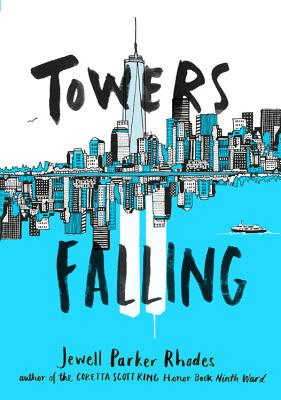
Towers Falling

towersfallingby Jewell Parker Rhodes
First sentence: “Pop groans.”
Support your local independent bookstore: buy it there!
Release date: July 12. 2016
Content: It’s simple enough that the younger set can understand it but complex enough that it won’t bore the older kids. It’ll be in the Middle Grade (grades 3-5) section of the bookstore.

Deja is starting over at a new school, but not by choice. Her family was evicted from their home in Brooklyn, and they’ve moved into a homeless shelter closer to Manhattan. It’s not a happy situation; her father suffers from headaches and can’t hold down a job, and her mother — an immigrant from Jamaica — can only work so many hours.

So, when Deja’s new school starts studying the terrorist attacks on the World Trade Center on 9/11, Deja wonders what on earth it has to do with her. But, as the weeks and months go on — and she learns more about the attacks that happened before she was born — she and her friends Ben and Sabeen learn that no one is unaffected by history.

Rhodes is doing a couple of things here: first, she’s telling the story of the towers falling for kids who may not know anything about it. Sure, it’s not super distant history, but there are still kids who aren’t really familiar with it. And I’m not sure how much it’s being taught in schools (C got it a lot, A got a lesson or two in 5th grade, and I’m not sure anyone at school has brought it up for K) anymore. So, there definitely is a need for a reminder. But, Rhodes has gone bigger than just “hey kids, this happened” history. She’s encompassing issues of kids being homeless, of religious tolerance (Sabeen is Muslim, and she and her family face discrimination because of that), of diversity. She strikes a nice balance in the book between teaching the kids and preaching to them, and  manages to be diverse and moral-centric without being didactic and moralistic.

It’s definitely a book worth checking out.

Outrun the Moon

outrunthemoonby Stacy Lee
First sentence: “In my fifteen years, I have stuck my arm in a vat of slithering eels, climbed all the major hills of San Francisco, and tiptoed over the graves of a hundred souls.”
Support your local independent bookstore: buy it there!
Review copy provided by the publisher.
Content: There’s some violence (done my Mother Nature) and some horrible people saying horrible things. Also, an illusion to sex (by minor adult characters). It’s in the YA section (grades 6-8) of the bookstore.

Mercy Wong has Aspirations and Goals. She wants out of Chinatown, where the whole of San Francisco in 1906 wants to keep her and her family. She wants more than marriage (though she does like Tom, the son of a respected apothecary). She wants to Be Somebody. And, she’s decided that St. Clair’s School for Girls is the way to get it. She bargains her way in, and discovers that things aren’t always as simple as they seem. Then the earthquake hits, and when everything comes crashing down around Mercy, she discovers that perhaps the best things in life are friends and a bit of determination.

This really was a nice combination of historical — the dresses and rules of etiquette and restrictions on women — and modern, with Mercy’s progressive ideas and determination to do things without the permission of authority figures. Lee did a great job balancing the two, so it never felt too modern, nor too old-fashioned. I appreciated seeing San Francisco through a Chinese girl’s point of view, and Mercy really is one of those characters you just want to root for. I liked that while there was a romance, it didn’t dominate the story, and that Mercy was enough of her own person to make the romance believable rather than sappy.

I should go back and read Lee’s first book; I’ve heard good things about it. And if it’s anything like this one, it’s sure to be good.

Ms. Marvel, vol. 2

msmarvelby G. Willow Wilson, Elmo Bondoc, Takeshi Miyazawa, Adrian Alphona
Support your local independent bookstore: buy it there!
Others in the series: Ms. Marvel, vol. 1
Content: There’s violence, again, but not as much as other superhero comics. It’s in the Graphic Novel section, but A (whose 12) loves this. (I bet K would too, except for the romance-y parts.)

I know I should be reading these as they come out (but that would require either webcomic-ing it,or schlepping down to the comic book store), but it’s just easier to wait for these huge eight-book compilations to come out to catch up on the storyline.

I’m still loving this. It’s got some strong, good YA themes, of trying to figure out how to fit in the world and with relationships (both friendships and with boys). I loved the fangirl aspect, especially when Kamala meets Carol Danvers. That was a lot of fun. I liked how she met and fell for a Pakistani boy, who then turns out to be a lackey for a bad guy. Nice. And I liked the themes of acceptance vs. control. And the art — especially in the middle sections, which was drawn by Takeshi Miyazawa — was fantastic.

It’s all great and a ton of fun. Wilson has definitely come up with a modern superhero I can get behind. (Now, when are we going to get her movie?)

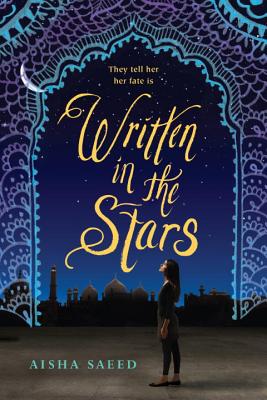
Written in the Stars

writteninthestarsby Aisha Saeed
First sentence: “‘Naila, I wish you didn’t have to miss the game,’ Carla tells me.”
Support your local independent bookstore: buy it there!
Review copy provided by the publisher ages and ages ago.
Content: There’s a (non-graphic) rape and some REALLY bad parenting. It’s in the Teen (grades 9+) Section of the bookstore, but if a 12- or 13-year-old were interested, I’d recommend it.

This was one I’ve been meaning to read for a long, long time. I have no excuse for not getting to it, except that I have a LOT of books to read (so much so that I’m actually starting to panic about my piles. There’s just not enough time!) and many things competing for my attention.

But, recently, I picked this one up and gave it a try. And finished it nearly in one sitting. It’s just THAT compelling.

Naila is the daughter of Pakistani immigrants, ones who are fairly traditional. While she can go to public school and is not required to wear a hijab, she’s not allowed over at friends’ houses, to date, to drive, and college is still up for grabs. (An interesting side-note: Saeed never spells it out, but the discrepancy in treatment between Naila and her younger brother is both unsurprising and frustrating.) She happens to have a boyfriend, though, one she keeps secret from her parents. And when her secret gets out, her parents react by whisking her away to Pakistan where they go about arranging a marriage for her. Behind her back.

It’s awful.  Seriously: I know that arranged marriages like this happen, and that they’re not always bad, but Saeed makes no bones about it: the way Naila’s parents go about this, in order to “save” her honor from the boy she picked, is just awful. And that’s being mild.

It’s an interesting thing to think about though: the balance between choice and tradition, between religious principles and progressive thought (I’ve been trying to think of a better way to say that, and I just couldn’t), between The Way Things Have Always Been and what individuals want. It was especially interesting reading it as a parent because I could see that while her parents thought they were doing right, they were so, so very wrong. And that’s a tough thing to see.

It’s excellently written, highly diverse (hardly any white people at all!), and an intriguing story. One that I hope many, many others will read.

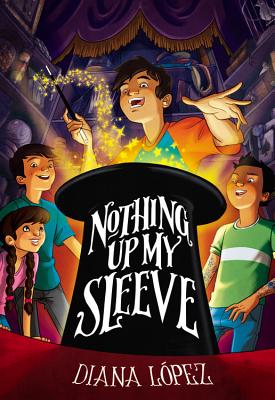
Nothing Up My Sleeve

nothingupmysleeveby Diana López
First sentence: “Z could always find a reason to feel cursed.”
Support your local independent bookstore: buy it there!
Review copy provided by the publisher.
Content: It’s bigger font on small pages, so even though it looks thick it goes fast. It reads very much like a Wendy Mass story, with short chapters, alternating viewpoints, and a lot going on. There’s a slight not-quite-romance (a couple of the boy main characters “like” the girl, but it goes nowhere). It’s in the middle grade (grades 3-5) section of the bookstore.

Z, Dominic, and Loop have been friends for a long, long time. Which means their friendship is one part they like each other and one part competitive. And so when, one hot Texas summer, they discover a magic shop and enter a competition, it becomes somewhat of a tension-creator. They spend the summer working on their magic tricks, but what starts out as just fun becomes more tension-filled. Will their new hobby ruin their friendship?

The good things first: this is full of diversity. Yay for making Texan kids Latin@! And giving them real-world problems: Dominic’s parents are divorced, Z is the youngest of a big family and is always getting ignored, and Loop just found out the man he thought was his biological father isn’t. Plus the way López writes about magic is really neat. She explains the tricks, so you can get a sense of what’s going on, but she doesn’t give away any (well, not many, anyway) of the secrets of the trade.

My big problem was that I felt sorry for Z, who was pathetic, and I felt Dominic was a bit annoying, but Loop and Ariel (she’s the daughter of the magic shop owners) were so annoying I wanted to smack them. Maybe I should give López props for making me care enough to want to smack the kids, but I found them annoying. Which means I really didn’t care too much about how it all resolved. I finished it — it wasn’t really bad — but I didn’t love it. (It really wasn’t bad. It just wasn’t great either.)

Maybe I just wasn’t the right person for it.

Genius: The Game

geniusthegameby Leopoldo Gout
First sentence: “The night Teo disappeared started off just like any other.”
Support your local independent bookstore: buy it there!
Content: There’s some mild swearing. It feels more like a YA book, so it’s in the YA section (grades 6-8), but I’d give it to an interested 5th-grader.

Three friends — Mexican-American Rex, Nigerian Tunde, and Chinese Cai — are at the top of the game when it comes to technology. Rex is a top-notch programmer and hacker, Tunde a brilliant engineer, and Cai a blogger who goes by Painted Wolf and exposes corruption in the government, and together they are LODGE, and have a massive on-line presence. Then they get word: the CEO of a major tech corporation is having an invitation-only competition for the world’s best and brightest. And Tex, Tunde, and Cai all need in, for different reasons. Not the least of which is to win.

On the one hand: this book is SO cool. It’s nice to have a tech-laden book that isn’t scifi, but rather just people using advanced technology the way it’s supposed to be used. Bonus points, as well, for an effortlessly diverse cast. (I did find Tunde’s chapters a bit odd, but I eventually warmed up to it.) It makes sense that all the people at the competition wouldn’t be white boys, and so I appreciated having not only a good ethnic mix (the CEO’s Indian, on top of it all!), but a good mix of girls and boys. The design of the book is cool too, from the sleek cover, to the art and graphics mixed in, depending on which narrator’s POV we’re reading. (Tunde’s was the most elaborate, Rex the most spare.)

But, I’m not sure cool is enough. For one thing, I was expecting a stand-alone, and about 2/3 of the way through I realized it wasn’t, and I’ll admit it: I lost interest. *sigh* The characterization lacked a bit, especially of the Big Bad; why on earth is he trying to bring the world’s tech down, and what does he want with our super-smart, capable kids? Questions that were, unfortunately, left unanswered. It’s not that it was bad — I finished it after all — but it just didn’t make me super enthused. It wasn’t bad. But it wasn’t super great either.

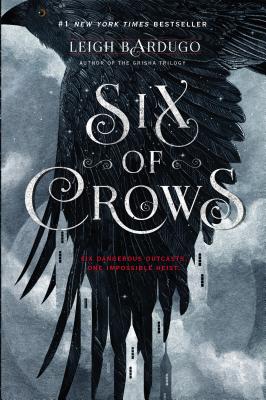
Audio book: Six of Crows

sixofcrowsby Leigh Bardugo
Read by: Jay Snyder, Brandon Rubin, David LeDoux, Lauren Fortgang, Roger Clark, Elizabeth Evans, and Tristan Morris
Support your local independent bookstore: buy it there!
Content: There is a lot of violence, some of it on the graphic side. Illusions to prostitution, and two swear words (they stood out). It’s in the YA section (grades 6-8), but I’m glad I read it. It’s probably on par with Hunger Games, so if your kid/you can handle the content of that, this one is probably okay.

I put this one off. I know I did. I know I should have read it last fall when it was Hot and Everyone was reading it. But, I was busy, and I kept putting it off. Until I was in need of a new audio book and I stumbled across this one. I finished it, went into work and declared “So THAT’S what I was missing!” Yeah.

Kaz Brekker has worked his way up in the Dregs — a criminal gang in the island city/nation of Ketterdam — and has a reputation for being brutal and willing to take anything on. So when he’s tasked with springing a scientist out of the most secure prison in the world — the Ice Fortress in Fjerda — of course he accepts. The price is right, after all. He gathers together a crew of six people — ranging from a merchant’s exiled son to a Grisha —  and they set out to achieve the impossible. Of course, they don’t get along, there’s a lot of internal mistrust and bickering. And, of course, things go badly. (I was wondering how it was all going to fit in one book. The answer is it does but it doesn’t.)

This was enormous amounts of fun. Perhaps part of that fun was the audio form: there were five different people doing the five different narrators, which helped immensely. I really enjoyed the way each one did the other characters slightly differently as well as the way each actor interpreted their own character. It definitely added something more to the book.

I have to admit that I liked this one better than the Grisha books. For whatever reason, I love heist books, I love books with twists and turns (though some of the twists were unfair; she didn’t give me enough information to see things coming and I was genuinely surprised a couple of times) and this one had both. I came to like the characters — Matthais the Fjorden had the most character growth (I wanted to throttle him in the beginning), but I loved the rest of the crew as well. I liked the diversity — it felt effortless and natural rather than an author just trying to be diverse. Bardugo expanded the narrow world she’d created in the Grisha books, and gave it much more depth, which I absolutely adored.

I’ll most definitely be picking up the next one (maybe even in audio) to see how this adventure ends.

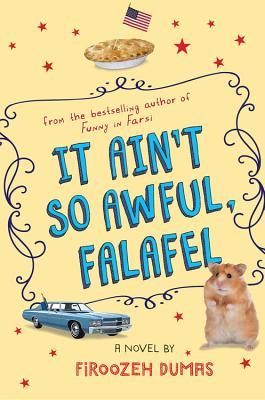
It Ain’t So Awful, Falafel

aintsoawfulby Firoozeh Dumas
First sentence: “Today’s Sunday and we’re moving, again.”
Support your local independent bookstore: buy it there!
Review copy provided by the publisher.
Content: There’s no swearing (well, maybe a mild one) but the subject matter — middle school and the Iran Revolution in 1978 — might be a little mature for the younger set. It will be in the middle grade (grades 3-5) section (or the YA — grades 6-8 — section, I haven’t decided) of the bookstore.

I was in third grade in 1981 when the American hostages in Iran were released and I have a vague memory of it. Nothing substantive, just some hazy images of me seeing the news on TV. I don’t know much else about that, and even though I’ve read a bit about the Iranian revolution, that’s one aspect that I didn’t know much about.

Zomorod Yousefzadeh is in America because her father has a job with an oil company in California. They’ve been here before, when Zomorod was younger, but now she’s going into 6th grade, and she wants to turn over a new leaf. Be more American. So, she changes her name to Cindy and sets out to make new friends. It’s not easy being Iranian in California in the late 1970s (most people either think she’s Mexican, or ask her if she owns a camel. The answer is no to both), but eventually, Cindy figures things out. And then the Iranian revolution happens, and suddenly the home she and her parents thought they could go back to is no longer there. Add to that, Americans were taken hostage, and suddenly Cindy and her parents find themselves subjected to anti-Iranian sentiment. Her father loses his job. Garbage is left on their doorstep. Kids at school tell her to “go home”. It’s not easy.

Loosely based on Dumas’ life, this novel not only captures a slice of history (fairly accurately, but without being kitschy) but also manages to be timely as well. I found myself thinking about how Americans reacted to Muslims after 9/11 (or now, really). Or how immigrants are treated in general. It’s a good thing to see American life from the perspective of an immigrant, and to find out that we’re equal parts good and bad. (Which really isn’t a surprise.) Dumas also manages to capture the awkwardness of middle school with grace and humor. There were some actual laugh-out-loud parts. She definitely understands middle school, with all its ups and downs. And it was delightful to read a book where the parents weren’t bad or sick or dead.

It’s definitely an excellent read.

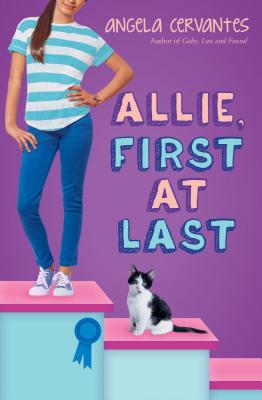
Allie, First at Last

alliefirstby Angela Cervantes
First sentence: “Blame it on Junko Tabei.”
Support your local independent bookstore: buy it there!
Review copy pilfered from the ARC shelves at my place of employment. G
Content: It’s a great book for middle readers, short (but not dumbed-down) with no romance or awkward situations. It’s in the Middle Grade (3-5 grade) section of the bookstore.

Allie comes from a highly competitive family. Her great-grandfather was the first World War II Veteran to get a Congressional Medal of Honor. Her mother has won best anchorwoman four years running. Her big sister is a national debate champion. Her big brother is a soccer star, and her younger sister is an aspiring actress. However, Allie feels like she’s just a string of flops. She can’t win anything, most recently the Science Fair. So when the Trailblazer Award comes along — with a fancy trophy and a $200 prize — she’s determined to win.

This was a cute, inter-generational book without the whole mystical Mexican thing. (Mexicans, yes, but not mystical at all.) I liked Allie’s relationship with her Bisabuela, and how he was able to guide Allie through life experience and stories. I liked that there was a nice moral at the end, but the book itself didn’t seem preachy at all. (I didn’t like that all the kids seem to have cell phones and were super-privileged, but that seemed to fit into the story okay, so by the end I let that go.)

It really is a sweet little story.  Plus: the author is from Kansas, which is nice.