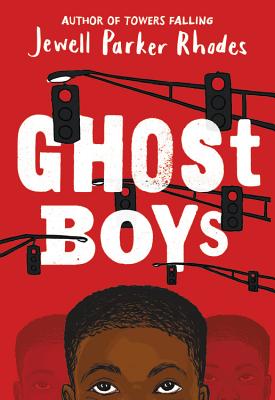
Ghost Boys

by Jewell Parker Rhodes
First sentence: “How small I look.”
Support your local independent bookstore: buy it there!
Review copy provided by the publisher.
Release date: April 18, 2018
Content: There are some tough issues here, but all the violence is either handled delicately or is off stage. The publisher has it for 10 and up, so I will probably shelve it in the YA section (grades 6-8) at the bookstore, but it would be good for curious 4th and 5th graders.

Twelve-year-old Jerome is shot by a white police officer while playing in the park. He had a toy gun, and the officer thought he was being threatened and therefore shot Jerome. If that sounds familiar, it’s intentional.

The book isn’t about the shooting, exactly. It’s told from Jerome’s perspective, after his death. He’s a ghost, hanging around, angry he is dead, and wondering what his purpose is. From there, we learn in flashbacks how he came to be shot, as well as following the preliminary hearing (in which the white officer gets off), and learn about Emmett Till’s murder in Mississippi in 1955. The point of the novel, however, isn’t about the story. It’s about the feelings this kind of murder generate. The sadness and anger in Jerome’s family. The questioning by the daughter of the officer. The sheer number of black boys that have been murdered. But also hopeful feelings: the friendships that come out of a tragedy like this.

While it’s a bit on the heavy-handed side, I think that was done intentionally. Rhodes wants to get her readers — many of whom are young — thinking about why this happens. About underlying racism. About seeing the “other” as, well, not “other”. And I think she wants to get a dialogue going, because if we don’t talk about these things, our culture won’t change and black men and boys will keep getting murdered.

It’s a quick read, and definitely a worthwhile one for kids (and adults!) to read.
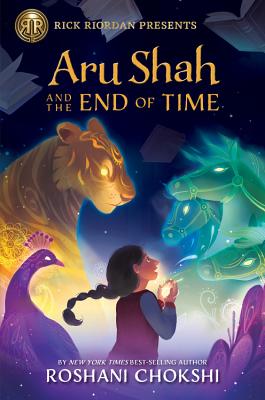
Aru Shah and the End of time

by Roshani Chokshi
First sentence: “The problem with growing up around highly dangerous things is that after a while you just get used to them.”
Support your local independent bookstore: buy it there!
Release date: March 27, 2018
Review copy provided by the publisher.
Content: There are some complex names, a little violence, and hints of crushes, but I’d give it to anyone reading the Percy Jackson series. It will be in the Middle Grade (grades 3-5) section of the bookstore.

When we saw Rick Riordan, and he was talking about his imprint, Rick Riordan Presents, one of my husband’s concerns is that the writers of these books on this imprint will just basically be telling Percy Jackson stories, superimposed on people of color and their mythologies.

And, after finishing Aru Shah and the End of Time — with its Hindu mythology — I can say that’s partly true. Aru Shah felt like a Percy Jackson book: a girl finds out she’s the daughter of a god (in this case, Indra, the god of Thunder), goes on a quest with a new-found friend and a sidekick to save the world (from the demon The Sleeper, which has awoken) , in a book full of humor, pop culture references, and non-stop action. So, yeah, in a sense that’s true. But Aru Shah is also wholly its own thing. Aru is more conflicted than Percy ever was: she, inadvertently sets off the crisis she has to save the world from, which fills her, not unexpectedly, with guilt. And while the quest part feels the same, there are notable differences: primarily being the mythology; there are a ton of stories in Hindu lore, and while I’m not familiar with all of them, I do know some, and I liked the spin that Chokshi put on them. I liked that Aru and her friend Mini’s relationship was complicated: they were reincarnated souls of former brothers, which makes them sisters, though they have different god fathers and different families in the human world. It gave a deeper, richer layer to their relationship, which I really enjoyed. Everyone in the book seemed more complex and mulit-faceted than I was expecting, which was nice.

In short, while this does feel familiar, and will to anyone who has read the Percy Jackson books, Choski has also put her stamp on the stories, which is a refreshing, welcome thing.

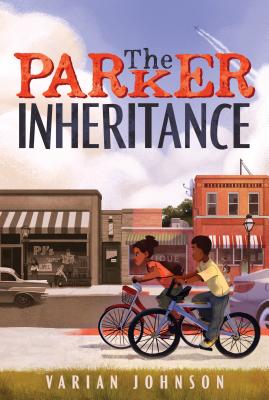
The Parker Inheritance

by Varian Johnson
First sentence: “Abigail Caldwell stared at the letter.”
Support your local independent bookstore: buy it there!
Review copy provided by the author.
Release date: March 27, 2018
Content: There are some tough issues brought up about racism, especially in the 1950s, but also currently. It will be in the middle grade (grades 3-5) section of the bookstore, though it  may be more interesting for grades 5 and up.

Candice does NOT want to spend the summer in Lambert, South Carolina. Her parents have recently divorced, though, and their house needs to be renovated in order to put it on the market, and it’s better if they’re not underfoot, so Candice’s mom decides to take up residence in her grandma’s old house in the small Southern town. It’s bound to be a boring, never-ending summer.

That is until two things happen: she meets Brandon, the boy across the street, and she discovers an old letter, detailing a mystery about an inheritance of $40 million. The same inheritance that her grandmother tried to find ten  years ago, and was fired from her job as city manager over. If Candace and Brandon can figure this out, they could not only help the city, but also clear her grandma’s name.

I love puzzle books, even if I’m not entirely smart enough to figure them out, and this was no exception. About halfway through, Johnson references The Westing Game (one of my favorites!), and from then-on, I was using what I knew about that book to figure out the clues. (I did pretty well, too!) So, perhaps this one is better the more you know that one. But, in addition to the fun puzzle solving, Johnson takes us through history. We learn about sharecroppers, and what it was like to be a black person in the South in the pre-Civil Rights era (there’s not a lot, especially for kids, written about that time). He weaves in themes of revenge, justice and forgiveness as well as acceptance and tolerance. It’s a lot for a middle grade novel, but under Johnson’s capable hands, everything comes together seamlessly. He knows how to write kids so they seem real, and address tough issues in a way that they are accessible but not watered down.

An excellent book.

Ninth Ward

by Jewell Parker Rhodes
First sentence: “They say I was born with a caul, a skin netting covering my face like a glove.”
Support your local independent bookstore: buy it there!
Content: There are some intense moments, but it’s written very simply. It’s in the middle grade (grades 3-5) section of the bookstore.

Lanesha lives in New Orleans’ Ninth Ward, one of the poorest sections of the city, with her Mama Ya-Ya, who is the woman who delivered her, because Lanesha’s mother has passed on and her extended family doesn’t want her. But, even though they’re poor, Lanesha’s happy. That is, until a storm — Hurricane Katrina — comes riding in. Mama Ya-Ya passes on in the middle of the storm, and Lanesha is left to figure out how to ride out the flooding that came after the hurricane by herself.

I adore Rhodes, and the way she takes tough issues and makes them really accessible to younger readers. She knows her audience, knows how to talk to her audience, and knows how to make difficult subjects into a gripping, interesting, compelling story. This one is no exception (I hadn’t read it before!). The only difference with this one is that it has ghosts. Lanesha has the ability to see those who have passed on, and can even talk to them. (Which makes me wonder why this one ended up in the “realistic fiction” section of my children’s lit class…) Even so, the ghosts don’t seem out of place; it is New Orleans after all. And even though the ghosts play a role in resolving the ultimate conflict, I think Rhodes did an excellent job in making this a real middle grade novel, with the action being propelled forward by the children.

Excellent. But that’s no surprise.

That Time I Loved You

by Carrianne Leung
First sentence: “1979: This was the year the parents in my neighbourhood began killing themselves.”
Support your local independent bookstore: buy it there!
Review copy provided by the publisher.
Content: There is some sex (on-screen but not graphic) and swearing, including a few f-bombs. It’s in the adult fiction section of the bookstore.

Set in a suburb of Toronto, specifically on one street in a particular neighborhood, this collection of connected short stories  follows the inner workings of a dozen people of all ages.  The characters are mostly women, except for one black teenage boy, and many of them are immigrants. Leung explores immigrant expectations and prejudices toward them. She explores female dynamics both with other females and with males. She touches on sexual assault and racism and emotional abuse. It’s a lot. And yet, it works.

I usually have problems with short stories, but I think because these are connected — the characters in the stories appear in their own as well as in the background of other stories — it felt more like a novel. We got to know the characters, we get to know the neighborhood, and because each story focuses on a different person, we get to know them intimately and it means more when they show up in a different story.

I really enjoyed this one!


Module 5: All American Boys

Reynolds, J. and Kiely, B. (2015). All American Boys. New York, NY: Atheneum Books for Young Readers.

Genre: Realistic fiction, Coretta Scott King Honor. Realistic fiction because it is set in contemporary times with no magic or other speculative elements.

Book Summary: All Rashad wants to do is pop into a convenience store and pick up some chips on his way to a party on a Friday night. What happens, though, changes everything. Rashad bends down to pick out his cell phone from his bag, a woman trips over him, and the next thing he knows, a cop has him handcuffed and is beating him. He ends up in the hospital, and — subsequently — the subject of discussion of police brutality in the community, even though Rashad isn’t comfortable with being the center of attention.

Quinn, a member of the basketball team, witnesses Rashad being beaten, and is friends with officer, who has been like a second father to Quinn, since his father’s death. Quinn’s struggle is a decision whether or not he wants to become political and speak out against his friend.

Impressions: Oh, wow. I’d been putting this book off for years, mostly because I thought it was a football book. (Shows you what I know!)  But, this one — especially in the light of all the books dealing with police brutality in the wake of Ferguson (among others) — really packs a punch, especially for me as a white person. I really appreciated the dichotomy between Rashad — who is just grateful to be alive and who is trying to figure out answers why — and Quinn — who has a much more passive decision to make, in whether or not he wants to speak out about what he saw. It really does provide a lot of food for thought, and brings forward white privilege in a way that I don’t think I’ve seen before. While this book was hard to read — both Reynold and Kiely are masters of getting across emotion in as few words as possible — it is an important one.

Review: Magoon praises the book, reflecting on the dissonance between the white and black characters and praising it for the questions it raises with readers. Her final thoughts were: “It is perhaps too easy to call this worthy book timely and thought-provoking. Let us reach beyond simple praise and treat it instead as a book to be grappled with, challenged by, and discussed.”

Magoon, K. (2015, December 8). ‘All American Boys’ by Jason Reynolds and Brendan Kiely. The New York Times [New York]. Retrieved from:  https://www.nytimes.com/2015/12/20/books/review/all-american-boys-by-jason-reynolds-and-brendan-kiely.html.

Library Uses: I would put this one on a display of either books about African American life, Coretta Scott King award winners, or books reflecting the issues in the news. This would also be fantastic for a book group.

Readalikes:

  • The Hate U Give by Angie Thomas: This book is written from the point of view of the friend of a boy who was shot by police. She was a witness to the event, and because of that, her grief was made political. It touches on the topic of police brutality as well as systematic racism in the country.
  • Dear Martin by Nic Stone: Through letters to Martin Luther King Junior, the main character looks at race relations in America — he is Ivy League-bound — and the judgement of the media after he has a run-in with a white, off-duty officer.
  • Ghost Boys by Jewell Parker Rhodes: This one is written for a slightly younger audience, but touches on the topic of police violence as well. The main character is shot by an officer, and spends the rest of the book as a ghost as he watches his family and friends deal with his death.

Black Panther, Book 1: A Nation Under our Feet

by Ta-Nehisi Coates
Illustrated by Brian Stelfreeze
Support your local independent bookstore: buy it there!
Content: There’s some violence (of course), but nothing else. I’d give it to a middle schooler or higher who’s interested in it. It’s in the Graphic Novels section of the bookstore.

I honestly didn’t know what to expect heading into this one; Black Panther isn’t a superhero I was really familiar with until the movie trailers started playing. But, it looked cool, and I thought I’d give it a try.

What I got was a really intriguing, somewhat complicated, very deep story about King T’Challa who comes back from being away (he was off fighting with the Avengers) and finding his country in chaos. He’s not sure if he can be a leader, or even really sure how to be the leader his people want. And it doesn’t help that there are two distinct groups rebelling against him. One has a mind-controller (I think) involved, and that’s the one T’Challa is most concerned with. But there’s this other one (to be honest, I liked their story better), a couple of women soldiers who go renegade and start punishing men for treating women badly (timely, no?) and decide that no one man should lead the country.

As I said, it’s a complex, fascinating story about what it means to have power, what it means to be a citizen of a country, and the dichotomy between holding on to one’s traditions and moving toward the future. There was a lot to think about in these four issues, and it kind of makes me want to continue the story, just to see what happens to T’Challa and Wakanda, in the end.

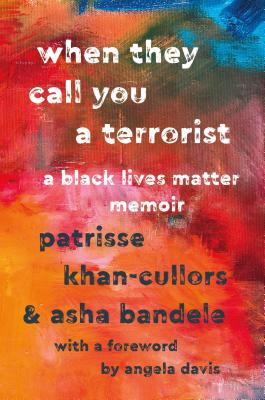
Audio book: When They Call You a Terrorist

by Patrisse Khan-Cullors and Asha Bandele
Read by the author
Support your local independent bookstore: buy it there!
Listen to it on Libro.fm
Content: There is a lot of swearing, including multiple f-bombs. It’s in the Sociology section at the bookstore.

This book, from one of the founders of the Black Lives Matter Movement, is small, but it packs a punch. It’s basically Cullors’ life, growing up poor in LA in the 1990s, and how that experience — along with the arrests of her biological father and brother — propelled her to activism and the forming of the Black Lives Matter movement.

I am a white, cis-gender, hetrosexual woman, so I don’t really have a lot to say, really, about this one. Except to stand as a witness to Cullors’ experience and pain and try to be better about my behavior and opinions and actions in the future. I do think this book, much like Between the World and Me is a vitally important one. We, as a society, need to open our eyes and recognize that experiences like Cullors’ are not only valid, but that they should NOT be happening in a first world country. That the world that she experienced is not the world I experienced, and that there is a fundamental wrong happening there.

The audio book is excellent as well. I highly recommend listening to Cullors’ experiences in her own voice; it adds a power to it that may not have existed in print. There is an interview at the end of the book, as well. I recommend sticking around for that.

The Belles

by Dhonielle Clayton
First sentence: “We all turned sixteen today, and for any normal girl that would mean raspberry and lemon macarons and tiny pastel blimps and pink champagne and card games.”
Support your local independent bookstore: buy it there!
Release date: February 6, 2018
Content: There is some physical and emotional abuse and an attempted rape scene, but it’s not overly graphic. It will probably be in the YA section (grades 6-8) of the bookstore.

Camille is one of the Belles, the only people in the kingdom of Orléans who was born with color and who have the ability to manipulate the bodies of everyone else, and she is determined to be the favorite of the Queen. This means she’s the best, the chosen, the, well, favored.  Only she’s not chosen to be the favorite… and from there, she starts unraveling the mystery that is the Belles, and discovers the lengths that the royals will go to keep the Belles in their control.

So the tagline on the ARC was “the revolution is here” which is REALLY misleading, so I’m glad they changed that. This is a very long (almost overlong), very opulent, set up to whatever is going to happen in the next. There’s a lot of world-building here, and quite of bit of it leaves questions hanging. We discover things as Camille discovers them, which means we are left as frustrated and impatient as she is. I liked the world and I liked the characters… for me the downfall was just the descriptions. Everything was food (buttercream, chocolate, caramel, honey) and fabric, and I felt almost smothered in it all. Underneath, I could sense a criticism of plastic surgery, of the desire to change one’s appearance, but I’m not sure I could find it underneath all the clothes and makeup. But that’s just me (though I do admit that I’m curious about the sequel). There will be readers who gobble this up and love every minute. I’m just not one of them.

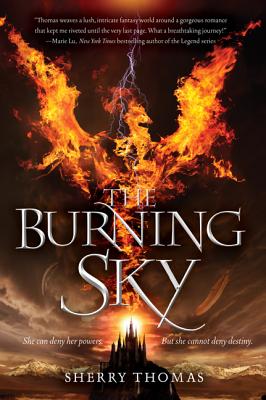
The Burning Sky

by Sherry Thomas
First sentence: “Just before the start of Summer Half, in April 1883, a very minor event took place at Eton College, that venerable and illustrious English public school for boys.
Support your local independent bookstore: buy it there!
Content: There is some violence and some mild swearing. It’s in the YA section (grades 6-8) of the bookstore.

Iolanthe was enjoying a quiet life with her guardian, Master Heywood, in a small town, when her life gets turned upside down. It was simple enough: she was trying to salvage a ruined light elixer, and brought down lightning from the sky. That simple (well, maybe not) thing brought not only the crown prince, Titus, to her doorstep, but the dreaded Inquisitor, and sent Iolanthe into hiding with Titus as she learned her True Purpose: to overthrow Atlantis and kill the Bane, Atlantis’s unkillable leader.

It’s pretty by-the-numbers — of course Titus and Iolanthe are taking on the Big Bad Guys, of course they fall in love. But, I still found myself enjoying this. Perhaps because it’s kind of a reverse Harry Potter — Iolanthe and Titus come from the magical world to go to school at Eaton where they not only have to pass as non-magical but Iolanthe also has to pass as a boy. It’s an interesting world Thomas has built, with the elemental vs. subtle (learned) magic, with dragons and wyverns and wands and potions. I liked it quite a bit. Maybe not enough to continue on with the series, but still. It’s an intriguing start to a series.