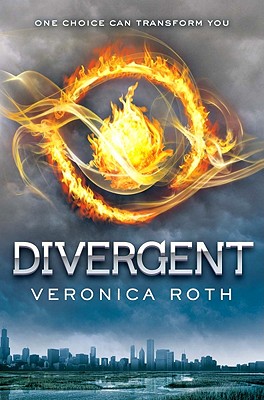
Divergent

by Veronica Roth
ages: 14+
First sentence: “There is one mirror in my house.”
Support your local independent bookstore: buy it there!

In what used to be known as Chicago in this post-apocalyptic world, humanity is divided into four factions, each devoted to developing a particular virtue: Candor, the honest; Erudite, the intelligent; Amity, the peaceful; Dauntless, the brave; and Abnegation, the selfless.

Beatrice has grown up in Abnegation, but doesn’t quite feel she fits. She’s not as selfless as her parents and brother, she’s always questioning her own inner motives. She sees kids from the other factions and wonders if she wouldn’t fit in better there. Then, at age 16, she is given a test and the opportunity to stay with her faction or choose another one. And she discovers that she’s Divergent.

We spend most of the book wondering, along with Beatrice — who christens herself Tris after she joins Dauntless — what the heck Divergent is. On one level, this is annoying; but by the end, when it all makes sense and you realize that the timing was perfectly right for it, all is forgiven. It’s an intense book and a violent one, as we follow Tris through her brutal training to join the Dauntless faction. As she goes through the training, Tris discovers two things: that the people in the factions — including her birth faction — aren’t nearly as altruistic as they proposed to be. And that romance can blossom in the oddest places.

There will be inevitable comparisons to The Hunger Games (it’s really a good book for those who love Hunger Games and are wondering what to read next): there’s a society that’s become corrupt, and a girl who doesn’t fit the norm who has the potential (yes, there is a sequel, at least) to change that society for the better. Though Tris is a more active and less selfish heroine than Katsa was, which makes her more interesting in my book. It’s less black-and-white, and more complex; Roth does an excellent job balancing the good and bad in every faction, providing us with not only the worst, but also both the best and the human in human beings.

It’s compelling and engrossing storytelling as well, with a little bit of everything — romance, politics, action, tension — for everyone. An excellent start to a good new series.

Lola and the Boy Next Door

by Stephanie Perkins
ages: 14+
First sentence: “I have three simple wishes.”
Support your local independent bookstore: buy it there!
Review copy provided by an ARC sent me from the amazing A Jane of All Reads

I need to say, first off: I completely and totally regret what I wore to my senior prom. It was white, it was totally late-80s, and it was completely forgettable. What I should have done was be daring (like Lola, who wants to attend her mid-winter formal as Marie Antoinette) and completely memorable.

So, one of my favorite things about this book was all the costume changes that Lola went through. I never knew what she was going to wear, and somehow, that made the book that much more enjoyable for me.

The plot is pretty simple: Lola and Cricket used to be neighbors. Then they were more than neighbors. And then he moved away because his family is pretty invested in following his sister Calliope’s dream of being an Olympic figure skater. But before that happened, he hurt Lola, so she’s spent the last two years trying to forget that Cricket ever existed. It’s worked so well, that she’s happily in love with Max, who’s a punk rocker and (gasp) five years older than she is (she’s barely 17). Then, one day, Cricket (and his family) move back in. Lola figured she was over him, but she didn’t count on him not being over her.

Second thing I adored about this book: Cricket. Seriously. He’s nice. No: he’s wonderful. Swoon-worthy, geeky, genius, awkward, and much, much too good for Lola. It was an interesting twist having the guy be the “good” one, the one that Lola has to aspire to “deserving”. (I find it’s often the guys who are the cads, but in many ways Lola is in this book.) At first she pushes Cricket away, but eventually realizes that she still has *feelings* for the boy next door.

I found, in this book, that it was the little things that made it enjoyable. Anna and St. Clair are back, and even though they only play a small role, they light up the pages they’re on. Lola’s two dads are also a delight: it’s nice to have a gay couple shown as stable and loving without making a big deal about it. (Additionally: they’re great characters in their own right.) That said, I still have issues with True Love (always have, always will) and this one is all about finding and recognizing True Love, but it wasn’t enough to get in the way of me thoroughly enjoying this book.

Perhaps it comes down to the awesome Marie Antoinette dress after all.

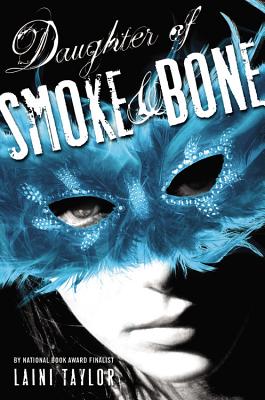
Daughter of Smoke and Bone

by Laini Taylor

ages: 14+

First sentence: “Walking to school over the snow-muffled cobbles, Karou had no sinister premonitions about the day.”

Support your local independent bookstore: buy it there!

Review copy provided by a friend of a friend who got it from the publisher.

Release date: September 27, 2011

As an art student in Prague, 16-year-old Karou tries to keep up the appearance of a normal life. Except her life (not to mention her azure hair and myriad of tattoos, including the hamsa eyes on her hands) is anything but normal. She lives with a group of monsters called chimera, who have been her family for as long as she can remember. She runs errands for her father-figure, Brimstone, collecting teeth. It’s a lonely life, but she finds comfort in knowing that while she has many unanswered questions about who she is, she has a family (of sorts).

And then things take a turn for the, well, interesting. The seraphim — other beings from the same world as the chimera — attack Brimstone, closing all the magic portals in our world. As they are doing this, one of them, Akiva spots Karou and is inexplicably drawn to her.

There is more to the story, obviously, but it’s best left for you to discover on your own. I will say this: I adore Taylor’s storytelling. It’s dark and sinister and yet so very lovely all at the same time. It’s a twisting, meandering sort of story, and yet nothing superfluous or out of place. Her characters are captivating, drawing you in with humor and affection; you can’t help but love Karou and all the people she loves in her life. (As M said when she finished: “I want to be an art student in Prague and have blue hair.”) Added to that, Taylor plays with fantasy and religion and myth in wild, fascinating ways. Yes, there are angels and monsters in this book, but in playing around with themes of tolerance and prejudice — there’s a war going on between the chimera and the seraphim, and Karou is, for many reasons, caught in the middle — Taylor takes the simple myths, and mythological creatures, to a new, higher level.

The only quibble I have — and it’s not really much considering this is the sort of haunting, beautiful story that will stay with you for a long time — is that while the story comes to a natural stopping point, it doesn’t fully resolve (infuriatingly!). Which means, we’ll need to wait until Taylor’s imagination works its wonders again, and she comes out with a sequel. Which is sure to be as wonderful as everything else Taylor writes is.

Anna and the French Kiss

by Stephanie Perkins
ages: 14+
First sentence: “Here is everything I know about France: Madeline and Amélie and Moulin Rouge.”
Support your local independent bookstore: buy it there!
Copy given to me by the lovely Vasilly

So, this one has been getting a lot of hype, all of it saying how wonderful, how great, how supremely perfect this was.

M, when she finished it said, “Well, that was cheesetastic. Good cheese, but so cheesy.”

The basic story: Anna Oliphant is the daughter of a Nicholas Sparks-type author, who, not wanting to be outdone by all his Posh Hollywood Friends, ships Anna off to a Posh boarding school in Paris. (Oh noes.) She doesn’t know a lick of French, doesn’t want to leave her comfortable life in Atlanta, doesn’t want to leave her blossoming almost-relationship with Toph. But, to Paris she goes.

Where she bumps into — literally — Étienne St. Clair.

(cue dreamboat music)

What ensues is a lot of romantic push-and-pull. Anna obviously St. Clair, but she has a double problem to deal with: he’s got a girlfriend though she’s kind of out of the picture, and Anna’s friend Mer likes him as well. Then there’s the question of whether or not St. Clair likes her? Sure, they’re friends, and they hang out all the time. But does he like her?

(Because, you know, we ALL want to know that.)

That’s not to say this is a bad book: it’s predictable, sure. But I did enjoy the relationship between Anna and St. Clair, it’s heights and valleys, and it’s inevitable, swoon-worthy resolution. It’s not a simple book, and much like Maureen Johnson’s work, Perkins knows how to write a romance that deals with more even while putting the relationship front-and-center.

Update, 2018: I can see how I thought it was cheesy, but for whatever reason (time, place, etc.), I found it to have a lot more depth this time. There were themes about communication and assumptions that touched me, and a reminder that while my children are my responsibility, they are also their own people with their own dreams, and it’s not up to me to control their lives. Also: I missed the subtext that Americans really can be awful (en masse) the first time around. Still a very good book.

Not perfect, b I ut delightful.

Audiobook: The Wee Free Men

by Terry Pratchett
read by Stephen Briggs
ages: 9+
Support your local independent bookstore: buy it there!

I first read The Wee Free Men two years ago, and thoroughly enjoyed every bit of the time I spent with the book. It’s hilarious, adventuresome, cool, and Tiffany Aching, even when she’s just 11 years old, is a force to be reckoned with. There’s a power in her, a determination. I love that in this world, all it takes to be a witch is powers of observation and the knowledge that you’re the only one who can do anything about the situation.

There’s magic, of course, but it’s not flashy magic. It’s quite, subtle, and still there, even after you know how it’s done.

That said, I loved hearing this book read aloud. Even more so than when I read it. It’s fine reading it and all, but nothing — nothing! — is funnier than someone doing a spot-on Scottish accent for the Nac Mac Feegle. And the voice for Toad? So deadpan, so hilarious. I laughed. So hard. Often. And I actually got the section near the end when Tiffany goes up against the Queen; something which I remember eluding me when I read it. Perhaps because listening to it means I go through things more carefully than when I read them? Whatever it is, listening to the audiobook made this books so much more loveable and enjoyable than it already was.

Which means, of course, that I’m going to have to listen to the rest of the Tiffany Aching books.

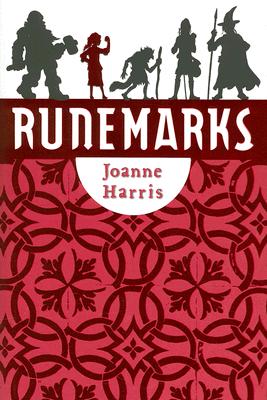
Runemarks

by Joanne Harris
ages: 14+
First sentence: “Seven o’clock on a Monday morning, five hundred years after the End of the World, and goblins had been at the cellar again.”
Support your local independent bookstore: buy it there!

Maddy Smith is basically a nondescript resident of the small village of Malbry in the Middle Worlds. Except for the runemark on her hand, which brands her a bit of an outcast, but she doesn’t pay that much attention. She has no friends, except for a wandering traveler that goes by the name of One-Eye whom she only sees once a year at Harvest time.

Then, one day when she’s fourteen, her world shifts: all the things she’s been taught to believe about the Order and the Word — the religious organization that rules the Middle World — are put into question. The End of the World was just a new beginning, and there are powers she has that she never knew. One-Eye sends Maddy on an adventure that will lead to a new end and a new beginning for everyone.

If that sounds really confusing, don’t worry: it is really confusing to summarize this huge, 521 page, fantasy. It’s based on Norse mythology, something which I found fascinating, and is quite impossible to summarize. It’s a sprawling fantasy, in the Grand High Fantasy style: adventure, twists, turns, multi-perspectives, and even a somewhat confusing ending. It’s got it all. Maddy is an interesting main character to follow through the world; she ends up being a very powerful character, but because of her age and innocence, she’s not quite in tune with all the subtleties of the world. It helps guide the reader through some complex mythology and relationships between the old gods which helps with the flow of the book. It takes a while to sink into the rhythm of the world, and the pacing of the novel, but once the adventure truly gets underway it’s enough to keep you involved and interested.

It also felt very Neil Gaiman-esque. I can’t quite pinpoint why: perhaps it’s because it’s so sprawling, or perhaps because it’s just got that dark, gritty undertone that Gaiman is known far. Whatever the reason, it reminded me of Gaiman’s work, which is never a bad thing.

That said, I don’t think I truly loved it. It was interesting, and I’m glad I read it, but it was lacking that spark to make it truly great.

Dragonfly

by Julia Golding
ages: 12+
First sentence: “The Fourth Crown Princess of the Blue Crescent Islands had sixteen rituals to observe from the moment of waking to when she broke her fast.”
Support your local independent bookstore: buy it there!
Review copy provided by the publisher.

This book has a lot going on; I’m going to do my best to summarize it without giving too much away. A lot of the enjoyment I had with this book was because I didn’t know where it was going next.

Taoshiri was just a goat girl in the furthest reaches of the Blue Crescent Islands until, one day four years ago, she was chosen to be the fourth of the Four Crown Princesses. She was surprised, of course, but accepted the Mother Goddess’s will, trying to be the best princess she could. Then, because of impending war with a bloodthirsty emperor, she’s sent to Gerfal to marry the crown prince Ramil. Not exactly something Taoshiri wants to do, especially when, once she gets there, she finds Ramil to be uncouth, rude, and plain unattractive.

Then — because you know these sorts of things have to happen — they were kidnapped, thrown into all sorts of unpleasant situations, forced to fight for their lives and their countries.

I won’t give away much more than that, because the twists and turns are quite delightful. As is the relationship between Taoshiri and Ramil. But, I think what really made this novel (which I’m still trying to decide whether it was too wordy or just right, and probably wasn’t all that well-written, but I really didn’t care), was the layers of political positioning and religious discussion that went on. It was never spelled out, exactly, but Golding spent a lot of time with religious tolerance and prejudices, with an underlying heartfelt plea for understanding. Much of the conflict in the novel comes from the snap judgements people make about different cultures, in this case the Goddess-worshiping Western culture of the Islands (as opposed to the God-worshiping Eastern cultures). Golding also flips the racial divide: the strangers are the fair-haired, fair-skinned ones, standing out in a darker culture. Though there is some brutality in the Eastern religions, one is never led to believe that worshiping one God (or Goddess) is better than the other, something which I found refreshing.

As for the politics, Golding spent time balancing the love story with the duties a ruler has to make for the good of the state. It was an interesting balance, and I think she managed to play it all out quite well.

One final note: this is a fantasy only because it’s set in the past, in a made-up land. There’s no magic, just adventure, wits, and some grand action. Which made it a lot more fun that I was expecting.

Mad Love

by Suzanne Selfors
ages: 12+
First sentence: “When you’re sixteen, summer is supposed to spread before you like a magic carpet, waiting to carry you to new, exciting places.”
Support your local independent bookstore: buy it there!
Review copy provided by the publisher

From one vantage point, it looks like Alice Amorous has a charmed life: her mother is the Queen of Romance Fiction, she lives in a quaint apartment in the College Hill area of Seattle. It should be good. Except that her mother has been hospitalized for mental illness, and it’s up to Alice to hold down the increasingly shaky fort.

Then she meets Errol, a strange boy (wearing black hoodies in the middle of the Heat Wave of the Century qualifies, I think) who claims he’s Cupid and wants Alice to write his story. Of course she doesn’t believe him: mental illness runs in the family, she must be going mad, right? Which terrifies her.

Much of the book is given over to convincing Alice that Cupid is really who he says he is. There’s some side stories, a distraction in the form of a Cute Skateboarding Guy, and conflicts with Alice’s neighbors as the lies and stories she’s surrounded herself with slowly fall apart. The characters are quirky and interesting and clever, as is the idea of melding mythology with writing romance fiction.

Sure, it gets a bit melodramatic at the end, but I was kept guessing as to where Selfors was going with the book, and delighted that she didn’t go for the easy road out. It’s always nice when a book ends well. I was thinking though, as I finished it, that the book doesn’t really qualify for a romance (though there is one). It’s more about love in general. And the song that went through my head when I finished was this one:

It’s what makes the world go round, after all. And this book is quite full of love.

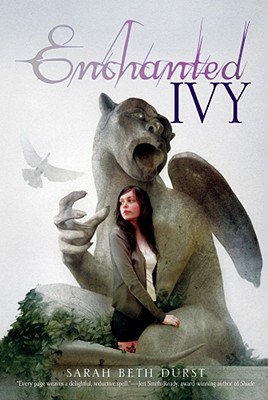
Enchanted Ivy

by Sarah Beth Durst
ages: 13+
First sentence: “‘Almost there,’ Grandpa said.”
Support your local independent bookstore: buy it there!

Lily has lived her whole life with her Grandpa and her mom in Philadelphia. Never gone anywhere, never done much, mostly because her mom isn’t quite, well, completely all there. She’s artistic and fun and interesting, but is also subject to brain hiccups.

Grandpa, on the other hand, is a graduate of Princeton, and goes to the reunions every year. And this year, the spring of Lily’s junior year, he’s decided to take both Lily and her mom along, much to Lily’s excitement: Princeton is exactly where she wants to go to school.

But once she gets there, she discovers that not everything is exactly as it seems. The gargoyles talk. Her father is a Knight. There’s a boy with black and orange hair. And there’s a whole alternative Princeton, full of magical creatures. And Lily’s been given a test to find the Key. Little does she know how deeply her family is involved in all this.

It’s a clever premise, making an old institution like Princeton magical, creating a whole alternate universe that’s connected through the Princeton gate. Durst plays with ideas of unity and cooperation as well as touching on fear of the unknown and how that tends to make groups overly cautious. She also addresses the idea of doing wrong for the right reasons. There’s adventure and romance (a bit of a love triangle) as well.

But, even with all that, it didn’t quite work for me. I usually love Durst’s stuff, but this one felt off. The romance didn’t quite work, even though the boys were more than awesome. The bad guy wasn’t evil enough for me. And then there’s the whole fact that she introduced a whole new character two-thirds of the way through the book. Generally, that doesn’t bother me, but it was enough of a plot twist that it threw me for a loop. It changed the game, and it made things a lot darker than they were initially setting out to be. And while I liked the dark element, the timing felt off to me.

That said, it really made me want to visit Princeton.

My Unfair Godmother

by Janette Rallison
ages: 10-14
First sentence: “Dear Professor Goldengill, Thank you for another opportunity to raise my semester grade with an extra credit project.”
Support your local independent bookstore: buy it there!
Review copy provided by the publisher

I read the first book in this series, My Fair Godmother, out loud to C about two years ago. In going back and looking at what I wrote, this jumped out at me: “I’m not sure how well this would stand up if I had read it by myself, but I really enjoyed reading it aloud.”

It stood out because I didn’t read this one out loud to C, and found that it worked just as well as a read as it did as a read-aloud.

My Unfair Godmother is the second book, and while it helps if you’ve read the first, it’s not necessary. The only returning people are Chrissy — the very lackadaisical, and somewhat incompetent fairy godmother, who has just picked up moonlighting as the tooth fairy since she can’t seem to get into the Fairy Godmother University — and her erstwhile (and somewhat grumpy) assistant Clover, the leprechaun. Everything else is new, though the premise plays out in much the same way.

Tansy Miller has been angry at her father since he and his mother divorced. He’s been too busy for her, what with a new family and moving to Arizona from New York and all. So, the fall that she’s sent to live with them — because her mom and younger sister are on tour with a Broadway touring company — she is not the happiest person around. Of course, that means she falls in with the wrong crowd, mostly to make her dad angry (it works), which culminates with her getting caught red-handed with a can of spray paint and thrown into jail.

The last thing she needs is a fairy godmother. And she really doesn’t get one; Chrissy’s only a fair godmother, and even though she grants Tansy three wishes, she doesn’t exactly deliver them the way Tansy thinks they should be delivered. After bring Robin Hood and the Merry Men forward to our time, Chrissy sends Tansy — and her father, mother, step-brother, and the police chief’s (cute) son — back to the Middle Ages, where they need to play out the fairy tale Rumpelstiltskin.

Rallison puts a twist on the fairy tale by combining it with Robin Hood, and spins them both delightfully. Tansy is a interesting combination of anger and loneliness, a heroine who doesn’t want to save the day (or even herself). Underneath all the humor, adventure and, yes, romance, it’s really a story about family and loss: learning to forgive and accept the family you’ve got,even when they disappoint you. And learning to understand, accept and forgive yourself for the bad things that happen in life.

It’s fluff, sure, but it’s good, enjoyable fluff.