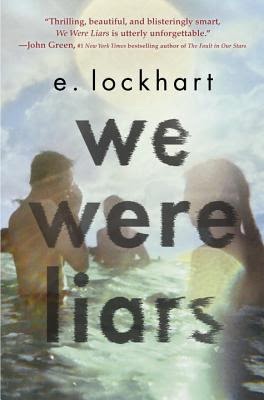
We Were Liars

by E. Lockhart
First sentence: “Welcome to the beautiful Sinclair family.”
Support your local independent bookstore: buy it there!
Release date: May 13, 2014
Review copy snagged from the ARC shelves at my place of employment.
Content: There were multiple f-bombs and some mild swearing. It’s also a very intense book, emotionally, so be prepared for that. It will be in the Teen section (grades 9 and up) of the bookstore, but I think a mature 13-year-old could handle it.

There is a problem with writing a review for this book. It’s best if you know absolutely nothing going in. Nothing. Nada.

In fact, the back of the ARC says “If anyone asks you how it ends, just LIE.”

I will tell you this. Cady is one of the Beautiful Sinclairs, an old-money family in Boston that vacations every summer on a small island near Martha’s Vineyard. Her grandfather is the patriarch of this family but her mother and her two sisters have not really lived up to the family name. Cady is also one of the four Liars: she, her cousins Johnny and Mirren, and Johnny’s mother’s boyfriend’s (Indian) nephew, Gat. Something happened two summers ago, and Cady lost her memory. No, the summer that she’s 17, she needs to figure out what happened.

I will also tell you this: read it. Just read it. Lockhart is amazing. This book is haunting and so gorgeous in its simplicity and so powerful.

I promise that’s not a lie.

Popular: Vintage Wisdom for a Modern Geek

by Maya Van Wagenen
First sentence:”‘School is the armpit of life,’ my best friend Kenzie once told me.”
Support your local independent bookstore: buy it there!
Content: Because eighth graders aren’t exactly the nicest creatures in the world, there is some language, all of it mild and very infrequent. It’s in the YA section (grades 6-12) of the bookstore, but honestly, anyone who can handle the subject matter (she does talk about taking sex ed and drug inspections and lockdowns at her school), should read this one.

The summer before she starts eighth grade, Maya Van Wagenen discovers in a box a copy of “Betty Cornell’s Guide to Teenage Popularity”, circa the 1950s  Her mom suggests, offhand, that maybe Maya should follow the advice in the book, write it down, and see what happens.

This book is the result of that year.

There aren’t the words to express my love here.  Perhaps it’s because I have a daughter just finishing eighth grade, and it’s been a rough year for her. Perhaps, it’s because I was much like how Maya started eighth grade: socially awkward, at the bottom of the social hierarchy, trying to fit in my small, conservative, Michigan middle school. (I had just moved there two years before, and still hadn’t figured out how to fit in with kids who’d known each other since kindergarten.)

But my enjoyment went beyond just being able to relate to Maya. She tackled a chapter or two of Betty’s book each month during the school year, and the chapters were divided up with her reflections of her progress. Along the way, I got to know her family (she has terrifically cool parents; my favorite side story of hers was the list of answers you’re not supposed to say when crossing through a U.S./Mexico border patrol. My favorite was “I am, but I’m not too sure about the kids in the trunk.”) and her school mates (she lives in Brownville, TX, and to say that she has a rough school, is an understatement). At first, she’s very humorous about he whole project. For instance, when she hits the dress chapter, she takes it literally, dressing like someone from the 1950s, getting stared at and teased for dressing like someone’s grandma. It’s easy to think that Betty’s guide really doesn’t fit in today’s world.

Somewhere along the way, Maya — and I, as well– discovered that Betty’s book is really still applicable, and maybe she really does have the secret to “popularity”.  I was touched by Maya’s insight, her observations, and her maturity. By the time I closed the book, I wanted to cheer for her — she’s an amazing girl, one I’d be proud to call my daughter — and to thrust this book in the hands of everyone I know, grownups and teens alike.

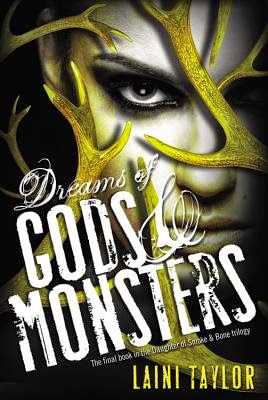
Dreams of Gods & Monsters

by Laini Taylor
First sentence: “Nerve thrum and screaming blood, wild and churning and chasing and devouring and terrible and terrible and terrible –“
Support your local independent bookstore: buy it there!
Others in the series: Daughter of Smoke & Bone, Days of Blood & Starlight
Content: There’s a lot of violence, and some mild swearing. Nothing as dire as the previous book, but it’s still hard to take, emotionally. It’s in the teen section (grade 9+) at the bookstore, but I would give the series to an 8th grader.

I’m at a loss where to begin. I suppose it’s with you reading the other two books before this one. While Taylor refreshed my memory (very eloquently) about the other books, you are missing a ton by not starting at the beginning of this story.

Also, by saying that even though this is a 600 page book, not much is extra. (M disagrees with me: she thinks Taylor could have cut out a couple of the subplots and the Epilogue and it would have been better.) Taylor picks up immediately after the events of Blood & Starlight and gives us the Apocalypse via angels. We’re introduced to a new character, Eliza, a PhD student in biology, who is on earth while everything in Eretz is falling apart. There’s something about her — I won’t tell you what — and even though she’s new to the book, she fits right into this elaborate and crazy world that Taylor has created.

There’s so many threads going on in this book, I couldn’t even begin summing up. And Taylor manages them all mostly deftly. She does introduce a new conflict when there’s 100 pages left, and it’s much too tidily wrapped up (or at least dismissed), but other than that, there’s so much too love. Mik is fantastic (there was one point where I was laughing and cheering; he and Zuzana MAKE the book), and Karou is incredible. In fact, that was the one thing I truly came away from this book with: the women rock. Seriously. And in so many different ways. They’re villains and tough and tender and loving and hurt and compassionate and just so, so complex. It’s fantastic.

The whole series is. The only thing I can say that was truly bad about this is that it’s over.

Fangirl

by Rainbow Rowell
First sentence: “There was a boy in her room.”
Support your local independent bookstore: buy it there!
Content: There’s quite a few f-bombs, and some insinuations of sex. Plus a lot of underage (and overage) drinking. Also, it’s about college freshmen, a subject which I’m not sure younger readers want to read about. It’s rightly in the teen section (grades 9 and up) of the bookstore.

Cath and Wren are twins. Wren is the outgoing one, the pretty one, the fun one. And Cath stays home and writes Simon Snow (think Harry Potter) fanfiction. She’s really good at it: her stories get thousands of hits, and are widely talked about on the fanfiction sites.

But none of that is going to matter now that they’re freshmen at the University of Nebraska. Cath wanted to go the safe route by rooming with Wren. But, for Wren, that wasn’t an option. So Cath is forced to branch out. Experience things. Actually have a life.

In many ways, this is a love story to those who write fanfiction. Yes, Cath is an introvert, and no she doesn’t want to engage in what most people call “living”, but in no way does Rowel make Cath seem pathetic. She puts her in contrast to Wren, who spends weekends (and some weeknight) partying until we hours (the “normal” college experience) and lets us choose on our own. Perhaps some readers will see Cath as pathetic and without a life, but I never did. (Perhaps, too, that’s because I’m an introvert and I have a nerdy family who actually read — and write — fanfiction.)

It’s also a traditional love story. Cath’s roommate, Reagan, has a boy, Levi, kicking around. Cath thinks they’re dating, but eventually realizes that it’s really her Levi is interested in. And it’s their romance that made the book for me. Levi is so danged good and it was a pleasure watching the good guy get the girl. (So often it’s the “bad” one.) I loved the banter, I loved the push and pull, and I loved watching Levi draw Cath out of her shell, while simultaneously wholly accepting her for who she is.

The ending was a bit pat, I thought, and all the drama with her parents (dad’s a bit on the manic side; mom walked out on The 9/11, and Cath is understandably resistant to her attempts to reconnect) was a bit over-the-top. And while I appreciated that Rowell was reaching out to those who immerse themselves in a fandom, including pages and pages of Cath’s fanfiction was a little boring for me.

Even with the quibbles, though, I thoroughly enjoyed reading this one.

Slated

by Teri Terry
First sentence: “I run.”
Support your local independent bookstore: buy it there!
Content: It’s a pretty intense book, and I think the plot would be a bit difficult for younger readers to understand. But there’s nothing “objectionable” it. It’s in the YA section (grades 6-8) of the bookstore.

Kyla has no memory beyond the past six months she’s been in the hospital in London. See, she’s been Slated by the government: a process done to criminals and terrorists to remove their memories. It’s most effective the younger you are — Kyla is only 16 — and after the process, they tie your consciousness to a device called a Levo, which monitors your endorphin levels. If you get too low, you black out. And die. Obviously, it’s supposed to reform the people who have it done, make them happy, productive members of society.

Except it didn’t quite work on Kyla.

While she doesn’t have any memories of her former life, she has nightmares. And she’s not as compliant as she should be. And so, back with her “Mom” and “Dad” in their small village outside of London, she starts noticing things. Noticing things which leads to questions. And we all know that in books like this, questions are never good.

This is a much less futuristic dystopian fantasy than most, and that’s one of the things, I think, that make it stand out. (The other being that it’s set in London. It’s nice to know that Big Brother is happening over there, too!) Sure, it’s set in the future — roughly 30 or 40 years — but there’s a lot that ties it to contemporary culture. The anti-terrorism movement, which leads to a really broad definition of “terrorist”. A government that seeks to control their population. The other thing that made this one unique for me is that Kyla wasn’t (for this book, at least; it might change) a lynchpin on which the Revolution of the Evil Government resides. She’s a girl who’s lost her memory but retained her consciousness. And it’s not until her friends start disappearing that she feels she needs to take action.

That lack of action is also a downside. I’m hoping that this is mostly just a world-building book, and that there’s more going on in the next one. While I did find the situations Terry put her character in fascinating, by the end of the book, there was more unanswered questions then there were answered ones. Additionally, I think the love interest was a bit forced; there was no need for her friendship to end up as a romance, and because of that, there was no underlying chemistry between the two of them.

That said, it was unique enough to hold my attention, I am curious to see where the next book goes.

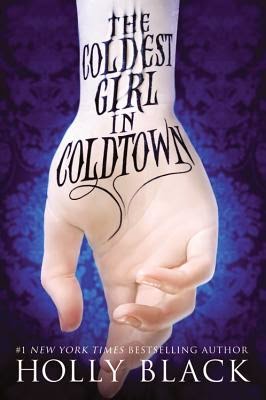
The Coldest Girl in Coldtown

by Holly Black
First sentence: “Tana woke lying in a bathtub.”
Support your local independent bookstore: buy it there!
Content: Lots of violence, some of which is graphic. Very little swearing, most of it mild, and no sex (though there is some talk of it). It’s in the teen section (grades 9 and up) in the bookstore, but I’d let a 12- or 13-year-old who was interested in vampires read it.

I’m going to start this one off by saying this is, hands down, the best vampire book I’ve read in AGES. (I’m not going to add that it’s basically the only vampire book I’ve read in ages.Oh, wait.) It’s dark, it’s gory, it’s bloody, it’s creepy and yet so very awesome. It’s everything a vampire book should be.

Tana Bach, 17, lives in a world where vampirism is a plague. It’s a disease, and there is a cure — to starve oneself of blood for eighty-eight days — but there are enough vampires running around to make it necessary to set up Coldtowns, places where vampires, and humans who are attracted to that lifestyle, can live without endangering the rest of the population.

Except that they sometimes do.

Tana wakes up on the morning after a huge party to find a houseful of corpses. Somehow she managed to sleep through a terrible vampire bloodbath, though she’s not the only survivor. She stumbles into the back bedroom and finds her ex-boyfriend, Aidan, newly infected, and a vampire chained nearby. She does the only thing she could do: saves them. Thus starts her terrifying adventure.

It’s one where she meets a lot of people, some nice — like Jameson and Valentina and Winter — most not so nice — like Gavriel, the vampire she saved. And yet, it’s not a black-and-white book. It’s wandering around in the murky shades of grey, where everyone is out to protect themselves. And Tana… oh, boy does she shine. She is AMAZING. Not in a superhero way, but in that human, flaw-filled, and yet awe-inspiring way. She faces her demons, in a most literal sense, and comes out on top.

Yes, there is a romance between a 130-year-old vampire and Tana, but, as I keep telling people in person, it’s not creepy. And while it’s there (and there’s this great sexy non-sex scene), it’s also something that’s not the focus of the book, which, perhaps, is why it’s not a creepy thing.

At any rate, I couldn’t put this one down, and having finished it, I wish it wasn’t due at the library so I could start it all over again.

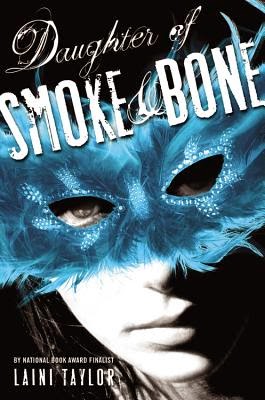
Audio Book: Daughter of Smoke & Bone

by Laini Taylor
read by Khristine Hvam
Support your local independent bookstore: buy it there!
Content: There is some talk about sex (though all the actual sex is off screen), a lot of violence, and some mild swearing. Is in the teen (grades 9 and up) section of the bookstore, though I didn’t have any problems with C (now 14) reading it.

I’ve been wanting to reread this (and Days of Blood & Starlight) in anticipation of Dreams of Gods & Monsters coming out. And so, when I saw that this one is out in audio, I snatched it up. (You should have seen me; I was fangirling all over the place. Kind of like when a customer came in to preorder Gods & Monsters. We were just gushing.) Anyway. I don’t have much to add about the story that I didn’t already say when I first read this.  But the audio was glorious. Hvam captured all the voices perfectly. To a spunky Zuzanna (love her best still) to Akiva and Karou, to the various chimera and seraphim that run throughout the book. (Brimstone is EXACTLY like I heard him in my head.) It was a joy to listen to. And one of those books that made you want to sit in the car, listening for hours on end.

If you haven’t had a chance to experience Taylor in all her awesomeness, you need to. And with the third coming out, take a weekend and splurge and read all three. You won’t regret it.

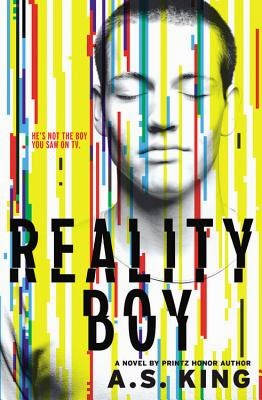
Reality Boy

by A. S. King
First sentence: “I’m the kid you saw on TV.”
Support your local independent bookstore: buy it there!
Content: A lot — a LOT — of language, and to say Tasha isn’t nice is to grossly misunderstand her. There’s also sex, but none of it is graphic. Or even titillating. It’s in the teen section (grades 9 and up) of the bookstore.

I’ve been doing a lot of thinking about this one since I finished it. Like other books I’ve read recently, I’m not sure this one boils down to a “like” or “dislike”. There was just so much going on that was SO horrific that when I was finished I didn’t want to run around saying to everyone that you HAVE to read this book. That said, I finished it basically in one sitting, because I couldn’t tear myself away.

When Gerald was five, his parents (his mother, mostly) decided that he was a Problem Child and wrote to the Network Nanny show to get them to come help Solve the Problem that was Gerald. And so the Network Nanny came, and he was shown crapping on national TV on the table, in his mother’s shoes, in all sorts of places. And, 12 years later, he still hasn’t lived it down. His nickname is “Crapper”. He’s in Special Ed (because someone who craps on the table MUST be developmentally delayed). He’s in therapy for anger management. And he given up all hope of having a future; his only goal is to stay out of jail.

As the book progresses, though, you come to realize that Gerald isn’t a problem child, that he’s just been labeled that way. And that the situation — from his parents who DON’T DO ANYTHING to his teachers who DON’T DO ANYTHING — has rendered Gerald completely helpless. The book is basically his awakening: the realization that it’s HIS life and if he wants to change it, he CAN. That he doesn’t have to be a victim, doesn’t have to conform to his mother’s expectations of him (which are low, to say the least). And that’s empowering.

Its not an easy read.  Gerald’s family is beyond messed up. But King’s writing is not without compassion towards Gerald and his eventual girlfriend, Hannah. There are moments of hope, breaks between the bleakness that make it easier to get through the moments — with his sister Tasha, especially, who is the driving negative force in Gerald’s life — that are hardest to get through. There is hope, in the end, as well. It’s not a happy book, by any means. But it is a powerful one.

And for that reason, it should be read.

Audiobook: The Killer’s Cousin

by Nancy Werlin
Read by: Nick Podehl
Support your local independent bookstore: buy it there!
Content: There’s talk about a murder and a suicide, a lot of mild language, and one f-bomb. Plus a lot of intense situations. It’s in the teen section, (grades 9 and up) of the bookstore, but I’d give it to an 8th grader if they showed interest.

David Yaffe is a killer. Sure, he was acquitted at trial for murdering his girlfriend, but he knows in his heart that he. is. a. killer. So, even though he’s off to Boston to live with his Uncle Vic and Aunt Julia (and their daughter, Lily) and to start over at a new school, he knows — knows — that things will never, ever be the same again.

It doesn’t help that Vic and Julia have waged a cold war with David’s parents for years, and that Julia (at least) is not happy to have David there. It also doesn’t help that their daughter, Kathy, committed suicide in the attic apartment where David’s currently living. And it really doesn’t help that Lily resents David’s presence. Not because he’s a killer — which is the reason most people can’t be around David — but because he’s an intrusion in her perfect little (albeit warped) world.

I don’t know how this is in print form, but listening to Podehl narrate the book, I was completely creeped out. Especially by Lily. It was one of those books where I was yelling at the CD in the car “NO. SHE NEEDS HELP!!” pages (discs) before the characters realized it. And Vic and Julia? I don’t care if it was the mid-1990s (I realized, at one point, that Kathy was my age, which means Vic and Julia were my parents age), they were horrible, horrible, horrible parents. (So were David’s, for that matter.) The epitome of controlling and judgmental. And there was very little growth arc, for them, at least. (Though I’m pretty sure that wasn’t the point of the book.) However, David and Lily, were fascinating characters, and the book is more about their relationship than anything else.

And that had me compelled — even if I thought Podehl’s voice for Lily was a bit on the whiny side — from the first disc to the last.

The Diviners

by Libba Bray
First sentence: “In the town house at a fashionable address on Manhattan’s Upper East Side, every lamp blazes.”
Support your local independent bookstore: buy it there!
Content: There wasn’t any language (at least that I noticed), and there was only illusions to sex. What puts this in the Teen (grades 9 and up) section of the library is the violence. There are 5 gruesome murders, spouse abuse, and other assorted violence. And then there’s the whole occult/creep factor, not to mention the teenage drinking. However, I’d give it to a 12- or 13-year-old if they weren’t overly sensitive.

Evie hates her small-town Ohio life. She’s a modern ’20s woman, and hates being shackled, especially by her Prohibition-supporting mother. So, when Evie makes big blunder with her talent for “reading” objects — she accuses the town’s Golden Boy with knocking up a maid — and she’s shipped off to Manhattan to stay with her admittedly odd uncle, she’s more than happy. She’s thrilled: finally, her life can Begin!

But while Evie makes some good friends, and goes to a couple of thrilling events, things aren’t all coming up roses. There’s a serial killer out there, brutally murdering people and leaving occult signs on the bodies. Her uncle — who runs the Museum of American Folklore, Superstition, and the Occult — has gotten involved with the investigation into the murders, and Evie, being the Modern Woman that she is, weasels her way into that. Which brings a whole mess of problems.

One of the strengths and weaknesses of Bray’s book is that Evie’s isn’t the only story. Bray is weaving a huge tapestry here, with multiple story lines that weave in and out of each other. She’s setting up a huge confrontation, of which the murders only play a small part, but I didn’t mind because the characters themselves were so engaging. To the tortured Ziegfeld star Theta, to the daughter of union supporters Mable, to the charismatic thief Sam, to the tortured Jericho, to the African American bookie runner Memphis, they were all characters I wanted to spend time with and get to know. But in many ways, there was almost too much. The book comes in at nearly 600 pages, and it’s only a first in a series. That’s a lot of set-up going there. And while the overall plot line — the murders — gets resolved, the last 40 pages are spent setting up the next book, which dampened my enthusiasm for it.

But dampened isn’t a dislike. There really is so much to love about this one, from the creepy to the characters.