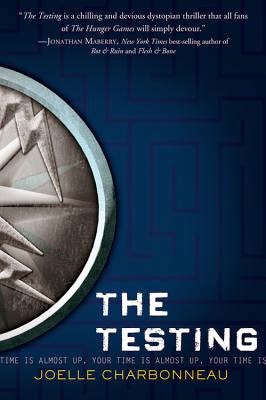
The Testing

by Joelle Charbonneau
First sentence: “Graduation Day.”
Support your local independent bookstore: buy it there!
Content: It’s violent, but not graphically so. And there’s kissing, but no sex. Which means it’s in the YA section (grades 6-8) of the bookstore. However, much like Hunger Games, I’d be wary of more sensitive readers liking it.

This book has been out for two years now, and I’ve been putting it off for just as long. Mostly because the whole post-apocalyptic/dystopian genre has been SO overdone, that I really didn’t want to read yet another one.

Then we scheduled Charbonneau to come to the store — they’ve been working on it since the first one came out and the rep mentioned it was set in a futuristic Wichita — and I was tasked with reading and reviewing the book before she gets here. And so I did, smacking myself when I finished for waiting too long to get around to this one.

Sixteen-year-old Cia Vale has just graduated from her colony’s small school near the top of her class. She’s excited: in this post-Seven Stages War America, now called the United Commonwealth, that means she’s likely to be chosen to attend The Testing in the capitol, Tosu City (aka Wichita, though it took me nearly the whole book to figure that out). Except her father — a former Testing candidate and University graduate himself — doesn’t want her to go. However, once Cia’s been chosen, she can’t say no; refusing the Testing is an act of treason, punishable by death.

So, Cia travels to Tosu City with her father’s warning — TRUST NO ONE — echoing in her ears, and discovers what he meant. The Testing is not just high-pressure and high-competition for the twenty university slots. It’s deadly.

While the plotting and writing isn’t as tight as Suzanne Collins’s, it’s still a quick, engaging read. Charbonneau sets the stakes high right away, with Cia’s roommate committing suicide, and doesn’t let up until the final pages of the book. There are twists and turns — some of which I saw, some of which I didn’t — and Cia is a good, strong narrator to carry this story on her shoulders. It’s definitely post-apocalyptic; Charbonneau cleverly gave us a brief history of how this country came to be in a series of short written test questions early on. The dystopian part is harder to see — Cia comes to hate the Testing officials, and the government as an extension, but I’m not sure I ever felt the way she did about the officials. Unlike, say, President Snow in The Hunger Games. (Yes, comparisons are inevitable.) I do think, on the other hand, that it’s a tighter, more interesting story than Divergent (yes, there’s a love interest, which I think was mostly unnecessary).

But the best thing about waiting to read this one is that the whole series is out already. And I don’t have to wait to read the second one. And I’m invested enough in Cia’s story that I’m quite curious to find out what happens next.

All the Bright Places

by Jennifer Niven
First sentence: “Is today a good day to die?”
Support your local independent bookstore: buy it there!
Content: There’s teenage smoking and drinking and some off-screen sex. Not to mention the several f-bombs, and the weighty subject matter. All this puts it squarely in the Teen (grades 9+) section of the bookstore.

Finch is just coming out of a two month’s “sleep”, as he calls it. Violet is dealing with survivor’s remorse, being the only survivor in a car accident that killed her sister. Both find themselves at the top of the school’s bell tower one wintery day, contemplating the idea of jumping off, ending it all.

It’s a weird way to start a relationship, saving each other from suicide, but Finch can’t get Violet off his mind. And slowly, through a class project and sheer determination, he wins her over.

There’s really not much else to the plot. I’m sure this one will get huge comparisons to Fault in Our Stars (teens fall in love in spite of Obstacles) or Eleanor & Park (teens fall in love in spite of Differences in background and in spite of Bad Circumstances), but I didn’t feel like it was as good as either of those.  I wanted to like Finch and Violet, but didn’t connect with either one. I felt like Niven was throwing WAY too much at me: suicidal thoughts, car accident deaths, neglectful parenting, abuse, depression, bi-polar, actual suicide, and bullying, with a smattering of eating disorders in there as well. It’s like all the crappy things that could happen to anyone in life were happening to Finch and Violet. And that was just too. too. much.

What I did like, however, were Finch and Violet’s trips exploring the state of Indiana. I enjoyed seeing the state through their eyes, exploring the nooks and crannies and off-beat places that people don’t usually go.

But that wasn’t enough for me to truly enjoy this book.

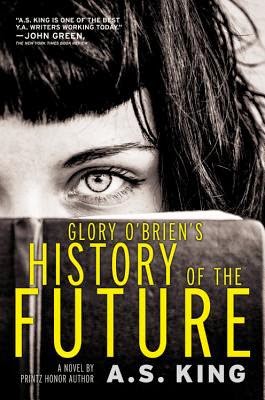
Glory O’Brien’s History of the Future

by A. S. King
First sentence: “So we drank it – the two of us.”
Support your local independent bookstore: buy it there!
Content: There’s some swearing — including multiple f-bombs — plus some frank talk about sex. It’s definitely a more mature book, and is in the teen section (grades 9+) of the bookstore.

Eighteen-year-old Glory O’Brien has had her mother’s suicide hanging over her for practically her whole life. It’s kept her father from doing his art; he stays home, eating, and working as an on-line tech consultant. It’s kept Glory from doing much of anything, really, frozen with the expectation that she, too, will commit suicide eventually.

And it doesn’t help that no one ever talks about It. Or her mom.

Then she and her best friend (by default, since they live across the street from each other), find a dead, mummified bat in the barn. It gets turned to dust, and they mix it with beer and drink it up. And then they start seeing visions.

Glory’s visions are of a horrific patriarchal future, where women’s rights are completely taken away, and the country ends up in another Civil War. This fascinates and terrifies Glory — what’s her role in this future? How does it come to be like this? Will it? — and the act of having these visions pushes her into action.

Trippy doesn’t even begin to cover this book. It’s wild, weird, trippy, odd… King has bitten off a huge piece of cake here, and I’m not sure how well it worked for me. On the one hand, I was thinking it was a Handmaid’s Tale-esque feminist warning about what will happen if we give up the fight and stop questioning the status quo. But the longer the book went, the more I wondered if there was a point to all this, aside from spurring Glory and her dad to action. Maybe there wasn’t. And while I am glad that Glory actually made decisions and started living her life, I kind of wish there were a less trippy way of doing it.

So, in the end, even though I liked the individual elements of the book, I was unsatisfied with it as a whole.

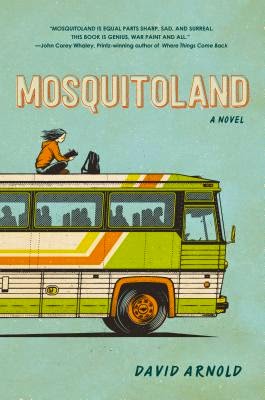
Mosquitoland

by David Arnold
First sentence: “I am Mary Iris Malone, and I am not okay.”
Support your local independent bookstore: buy it there!
Release date: March 3, 2015
Review copy handed to me by the publisher rep.
Content: There’s a whole lot of language, both mild and strong. There’s some creepy characters, including a serial rapist, but nothing is graphic. It’ll be in the teen section (grades 9+) of the bookstore.

Mary Iris Malone, Mim to everyone but her mother, is not happy. Her father, in a whirlwind, divorced her mother — who then disappeared — married the waitress at the local Denny’s, then relocated the three of them — Mim had no choice — to the middle of nowhere, Mississippi.

This does not sit well with Mim, who just wants her mother back, her old life back, her home back. So, when she’s called to the principal’s office and overhears her dad and Kathy talking about Mim’s mom with the principal, she snaps. She takes off from school, packs a backpack, grab’s Kathy’s coffee can stash of money, and heads to the Greyhound bus station. She’s headed back to Ohio this Labor Day weekend to see her mother, come hell or high water.

It’s not as easy as it sounds; there’s perils in them thar woods, and Mim is in for one of those life-changing adventures. There are some creepy people on the road, but she makes friends, both causal and the best-friend-types. And she discovers that maybe humanity — and Kathy — aren’t as bad as she’s always made them out to be.

I thoroughly enjoyed this one. Seriously. It started out slow and kind of awkward; Mim is a tough shell to crack and a prickly one at the beginning. But the more time I spent with her, the more I grew to love her. The more she revealed about her family and her life, the more I enjoyed spending time with her. And her adventures were fantastic. The people she met were fascinating and quirky, and I wanted to go on more adventures with them. I was almost sad when the book ended because I wouldn’t be spending more time with Mim and her friends.

I’m not sure this is a book for everyone. But for those who love good road trip adventures, and quirky characters, it’s a gem.

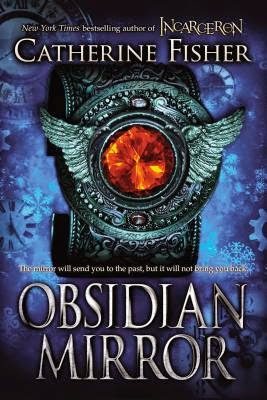
Obsidian Mirror

by Catherine Fisher
First sentence: “The boy put on the mask outside the door.”
Support your local independent bookstore: buy it there!
Content: Nothing objectionable, but it’s slow to start and is a  bit confusing. Not for the reader who gives up easily. It’s in the YA (grades 6-8) section of the bookstore.

This has been on my shelves for a long time. Seriously. I had the ARC, but gave that up, and finally, again, decided that I really needed to read this one. And I was in the mood this past weekend to indulge myself.

I shouldn’t have put it off. (Or maybe I should have: I’ve got the second one waiting to be picked up at the library. Shhhh. I know I said I wasn’t going to. But it’s CATHERINE FISHER.)

There’s three parts to this story. One is Oberon Venn, a very wealthy explorer who has spent the last two years in a depression because he was he cause of the accident that killed his wife, Leah. He will do anything to get her back. Including time travel. He and his trusty slave — there’s more to that than meets the eye — Piers are hidden out at Venn’s estate, trying to do just that: travel through time through the Obsidian Mirror.

The second player in this drama is Jacob, the son of Venn’s best fried. Who is missing and presumed dead. Or at least that’s what Jake thinks. So he’s headed, along with his unsuspecting teacher, Wharton,  to Wintercombe Abbey to force answers from Venn. Little does he know the web he will be tangled in.

The final player is the most complicated one: Sarah is possibly an escapee from an insane asylum. Or perhaps she’s a traveler from the future, a future where the mirror has destroyed the world, in order to destroy the mirror and prevent Venn from bringing his wife back.

There’s so much going on in this one, it’s hard to know where to begin. Yes, it’s slow and incredibly confusing to start with. I kept thinking “HUH?” But, I know Fisher’s work, so I stuck it out, and was richly rewarded. It’s time travel mashed with a mystery mashed with faery stories (yes, the Fey show up, and play a role), and if you give it time, it will begin to play out — it’s the first of a trilogy — in some incredible ways.

I can’t wait to read the next one.

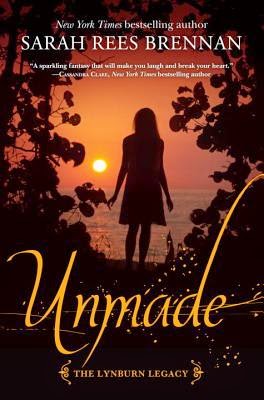
Unmade

by Sarah Rees Brennan
First sentence: “Kami Glass was standing to close to the fire.”
Support your local independent bookstore: buy it there!
Others in the series: Unspoken, Untold
Content: There’s a lot of violence, some of it brutal, plus some almost sexytimes. Not enough, however, to move it from the YA section (grades 6-8) of the bookstore.

Remember last time when I said the book was a bit of a middle book, and that the ending had me excited for the conclusion? (No? Well, neither did I?) Even so, I was able to fall back into Sorry-in-the-Vale with the Lynburns and Kami Glass with all her snarky confidence and contagious hope with ease.

Rob Lynburn has all the cards, all the power. And that has made Jared and Ash and Kami and their “side” quite desperate. Desperate enough to do desperate and dangerous things. This is an epic battle, a long, slow buildup to an intense climax. And interspersed in all that is heartache and love, loss and life, and a lot of heart.

This is a series, I think, that demands to be binge-read. And, thankfully, now you can. Sit down over a long weekend (like… Thanksgiving!) and immerse yourself in this deep, complex, wonderful world Brennan has created. Enjoy the characters, the good vs evil, the humor, the mystery, all at once without the wait.

I wish I could have. I enjoyed this book, but I think I would have enjoyed it SO much more had I read them all at once.

Vivian Apple at the End of the World

by Katie Coyle
First sentence: “There came a time when the American people began to forget God.”
Support your local independent bookstore: buy it there!
Release date: January 6, 2015
Review copy snagged from the ARC shelves at my place of employment.
Content: There is teenage drinking and a lot of swearing, including multiple f-bombs. There is also frequent off-screen violence. It’ll be in the Teen Section (grades 9+) of the bookstore.

In this sort-of future, American has been taken over by the conservative, pseudo-Christian  Church of America. Except “taken over” is too strong. It’s not like America has become a theocracy. No, it’s just that the Church of America founder, Beaton Frick, has predicted the end of the world. The rapture will come on a night in March, and all the faithful will be taken up.

Even though a good majority of Americans follow the Book of Frick, as it came to be called, Vivian Apple doesn’t. Her parents do, though. They’re faithful believers. And so, when the “rapture” comes, they disappear, leaving Vivian behind.

I’m going to stop right here for a minute. I’ve read a bazillion dystopian/post-apocalyptic novels and this is the first time I’ve come across the rapture as the cause. (At least in mainstream fiction. Is this a theme in Christian fiction?) In fact, this is what compelled me to pick the book up. I’m often curious about the way religion is portrayed in mainstream fiction, and I thought this could be an interesting take on it. And it was, even if it wasn’t necessarily a kind one. Religion and believers come off badly in this book, as people who believe anything they hear without question and are willing to commit acts of violence for the sake of their belief. More than once, I cringed at the “religion” and marveled at what I saw as pot-shots against the religious right.

But I digress.

Vivian determines that it’s all a hoax and she sets out from her hometown in Pittsburg to the Church headquarters outside of San Francisco with her friend, Harp. She just wants to know answers. They pick up a boy along the way, Peter, who seems to be on their side. Little do they know what’s waiting for them.

There is some good in this book: I really liked the tentative romance that budded between Vivian and Peter. I liked that Harp was Indian. I liked the way Vivian grew and became more willing to make decision and to Act in her own life throughout the course of the book. And I can even forgive that the book didn’t end, but rather left me hanging with more questions than answers.

But this one will be a tough sell around here.

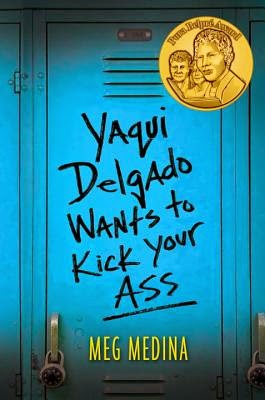
Yaqui Delgado Wants to Kick Your Ass

by Meg Medina
First sentence: “Yaqui Delgado wants to kick your ass.”
Support your local independent bookstore: buy it there!
Content: There’s some mild swearing. The real reason it ended up in the Teen (grads 9+) section is for the bullying and the violence. It’s pretty graphic and the fallout is pretty severe.

Piddy Sanchez is starting a new school. It’s one of those inner city schools in a Hispanic neighborhood in Queens, the kind that justifies every bad stereotype there is. Just a few weeks in, and someone informs Piddy that Yaqui Delgado — whom Piddy has neither seen nor spoken with — is going to kick her ass. Why? Because she thinks Piddy is flirting with her boyfriend. (She’s not.)

It’s this threat, among other things, that begins defining Piddy’s life. She doesn’t feel like she can talk to her mother, who is working extra shifts to try and provide for the both of them. She does turn to her aunt Lila, but even then she keeps the awful details to herself.

It’s a harsh journey, one that I wouldn’t wish on any kid. I did like that there was a range of diverse people in this one; not all white characters were “good” and not all Latin@ ones were “bad”. There was a wide range of personalities, and the color of the skin just happens to be incidental. I also enjoyed how Piddy embraced her culture and loved her neighborhood.

I was glad for the solution to this one, as well. No one really “learned their lesson” and the bully wasn’t reformed and they didn’t become friends and live happily ever after. No, it was much more realistic and messy and showed that sometimes the best option isn’t always the most noble one.

It was a tough read, emotionally raw especially for me (because of the whole daughter thing), but I’m glad I did.

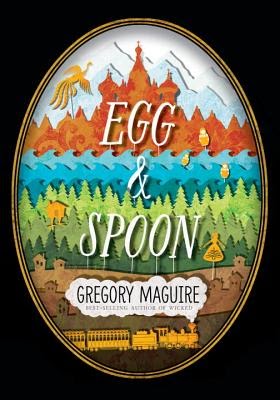
Egg & Spoon

by Gregory Maguire
First sentence: “The heels of military boots, striking marble floors, made a sound like thrown stones.”
Support your local independent bookstore: buy it there!
Review copy provided by the publisher.
Content: There’s nothing objectionable, but it’s a bit long and slow for all but the most advanced middle grade readers. It’s not a Teen book, either, so it’s ended up in the no-man’s land of YA books (grades 6-8) at the bookstore. I’m wondering how it would go as a read-aloud, though.

Elena Rudina is a peasant in pre-Revolution Russia. Her father died in a freak accident, and her mother never quite recovered from that. Her oldest brother is a servant in the baryn’s household and is away in Russia. So when her other brother gets conscripted into the Tsar’s army, Elena decides she needs to do something about that.

Ekaterina is the daughter of semi-noble parents who have dropped her in a London boarding school and gone off gallivanting around the world. The only person who cares about her is her Great-Aunt Sophie, and she’s determined that Ekaterina is going to show up at the Tsar’s party for his godson and be presented as a possible match, which is something Ekaterina does not want.

So, it was quite fortuitous when Elena and Ekaterina meet by accident — the train stops in Elena’s village when the bridge is out — and then (again by accident) switch places. Each get exposure to a different world and are led on the adventure of a lifetime.

I really wanted to like this one. And I did, sometimes. I loved Baba Yaga in all her snarkiness. (In fact, I bookmarked a bunch of her lines. Like: “You’re not going to drink the Kool-Aid?” and “Dumb Doma remodels itself. A nasty habit, like binge shopping.” and “No wonder they call these fairy tales. Tolstoi woudl know better, and a fast train comign into a station would be involved. Blood, tears, regrets. All the fun stuff.”) I sometimes liked the adventure that Elena and Ekaterina were having. (Madame Sophia ended up being a favorite of mine as well.) But, something seemed… off… about this one. Usually I don’t mind intrusive narrators, but this time, he (though I wonder why Maguire chose that particular narrator) was annoying enough that I just wanted him to go away. And that (along with Baba Yaga) got me wondering if this is really a kids’ book, or rather a book for adults who like kids’ books. I found myself hard-pressed to come up with a kid who would enjoy this.

It reminded me most of The Girl Who Circumnavigated Fairyland in tone and style (though it’s much, much longer), And K really liked having that one read aloud to her. So, maybe there is some hope for this one. I just wish I liked it better.

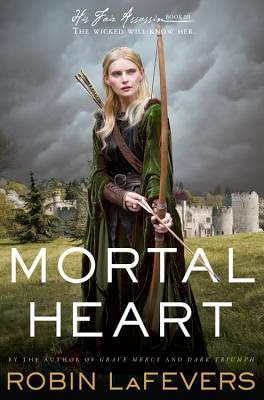
Mortal Heart

by Robin LaFevers
First sentence: “For most the bleak dark months when the black storms came howling out of the north is a time of grimness and sorrow as people await the arrival of winter, which brings death, hunger, and bitter cold in its wake.”
Support your local independent bookstore: buy it there!
Others in the series: Grave Mercy, Dark Triumph
Content: Like the other two, it has death (though no murders, I think), some sex (off screen) and more mature themes. It’s in the Teen section (grades 9+) of the bookstore.

Annith is the one who was always left behind. Quiet and dutiful, the Abbess always passed her over when it was time to go on missions. First Ismae left, and then Sybella. And Annith is the one to babysit the new novices. However, when the resident seer gets ill and Annith overhears the Abbess say that Annith would be perfect for the position, Annith panics. And takes off in the middle of the night: dang it if she isn’t going to get her adventure.

She ends up being overtaken by hellequins — servants of the God Mortain, like Annith herself — and their leader Bathazar, takes it upon himself to protect her from the, shall we say, less savory of the bunch. They ride around together — nominally to get Annith to some city I can’t remember the name of right now — for a couple of weeks, falling in love. And then Annith — and this is what I liked most about the book — decides that she really wants to be Independent and Have and Adventure, so she takes off. And she does. She never really becomes as Awesome as Ismae (who is still my favorite) or Sybella, but she holds her own.

Of course there are twisty twists and swoony swoons, and over it all is some very interesting (if only vaguely) historical setting. At some point, though, the twists made my eyes roll, and the swoons stopped being swoony, and I was predicting things right and left, which is never much fun for me.

It’s not my favorite in the trilogy, though it does wrap things up nicely. Even so, it’s a good series, and one worth reading.