Vivian Apple at the End of the World

by Katie Coyle
First sentence: “There came a time when the American people began to forget God.”
Support your local independent bookstore: buy it there!
Release date: January 6, 2015
Review copy snagged from the ARC shelves at my place of employment.
Content: There is teenage drinking and a lot of swearing, including multiple f-bombs. There is also frequent off-screen violence. It’ll be in the Teen Section (grades 9+) of the bookstore.

In this sort-of future, American has been taken over by the conservative, pseudo-Christian  Church of America. Except “taken over” is too strong. It’s not like America has become a theocracy. No, it’s just that the Church of America founder, Beaton Frick, has predicted the end of the world. The rapture will come on a night in March, and all the faithful will be taken up.

Even though a good majority of Americans follow the Book of Frick, as it came to be called, Vivian Apple doesn’t. Her parents do, though. They’re faithful believers. And so, when the “rapture” comes, they disappear, leaving Vivian behind.

I’m going to stop right here for a minute. I’ve read a bazillion dystopian/post-apocalyptic novels and this is the first time I’ve come across the rapture as the cause. (At least in mainstream fiction. Is this a theme in Christian fiction?) In fact, this is what compelled me to pick the book up. I’m often curious about the way religion is portrayed in mainstream fiction, and I thought this could be an interesting take on it. And it was, even if it wasn’t necessarily a kind one. Religion and believers come off badly in this book, as people who believe anything they hear without question and are willing to commit acts of violence for the sake of their belief. More than once, I cringed at the “religion” and marveled at what I saw as pot-shots against the religious right.

But I digress.

Vivian determines that it’s all a hoax and she sets out from her hometown in Pittsburg to the Church headquarters outside of San Francisco with her friend, Harp. She just wants to know answers. They pick up a boy along the way, Peter, who seems to be on their side. Little do they know what’s waiting for them.

There is some good in this book: I really liked the tentative romance that budded between Vivian and Peter. I liked that Harp was Indian. I liked the way Vivian grew and became more willing to make decision and to Act in her own life throughout the course of the book. And I can even forgive that the book didn’t end, but rather left me hanging with more questions than answers.

But this one will be a tough sell around here.
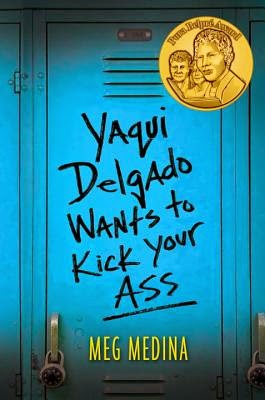
Yaqui Delgado Wants to Kick Your Ass

by Meg Medina
First sentence: “Yaqui Delgado wants to kick your ass.”
Support your local independent bookstore: buy it there!
Content: There’s some mild swearing. The real reason it ended up in the Teen (grads 9+) section is for the bullying and the violence. It’s pretty graphic and the fallout is pretty severe.

Piddy Sanchez is starting a new school. It’s one of those inner city schools in a Hispanic neighborhood in Queens, the kind that justifies every bad stereotype there is. Just a few weeks in, and someone informs Piddy that Yaqui Delgado — whom Piddy has neither seen nor spoken with — is going to kick her ass. Why? Because she thinks Piddy is flirting with her boyfriend. (She’s not.)

It’s this threat, among other things, that begins defining Piddy’s life. She doesn’t feel like she can talk to her mother, who is working extra shifts to try and provide for the both of them. She does turn to her aunt Lila, but even then she keeps the awful details to herself.

It’s a harsh journey, one that I wouldn’t wish on any kid. I did like that there was a range of diverse people in this one; not all white characters were “good” and not all Latin@ ones were “bad”. There was a wide range of personalities, and the color of the skin just happens to be incidental. I also enjoyed how Piddy embraced her culture and loved her neighborhood.

I was glad for the solution to this one, as well. No one really “learned their lesson” and the bully wasn’t reformed and they didn’t become friends and live happily ever after. No, it was much more realistic and messy and showed that sometimes the best option isn’t always the most noble one.

It was a tough read, emotionally raw especially for me (because of the whole daughter thing), but I’m glad I did.

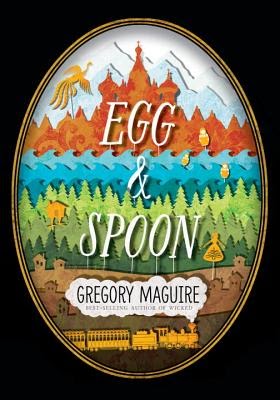
Egg & Spoon

by Gregory Maguire
First sentence: “The heels of military boots, striking marble floors, made a sound like thrown stones.”
Support your local independent bookstore: buy it there!
Review copy provided by the publisher.
Content: There’s nothing objectionable, but it’s a bit long and slow for all but the most advanced middle grade readers. It’s not a Teen book, either, so it’s ended up in the no-man’s land of YA books (grades 6-8) at the bookstore. I’m wondering how it would go as a read-aloud, though.

Elena Rudina is a peasant in pre-Revolution Russia. Her father died in a freak accident, and her mother never quite recovered from that. Her oldest brother is a servant in the baryn’s household and is away in Russia. So when her other brother gets conscripted into the Tsar’s army, Elena decides she needs to do something about that.

Ekaterina is the daughter of semi-noble parents who have dropped her in a London boarding school and gone off gallivanting around the world. The only person who cares about her is her Great-Aunt Sophie, and she’s determined that Ekaterina is going to show up at the Tsar’s party for his godson and be presented as a possible match, which is something Ekaterina does not want.

So, it was quite fortuitous when Elena and Ekaterina meet by accident — the train stops in Elena’s village when the bridge is out — and then (again by accident) switch places. Each get exposure to a different world and are led on the adventure of a lifetime.

I really wanted to like this one. And I did, sometimes. I loved Baba Yaga in all her snarkiness. (In fact, I bookmarked a bunch of her lines. Like: “You’re not going to drink the Kool-Aid?” and “Dumb Doma remodels itself. A nasty habit, like binge shopping.” and “No wonder they call these fairy tales. Tolstoi woudl know better, and a fast train comign into a station would be involved. Blood, tears, regrets. All the fun stuff.”) I sometimes liked the adventure that Elena and Ekaterina were having. (Madame Sophia ended up being a favorite of mine as well.) But, something seemed… off… about this one. Usually I don’t mind intrusive narrators, but this time, he (though I wonder why Maguire chose that particular narrator) was annoying enough that I just wanted him to go away. And that (along with Baba Yaga) got me wondering if this is really a kids’ book, or rather a book for adults who like kids’ books. I found myself hard-pressed to come up with a kid who would enjoy this.

It reminded me most of The Girl Who Circumnavigated Fairyland in tone and style (though it’s much, much longer), And K really liked having that one read aloud to her. So, maybe there is some hope for this one. I just wish I liked it better.

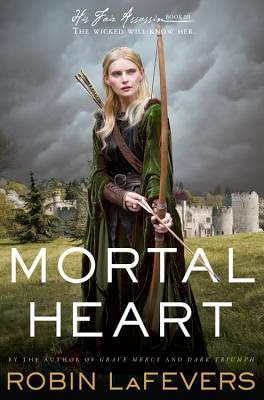
Mortal Heart

by Robin LaFevers
First sentence: “For most the bleak dark months when the black storms came howling out of the north is a time of grimness and sorrow as people await the arrival of winter, which brings death, hunger, and bitter cold in its wake.”
Support your local independent bookstore: buy it there!
Others in the series: Grave Mercy, Dark Triumph
Content: Like the other two, it has death (though no murders, I think), some sex (off screen) and more mature themes. It’s in the Teen section (grades 9+) of the bookstore.

Annith is the one who was always left behind. Quiet and dutiful, the Abbess always passed her over when it was time to go on missions. First Ismae left, and then Sybella. And Annith is the one to babysit the new novices. However, when the resident seer gets ill and Annith overhears the Abbess say that Annith would be perfect for the position, Annith panics. And takes off in the middle of the night: dang it if she isn’t going to get her adventure.

She ends up being overtaken by hellequins — servants of the God Mortain, like Annith herself — and their leader Bathazar, takes it upon himself to protect her from the, shall we say, less savory of the bunch. They ride around together — nominally to get Annith to some city I can’t remember the name of right now — for a couple of weeks, falling in love. And then Annith — and this is what I liked most about the book — decides that she really wants to be Independent and Have and Adventure, so she takes off. And she does. She never really becomes as Awesome as Ismae (who is still my favorite) or Sybella, but she holds her own.

Of course there are twisty twists and swoony swoons, and over it all is some very interesting (if only vaguely) historical setting. At some point, though, the twists made my eyes roll, and the swoons stopped being swoony, and I was predicting things right and left, which is never much fun for me.

It’s not my favorite in the trilogy, though it does wrap things up nicely. Even so, it’s a good series, and one worth reading.

I’ll Give You the Sun

by Jandy Nelson
First sentence: “This is how it all begins.”
Support your local independent bookstore: buy it there!
Content: There is some teen drinking, a (non-graphic) rape scene, and several f-bombs. That, and because of the subject matter, puts it in the Teen section (grades 9+) of the bookstore.

Noah and Jude are twins, separate people but connected in thought and purpose (generally). So much so that they’ve become NoahandJude, pratically inseparable. That is, until the summer they turn 14. Then everything starts to fall apart. Jude becomes “wild”; Noah retreats into his own world until a new boy shows up next door. They end up “dividing” their parents, each vying for the other parent’s attention and love. On top of that, they are fiercely competing to get into the local prestigious art high school. It’s a mess.

Two years later, things aren’t much better. Jude made it into the school; Noah (who was arguably the better artist) did not. They’re still dealing with the aftermath of their mother’s fatal accident. They harbor secrets. And they’re no longer NoahandJude. They’re not even Noah and Jude. They’re two separate planets, who never talk to each other. It’s different from what it was before, but no better.

Did I mention that Jude sees the ghost of her dead grandmother, and senses the presence of her dead mom?

It’s thanks to the two ghosts that Jude searches out Guillermo, sculptor extraordinaire and Latino Mystical Guide, and finds not only salvation but True Love.

Yeah, the book derailed just about there.

For the record: everyone in this book is a Tortured Soul Needing Redemption. And they all find it together. I did enjoy Guillermo — in fact, he was the most interesting character — but that doesn’t change the fact that his role in the book was to cause a change in the white people around him. He was Passionate Lover, he was Father Figure, he was Spiritual Guide. And sometimes he was a living-breathing person, but those times were rare.

And don’t even get me started on the whole Soul Mate thing. Ugh.

What saved this book from being Truly Horrible was the writing — Nelson paints the world vividly, and I do have to admit that there was some good chemistry between Jude and her Soul Mate, even if that’s a trite trope and needs to be done away with. But what I really loved was the art. I loved Guillermo’s giant sculptures and the way Nelson depicted the process of art. I loved Noah’s chapters and the way he’d come up with paintings for everything. I loved how she considered fashion an art.

In the end, I did respect what Nelson was trying to do. But it’s not a perfect book by any means.

Poisoned Apples

by Christine Heppermann
First sentence: “The action’s always there.”
Support your local independent bookstore: buy it there!
Content: There’s some mild swearing and one (very well placed) f-bomb. The content is about female empowerment, so if you give it to younger readers, be ready for questions. (Not a bad thing at all!) We have a kids poetry section at the store, but this doesn’t really fit. I could put it with the adult poetry but it might get lost. So, I might just shelve it in the YA section (grades 6-8), though it could go for any age.

I picked this up because Anne Ursu (whose work I’ve enjoyed, and who is fast becoming one of my favorite people on Twitter/Tumblr) told me I needed to. I don’t generally read poetry; I’ve never quite “gotten” it, and I don’t particularly want to curl up with a collection of poetry. But I couldn’t resist the draw of modern fairy tale retellings, even if it was poetry. (Plus: Anne Ursu!)

I didn’t know what to expect, but what I got was a weird, wonderful, empowering collection of poems. Hepperman mixes fairy tale retellings with modern issues, from anorexia and photoshopping to the everyday over sexualization of women. It’s a seamless transition from fantasy to reality. One of my favorites was “Retelling”, which is about what the miller’s daughter should have done. Thankfully, Heppermann got a bunch of people to read this, so you don’t have to listen to me sum it up.

But my favorite, the one I texted a picture to M about, was this:

But what really makes this book (aside from the awesome poems) are the weird and wonderful photographs that accompany the poems. They add a fantastical element that just makes this slim collection absolutely perfect.

C has already devoured this several times over and has declared that we need to own it. I agree.

The Cure for Dreaming

by Cat Winters
First sentence: “The Metropolitan Theater simmered with the heat of more than a thousand bodies packed together in red velvet chairs.”
Support your local independent bookstore: buy it there!
Review copy snagged off the ARC shelves my place of employment.
Content: There’s some pretty disturbing parenting, and enough horrible people to make anyone angry. It’s in the YA section (grades 6-8) of the bookstore, but it’d be appropriate (though they might have a difficult time understanding the politics of the situation) for younger readers.

It’s the turn of the 20th century, Olivia Mead is several things: a burgeoning scholar, the daughter of the local dentist, 17-years-old, and (most importantly) a supporter of the women’s suffrage movement.

This does not make Olivia’s father happy. So, when a hypnotist comes to town, he decides to hire the hypnotist to change Olivia, and make her bend to his will.

Fortunately, Henri the hypnotist is on Olivia’s side. Even though he does what her father wants, despicable as it is (he needs the money), he phrases the words so that Olivia will see the world as it Truly Is. Which means, her father is demonic, covered in blood. The rich socialites are bloodthirsty vampires. Women who don’t support suffrage are slowly turning invisible. And the women who do? They’re glowing from the inside out.

Sure, there’s more plot to this one than that, but who cares? This one has a strong feminist agenda and it’s not afraid of it. The father had me seething. The rich handsy boy whom the father liked made me want to smack him. Henri was nice enough, but I really loved Olivia and her struggle against the system (and the Man) and her desire to be Free. I was just cheering her on: you go girl!

I’m not entirely sure that the historical details were completely accurate, and I was kind of hoping for more of a supernatural element (like her father turned out to REALLY be a demon). But I’m not sure it matters. This is one of those books that’s just enough of a fun ride to let everything else slide.

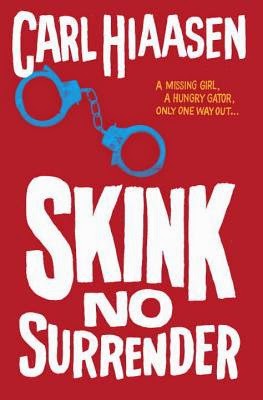
Skink No Surrender

by Carl Hiaasen
First sentence: “I walked down to the beach and waited for Malley, but she didn’t show up”
Support your local independent bookstore: buy it there!
Content: Even though the reading level isn’t very difficult, the nature of this book solidly lands it on the YA (grades 6-8) shelves. Not for the young or the faint of heart.

Richard has grown up in a little beachside town in Florida his whole life. And it hasn’t been a bad life; even though his father died in a freak accident a few years ago, Richard has his mother, older brothers, an okay stepfather, and his best friend — his cousin Malley.

Richard and Malley had a long-standing nighttime ritual on the beach: walking and looking for turtle nests. Then one night, two things happen: Malley doesn’t show up, and Richard meets former-governer-turned-ecoterrorist Clint Tyree, otherwise known as Skink.

It turns out that Malley has run away with a guy she met online in a chat room. And even though it started out okay — there was video of her willingly getting in his car — it took a turn south. And the people on tap to rescue her? Richard and Skink.

I wanted to like this. And sometimes, I did. I really did laugh at the oddness of Skink, at the adventures that Richard found himself in. But I couldn’t get past the whole SHE RAN AWAY WITH A GUY SHE MET IN A CHAT ROOM problem. And it’s corollary: SHE NEEDED A GUY TO RESCUE HER. Aren’t we past all this? I do have to give Hiaasen one bonus point: when the guy tried something on Malley she punched him in the nose, breaking it. She also said that he needed to be caught and punished because the next girl might not be as strong as her. So, she’s not completely helpless. And Richard rescued her not as part of some macho thing, but because he truly cared for her. So, there’s that as well.

And I did like the environmental trivia that Hiaasen threw in, as well; he really does make Florida come alive. So, I didn’t hate the book in the end. I just wish there was a better premise for it.

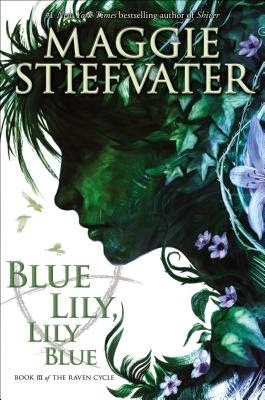
Blue Lily, Lily Blue

by Maggie Stiefvater
First sentence: “Persephone stood on the bare mountaintop, her ruffled ivory dress whipping around her legs, her masses of white-blond curls streaming behind her.”
Support your local independent bookstore: buy it there!
Release date: October 21, 2014
Others in the series: The Raven Boys, The Dream Thieves
Content: There’s swearing, lots of it, including f-bombs, but nothing felt gratuitous. There’s also violence and some adult drinking. Plus, it’s a complicated story arc that may prove confusing for younger readers. It will be in the Teen section (grades 9+) of the bookstore.

I’m always at a bit of a loss when dealing with this series. I just want to throw it at everyone (especially people who come in the store. WHY WON’T THEY BUY THIS BOOK?) and say “READ THIS! THIS IS WHAT STORYTELLING AND WRITING IS.” It really doesn’t matter that I love the characters (“What [Orla] didn’t realize about Blue and her boys was that they were all in love with one another.” Count me in on that.), and I am intrigued and fascinated by the people they meet. In this book, most especially, it was Jesse Dittley, the man who took care of the cave in the hills, who talked in ALL CAPS and called Blue an ANT. He was wonderful.

The basic plot that Stiefvater weaves is that Blue, Gansey, Adam, and Ronan are getting closer to waking their unknown king, Glendower. Blue’s mom, Maura is missing, gone off on a quest of her own. And Mr. Gray’s employer, Greenmantle (“Greenmantle had always liked the idea of being a mysterious hit man, but that career goal invariably paled in comparison with his enjoyment of going out in the town and having people admire his reputation and driving his Audi with its custom plate (GRNMNTL) and going on cheese holidays in countries that put little hats over their vowels like so: ê.”), has shown up in town, furious at Mr. Gray for defying him, determined to make him pay.

But, things don’t necessarily go right. (There is one more book, after all.) And Blue and the boys are possibly in deeper than they can handle.

What I love most (as evidenced by the frequency of quotes already), however, is the writing. It’s so drop-dead gorgeous. Stiefvater is a poet here, capturing so much — mood, character, events — with so little (even her use of swearing has Meaning.), it’s breathtaking.

If you haven’t picked these up yet, the series is almost done. Now is a good time to start. You won’t regret it.

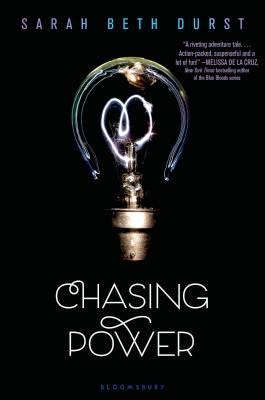
Chasing Power

by Sarah Beth Durst
First sentence: “Razor blade.”
Support your local independent bookstore: buy it there!
Review e-copy sent to me by the author.
Release date: October 14, 2014
Content: It says it’s for 14 and up, and maybe they did that because most of Sarah Beth Durst’s books lately have been aimed toward that crowd. That said, there’s really nothing that I think a 7th- or 8th-grader couldn’t handle (mild swearing, some pretty bad parenting, etc.). It’ll be in the YA section (grades 6-8) of the bookstore.

Kayla and her mother — Moonbeam — are on the run. They have been for eight years now, moving frequently, changing their names, trying to keep a low profile. Why? Because Kayla’s dad killed Kayla’s sister, Amanda. Why? Because Kayla — and her sister, presumably — have magical powers.

Kayla’s powers aren’t that big, and mostly she uses them to steal little things — cash, jewelry — to help keep her and her mother afloat. Thing is: her mother doesn’t want Kayla to use her powers. She says it’ll help her dad find them. And then, one day, someone does find her. His name is Daniel, and he knows about her and her powers. And he needs her help to rescue his mom.

What Daniel starts is an epic quest to find not only Daniel’s mother, but Kayla’s past. And not everything is as it

I adore Sarah Beth Durst (and I’m not just saying this because she offered me this e-book (and an interview!), I really do enjoy her writing and world-building. I loved Kayla for her strength and for her insecurities. I was often annoyed with Moonbeam and her “I know better, trust me, it’s for your protection” routine, but in the end, she was someone worth cheering for as well. And I love the way Durst used the magic — both Kayla’s telekinesis and Daniels transporting — to forward the story; the quest couldn’t have happened without their powers, rather than them just being incidental to the whole story.

A fantastic read.