Arrows of the Queen

by Mercedes Lackey
First sentence: “A gentle breeze rustled the leaves of the tree, but the young girl seated beneath it did not seem to notice.”
Support your local independent bookstore: buy it there! (Though, to be honest, you’ll probably have to buy it used.)
Content: There is some violence, and some (tasteful) attempted sex. It would be in the YA section (grades 6-8) of the bookstore, if we had it.

Talia is a young, sheltered girl in a Holding that is super patriarchal, giving all the power to men and making women either wives or nuns in service to the Goddess. But Talia dreams of something more: she wants to be a Queen’s Herald. She’s secretly read tales of the Heralds, with the horse-Companions and the adventures, and longs to be one of them. She has no idea how one becomes a Herald, but when she turns 13 and her elders start talking about marrying her off, she runs off. And is chosen by one of the Companions, Roland. From there, Talia is thrust into a whole new world, one of classes and work and acceptance and challenges and friends. At first, she is hesitant, but as the months and (eventually) years go on, she becomes more confident with her role not only as a Herald, but as the Queen’s Own.

I’ve read Lackey before, but not in a while, and not very much. I like her style, though there seems to be a lot more exposition than either action or dialogue. Perhaps that was part of the style when this was written in 1987, but it did drag the story down. That, and Talia was super perfect. I liked her — I mean you have to be heartless if you don’t — but she wasn’t the most interesting character. She was always stalwart, always likable, and always had the answers to her problems. It got old pretty quickly.

Even so, I liked her adventures and the world that Lackey built, and I’m not sorry I dipped into this one.

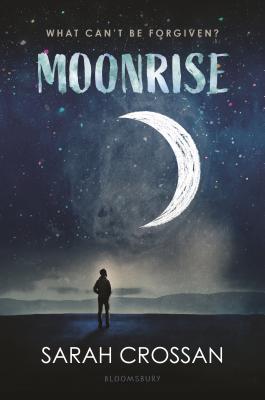
Moonrise

by Sarah Crossan
First sentence: “The green phone on the wall in the hall hardly ever rang.”
Support your local independent bookstore: buy it there!
Review copy provided by the publisher.
Content: There’s swearing, including multiple f-bombs, and some off-screen sex. It’s in the teen section (grades 9+) of the bookstore.

Ten years ago, Joe’s older brother, Ed, was imprisoned and sentenced for killing a cop. He says he didn’t do it, but that hasn’t made any difference, since they can’t really afford a good lawyer. Or one at all, really. And now Ed’s time is up, and an execution date has been set. And he wants Joe, who’s 17, to come to Texas and be with him as he faces his execution. Since Joe (and their older sister) is really all Ed’s got.

This is heartbreaking. Seriously. It’s easy to forget with Black Lives Matter (which is important!) that the problem with the U.S. justice system isn’t just race, it’s also money. Crossan picks a poor white family as her characters, one that scrapes by barely making ends meet. A mom who is plagued by drugs and alcohol, kids who aren’t the brightest in school. And it didn’t take much for the cops to intimidate and bully Ed into a “confession” which held up in a jury. It’s heartbreaking.  And the take away? If you’re poor, you’re going to end up in prison.

That said, this isn’t a book about the justice system, though that’s a part of it. It’s about forgiveness and family and decisions and choices. And it’s packs a punch. Written in verse, it’s spare but that spareness works to Crossan’s advantage in the book. There’s nothing extra in here that needs to be cut out; it’s straightforward, but told with a lot of heart.

Excellent.

(As an aside: I met her at Children’s Institute, and she’s hilarious. She also has the Irish storytelling genes, keeping us all spellbound with her stories.)

The Bird and the Blade

by Megan Bannen
First sentence: “I arrived in Sarai on the fifteenth day of the seventh month — Ghost Day — but for the first time I dream of my brother, Weiji, is two months later, on the night I meet Khalaf.”
Support your local independent bookstore: buy it there!
Review copy provided by the publisher.
Content: There are several f-bombs (I think I didn’t count more than four) and other mild swearing. There is also frank talk about genitals. It’s in the Teen section (grades 9+) of the bookstore, but I think an interested 7th grader could handle it.

They say, “Don’t judge a book by a cover”, but we all do.  And my judgement for this one, when I first saw the cover was “okay, it’s going to be a light fantasy; I hope it’s good.” Well. It’s not a light fantasy (okay, so there’s a small ghost element at the end, but I’m not really counting that). Set in the late 13th century and  loosely based on the opera Turandot, it’s a sweeping story about a captured girl from the Song empire, Jinghua, the slave of the Kipchack Khanate. The il-khan, Timur, and his youngest son, Khalaf, are on the run after an invasion from a neighboring khanate, and through a twist of fate, Jinghua ends up with them as they travel across the Mongol empire. Once Khalaf finds out that the daughter of the Great Khan, Turandokht, is refusing to marry anyone unless they solve three riddles, Kahalf decides that that’s the only way to save his father and his kingdom, so they head there. Khalaf to solve the riddles, Jinghua to stop him.

It’s a difficult one to sum up, this book, because there is so much going on. It’s a forbidden romance — as Jinghua and Khalaf spend time together, they find they have  a mutual respect and admiration that develops into something more, but a son of an il-khan and a servant can never be together in any real way. It’s a road trip — as her characters travel, Bannen takes us through multiple parts of the Mongol Empire, showing just how vast and varied it was. And it’s a work of historical fiction, though it felt like it had a modern sensibility. Khalf stood up for Jinghua in ways that I’m not sure a 13th century man would, but I found I didn’t mind. It’s a unique book, set in a unique place, with some fantastic characters.

Definitely recommended.

The Strange Fascinations of Noah Hypnotik

by David Arnold
First sentence: “I’ll hold my breath and tell you what I mean: I first discovered the Fading Girl two months and two days ago, soon after summer began dripping its smugly sunny smile all over the place.”
Support your local independent bookstore: buy it there!
Review copy provided by the publisher.
Content: There’s some teenage drinking, and lots of swearing, including f-bombs. It’s in the Teen section (grades 9+) of the bookstore.

The plot of this one is going to sound weird. And, to be fair, it’s not really the point of the book,  I think.

Noah Oakman is feeling a bit at sea heading into his senior year. He’s a great swimmer, but he doesn’t love it, and so he fakes a back injury to get out of spending his life in the pool. He’s thinking about college, sort of. Mostly he just wants to Think. And then, at a party he didn’t want to go to, he meets this kid Circuit, and heads to his house. It seems uneventful, but after that, everything’s slid sideways just a little bit. His best friend, Alan, used to be a huge DC fan, and now he’s a huge Marvel fan. His mother has a scar. Nothing life-shattering, but enough to throw Noah off. The only things that haven’t changed are his “strange fascinations” — little things, like the Fading Girl of the opening sentence, that have captured Noah’s interest. And perhaps by pursuing those and trying to make sense of them, he can make sense of his life.

I’m not going to give you much more than that, mostly because it’s the journey in this one that makes it such a good book. It’s populated with people that are fascinating and interesting and quirky and fun, and Noah’s journey is a strange and weird and wonderful one. I even thought that the ending explanation made sense, and made the book that much better.

I’ve liked Arnold’s books in the past, but I honestly think this is his best one so far.

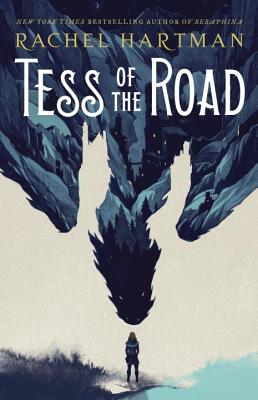
Tess of the Road

by Rachel Hartman
First sentence: “When Tessie Dombegh was six and still irrepressible, she married her twin sister, Jeanne, in the courtyard of their childhood home.”
Support your local independent bookstore: buy it there.
Others in the series: Seraphina, Shadow Scale
Content: There are many allusions to sex (including rape). It’s in the Teen section (grades 9+) of the bookstore.

As a head’s up, while this one references Seraphina and Shadow Scale, it’s a completely separate story, and you can probably get away without reading them if you’re not interested. (I didn’t re-read them, and so really didn’t remember much, and still enjoyed Tess.)

Let me say this at the start: I love Hartman’s writing. It’s not elegant like Laini Taylor or Maggie Stiefvater, but Hartman knows how to tell a story in such a way that you lose yourself in it. Tess is a human girl — Seraphina’s half sister — who just wants to be intellectually challenged. But raised in a strict household (they’re paying for Seraphina’s “sin” of being a dragon), what’s expected of her is to marry well. But Tess messes that up when she gets pregnant (at age 14!) and has a baby. And now, when she’s 17, faced with the prospect of raising her twin sisters children or going to a convent she does the unthinkable: she disguises herself as a boy and takes to walking the road, ostensibly to help her quigutl (a sub-species of dragon) friend find the World Serpent.

This is such a remarkable book: a heartfelt and emotional tale as Tess’s story unfolds through a series of flashbacks, but also an adventurous one, as we experience Tess and Pathka’s adventures on the road. It’s a deeply feminist book as well, as Hartman explores the consequences of not teaching your kids sex ed or discouraging girls from getting an education, if they want. It’s all about expressing anger and compassion and helping others out along they way and redemption and forgiveness.

And it’s left open-ended, so we may (or may not) get to join Tess for more adventures.

It’s wonderful.

From Twinkle, With Love

by Sandhya Menon
First sentence: “Hello, namaste, buenos dias, and bonjour, Mira Nair!
Support your local independent bookstore: buy it there!
Review copy provided by the publisher.
Content: There’s some mild swearing, and lots of kissing. It’s in the YA section (grades 6-8) of the bookstore.

Twinkle is a budding filmmaker. She loves looking at the world through the eye of her camera lens, and it’s what she wants to do with her life. She has a YouTube channel (though not many subscribers), and a dream. The rest of her life isn’t so hopeful: she’s not really high up on the popularity totem pole at her prep school, her best friend has begun to ditch her for other girls (who are higher up in popularity), and her parents are often gone. Thankfully, she has her grandmother and her crush on the most popular kid in school, Neil.

Then comes the Midsummer Festival. Popular guy’s twin brother, Sahil, talks Twinkle into making a film — they decide a gender-swapped Dracula — and that fact sets a whole lot in motion.

I wanted to like this. It’s got everything that should hit for me in a summer romance: a cute guy, some conflict, a lot of swoony situations… it feels like a Bollywood film with kissing. I should have loved it.

But, I didn’t. I was talking to a co-worker about it, and she said that Twinkle was annoying — and she was, being so obsessed with being popular and getting her friend “back” that she didn’t realize what was right in front of her — and because of that, she couldn’t get into the book. I think that’s a lot of it. Twinkle was very human, and very much a teenage girl, and I appreciated that. I thought the relationships, at least between the girls, were very realistic. Maybe what didn’t sit well with me was the juxtaposition between the friendship arc and the romance arc. The romance was all very “true love”-y; Sahil’s had a thing for Twinkle since they were 11 and he’s finally on it (that’s what came off as unrealistic to me!) and he’s all “you’re my One True Love”, and I think that’s (for a high school book) what didn’t work for me. I understood the friendships, and Twinkle’s desire not to have things change, but when you put that in the same book as a meet-cute, fluffy summer romance that you’r trying to make weightier with declarations of True Love. Maybe that’s also what didn’t quite sit well with me. If Menon had just kept it fluffy, Bollywood-like (with kissing!), then maybe I would have liked it better.

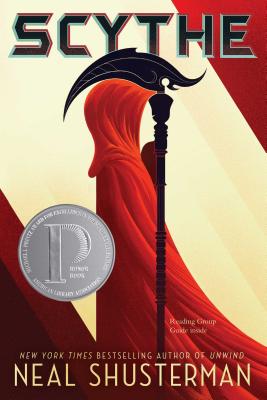
Scythe

by Neal Shusterman
First sentence: “We must, by law, keep a record fo the innocents we kill.”
Support your local independent bookstore: buy it there!
Content: There is, by the very nature of the book, violence. Some of it is graphic. There is also mild swearing. It’s in the YA section (grades 6-8) of the bookstore, but, like Hunger Games, I’d be wary about giving it to overly sensitive kids.

My co-workers have been on my case to read this since it first came out. A couple of them love it (and Shusterman), but I just didn’t have time. (Sometimes, when I need to sell a book at work, I rely on other people’s opinions rather than just reading it myself, since I won’t have time to read all the books. Unfortunately.) But then, it won a Cybils award, and was picked for my online book club (and then they picked it for one of my in-person book clubs), so I figured it was about time I read this.

And, oh wow, everyone was right. This is an excellent piece of speculative fiction.

The basic premise is this: in the future we will have figured out how to defeat disease and death, thereby becoming immortal (pretty much). However, the earth couldn’t handle the subsequent population growth, so a group of people — called scythes — were organized to deal with that. They have a set of commandments, are outside the general law, and basically get to decide when people should die. There are rules governing that, as well — they have quotas they have to meet and can’t go over, and they can’t do it with forethought or malice. The book follows two teenagers, Citra and Rowan, who were chosen as a scythe’s apprentices. As it follows them through the year of their apprenticeship, it’s fascinating reading about their scythe and his philosophies, and then the difference between scythe philosophies (including a radical one who was just horrid). There is a bit of a romance(ish), but that didn’t really go anywhere (thankfully). Mostly it’s about humanity and the meaning of immortality, and how one deals with the power over life and death. There is definitely much to think about and talk about in this book.

145th Street

by Walter Dean Myers
First sentence: “The way I see it, things happen on 145th Street that don’t happen anywhere else in the world.”
Support your local independent bookstore: buy it there!
Content: There’s violence but the stories are short and to the point. It’s in the YA section (grades 6-8) of the bookstore.

I’ll be honest here. I’m not a fan of short stories, and I had to read one for class, and I’ve never read Walter Dean Myers, so I picked this one. All the stories surround people on this street in New York (in Harlem?), their lives and experiences. But, as I sit back and think about this, what comes to mind are the stories in Bronx Masquerade. Which means this one just kind of went in but slid right out. I’m pretty sure I looked at the words and turned the pages, but I can’t, for the life of me, remember what I read.

I’m sure that’s not because Myers isn’t a good writer. It’s more I’m not a great reader of short stories.

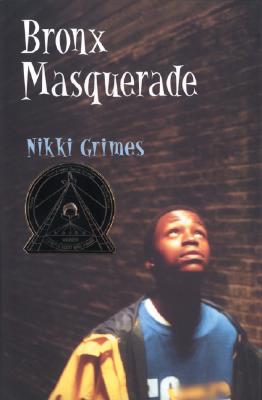
Bronx Masquerade

by Nikki Grimes
First sentence: “I ain’t particular about doing homework, you understand.”
Support your local independent bookstore: buy it there!
Content: There’s some tough situations, but nothing “objectionable”. The format — short stories with poetry — is great for reluctant readers, as well. It would be in the young adult (grades 6-8) section of the bookstore.

I read this back during my poetry section of class and was expecting a novel in verse. While I don’t think it’s that, it is a fascinating look into the power of poetry. Set in the Bronx (obviously), the book follows a group of students in an English class as they study the Harlem Renaissance, and then decide they want to try writing poetry themselves. That turns into an Open Mike Friday once a month, which morphs into once a week, as the various students — black, Latnix, and white — learn to express themselves and understand other people throughout the year. Interspersed with commentary from our “narrator” Tyrone, it’s a good look at how poetry not only can help people express ideas and feelings they couldn’t otherwise, it also is a way to understand other people.

I liked how we got a peek into a bunch of different lives, even if that meant we didn’t get to delve deeply into one person. I think the purpose of the novel was to explore connections that poetry makes, not so much to explore one person, and once I realized that, I was able to enjoy the book more. I’ve never read anything by Nikki Grimes before, though I’ve heard a lot about her, and this made me curious. I’ll definitely have to check more of it out.

Legendary

by Stephanie Garber
First sentence: “While some rooms on the estate had monsters hiding beneath the beds, Tella swore her mother’s suite concealed enchantment.”
Support your local independent bookstore: buy it there!
Review copy provided by the publisher.
Others in the series: Caraval
Content: There’s some violence and intense moments. It will be in the Teen section (Grades 9+) of the bookstore.

Spoilers for the first one, obviously.

I had high hopes for this one, even though it’s been a long time since I’ve read Caraval and admittedly I don’t remember much. And while Legendary was good, I don’t know if it lived up to my high hopes.

It’s shortly after the Caraval that Scarlett won, and Legend has already set up another one. This one is  in the capital city, and it’s Tella’s turn to play. The prize? Legend’s name. The cost? Tella’s mother’s life. She’s made a bargain with a criminal: the location of her mother in exchange for Legend’s name. She has to win, but at what cost?

I did find this one engrossing; Graber has created a very unique world, full of magic and deception. But, maybe because it wasn’t new like it was in Caraval, I just wasn’t that thrilled by it. It could be that Tella’s journey wasn’t as interesting as Scarlett’s or that I just didn’t find the villain of the book that enticing, or even the final reveal all that shocking. I definitely found the ending unsatisfying. I probably just wanted… more.

It’s not that it’s a bad book; it’s not. And maybe if you read it right after Caraval, it would come off as better. Whatever the reason, I was a little disappointed.