Beneath the Citadel

by Destiny Soria
First sentence: “Four people were supposed to die at sunrise.”
Support your local independent bookstore: buy it there!
Content: There’s multiple instances of one swear word, and some violence. It’s in the YA section (grades 6-8) of the bookstore.

Things I really liked about this book:

  1. The time frame was super condensed: most of the action took place (shock) beneath the citadel, where the council of Eldra has been hiding, listening to prophecies, and determining the Fate of the citizens of their country.  Likewise, the entire book took place over four days. 
  2. Even though there was shifting perspectives (I really am kind of over that) between the five characters, Soria kept the action propelling forward, and I never found myself losing interest in the story. 
  3. Which is to say: Soria really knows how to write. No, the sentences weren’t lyrical and lovely all the time, but the characters and dialogue popped, and she kept me guessing throughout the whole book. And she doesn’t hold back any punches. 
  4. I really liked the world Soria built, and the conflict between prophecy and free will. It was a nice tension, and the fact that who the “bad guy” was kept shifting was pretty impressive as well. 

In short? I really enjoyed this one. 

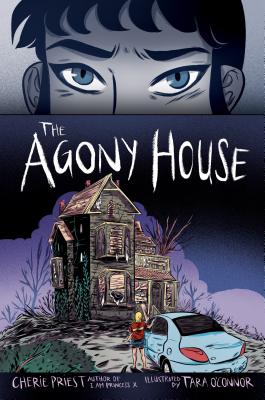
The Agony House

by Cherie Priest
First sentence: “Denise Farber stomped up the creaky metal ramp and stood inside the U-Haul, looking around for the lightest possible box.
Support your local independent bookstore: buy it there!
Review copy provided by the publisher for the Cybils. 
Content: There is some violence, but it’s not bad. And some mild swearing. It’s in the YA section (grades 6-8) of the bookstore. 

Things I really liked about this: I liked that it was set in New Orleans, post-Katrina, and that white people moving into underdeveloped neighborhoods and displacing the black population was an issue, if only in passing. I liked the subtle feminism in the story, as well as the fact that the parents were really good. I liked that Priest highlighted a New Orleans that wasn’t voodoo or jazz music. And I liked the way she wove the graphic novel into the story.  

Things I didn’t like: it just really didn’t work terribly well as a ghost story, for me. I never felt terribly threatened or scared by the ghosts, or even terribly worried for the characters (even though the ghosts were causing a LOT of damage to the house). I also didn’t like that the main character was balancing her new life in New Orleans — her mom and step-dad moved her there right before her senior year — and her old life in Houston. It was realistic, sure, but it felt unnecessary to the overall plot (which was the ghost story). 

It wasn’t a bad book, but it wasn’t as good as I was hoping. 

LifeL1k3

by Jay Kristoff
First sentence: “They kill my father first.”
Support your local independent bookstore: buy it there!
Review copy provided by the publisher for the Cybils. 
Content: There is some mild swearing and some very offscreen, alluded-to sex. It’s in the YA section (grades 6-8) of the bookstore. 

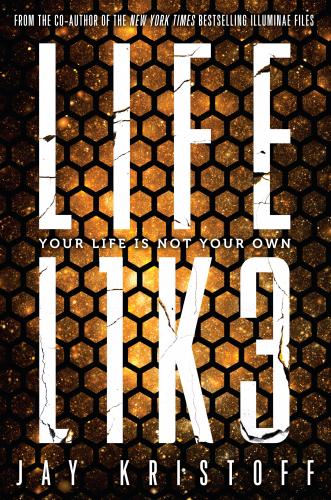
Eve doesn’t remember much — just snippets, really — from her childhood. She mostly just remembers the two years she’s been living in the Dregs with her grandfather, scrapping for work, and fighting the bots in the WarDome. But then, one fateful night, everything changes. Eve “manifests”–she destroys a bot with a wave of her hand — and suddenly she, and her best friend Lemon (Lemon Fresh, named for the box she was found in as a baby) and her bot Cricket are on the run for their lives. But what they find — a Lifel1k3 bot, which everyone assumed had been destroyed, among other things — will rock their worlds forever. 

The best thing about this one, for me, was that Kristoff is playing with the old “robot rules” that Asimov had set up. Not only does he envision a future in which bots are a huge part of everyday life (and the world is run by megacorporations, which is probably the way it’s gonna be), but a world in which bots can not only “pass” as human, but aren’t subject to the “rules”. Which begs the question: are they human or not? 

I was describing this to a friend at work, and she said “oh, like the Romanovs in Russia” and she’s right:it is, very loosely, based on the Romanovs as well. Which kind of makes it cooler. A futuristic, dystopian, robot story based on Russian history. Kind of cool.

I really liked the world Kristoff built: It actually felt a lot like Uglies to me, with the slang and the shortcut languages and the techie world. But I could see how the slang would get tiresome to some readers. Even so, I loved that it was fast-paced, and I loved that it was playing around with ideas of how tech might play a role in the future. 

I really enjoyed this one.  

Isle of Blood and Stone

islefobloodandstoneby Makiia Lucier
First sentence: “The outing had been planned on a whim; an afternoon lesson up in the ills, away from the smoke and stink of the city.”
Support your local independent bookstore: buy it there!
Content: There is some mild swearing and violence. It’s in the YA section (grades 6-8) of the bookstore, even though the characters are 18/19 years old.

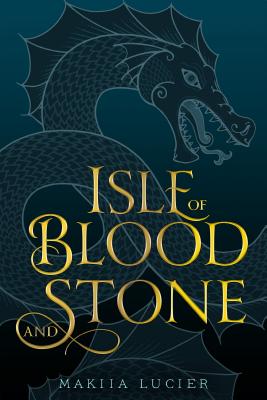
Eighteen years ago, the two princes of Island of St. John del Mar were kidnapped with the chief navigator and their nurse, never to be seen again. The king (and everyone, really) presumed them to be dead and went to war with a nearby island, Mondrago, ravishing it. Fast forward, and the king’s remaining son, Ulises, has become king, and his two friends, Mercedes — half Mondragan and Ulises’ cousin — and Elias, the son of the former chief navigator, have discovered some maps with a riddle about that fateful event 18 years ago. And, at the king’s command, Elias begins to look into it.

What he finds is a complex and tangled riddle, full of lies and information that will shake not only Elias’s beliefs, but perhaps the entire kingdom.

On the one hand: this was a compelling book, and a fantastic idea. I liked both Elias and Mercedes (who were roughly our narrators; it was written in third person, but we never followed Ulises around), and I loved the twists and turns as Elias uncovered information about the princes’ disappearance.

What held me back from really loving the book, however, was that I felt that Lucier told me what was going on rather than showing me. There was a LOT of exposition, and a lot of narrative, which isn’t necessarily bad, but what it did was keep me at an arm’s length. Like, Elias and Mercedes ended up falling in love (mild spoiler), but I had absolutely no connection to that. At all. There were strains of racism and sexism, but I felt like it was all at a distance, and never really connected with any of it.

Which is too bad. I really wanted to love this one.

Reign the Earth

reigntheearthby A. C. Gaughen
First sentence: “There was a scorpion in my tent.”
Support your local independent bookstore: buy it there!
Content: There’s violence, including spouse abuse (both verbal and physical). Also, though the main character is 17, she marries a man 10 years older than her. It’s in the teen section (grades 9+) of the bookstore.

The basic plot: a desert girl, whose nomadic country has been at war with a bigger, more powerful, oppressive country, is married off to the king of the country in order to achieve peace. Said peace is only tentative as long as the king is happy (and he’s not often happy, for many reasons) and as long as desert girl keeps her magic powers a secret from her husband.

There’s more to it: including a prophecy and a resistance and a secret love, but really, that’s it.

I’m being a little snarky, but I did like this enough to finish it. I did have a big issue with this: the main character is married to an abusive man. It starts out with him raping her on their wedding night (he kind of couches it in “I don’t want you to be uncomfortable” but he doesn’t really take her comfort into mind) and it just escalates from there. Granted, our main character does, eventually, stand up to him (and he is the “bad guy” of the story), but I couldn’t help but wonder: is this really a book for teens? I don’t mind darkness in books, or even dealing with issues like abusive relationships, but this one felt more… adult than usual. I know the marriage has something to do with it, but I’m not sure that’s all. I don’t know if I can put my finger on it exactly.

Also: I feel like this one could have been better if it were an own voices story. Again, I’m probably nit-picking, but I felt like it was just “desert girl saves white oppressed culture” and not much else.

So, while I liked it enough to finish it, I didn’t love it.

What If It’s Us

whatifitsusby Becky Albertalli & Adam Silvera
First sentence: “I am not a New Yorker, and I want to go home.”
Support your local independent bookstore: buy it there!
Content: Loads and loads of f-bombs, some mild drinking, as well as some off-screen sex. It’s in the Teen section (grades 9+) of the bookstore.

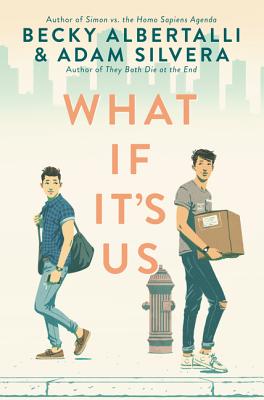
It’s the summer before senior year, and Arthur Seuss is in New York City from Atlanta with is parents for the summer. His mom is a lawyer working on a big case, and he’s got an internship. But mostly, he’s there to see the city and hopefully a few Broadway shows. Love is definitely NOT on the radar.

And then he bumps into an attractive boy at the post office and he’s smitten. The problem? He didn’t get the boy’s name.

Ben is trying to just make it through the summer. He’s come off a bad breakup with his boyfriend, Hudson, and he’s stuck in summer school because he failed chemistry. He just wants to pass the class. Love is definitely NOT on the radar.

That is, until Arthur (and the universe) conspires to get them together.

So this is very rom-com-y: a meet-cute, they have to work to get together, ups and downs in a relationship… it hits all the tropes. But, it was still a lot of fun. Especially if you (like me) really like romcoms. I adored Arthur and his extra-ness, and Ben and his great Puerto Rican family. I loved the side characters (especially Dylan; he was so great) and it’s nice to have a couple sets of decent parents in a YA book.

So, while it’s not really breaking any new ground (maybe in that it’s a gay romcom?) it’s still an incredibly fun read.

Audio book: The Gentleman’s Guide to Vice and Virtue

gentlemansguide

by Mackenzi Lee
Read by Christian Coulson
Support your local independent bookstore: buy it there!
Or listen at Libro.fm
Content: There’s some mild swearing and a lot of drinking and some allusions to sex, including one mostly nude scene. It’s in the Teen section (grades 9+) of the bookstore.

The only thing Henry “Monty” Montague wants is to go on his Tour of the continent with his best friend Percy. Sure, there are complications, the big one being is that Monty has a secret crush on Percy. That, and his father has given him an ultimatum: go have a supervised year on the continent and then come back, settle down and run the estate. None of which Monty wants.

However, the year doesn’t go the way that Monty expect. After a disastrous escapade at Versailles, in which Monty steals what he thinks is a simple trinket box, things go away. Monty, his sister Felicity, and Percy find themselves on the run from highway men. And it just goes downhill from there. Full of twists and turns as our fair adventurers try to find out exactly what that box Monty stole was, and then figure out their way home.

Oh, heavens, this is so much fun! Perhaps this was one that I liked because I listened to it, because Coulson was a fabulous narrator. I appreciated that he didn’t make Felicity overly “girly” (because she’s not; let’s hear it for 18th century girls who want to be doctors!) and I adored all the French accents. I loved Monty’s growth arc; he was a douche in the beginning, but as the layers peeled away, I began to understand just why Monty was the way he was. And Percy, even if he was a little overly long-suffering, was sweet and adorable, and I ended up loving him as much as Monty did.

There were some darker parts of it; Lee doesn’t gloss over the racism inherent in 18th century society (Percy’s half black and always mistaken for Monty’s servant/slave) and the prejudice against gay people. It grounds the silliness and over-the-top-ness in the book, giving it a darker edge.

But really, this is just a trip and a half, and definitely worth the read/listen!

A Winter’s Promise

winterspromiseby Christelle Dabos
Translated by Hildegarde Serle
First sentence: “It’s often said of old buildings that they have a soul.”
Support your local independent bookstore: buy it there!
Review copy provided by the publisher.
Content: The main character is engaged, but other than that there’s nothing “objectionable” (at least that I read). It’s in the teen section (grades 9+) but if a 6-8th grader is interested, I’d give it to them.

When my rep for Europa pitched this book, the first thing I told him was “the cover is awful”. Yes, it fits with the other Europa titles, but, really: what kid is going to want to pick up this book?

But it’s a huge deal in France, he countered. And it’s supposed to be sweeping and epic. So I picked up a few for the store, if only to support Europa’s first foray into young adult fiction. And then I nominated it for the Cybils, so I’d force myself to read it.

And…

Well…

I’m sorry. It’s awful.

I liked Dabos’ world building: she’s imagined a world where there are a bunch of floating “arks” populated by different families with different magical skills. I really  liked our main character, Opheilia’s, magical skill at reading items — she can tell the history of the owner through their items, and she wears gloves so she doesn’t accidentally read other people’s histories without their permission. But, Opheila herself was a huge pushover. I think she was supposed to be cheerily mousy, but instead I just got annoyingly wimpy. She’s been given in an arranged marriage (arranged by the heads of her family, I assume?) to Thorn, who is from the Polar ark (I think), and whose family’s skill has to do with illusion. Except, once on their ark, Sophie finds out that everyone is at each other’s throat and she’s in the middle of it.

At this point, I was more than 200 pages into a nearly 500 page book, and I bailed. It was just going nowhere too slowly for me. The only thing that was holding my attention was the world, and there wasn’t enough of that to make me care enough to keep reading. (And I thought Rowling was overly wordy!) So, I bailed.

But, I suppose, if large, very French, fantasies are your thing, then this one will be perfect. They’re just not my thing.

A Room Away From the Wolves

roomawayfromthewolvesby  Nova Ren Suma
First sentence: “When the girl who lived in the room below mine disappeared into the darkness, she gave no warning.”
Support your local independent bookstore: buy it there!
Content: There is a lot of swearing, including multiple f-bombs, and abuse that could be triggering. It’s in the Teen section (grades 9+) of the bookstore.

This one is going to be tough one for me to sum up, because I am not sure what, exactly, happened. The words were very pretty and I read the whole thing, but I, for the life of me, do NOT understand what happened.

There’s a girl — Bina — whose mother remarried when she was nine to a man with two daughters who were quite abusive to Bina. And so, the summer before Bina turns 18, her mother suggests she leaves. Bina goes to a place in New York City her mother had stayed when she was young, before Bina, the Catherine House. There are 14 girls in the house, where weird things happen, and they try to bring the ghost of Catherine back, and Bina’s super confused, and… I just lost the thread of what was going on.

I suppose this was meant to be a grand metaphor for something, and I’m sure there are people out there who like this atmospheric type of book with a hugely unreliable narrator, and I did finish it, to it’s not terrible.

It’s just that I need someone to explain it to me.

Dry

dryby Neal Shusterman and Jarrod Shusterman
First sentence: ”
Support your local independent bookstore: buy it there!
Review copy provided by the publisher.
Content: There are many intense situations, some reference to drinking and drug use (by adults, mostly), and violence. It’s in the YA section (grades 6-8) of the bookstore.

I will say this up front: this novel is TERRIFYING. The father-son team takes the plausible — what would happen if there was a severe drought in Southern California and then access to the Colorado River was entirely cut off — and turns it into a gripping, thriller-like survival ride, to answer the question: What would you do for access to water?

The story alternates viewpoints between Alyssa, who with her brother Garret, have to figure out what to do when their parents go missing; their neighbor Kelton, a son of a survivalist who has prepared for Times Like These. When things go from bad to worse — let’s just say their other neighbors aren’t forgiving of the fact that Kelton’s family has prepared — they go on the run, nominally to find a place to ride out the “crisis” and pick up two other kids — Henry and Jacqui — on the way. Interspersed are “snapshots” of how the wider community is reacting and gives the reader a bigger picture of how this is affecting the community as a whole.

Shusterman is an incredible storyteller, and he knows how to keep a plot going from page to page. There are funny bits and touching bits and terrifying bits (lots of those actually), and it all felt incredibly realistic. I could see this playing out — especially with the way society is in denial about climate change — pretty much exactly like this. I’ve heard it said that science fiction isn’t about predicting the future, but rather about what it’s happening in the present. If that’s true, then this should be a wake up call to take better care of the planet. Otherwise, this “prediction” might just become reality.