Enchanted Air

by Margarita Engle
First sentence: “When my parents met, it was love at first sight.”
Support your local independent bookstore: buy it there!
Content: It talks indirectly about drugs, sex, and teen pregnancy, as well as the violence of war, but it doesn’t dwell on that. It’ll be in the children’s biography section of the bookstore

I noticed that Abby had read this one and liked it, so I pulled it off my pile to give it a try. I mostly wanted something I could finish in one sitting, and this one — being a memoir in verse — fit the bill.

I didn’t expect to be thoroughly delighted by it.

Margarita is the daughter of a Cuban immigrant and the son of Ukranian holocaust survivors. Needless to say, she had an interesting story to start. Add to that the conflict in the 1950s with the Cuban revolution and the subsequent cold war, she definitely had  a story to tell. But: she chose to tell it through travel, through depictions of the island itself (which she described so lushly) as well as her family’s vacations to Mexico and Europe. She portrayed herself as an awkward child, caught between two countries and then unexpectedly cut off from half of her family. I can only imagine what her mother felt.

Elegantly told, beautifully imagined, it’s a love story to the power of words and images and home. (And I’m glad that her hope in her afterward for more normalized relations between the U.S. and Cuba may slowly be coming to fruition. I would love to visit there someday.)

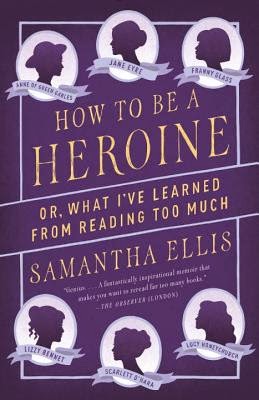
How to Be a Heroine

by Samantha Eliis
First sentence: “A couple of summers ago, I was on the Yorkshire moors, arguing (over the wuthering) with my best friend about whether we’d rather be Jane Eyre or Cathy Ernshaw.”
Support your local independent bookstore: buy it there!
Review copy provided by the publisher.
Content: There’s a handful — not more than six — of f-bombs and some mentions of sex, but nothing graphic. It’s in the adult creative nonfiction section of the bookstore, but I’d give this to anyone in high school and up.

Somehow, I ended up with a complimentary copy of this book. I really have no idea how it ended up on my pile. I do know the idea of it (and the subtitle: “Or, What I’ve Learned from Reading Too Much”) appealed to me. Any book that is about books or the love of reading has to be good, right?

And it was.

The book is nominally a reflection of Ellis’s life. She’s an Iraqi Jew, living in London, with all the cultural and religious implications you’d think that entails. She struggled against expectations, she struggled with faith, she struggled to find her own path. And, on its own that would be a fascinating story. But she framed the book with an analysis, heavily feminist, of classic heroines. From familiar to me ones like Jo March and Anne Shirley and Jane Eyre to ones I’ve never heard of, like Franny Glass and Esther Greenwood. She explored their narrative arcs, and what she took away from their stories. Both when she was younger and then, as an adult, how she feels the held up. Some did. A lot didn’t. And many she got something different out of the book than what she got when she was younger. She discovered new things along the way, and made me want to revisit books I’d loved when I was younger and read ones I’ve not read before.

And for all the literary criticism, it wasn’t a stuffy book. Ellis has a way of drawing the reader in, of making the characters pop to life. Perhaps that’s because she’s a playwright and has a way with words as it is. But whatever the reason, this one won my heart over.

I Will Always Write Back

by Caitlin Alifirenka, Martin Ganda, and Liz Welch
First sentence: “I’d never heard of Zimbawe.”
Support your local independent bookstore: buy it there!
Content: It’s a non-fiction book that deals with teens, and so there’s some mention of teen drinking and pot smoking, but for the most part it’s pretty harmless. It’ll be in the middle readers biography section, though I’d hesitate giving it to the younger end of the readers. I think it’ll be best for grades 5 and up.

In the fall of 1997, Caitlin Stoicsitz made an impromptu decision that changed multiple lives. She raised her hand to get a pen pal, and her letter was sent to Martin Ganda in Zimbabwe. You wouldn’t think something as simple as that would be life-changing, but it was. Caitlin’s letter got sent to a small, rural school in Mutare, and by chance Martin, who was one of the best students in class, was on the receiving end. He wrote back, and that was the beginning of what became a deep friendship for them. And because of that friendship, Caitlin was able to change Martin’s life, to give him the opportunities — especially educational — that he wouldn’t have had otherwise. For what seems like mere pittance, Caitlin (and eventually her whole family) was able to pay Martin’s fees for school (especially since his father was out of work) and help him get into a U. S. College. That doesn’t sound like a whole lot, but as you get to know both Caitlin and Martin over the course of the book, you realize that it IS.

In return, Martin gave Caitlin something that many Americans desperately need: a view of how everyone else lives. Compassion for the downtrodden, and a knowledge that we really, truly are privileged in America.

Like many memoirs, this one is uneven. It’s chatty, and sometimes Caitlin’s narrative borders on whiny, neither of which might bother the intended audience, but kind of grated on me. I also felt like there was a bit of the “American savior swoops in to save the day” which also kind of grated.

But I do honestly believe that Caitlin and Martin have a bond, and I do believe that writing and responding to the letters, when one truly cares and when one is open to other ideas, can change lives.

And this book is a good reminder of that.

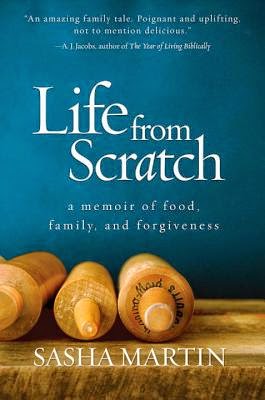
Life from Scratch

by Sasha Martin
First sentence: “This is not the book I meant to write.”
Support your local independent bookstore: buy it there!
Review copy picked up from the Random House rep.
Content: She didn’t have an easy upbringing and she doesn’t hold back on that. But, other than that, it’s suitable for anyone who’s interested in a culinary memoir. It’s in the biography section (for lack of a better place; it also fits in our creative non-fiction, which is kind of a catch-all) of the bookstore.

I know I’ve told y’all how much I love foody books How much they feed my soul, and how, when they’re wonderful, they just make me happy. Last time our Random House rep came to the store, he held this one out and said it’s a food memoir, I snatched it. I took too long getting to it, though: it wasn’t until it actually came in (the actual cover is so much more appealing than the ARC cover, trust me) and I actually read the first sentence, that I knew I would love this book.

Sasha had a hard life. Seriously. The daughter of a single mom struggling to get by in Boston, she and her older brother, Michael, didn’t know how hard their life was. They had Mom, they had each other and as far as they were concerned, things were good. Then the state decided that what they had wasn’t enough, and sent them into the foster system. Which, in the late-80s, was a terrible place to be. Sasha’s mom, however, was — is — an incredibly concerned and passionate person, and she fought to get them back. However, the state (I can see people’s objections to the state here) deemed their mother unfit, and decided that the kids needed to be raised elsewhere. Sasha recounts her mom sending out tons of letters, looking for a home for her children. And it was an old friend and her husband who took on the burden of raising the children.

You might be wondering what all this has to do with food? Well, the one thing that kept Sasha going throughout her life was a love of food and cooking. Her mother is Italian and Hungarian and she believed in the power of community coming together to eat, so very early on, Sasha helped out in the kitchen.

Her years with the friends weren’t happy. She missed her mother. Her brother committed suicide. Which propelled Sasha into a life of drinking and drugs and avoidance. The upside was that the family moved to Europe, so Sasha was exposed to culture there. So, when she finally landed on her feet, after years, in Oklahoma (I’m condensing here; there’s a lot going on), she decides that what she needs to do is cook her way around the world.

Sasha’s a compelling writer, telling her story with love and understanding, when no one would have faulted her for being bitter. She was angry at her mother for years, but somehow forged a new relationship with her. And I loved how this city girl found solace in a smaller community, finding the interesting and unique things about Tulsa. (She actually made Tulsa sound like a pretty cool place.) But the best thing, hands down, about this was the food. Sasha has a way of making the food leap off the page, of capturing not only the flavor of every day dishes, but also of the exotic ones she made from around the world.

It’s a delightful book, one that I’m sure will stay with me for a long, long time.

Audiobook: Small Victories

by Anne Lamott
Read by the author
Support your local independent bookstore: buy it there!
Content: She likes the word s**t, and drops about five f-bombs.  Which kind of caught me off-guard. It’s in the religion/philosophy section of the bookstore.

I’ve been curious about Anne Lamott for a while now; she’s an incredibly popular author at the store. I was in between audio books recently and discovered this one, and it was delightfully short. I figured audio was a good way to experience her.

This is basically a series of short reflections on life, God, and the intersection of the two. For the record: Lamott is a liberal, which I don’t mind at all, and was very against the invasion of Iraq in 2003. (Several of the essays are from around that time period.) She belongs to a church in northern California. She has a son, and lots and lots of friends, many of whom are suffering from serious illnesses. She has a good sense of humor, and is honest about her struggles with God, people, and just life in general.

In many ways, the words were just what I needed to hear: we’re all human, we’re all trying. God is in connecting with other people and reaching out to love them.

What I didn’t like so much, was Lamott’s reading of her own work. I understand why she needed to read her own words; it would have been odd otherwise. But Lamott read in such a way that it soundedlikeonereallylongsentancewithoutevertakingapauseorevenraisedorloweredhervoicewithsentenceinflection. When I concentrated to hear the words, I loved it. But her reading of them almost turned me off altogether. I’m glad I stuck it through to the end, for the thoughts and ideas. But, I wish Lamott had been a better narrator.

El Deafo

by Cece Bell
Support your local independent bookstore: buy it there!
Content: There’s a little talk of Love (she has a crush) but other than that, it’s quite accessible for the 3-5 grader. It’s in the middle grade graphic novel section at the bookstore.

This one has been on my radar for a long time, and (like too many other things), I can now say I Should Have Read it Sooner!

It’s the mostly-true (except for the part where she’s a bunny) story of Cece Bell, and her experiences as a deaf child in the 70s and early 80s. She lost her hearing due to a bout with meningitis when she was four, and as a result had to wear a hearing aid and use a Phonic Ear during school. It’s not something she really enjoys at first, even though she realizes it gives her a sort of super-power.

But, the story is really only incidentally about being deaf, it’s more about finding a way to belong and a friend. Bell is very practical about the friends she made, not sugar coating anything. But, it’s not a harsh book; on the contrary, it’s a very sweet and often hilarious story. And it’s good that it’s out there to remind readers that it’s because of our differences that life is interesting.

Very highly recommended.

Just Mercy

by Bryan Stevenson
First sentence: “I wasn’t prepared to meet a condemned man.”
Support your local independent bookstore: buy it there!
Content: It’s intense, and there are some graphic elements, as well as swearing. It’s not for the tender-hearted (I had to put it down several times and read other books because I couldn’t handle the nature of the story). It’s in the adult non-fiction sections of the bookstore.

This one has been on my radar for a while as one I’d need to get around to reading. But what really prompted me to pick it up was listening to Serial. The two don’t really have a ton in common, but there are similarities. Both deal with minorities being imprisoned, mostly unjustly. Both are difficult, at times, to listen to/read. Both are important.

Bryan Stevenson was a young lawyer from Harvard in the mid-80s when he went to Atlanta to do an internship there. He got involved with a death-penalty case in Alabama, where he determined that the man was accused falsely. Stevenson became involved in the case to the point where he started the Equal Justice Initiative, a group that advocates for people on death row, as well as for children and for those with mental disabilities who have been imprisoned for life.

I took away two things from this book: First, our justice system may work “as well as it can”, but that usually means “for those who can afford it.” If it wasn’t clear before, it’s clear after reading this: our system is broke. It favors those who are white, those who are healthy, and those who are well off. Especially in the South. It saddened and depressed me that this isn’t history. This is happening in my lifetime, not in some distant past.

The second thing is that Stevenson is an incredibly hopeful individual. He’s practical, yes. But he’s also hopeful, and Christian, and just Good to do this work for people society — people like me — have written off. It makes me want to go out and give everyone I meet a second, or third, chance. Yes, there are people out there who are beyond hope, but I think, especially after reading this, that there aren’t that many people who are completely unredeemable.

It was a tough book, emotionally, for me to read (it didn’t help that I went and saw Selma while reading this as well). I cried a lot. My heart broke. And I had to think about the way I treat and judge people.

I am grateful that there are people like Stevenson out there doing this work. And I’m glad he wrote this book if only to make people like me more aware.

Audiobook: Yes, Please

by Amy Poehler
Read by the author.
Support your local independent bookstore: buy it there!
Content: Amy likes to swear. A lot, but not excessively, and generally not gratuitously. She is also pretty frank about sex and her drug use. I’m not going to say it’s not for teens — whom I know make up some of her fan base — but know that going in. It’s in the humor section at work.

I have made an executive decision: all celebrity bios are better in audiobook form. Period. That is all.

I really wasn’t that interested in reading this one; I’d paged through it a couple times when it came in back in October, and I figured: this was one for the True Fans. (Which I am not. I’m more like a Passing-by Fan.) But even I couldn’t resist the opportunity to listen to Amy Poehler read her book.

And, for the most part, it was a lot of fun. It’s a meandering book, wandering through memories, observations, Deep Thoughts, and Pithy Comments. That worked for me for a while, but wore me down by the end. Thankfully, the last chapter was recorded live, which helped end the book on a high note.

Perhaps it’s because she comes from an improv background, but I felt Poehler (and the audiobook) was at its best when she strayed from the script and just riffed. The two minutes she and Seth Meyer went off (which I’m assuming is not in the book, though I haven’t checked) were brilliant. She operated under the guise that she was recording the whole thing in her own personal home audio booth, and that there was a party going on in the background. She chatted for a bit with Patrick Stewart, Kathleen Turner, and Carol Burnett which just made me happy. And hearing her parents’ Boston accents (actually, I loved it when Poehler’s came out too) was charming.

It was all the little extra things that made this book enjoyable. But in the end, that wasn’t enough for me to truly love it.

Audiobook: The Art of Asking

by Amanda Palmer
Read by the author
Support your local independent bookstore: buy it there!
Content: Amanda doesn’t check her language. There’s a ton of swearing, of all shades. And she’s pretty frank about pretty much everything. It’s in a couple of sections at the bookstore: self-help (which it really isn’t) and biography (where it fits a bit better).

When this book came in, the conversation with one of my bosses as I was shelving this went something like this:

Her: “I saw Amanda Palmer once. She was intense.”
Me: “I didn’t know who she was until she started dating Neil Gaiman.”
Her: “You know, she’s her own person.”

That last sentence really does sum up this book quite nicely: Amanda Palmer is, for better or worse, her own person. And she is not ashamed of any of it.

Nominally an expansion of her TED talk, it’s more a meandering look into what makes Amanda Palmer tick. On the surface, it’s not a book for everyone. Amanda is frank, which means that sometimes she (and her music) will rub you the wrong way. BUT, she is frank. Which means she’s honest, and that gives the book a refreshing clarity. She talks about a lot of things: her time as a street performer, her music, her relationship with Neil Gaiman, but at its heart, it comes down to one thing: she is interested in the connections between people and how we ask for things.

Because of who she is, this is framed in music terms: a musician asking her fans for support, help, love, money. But what she says — that there are ways to ask that isn’t begging, and that it’s the connections (what she calls the net) that makes asking possible — is applicable for just about everyone. It got me thinking about gifts and connections, and how we work at relationships, and about how I’m much too hesitant to ask for things. At one point, she says that asking without condition is a gift, because it allows the other person to give. That’s something that resonated with me.

I enjoyed the audio version of this quite a bit as well: while Amanda’s voice was sometimes difficult for me to hear (which is entirely my fault), I loved hearing snatches of her music (I prefer her later, ukulele songs to the Dresden Dolls stuff) and her Neil Gaiman voice (seriously: she had a slightly British affection when she had him talking. It was quite adorable). But, mostly, I felt like she was in the car with me, explaining her life view, and how, just maybe, it might make my life a little bit better.

Highly recommended.

Audiobook: Food, A Love Story

by Jim Gaffigan
read by the author
Support your local independent bookstore: buy it there!
Content: There’s some mild swearing, but its quite seldom. It’s in the humor section of the bookstore.

I love food. I  love to laugh. And yeah, I kind of like Jim Gaffigan’s humor, though I’m new to it (and only in book form, having quite enjoyed Dad is Fat.) All that adds up to a “yeah, I guess I’ll pick up the audio version of his new book” mentality.

There’s really not much to say about this book beyond that it’s hilarious and a lot of fun to listen to. Gaffigan isn’t a foodie (he’s an “eatie”) and so there’s really not luscious descriptions of making food or of recipes (there is one — how to make a hot dog — and it’s quite hilarious) or how food changes lives. No, I imagine it’s just a series of stand-up bits (which is why I think this works better in audio. Plus he does voices, which end up adding to the humor) based on Gaffigan’s love of eating… everything. (And, yes, for those who are actually fans, he does have a chapter on Hot Pockets.)

Some highlights: the chapter on steak, or desserts, or breakfast foods, or on bacon. He hates vegetables and thinks kale is the worst thing ever. It’s really an every-person’s (read: non-food snob) tribute to the joy of eating. And the only down side? I often got hungry while I was listening to it.

Enjoyable, to say the least.