Two Transgender Books

I thought about reviewing them separately, but then I realized that the authors of the two books actually dated at one point, and I think Simon & Schuster kind of meant for them to be a pair. So, here they are, together.

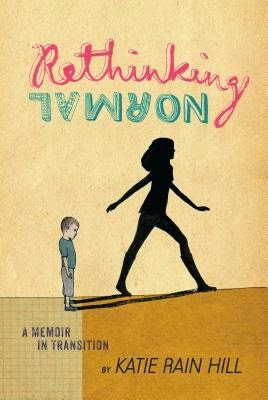
Rethinking Normal
by Katie Rain Hill (with Ariel Schrag)
First sentence: “I really, really hate flies.”
Support your local independent bookstore: buy it there!
Content: There are a few f-bombs, and some frank talk about genetalia. Also, some frank talk about having sex, though it’s not graphic. That, and the subject matter (which isn’t necessarily not for younger kids, but maybe parents want to have a chat with the younger set while they read this), put this in the Teen section (grades 9+) of the bookstore.

Katie is a trans girl. Which means — if I get this correctly — she was assigned the male gender at birth, named Luke by her parents, and as she grew up, she felt increasingly at odds with her physical body. She didn’t feel “male”; she was attracted to males, but wanted them to see her as a woman. This is the story of her journey.

It’s not an easy one for her. For her first few years, she was okay, but as she grew older, she became depressed. She didn’t know what was wrong with her, or why she didn’t feel comfortable in her body. Why she wasn’t compelled to do traditional “guy” things. She went to therapists, but they didn’t help. Most just threw medication at her. It wasn’t until she was 13 that she discovered a transgender website that opened the doors to what she was experiencing. She found a support group, a doctor who was willing to take her seriously (turns out that she was intersexual; she had high levels of estrogen in her body and undeveloped ovaries as well as a penis), and she was on the path to becoming who she truly felt she was.

I was hoping, I think, for this to shed some light on transgender(ism? Can I say that?) for me. It didn’t; but then I think my expectations were too high. One person’s story is going to shed light on just that: one person’s story. And even though the writing style was overly casual (imagine Katie sitting down and just rambling her story at you), I was fascinating by her experiences. And ashamed; this was set down in Oklahoma, and unfortunately, the religious people Katie knew did not treat her well. That always makes me feel sad; I do hope that there would be more acceptance and charity and kindness in these sorts of stories.

I am glad Katie wrote this book, though. The first step to making the unknown more knowable is to learn someone’s story. And this book does just that.

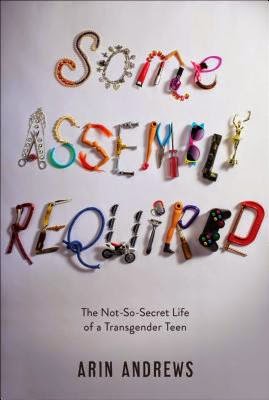
Some Assembly Required
by Arin Anderson (with Joshua Lyon)
First sentence: “Getting dumped at prom sucks.”
Support your local independent bookstore: buy it there!
Content: Same as above.

I didn’t have as positive an experience with this one. I’m not quite sure why, so this is mostly going to be me ruminating about why I bailed on this memoir, when I found the other one fascinating

First off, Arin is a trans boy, which means he was assigned the female gender (and had female body parts) when he was born. He struggled with this, but unlike Katie, his struggles seemed to come off as “I don’t like the clothes/pageants my mother is putting me in.” He was a tomboy as a child, even though he enjoyed the dance classes his mother insisted he take. He didn’t want anything to do with anything else about being a girl, and was repulsed when his body started to change.

I’m not asking for a justification or an explanation, but this seems weak to me. Especially in the light of the experiences Katie had. The way Arin presented himself (to me) came off as much more shallow. Or maybe it was because I’m a woman, and I had some of the same struggles with expectations and my body image. (I just turned feminist instead of trans, though…) I wanted to know what made his experience DIFFERENT from mine. How I could have a similar reaction to clothes/pageants/activities/my body changing and NOT be trans. Maybe I was expecting too much

Growing up in Oklahoma, Arin had a tough time. He came out as bi, and then trans, both of which were strongly rejected by the community, the religious school he was attending, and his mother.  (Of course, since religious people are closed-minded, duh.) In the end it was the the way these so-called Christians treated him that made me put down the book.

But, I also had to admit that my perception of Arin was skewed from the beginning; he shows up in Katie’s book, and while she isn’t cruel, he comes off as a whiny, clingy, needy boy. I couldn’t shake that image as I tried to read this one.

So, maybe the best thing is to pick one or the other, and immerse oneself in that individual story, recognizing that it’s just that: one individual story. Even so, it’s something that isn’t talked about much, and both of these books would be good for discussion.

Audiobok: Stiff

by Mary Roach
Read by Shelly Frasier
Support your local independent bookstore: buy it there!
Content: Um, Roach doesn’t mince her words when she talks about scientific stuff, and so some of this is kind of … gross. Fascinating, but gross. There’s a few mild swear words, but if you’re interested in dead bodies, go for it. It’s in the science section of the bookstore.

I picked this one out because I was in between audio books and because I really enjoyed Roach’s writing in Gulp. This time (it’s an earlier book), Roach takes a look into what happens to bodies after people die. From the ones that are donated to science — used in anatomy labs, for surgery practice, for research, etc — to the way the bodies decompose, you have to say that Roach is nothing but thorough.

On the one hand, this wasn’t the best book to listen to. Frasier did a good enough job narrating (though I had to keep reminding myself it wasn’t Roach talking; much of the book is in first person), it’s just that when you read about bodies decomposing, you don’t want to LISTEN to the words. Or at least I don’t. I never got physically ill, but it did make me queasy on a couple of occasions.

On the other hand, though: it was fascinating. Even if the book is 10 years out of date, it’s interesting to think about what can be accomplished through science after one dies. If anything, it got me thinking about what I want done with my body (though Roach pointed out that much of what is done with the body is decided not only by the deceased but by the family members) after I pass on. I think I was most swayed by one of the final chapters where Roach wrote about a woman in Sweden who was advocating for promession, which is a way of composting bodies. For some reason, this really struck a chord with me. I’d much rather be turned into earth and help a tree grow than sit in a graveyard. Shocking, I suppose. But my kids are on board with that (at least right now).

In the end, even though it was gross at times, I really enjoyed this one.

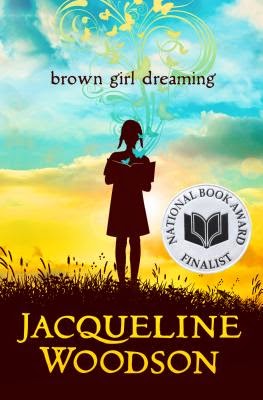
Brown Girl Dreaming

by Jacqueline Woodson
First sentence: “I am born on a Tuesday at University Hospital Columbus, Ohio, USA — a country caught between Black and White.”
Support your local independent bookstore: buy it there!
Content: There’s nothing objectionable. And it’s even an easy-ish read. Sure, it’s poetry, but it’s not difficult. Hand it to anyone with an interest in writing, kids, and history. It’s in our middle grade biography section at the bookstore.

I’m not quite sure where to start on this one. It seems We’ve (the collective we, here) been inundated by memoirs and biographies of celebrities, People of Note, and at first glance Jacqueline Woodson’s new book just falls into that pit of “celebrity” (of a sort) biographies.

Except, it’s not so much a biography or memoir as it is a reflection upon a childhood. Woodson makes her childhood an Everyperson experience, something that the reader can readily identify with, even if they didn’t have her exact same experiences.

Her childhood begins in Ohio, but mostly it’s spent in South Carolina, with her grandparents, and in Brooklyn, where her mother finally settled with Jacqueline and her brothers and sister. I kept trying to figure out the timeline (if she was born in 1963, then it must be…) but eventually, I just gave up and let myself get absorbed in the story.

And absorbed I was. Woodson wove historical elements into her story — sit-ins in the South; the way her grandmother felt about the way she was treated in stores by white people; music that was playing on the radio — all of which helped put her personal story in a larger framework. I could easily forget I was reading a memoir; it felt so much like a novel.

Part of that, too, was the form. Written in free verse, the memoir took on a lyrical quality. There were moments, especially toward the end, where I was moved by her insights not only in her life, but for Life in general.

One more thing: I appreciated her portrayal of religion. I get the sense she’s not a practicing Jehovah’s Witness anymore, but she portrayed the religion of her grandmother and her own childhood with respect. It was neither good nor bad; it was just a part of her life. And I found that refreshing.

Highly recommended.

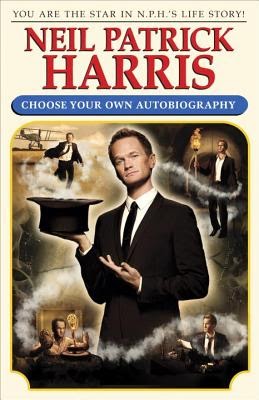
Audiobook: Neil Patrick Harris: Choose Your Own Autobiography

by Neil Patrick Harris
Read by the author.
Support your local independent bookstore: buy it there!
Content: There are eight f-bombs (yes, I counted) and some frank (but not graphic) descriptions of his sexual experiences as he was trying to figure himself out. It’s in the adult biography section of the bookstore, but if you’ve got an interested teen, it’s a lot of fun and quite accessible.

I’m a sucker for celebrity bios. I really am. I love the peek into their lives and their histories, and I’ll devour their histories. I’m curious and a bit of a voyeur. (but not a stalker. Yet.)

So, I was probably going to read Neil Patrick Harris’s bio anyway. But when I got wind of the premise — it was going to be a choose your own adventure book! I LOVED those! — I knew I had to read it.

It comes in two formats: print and audio, and for this experience I chose audio. (Event though I ended up picking up the print book as well. Just to see.) And what an experience it is. On the one hand, I missed out on the whole “choose your own” part; it’s kind of hard to do that with audio. And one of the reasons I wanted to see what the print book was like. Instead of leaping through the book following one path (some of which include fake deaths by sand trap — somehow Joss Whedon was responsible for that one — or avalanche — Big Bird’s fault — or death by bowling ball) or another (where he/you end up overweight and working in a Schlotzsky’s), he reads it straight through. So, it gets a little difficult to tell which is Truth (so, I thought the bit about Katy Perry and the homophobe at the pre-Superbowl Party was fake until C informed me otherwise) and what was Fiction.

But the positives completely offset the negatives in this listening experience. For one: it’s NEIL PATRICK HARRIS narrating. And he’s brilliant. More than brilliant: phenomenal.  Voices (I LOVE his announcer voice) and clips (the best one is the audio of 13-year-old Neil doing a speech on optimism). And (in my favorite section) the vocal annotation of David Burtka in the chapter on how they met which just slayed me with adorableness.

I could go on and on raving about this one. I loved every moment I spent listening to it. The format (using second person instead of presenting it as “this is my life”) involved me, and on top of that NPH has a wonderful sense of humor and gratitude about his life. Maybe it’s not great literature, but it was a truly enjoyable book to read/listen to.

The Port Chicago 50

by Steve Sheinkin
First sentence: “He was gathering dirty laundry when the bombs started falling.”
Support your local independent bookstore: buy it there!
Content: There’s some disturbing moments, not only violence, but also racism. I was made uncomfortable by it (which I think was the point). There is also about four censored f-bombs. Sheinkin is masterful at simplifying data  without being simplistic, so I think this is suitable for 5th grade on up. It’s in the Middle Grade History section at the bookstore.

During the summer of 1944, on a little-known port in the San Francisco Bay where Navy ships were loaded with ammunition, an enormous explosion happened. So large that it killed more than 300 men were killed, the pier and the docked ship were obliterated, and men in the barracks were injured, some severely.

It sounds like a tragedy, but nothing too serious. Except for this fact: of the 320 men who were killed, 202 of them were African American men who had signed up for the Navy and had been relegated to the dangerous job of loading the ammunition. The way the Navy worked in 1944 was that the white men got to serve on the ships; the black ones were segregated out and assigned the menial tasks the white sailors didn’t want.

But it gets better. The men who survived the blast were shuttled to a nearby port, and even though they were suffering trauma from the blast (who wouldn’t be), the were ordered to go back to loading the ships. Fifty sailors flat out refused orders. So they were put on trial for mutiny. And convicted. Even though there was never any plot to defy their superiors or take over the base. They just were tired of being treated differently than the white sailors and wanted to know why.

Some good came out of this: because the Secretary of the Navy was a (mostly) reasonable man (and because Eleanor Roosevelt got involved) the Navy (and soon after the rest of the military) was one of the first places that was desegregated in the country.  But, was the price of being convicted mutineers and spending 16 months in jail too high?

Sheinkin doesn’t whitewash anything that happened during those months and years surrounding the Port Chicago 50 trial. He lets the Naval officers stand for themselves (and any reasonable person would see that they were IDIOTS. Or maybe that was just me), and lets the trial transcripts stand for themselves. Thurgood Marshall even got involved, trying to get the government and the military (the officers of which come off as a bunch of racists; I was going to use a stronger word, but changed my mind) to exonerate these men for being human. Sheinkin pointed out that this was the first event on the long path of the Civil Rights movement, which was something I didn’t know, and something we don’t often remember in history books.

It’s extremely well-written and as intriguing as Sheinkin’s other works. He’s a masterful history writer, and knows just how to make things interesting and informative without being dry.

Excellent.

Audiobook: The Boys in the Boat

by Daniel James Brown
Read by: Edward Herrmann
Support your local independent bookstore: buy it there!
Content: It’s a book about the 1930s, rowing, and Nazism. It’s appropriate for anyone who’s interested in reading about those things, and can handle a long-ish book. It’s in the History section of the bookstore.

In the 1930s, 8-man rowing was one of the most popular sports (who knew). And the west coast — the University of California and University of Washington — was the hot-spot of the sport. And in the years leading up to the 1936 Olympics in Berlin, the Washtington team became the best of the world.

This is the story of how the Washington boys became the Olympic gold medalists.

I think this is one of those books that I really needed to listen to rather than read. While I think it would have been interesting, listening to it made it riveting. I enjoyed the stories of Joe Ranz — who ended up in the number 7 seat in the Olympic boat — and the other boys, and how they came to be at Washington. I enjoyed the conflict that coach Al Ulbrickson had with the California coach. I didn’t enjoy the rehashing of 1930s Berlin, but I think that’s because I listened to In the Garden of the Beasts and this is basically re-hashing much of that territory. For someone who is unfamiliar with Hitler’s rise, it’s pertinent information.

But what I  really loved was the bits about how the sculls were made, about the effort it took to row a race. And the races themselves? They had me glued to my seat, hooked on every word.

It was a remarkable event, a remarkable story. And I’m so glad I know about it, now.

Gulp

by Mary Roach
First sentence: “In 1968, on the Berkley campus of the University of California, six young men undertook an irregular and unprecedented act.”
Support your local independent bookstore: buy it there!
Content: One f-bomb (in the chapter about the rectum as a criminal accomplice) and a bunch of s-words (in the chapters on the colon and intestines). It’s in the science section at the bookstore.

I never would have thought to pick up a book on the Alimentary system (that’s your digestive system for the non-medically minded), except that this was picked for my in-person book group.

I’m so glad it was: it was fantastically fascinating.

She takes apart the digestive system, starting from the nose, working her way down. It sounds like it’d be boring, but it really isn’t. Roach is not only an engrossing and accessible writer, but a hilarious one. Especially the footnotes. All her little asides and historical facts had me laughing out loud.

True, the last few chapters aren’t for those who get queasy talking about bodily functions. But if you can get past that, it’s an excellent book.

Parenting Teens with Love & Logic

by Foster Cline and Jim Fay
First sentence: “Parents whose children are now turning twelve and thirteen know their kids face far greater challenges than they did just a few short years ago.”
Support your local independent bookstore: buy it there!
Content: It’s geared toward parents, and it talks frankly (but not graphically) about a lot of things. It’d be either in the Parenting section (most likely) or the Self-Help section.

I don’t usually read self-help books. I prefer to talk to other people, find out what works for them, and then see if it fits with my kids. But after a couple of fights (which may have been my fault), I pulled this book off the wayback TBR pile (the ones I should read, but have never gotten to). I think my parents sent it to me when M turned 12 or 13, but I just threw it on the shelf.

The edition I read was pretty out of date — 1992 — but even so, there was a lot of good advice in it. Simple little changes that I’ve started making, and (surprise!) this past week has gone so much more smoothly. The basic principle is this: give your teens the freedom to 1) make decisions and 2) own them. Use real-world consequences. Ask questions, offer sympathy, but don’t solve their problems. Don’t make orders, ask for things (but give them choices: “Would you rather x or x?”). And demand respect; it’s YOUR house after all. (I’m pretty lousy at that last one. Something I need to change.)

I’m sure there will be bumps along the way, especially as I (and Hubby) try to internalize a slightly different way of parenting (we were happy to find that some of the things — like respecting the girls’ ideas, and not criticizing their friends/hair/pop culture likes — we do already). But, I’m hopeful that maybe the next 10 years (as the rest of the girls head through teenagerhood) won’t be too rough.

The End of Your Life Book Club

by Will Schwalbe
First sentence: “WE were nuts about the mocha in the waiting room at Memorial Sloan-Kittering’s outpatient care center.”
Support your local independent bookstore: buy it there!
Content: There’s really nothing. It’s a very adult book in its sensibilities, but there’s no reason a teenager — especially a bookish one — couldn’t read this.

This book has been on my radar for a little while; it made the rounds at the bookstore when it came out and many of the staff and regulars loved it. But I didn’t get around to reading it until a good friend of mine suggested it for our book group.

If you haven’t heard about this one, it’s basically the story of Will’s mother as she goes from diagnosis for pancreatic cancer through her final days. The two of them are both avid readers, and they formed their own small book group during her chemotherapy sessions. It’s one part book-lovers book, and one part death and dying story.

I liked the book-lover part better, mostly because it was something I could grasp. I hadn’t read (or even heard of) a good number of the books they talked about, but Schwalbe was enthusiastic and thoughtful about enough of them that I’m interested in checking several of the books and authors out. I highlighted quite a few quotes about books and reading, ones that resonated with me.

As for the death and dying part, I was touched by Schwalbe and his mother’s story. She was a remarkable woman, who did remarkable things in her own small way. I had one of those “if I could only be as awesome as she was” moments. And you could tell the affection that Schwalbe had for his mother. I know that sometimes in these sorts of books the dead person gets “sainted”, but I never felt that his mother was. By framing the book around the books they read, Schwalbe gave this book a grounding — and a broader audience — that you don’t usually find in cancer books, something which I appreciated quite a bit.

I don’t think it was my favorite book ever, but I am glad I finally got to read it.

Primates

The Fearless Science of Jane Goodall, Dian Fossey, and Birutė Galdikas
by Jim Ottaviana & Maris Wicks
Support your local independent bookstore: buy it there!
Content: There’s nothing objectionable, content wise. There is, however, some text in cursive, which may make it difficult for younger readers to read. Also, A found the format confusing, since it bleeds from one story into the next. It’s in the middle grade (grades 3-5) graphic novel section at the bookstore.

This one caught my eye when it came into the store, because honestly? A graphic novel about women scientists: how rare is that. Granted, it’s the same famous women scientists (we ALL know Jane Goodall, right?), but still. Women, animals, science: I’m there.

It’s a loose (read: slightly fictionalized) retelling of how Goodall, Dian Fossey, and Birutė Galdikas became the sort of scientists they did. It was full of information on how they all met Louis Leakey and how he sent them out to observe and study chimpanzees, gorillas, and orangutans in the wild. Their styles were vastly different: Dian was the most emotionally involved in her study, I think, and the most passionate about her work. That said, Birutė went the most native; her husband left because she devoted too much of her time to the orangutans purely for the sake of studying them.

I think that’s what fascinated me most about these women. They weren’t in it for recognition or even for purely the sake of science.They were in it because they loved the animals, they wanted to understand them,  and ultimately protect them from ignorance through educating the world. I admire that.

As for the format, I mentioned that A found it difficult to follow. I didn’t, but then I’m an adult. It made me a little sad, though, that she did, because if the kids find the book hard to follow, they won’t be inspired by these women’s stories. And that makes me sad. Perhaps it would have been better to do this in three books, but I enjoyed seeing the connections between these women. I don’t know if I was inspired, but I was at least interested. And that counts for a lot, I think.