Most Dangerous

mostdangerousby Steve Sheinkin
First sentence: “They came to California to ruin a man.”
Support your local independent bookstore: buy it there!
Content: There’s some swearing (no f-bombs), and it’s a bit complex. It’s in the teen non-fiction section at the bookstore, but I think a 5th- or 6th-grader would be interested.

I’m late fan of Sheinkin’s but I’m becoming a truly devoted one. There are few people who tackle more interesting subjects in a way that’s accessible to kids without being simplistic and yet make the book (and the subject) utterly fascinating.

This time, the subject is Daniel Ellsberg, a former Pentagon employee in the 1960s who turned against the Vietnam War and ended up stealing and releasing a series of Top Secret papers in order to expose conspiracies in the government surrounding the war. It’s a fascinating story, one that (given my age; I was only 2 years old when Vietnam ended) I hadn’t heard of before. And Sheinkin raises interesting questions: sure, governments need secrets in order to operate, but how much is too much?

Much like Port Chicago 50, the government didn’t come off well in this book. Sheinkin was fair — Ellsberg was never lauded as a hero or portrayed as anything but human  and Sheinkin pointed out times in which presidents made good decisions — but, in my view, the actions of the government were despicable. Perhaps it’s my political views toward war in general, but there really was never anything solid given for why Vietnam happened. It seemed like it was all just a big Bro statement: look at us, we’re America, and we’re bigger than you.

And yes, I drew a lot of parallels to our current situation as well. There’s the obvious one that Sheinkin brought up in the epilogue with Edward Snowden, but for me, there was a general underlying mistrust of current motives for the government to head into any military action. Why, actually, are we doing this?

A very timely book, and (like everything Sheinkin touches) an excellent one.


Audiobook: You’re Never Weird on the Internet (Almost)

youreneverweirdby Felicia Day
Read by the author
Support your local independent bookstore: buy it there!
Content: There’s some mild swearing and a couple of f-bombs until you get to the second-to-last chapter, where she talks about Gamer Gate and trolls on the internet,  and then there’s a LOT. It’s in the Biography section of the bookstore.

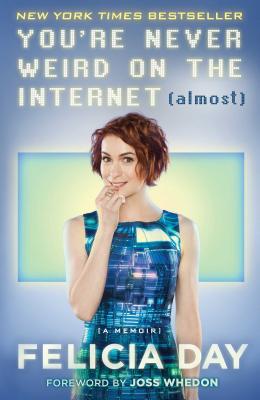
I am not a huge fan of Felicia Day. Don’t get me wrong: I know who she is, I’ve seen some of what she’s done, and I like her. But fan? Not really. And yet, this book appealed to me from the moment I saw the cover (and heard the title). A memoir of an awkward, anxiety-riddled, gamer girl who happens to be a semi-famous actor? Count me in.

And it, as read by Day, was absolutely charming. (I’m sure it was charming in print form, too, but I’d definitely recommend listening to this one.) Day writes about her interesting childhood (homeschooled for “hippie reasons not God reasons”), starting college at 16 (double majoring in math and violin performance), heading to LA and trying to break into the acting business, playing World of Warcraft, and finally, creating her own web show ages before anyone knew what a web show was.

It’s a fascinating journey, and while she has “coffee mug” nuggets of wisdom along the way (I wish I wrote them down; they were pretty great), the best part, for me, was just listening to Day be honest about anxiety, depression, and figuring out how to be the best and most honest person she can be.

She sounds like a delightful person, one I’d happily invite to that dinner party with famous people I’d love to have. And this is an absolutely delightful book.

Bad Feminist

badfeministby Roxane Gay
First sentence: “The world changes faster than we can fathom in ways that are complicated.”
Support your local independent bookstore: buy it there!
Content: There’s fewer than 6 f-bombs, and some other mild swearing. And there’s a whole chapter on 50 Shades of Gray which is frank, but not explicit. It’s in the Sociology section of the bookstore.

I really don’t know what compelled me to pick this up. It’s been on my radar for a while, and I always figured I’d get to it, but why now?  No idea.

I’m glad I did, though.

In this series of essays, Gay takes on not only feminism (the Establishment) but race relations, sexism, culture, and Scrabble. (Well, there’s only one essay on Scrabble.) She’s insightful about relationships, critical about the State of Culture, but most of all, open and honest about the fact that she’s conflicted. She laments the lack of people of color on TV but is critical of the idea of diversity for Diversity’s Sake. (She’s not all that impressed with Orange is the New Black. It’s still a white woman’s story and the diverse characters are often stereotypes.) She admits to finding Blurred Lines catchy, while being disgusted at the content. There’s a whole chapter about the disturbing nature of 50 Shades of Grey while addressing the fact that its popularity shouldn’t be dismissed.

And it was this conflict I found I connected with. Because I’m a conflicted feminist. I don’t live up to Establishment Ideals. And it’s so refreshing to hear the voice of someone outside the establishment — in this case, a first-generation Haitian woman — stand up and say that there’s room in feminism for those of us who don’t fit the mold.

I borrowed my copy from the library, but I need to get this one. There’s an awful lot I need to underline and mark up, and it’s definitely one I want all my girls to read.

Between the World and Me

betweentheworldby Ta-Nehisi Coates
First sentence: “Son, Last Sunday the host of a popular news show asked me what it meant to lose my body.”
Support your local independent bookstore: buy it there!
Content: There is some swearing, including a couple f-bombs and the use of the n-word. It’s in the Sociology section (I think) of the bookstore.

By now, most of you will have either heard of this or read it, I think. There’s not much to say, summary-wise; it’s a letter from Coates to his son concerning what Coates thinks about being a black man in America. It’s sort of rambling, and kind of disjointed; it feels like a series of random thoughts jotted down on a piece of paper as Coates was musing about his place in this world. Which fits, I think.

What it is, really, is damning. Especially if you, as Coates put it, think you’re white. There’s a complacency that comes with being white, with being privileged (even if you’re “just” middle class), that isn’t afforded to those who are not. And Coates, rightly, forcefully, reminds us of that. Reminds us that to be black — particularly a black male, since he’s writing from his own experience — is to bear the burdens of all our complacency. That our “freedom” isn’t free, and that it’s not the military who are paying for it. That all these shootings that are making the news aren’t new, that they have been going on for hundreds of years, and those that think they are white just throw up their hands and turn a blind eye.

One passage that really struck me:

I am ashamed I made an error, knowing that our errors always cost us more. This is the import of history all around us, though very few people like to think about it. Had I informed this woman that when she pushed my son, she was acting according to a tradition that held black bodies as lesser, her response would likely have been “I am not a racist.” Or maybe not. But my experience in this world has been that the people who believe themselves to be white are obsessed with the politics of personal exoneration.

It’s a difficult read, because he condemns everyone and offers no answers. There’s no solutions, possibly because Coates doesn’t have any, and I found that a difficult thing to swallow. I want to know HOW I can change, what I can do to make a difference. Perhaps reading books like this is a start; it has made me aware that there are black men and women who think this way, who believe that they are lesser because we let police arrest and shoot them. Who are not given the same opportunities because they can’t afford to buy a house in the suburbs. Who are treated differently when they walk into stores just because of the color of their skin.

It does make me feel hopeless, in a way. But, on the other hand, I’ve read this and I’ve been made aware. Maybe that’s a start.

Audio book: Big Magic

Creative Living Beyond Fear
by Elizabeth Gilbert
Read by the author.
Support your local independent bookstore: buy it there!
Content: There are a few f-bombs (around fourish, if I remember right) and other mild swearing. It’s in the Creative Non-Fiction section of the bookstore.

Big Magic is what Elizabeth Gilbert calls the act of creation. Sure, she’s a writer, someone who makes their living off of creativity, and so this book — much like The Art of Asking by Amanda Palmer — is nominally written toward those who want to live an artistic life. But, as Gilbert argues in the book, who wouldn’t want to do that?

It’s not a new message: find time to be creative. Make space in your life to be creative. Be open to creative inspiration and connection You will be a happier person for it. And you can just add Gilbert’s voice to that message. She has no patience for people who say they Can’t (that’s a very limiting word) do that. And she has no patience for people who want to Suffer for their Art. She believes — and I buy into this — that happy people are the most creative, and conversely, creative people are happiest.

(As a side note: I used to be more creative, both cross-stitching as well as decorating the house and other projects. They’ve all fallen by the wayside. I suppose that’s one of the reasons I like doing story time every Saturday: it allows me to have a creative outlet.)

It’s an interesting look at art and is incredibly practical about how it can be a part of your life. And while I enjoyed listening to Gilbert read her work, I think this is one I want to buy, to have on hand to read and to share with the children. For while I don’t think it’s an absolute Recipe for Happiness, it’s a good reminder that I enjoy being creative and that I can, in fact, make time for that sort of thing in my life.

Audiobook: Steve Jobs

by Walter Isaacson
Read by Dylan Baker
Support your local independent bookstore: buy it there!
Content: Steve Jobs had a foul mouth. You are forewarned. Also, it’s a bit on the business-y side. It’s in the biography section at the bookstore.

I don’t know why, really, I picked this up. I’m not a computer person, or even an Apple fan (though I do own an iPhone). I needed something short to listen to while I drove around delivering things one day, and this kind of jumped out at me.

It’s a basic biography of Steve Jobs, the founder and eventual CEO of Apple computers and CEO of Pixar. Isaacson, a reporter, was picked by Jobs before his death in 2011 to write this book, and given access to all sorts of information that Jobs, who was someone who valued complete control, usually didn’t divulge.

I did learn a lot of things about Jobs, computers, the 1970s, business and the intersection between all of them. First and foremost: Jobs wasn’t a nice person. Which got me to wondering: are all people at a high level of business — either CEOs or just high up in the business — generally work-obsessed jerks? If so, what does that say about us as a country, that in order to be “successful” and proclaimed “innovative” and “a genius” we have to treat other people like crap?

The other thing I learned about Jobs was that he was just an Idea Man. He worked, sure, but it was managing and thinking outside the box and demanding things of others, but he never really created anything himself. I don’t know if I had any respect for him to lose, but knowing that he just thought up the ideas rather than actually implementing them changed my perception of him.

Did I like the book? Not really. It was kind of long and a little boring. Part of that may have been the narrator, who wasn’t the most engaging. But part of that was Isaacson’s writing: it was meandering and a bit pandering. Not something (or someone) I would want to read again.

The Bitch in the House

26 Women Tell the Truth About Sex, Solitude, Work, Motherhood, and Marriage
edited by Cathi Hanauer
First sentence: “This book was born out of anger – specifically, my own domestic anger, which stemmed from a combination of guilt, resentment, exhaustion, naivete, and the chaos of my life at the time.”
Support your local independent bookstore: buy it there!
Content: A lot of swearing, including multiple f-bombs. Talking about sex, but no actual sex. Probably not interesting to teens, since most of these women are in their mid- to late-20s and older. It’d be in the sociology section of the bookstore.

I got a text from M a while back, with a picture of this, saying (essentially) that she really needed to talk to someone about this. So, I picked it up, just to see what it was.

It is precisely what the cover said it was: 26 women, all employed, some with families, expressing anger at their life situation. I get some of that anger: a lot of the pressure on women is societal. We were told we could have it all, but no one bothered to tell the men that they needed to help out. (Which, truly, seemed the biggest complaint.)

I did find myself identifying with some of the essays: life is tough, and I can see how it not going the way you think it should would equal anger. But, I can’t just muster that; I’m much too tired. I bailed about 2/3 of the way through; I found that I just didn’t care about upper-middle class women’s whining that they can’t have a job and a family and a relationship and everything else. So what? There are people out there who are trying to make ends meet without the help of a nanny.

That’s a bit harsh.

It’s also 12 years out of date, and I felt that time lapse. Maybe things haven’t changed all that much. Maybe they have changed a bit, and maybe not always for the better. But, I’m tired of anger. (I know it’s useful. I’m just tired of it.)

In the end, it just wasn’t the book I wanted to be reading.

The Joy of Living

by Yongey Mingyur Rinpoche
First sentence: “When you’re trained as a Buddhist, you don’t think of Buddhism as a religion.”
Support your local independent bookstore: buy it there!
Content: It’s pretty complex, and somewhat dull, so it’d probably appeal to those who have the patience for it. It’d be in the religion section of the bookstore.

This was for another bingo square. I initially picked it up to cover “a religion you don’t know about” (hard for me, actually) but ended up using it as “popular psychology” because this was less about Buddhism and more about the scientific benefits of meditation.

And there are many: Rinpoche draws upon Western studies proving that the brain is calmer and that people are healthier when you meditate. And he explores some of the Western preconceptions about meditation: how we’re often intimidated by it because it seems so, well, unattainable.

He gives some practical advice for meditating: shorter times, more frequently during the day. And I’ve tried to take some of what he said to heart. During my last “down” time (I suffer from intermittent depression; it’s not chronic, but it is there and it is real), I worked on being attentive to my feelings and breathing through the sadness. I won’t say it worked well (or even much at all), but I did manage to come out of the funk faster than in the past. I need to get into the habit (again; I used to meditate more often) of stopping and unplugging and just Be longer.

I did find that a lot of this was familiar to me through my experiences with yoga over the years. A truly mindful yoga practice (of which I am not doing right now; I still go to yoga, but it’s more about the physical movement rather than a mindful practice) will incorporate elements of Buddhist meditation, I think.

It has made me curious about Buddhism, though. I think I’m going to hunt down and read more.

Between You & Me

Confessions of a Comma Queen
by Mary Norris
First sentence: “Let’s get one thing straight right from the beginning: I didn’t set out to be a comma queen.”
Support your local independent bookstore: buy it there!
Content: There’s a passage with about four F-words, and then a whole chapter on swearing. It’s in the Literary Reference section of the bookstore.

I am not an expert grammarian. I didn’t really pay attention in school when it came to the parts of a sentence or how things are ordered, or when to use (or not use) commas (which I use much too abundantly). But, a good book on grammar? I love that. I don’t know what it is, why I adore learning about this obnoxious language of ours, but I do.

And Between You & Me is a great book on grammar. (Which means I adored it.)

Mary Norris has been a copy-editor at the New Yorker magazine for the past thirty years, so she has some credibility. But, what she also has is a terrific voice. It’s not only readable, she has a snarky streak that is just endearing. She recounts a bit of the history of her time at the magazine, their style differences with the New York Times, and a little bit about how she ended up as a copy-editor. All of which is fascinating.

But what I really enjoyed was a refresher on grammar. Her chapter on commas (where she took on both Melville and Dickens). Or a whole one on apostrophes. (Where she came up with this: “If you are going to put a sign with your family’s name on it in front of your house, as if to say ‘Our House,’ then you wan the plural possessive: The Volts’. And if your name ends in an s you still want the plural, even if it looks terrible: The Norrises’. And if you don’t like it, simply refrain from putting a sign with your name on it in front of your house.” I almost stood up and cheered.) And even the chapter on cursing was entertaining.

I could go on, but i won’t. I’ll just say this: read it. You won’t regret it.

As You Wish

Inconceivable Tales from the Making of The Princess Bride
by Cary Elwes with Joe Layden
read by Cary Elwes (with other actors/directors/etc. reading their contributions)
Support your local independent bookstore: buy it there!
Content: There’s nothing “objectionable”, though the reading level is probably that of high school. It’s in the biography and film sections of the bookstore, but I’d give it to anyone who has a interest in the movie (especially if they are big fans).

I’m late to this party, since this book came out last October. But, I’ve had my eye on it, mostly because I have loved the movie for years (and am constantly surprised how many of my regular daily sayings are actually lines from this movie) and finally got my hands on the audio book.

There’s not much to say about the content: Cary Elwes was asked at the 25th anniversary screening of the movie what he took away from the making of it. He came up with (in his words) a lame answer, and this book was born out of his desire to really detail what the experience meant to him. He got contributions from the actors who are still alive, and a book was born.

It’s not brilliant writing by any stretch of the imagination. But, it is chock-full of fun trivia (yes, I did watch the movie again, spouting out all the wonderful tidbits I’ve learned. My family was patient with me.) and delightful stories.

But, the best thing? (And the reason I’d recommend the audio over the print?) Cary Elwes is a brilliant narrator. Not just his regular voice, but he does a spot-on American accent (several, in fact), and he is just a delightful narrator to spend six hours with.

At the very least, it’ll make you smile. And that, I think, is worth it.