Lilliput

lilliputby Sam Gayton
First sentence: “All down the pebble path to the beach, Lily sulked about her iron shoes.”
Support your local independent bookstore: buy it there!
Content: There’s some abuse and danger, and there are some larger words, but for the most part, this one is suitable for grades 3 and up. It’s in the Middle Grade (grades 3-5) section of the bookstore.

Lily is a young child in the land of Lilliput when this big giant, Gulliver, comes and snatches her away. He takes her back to London to serve as “proof”. It seems, his stories of his travels have been dismissed as fake and so for the sake of his pride, he kidnapped Lily. He has her in a cage while he finishes his book. Lily, however, just wants to be free. Her life span is a lot shorter than Gulliver’s, and she’s spent half of her life in this cage. She needs to be free.

So, she keeps trying to escape. And eventually, she finds some humans who are willing to help her.

It’s an interesting take on Gulliver’s travels, and I enjoyed having it from the point of view of Lily. There’s some nice subtle commentary on the ethics of taking people from their homeland as well as the conditions which children often found themselves in, both in orphanages as well as in apprenticeships. It was a nice change to have the Spanish character be the “good” guy (in addition to him being the stay-home dad while his wife traveled the world).

But, while it all added up to something nice, it wasn’t overwhelmingly compelling, in my view. And that’s too bad.

(Just for the record: because this is a Cybils nominee, I’ve been asked to make sure y’all know this is my opinion only, and not that of the panel.)
A Dragon’s Guide to the Care and Feeding of Humans

dragonsguideby Laurence Yep and Joanne Ryder
First sentence: ”
Support your local independent bookstore: buy it there!
Content: It’s short, there are lots of pictures, and the words aren’t terribly difficult. It’s a great bridge book between beginning chapter and middle reader, and good for ages 7 and up. It’s in the middle reader (grades 3-5) section of the bookstore.

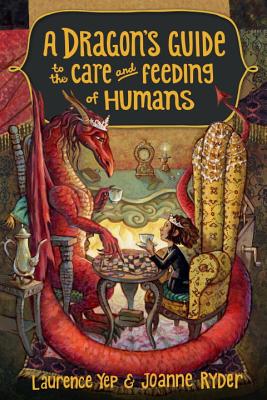
Miss Drake, a dragon who has been around a long time, is happy with her lifestyle. Sure her “pet”, a human she calls Fluffy, recently died and she is grieving that. But when another human, the 10-year-old great-niece of Fluffy (aka Great-Aunt Amelia), comes into her life, she is not at all happy with it.

And thus begins the relationship between Miss Drake and Winnie. Sure, there’s a little adventure with a magical sketchbook and a rabid magic-eating monster, but mostly it’s about overcoming grief of the death of a loved one (Winnie’s father has recently passed away as well) and making friends.

My favorite thing is that it’s written from the dragon’s point of view. Beginning each chapter is a word of “advice” to magical creatures about how to deal with their “pets”, but the narrative is from the point of view of a very old, somewhat cranky dragon. It’s a clever take. That, and it’s blissfully short. Yep and Ryder know their audience, get to the point, and don’t bother putting in a whole lot of backstory. There are clues here and there about Miss Drake’s former pets and Winnie’s family (I’d like to read more about them in other books!), but there are no long-winded passages, no extra words. It’s refreshing.

My  only complaint is that while there is a child character, the protagonist (and the one who propels the action, in the end) is the dragon. And that felt a little off. But other than that, it’s an enjoyable story.

(Just for the record: because this is a Cybils nominee, I’ve been asked to make sure y’all know this is my opinion only, and not that of the panel.)

Mars Evacuees

marsevacueesby Sophia McDougall
First sentence: “When the polar ice advanced as far as Nottingham, my school was closed and I was evacuated to Mars.”
Support your local independent bookstore: buy it there!
Content: There’s several mild swear words and some violence (including bullying). It would be in the middle grade (grades 3-5) section of the bookstore.

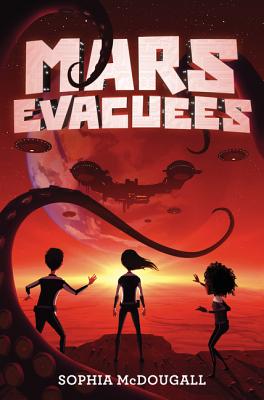
It’s sometime in the future, and the Earth has shared its home with an alien species, the Morrors. The problem? The Morrors are changing the nature of the earth, freezing it over, and that’s got the humans mad. So, they started waging war against the Morrors, trying to kick them out. But it’s not working, mostly because they’re invisible to the human eye.

So, the humans are resorting to evacuating a select group of kids to Mars to train for combat. Alice Dare, whose mother is a star fighter pilot in this war, is one of those kids.

At first, it seems to be like any other boarding school: there are bullies, and Alice makes some friends — another English girl named Josephine and an annoying boy named Carl and his younger brother Noel — and everything seems to be going okay. Then, one day, all the adults disappear.

Most of the school goes haywire, but Josephine and Alice (along with Carl, Noel, and their robot teacher Goldfish) decide that what they really need to do is go find the adults. What they end up finding is a whole lot of trouble.

Oh. My. Gosh. I know the summary didn’t do this justice because it was the most awesome I’ve read in a long time. It’s smart, it’s funny, there’s fantastic characters, it’s packed with adventure, it’s diverse. It kept me hooked from page one through the conclusion. (And while there’s a sequel, this one stands on its own.) It was just so. much. fun.  Seriously.

(Just for the record: because this is a Cybils nominee, I’ve been asked to make sure y’all know this is my opinion only, and not that of the panel.)

Castle Hangnail

castlehangnailby Urusla Vernon
First sentence: “It was a marvelously dark and dour twilight at the castle.”
Support your local independent bookstore: buy it there!
Content: There’s nothing in here that a third-grader (and up) wouldn’t enjoy. Plus lots of white space and illustrations for the reluctant readers. It’s in the middle grade (grades 3-5) section of the bookstore.

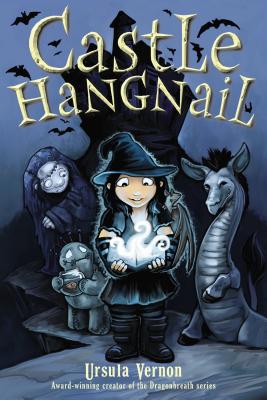
Molly is a 12-year-old twin with a knack for magic. So when her friend Eudaimonia gets an invite to become the Master of Castle Hangnail, a kind of small, run down castle in need of some sort of Wicked/Evil Master in the middle of nowhere, Molly jumps at the chance. Perhaps, if she can learn to become a Master of a castle, she can get the respect she’s been wanting.

However, Molly finds it’s not as easy as saying she’d do it. The Board of Magic has several tasks that she needs to accomplish (among them: securing and defending the castle, committing acts of smiting and blighting, and winning the hearts/minds of villagers by any means necessary) before she can truly be called the Master. Plus there’s the small feat of getting the minions in Castle Hangnail on her side. Not to mention that her parents (and “good” twin sister) think she’s just away at summer camp…

Oh, this book was delightful. So, so very delightful. The tone is a lot like Terry Pratchett’s Tiffany Aching series: a smart, no-nonsense girl who figures out how to be a “wicked” witch with some hilarious side-kicks and a lot of snide asides. There’s so much to love. From the goldfish who always thinks she’s dying to the steam fairy who doesn’t deal with cold well, to the plumber who  “when he knelt to work on the boiler, you sall rather more of Harry than you wanted.” The tone, the characters, even the bullying (which it was, even if it never was called that) were all spot-on and made this book absolutely enjoyable to read.

(Just for the record: because this is a Cybils nominee, I’ve been asked to make sure y’all know this is my opinion only, and not that of the panel.)

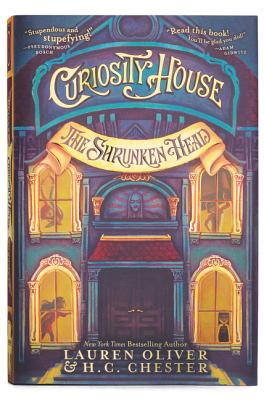
Curiosity House: The Shrunken Head

curiosityhouseby Lauren Oliver (and H. C. Chester)
First sentence: “Ladies and gentlemen, boys and girls: step right up and don’t be shy.”
Support your local independent bookstore: buy it there!
Review copy pilfered off the ARC shelves at my place of employment.
Content: There’s murder and some adult smoking and drunkenness. It’s in the middle grade section (grades 3-5) of the bookstore.

Orphans Philippa, Sam, and Thomas have basically grown up in Dumfrey’s Dime House, a place where unusual kids like them — Philippa is a mentalist, Sam is a strong man, and Thomas is a super-math-genius — are welcome. But, soon after Max (knife thrower extraordinaire) arrives, Mr. Dumfrey’s prize shrunken head goes missing and then people around the city start dying. It’s up to the four kids to figure out what is going on. And, in the process, figure out who they Really Are.

I found the mystery end of this delightful. I thoroughly enjoyed the four kids as they learned to work together and puzzle out who exactly was the person behind the killings. I figured it out before they did, but not much before, and I loved that the clues were there for anyone to pick up. Even the big twist ending wasn’t a huge surprise. It’s only vaguely speculative fiction (mentalist abilities and all that), so it’s perfect for those who don’t want much magic or ficitonal places. The only complaint is one I remember Ms. Yingling having: I wish the historical context was more explicitly put out there. Like her, I was able to figure it out, but I’m not sure that kids would get it (in fact I know so: this is one that my kid review group at work read and they didn’t even notice). Though that’s probably not something that would bother them.

At any rate, it’s a lot of fun.

(Just for the record: because this is a Cybils nominee, I’ve been asked to make sure y’all know this is my opinion only, and not that of the panel.)

Upside Down Magic

upsidedownby Sarah Mynowski, Lauren Myracle, and Emily Jenkins
First sentence: “Nory Horace was trying to turn herself into a kitten.”
Support your local independent bookstore: buy it there!
Review copy pilfered off the ARC shelves at my place of employment.
Content: It’s simple enough for the younger set; probably good for advanced 2nd graders and up. It’s in the middle grade (grades 3-5) section of the bookstore.

Nory has a problem. She’s a witch, and she wants to get into the prestigious magic school that her super stuffy, absent father is head of. All she needs to do is turn into a kitten and hold that form for a few minutes. The problem is that she can’t do it. Well, she can turn into a kitten, but it never is just a kitten: it’s a beaver-kitten, or a dragon-kitten, or some other awful, terrible combination.

sOf course she doesn’t get into the school, and ends up going to a public magic school (the horror) and put in a class for those with “wonky” magic. There’s a kid who floats but can’t come down, another kid who turns into a rock, one who makes it rain inside and another one who is terrifying to animals. They are working to not only accept their magic as valid (in this society, those with wonky magic are Outcasts) and work together to make their magic do something incredible.

I think there’s a certain sort of kid who would love this kind of book. The kind of kid who likes magic stories, who likes an underdog story, and who doesn’t want to smack the adults in the book. I, unfortunately, am not that kid. I was annoyed at the predictable storyline and wanted to smack both the dad (the aunt who Nory ends up with is okay) and the mean girl at the new school. I understand I’m not the intended audience, so even though I didn’t care for it much, I realize that there are kids out there who will. And so I’m glad I read it for that reason.

(Just for the record: because this is a Cybils nominee, I’ve been asked to make sure y’all know this is my opinion only, and not that of the panel.)

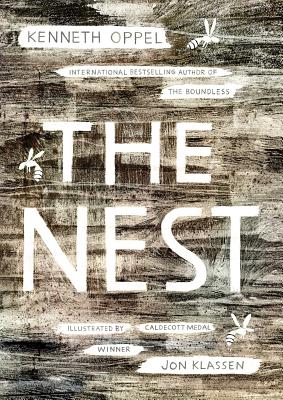
The Nest

by Kenneth Oppel
First sentence: “The first time I saw them, I thought they were angels.”
Support your local independent bookstore: buy it there!
Content: It’s sad and a bit odd, but there’s nothing, content-wise or language-level, that would kick it out of the middle grade (grades 3-5) section of the bookstore.

Steven’s baby brother has been in the hospital ever since he was born. The family and the doctor’s aren’t quite sure what’s going on, and how to fix it. So, when Steven starts having dreams about angels who have come to fix the baby, he figures that he’s either incredibly stressed about it all (which is what his therapist says) or that he’s going crazy (which is what he secretly thinks).

 Then those angels turn out to be a strange new breed of wasp that’s taken up residence in Steven’s house and suddenly what sounded like a good idea — fixing the baby — turns out to be a Horribly Bad One. Especially since Steven is fatally allergic to wasp stings.
This, I think, has to be (hands down) the weirdest book I’ve read. It’s a unique blend of things: mature and yet geared toward younger people; an allegory and a horror tale; both impossibly sad and incredibly strange. I’m not sure it always works as a story. But on the other hand, I kept coming back to it. I wanted to know how it ended, I wanted to know the choices that Steven made and how it all played out. And while I was never truly Terrified (which is why I’m hesitant to call this horror), I was really weirded out. It’s strange, it’s gripping, it’s odd, it’s engrossing.
In the end, I thought it was pretty good. I just have no idea who to sell it to.
(Just for the record: because this is a Cybils nominee, I’ve been asked to make sure y’all know this is my opinion only, and not that of the panel.)

A Curious Tale of the In-Between

by Lauren DeStefano
First sentence: “Pram died just before she was born.”
Support your local independent bookstore: buy it there!
Review copy provided by the publisher.
Content: There’s some slight romance and a few scary moments. It’s in the middle grade (grades 3-5) section of the bookstore, but I’d give it to the older end of that range.

Pram sees ghosts. She has ever since she was a little girl, the theory (of the narrator, anyway) is that it’s because her mother committed suicide when she was 9 months pregnant and the doctors had to revive Pram. But, thankfully, all that’s taken care of in the first chapter of the book, and it’s pretty vague so that it would probably go over most kids heads.

Anyway.

Pram’s best friend is a ghost, Felix. They do everything together because Pram’s aunts have decided that she needs protecting from the world and homeschool her. But then, the State decides that Pram needs to go to school, and so off she goes. Where she meets Clarence, whose mother has just died. (So many dead mothers.) He convinces Pram (much to Felix’s distress) to go searching for a spiritualist in order to contact his mother. It turns out, however, that this spiritualist is not a nice person. Like INCREDIBLY not nice. And so Pram has to figure out how to get out of the clutches of a greedy, evil woman.

This is a weird book. On the one hand, I liked the ghost angle, how Pram could see ghosts and communicate with them and see their memories. Even the creepy weird spiritualist was intriguing and I thought that DeStefano played around with memories and the afterlife was quite original. But the whole relationship with Clarence was a little… odd. It wasn’t quite a romance, but it wasn’t quite just friendship either. I suppose some kids will like it, but I thought it was a bit out of place in a ghost story.

But, aside from that, it was a good book. Not a great one, but a good story.

(Just for the record: because this is a Cybils nominee, I’ve been asked to make sure y’all know this is my opinion only, and not that of the panel.)

Hunters of Chaos

huntersofchaosby Crystal Velasquez
First sentence: “My muscles burn as the thick green jungle vines speed by in a blur.”
Support your local independent bookstore: buy it there!
Content: The characters are in high school and there’s some bullying and a little bit of romance (he like likes me!) but otherwise, it’s appropriate for the middle grade (grades 3-5) section of the bookstore.

Ana is an orphan (oh no!) living with her aunt and uncle, who happen to be enthusiastic scholars and collectors of Mayan artifacts. It’s their heritage, as well as Ana’s, and they’re incredibly proud of it. Even though Ana misses her parents, she’s incredibly happy. Then, the summer before high school, Ana gets a letter admitting her to to her parents’ alma matter, Temple Academy. Her aunt and uncle are a bit wary, but they send her off anyway.

At first, Ana tries to fit in with the super rich, super popular girls, which includes her roommate, Nicole. But, she soon finds out that fitting in costs way too much (both financially and morally). She ends up being friends with Doli, who’s Navajo, and Shani, who’s Egyptian. It turns out that the three of them — four with Lin, who’s Chinese, and a bit of a bully at first — are part of something bigger, something more ancient than any of them had ever expected.

It’s so hard for me not to spoil this book because it really was awesome. Not only are four of the main characters people of color (and descended from ancient civilizations which the author respects, I think) but they do some awesome things. There’s a whole scene near the end of the book that just had me cheering. There was a bit of a bullying dynamic and the love triangle-y stuff was a bit much (More adventure! More magic! Less love!), but it wasn’t enough to get me to dislike this. There’s just so much to love.

Give it to all those kids who are reading the Warrior books. They’d love it.

(Just for the record: because this is a Cybils nominee, I’ve been asked to make sure y’all know this is my opinion only, and not that of the panel.)

Firebrand

by Aaron Barnhart
First sentence: “The boy with the long black hair pushed his way through the shouting, jostling mass of students.”
Support your local independent bookstore: buy it there!
Content: There’s some fighting and battle scenes, but the language is simple(ish) and the book itself is short. It’s in the middle grade (grades 3-5) section of the bookstore.

Fifteen-year-old August Bondi and his family are Jews who are getting by in early 19th-century in Vienna, Austria. Life is good until the law comes down against them, and the Vienna Uprising occurs in in 1848. August’s parents decide that life is too dangerous for their family, and so they flee to America where they hope to have a better life. After a harrowing journey, the family ends up in St. Louis, where August’s parents find work and a community. But August is still restless and settling down doesn’t suit him. So he heads out to the Kansas territory, where he discovers the fight between those who want Kansas to be a slave state and those who don’t. It’s a cause that August can get behind: he is more than willing to fight against slavery and for the freedom of all people. So, he joins up with John Brown and his sons, fighting back against those who would have Kansas be a slave state. It’s a dangerous business, but one that August is willing to sacrifice for. From there, he settles down with a wife and then joins the Greater Cause in the Civil War.

It’s not a bad book, overall, and August’s story (he’s a real person) is a good one to tell. My only problem is that this is really three books. The first book: August’s story back in Vienna. How did he become a part of the resistance? What was it that caught his eye? What was it like being a Jew in Vienna in the early 19th century? So many questions glossed over. The second book is August’s journey to America and perhaps his joining the Browns in their fight against slavery. And the third is August’s time in the Civil War. It’s not that Barnhart can’t write (he can, actually; there were parts of this that were quite interesting), it’s just that he tried to do too much in such a small book and I feel like it would have been better served spreading it out. (And I never think that!)

But it is a good story to tell; it’s always good to hear the lesser known stories of history. (Even if they are more white male stories.) And the fact that it’s set here in Kansas is good as well. But I feel like it could have been better.