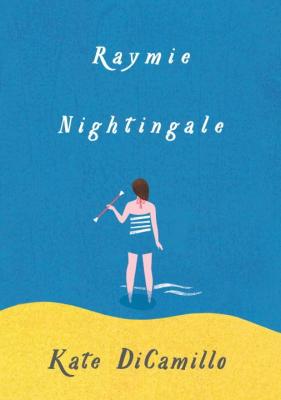
Raymie Nightingale

raymieby Kate DiCamillo
First sentence: “There were three of them, three girls.”
Support your local independent bookstore: buy it there!
Review copy provided by the publisher.
Release date: April 12, 2016
Content: The publisher suggests 10 and up, but I think a 4th-grader would be able to handle it. It will be in the middle grade (grades 3-5) section of the bookstore.

Raymie has a plan. She will take baton lessons — it’s the summer of 1975, after all — and enter the Little Miss Central Tire competition, and win. That way, her picture will get in the paper and her father — who recently ran off with a dental hygienist — will see it and want to come home.

The thing is: her plan (like most plans) doesn’t go as she thought it would. She meets two other girls: Louisiana, whose parents have died and who wants to win the competition as much as Raymie because that means she and her grandmother will have money for more than tunafish;  and Beverly, whose mother is insisting on the competition, but who secretly hates it all and would much rather sabotage the whole thing. Together, the three of them have a summer they will never forget.

In many ways, this is vintage DiCamillo: quiet and unassuming, and yet it reaches something deep inside you. I didn’t want to put it down, not because I was thoroughly invested in the plot or the characters, but because this longing to belong, to figure out what life Means, to find and have friends all spoke to me. It’s a common enough theme, but in DiCamillo’s deft hands it transcends the ordinary. (I don’t know if I can praise this highly enough.) And yet, I think it’s going to be one of those books that adults like but kids just don’t quite get. I think this one sits better with some life experience, and some perspective coming to it. But I may be wrong.

Who ever reads it will definitely be touched, I think.

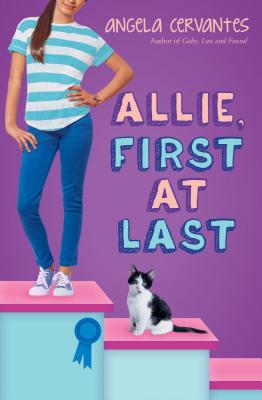
Allie, First at Last

alliefirstby Angela Cervantes
First sentence: “Blame it on Junko Tabei.”
Support your local independent bookstore: buy it there!
Review copy pilfered from the ARC shelves at my place of employment. G
Content: It’s a great book for middle readers, short (but not dumbed-down) with no romance or awkward situations. It’s in the Middle Grade (3-5 grade) section of the bookstore.

Allie comes from a highly competitive family. Her great-grandfather was the first World War II Veteran to get a Congressional Medal of Honor. Her mother has won best anchorwoman four years running. Her big sister is a national debate champion. Her big brother is a soccer star, and her younger sister is an aspiring actress. However, Allie feels like she’s just a string of flops. She can’t win anything, most recently the Science Fair. So when the Trailblazer Award comes along — with a fancy trophy and a $200 prize — she’s determined to win.

This was a cute, inter-generational book without the whole mystical Mexican thing. (Mexicans, yes, but not mystical at all.) I liked Allie’s relationship with her Bisabuela, and how he was able to guide Allie through life experience and stories. I liked that there was a nice moral at the end, but the book itself didn’t seem preachy at all. (I didn’t like that all the kids seem to have cell phones and were super-privileged, but that seemed to fit into the story okay, so by the end I let that go.)

It really is a sweet little story.  Plus: the author is from Kansas, which is nice.


Hour of the Bees

hourofbeesby Lindsey Eagar
First sentence: “Something flies too close to my ear.”
Support your local independent bookstore: buy it there!
Review copy provided by the publisher.
Content: It’s a tricky story, moving between “reality” and “magic” for much of it. Though there’s really nothing content-wise that would be inappropriate for younger readers, they might lose interest with the plotting. It’s in the YA section (grades 6-8) of the bookstore, though I’d give it to a 4th or 5th grader if they expressed interest.

All Carol wants to do the summer before 7th grade is hang out with her friends and have pool parties and sleepovers, but instead she’s stuck out at her grandfather’s ranch in southwest New Mexico, helping her family pack him up in order to send him to a nursing home. Not exactly her idea of fun. And it doesn’t help that her grandfather is suffering from dementia, either. It’s shaping up to be a long, hot, boring summer.

Except, once she gets there, Carol finds out that her grandfather is full of crazy, magical stories, ones that may or may not be true. And, over the course of the summer, Carol decides that maybe it’s not too bad.

Okay, that’s not exactly all there is to it. There’s a whole thread about a drought, and a tree, and bees taking away the rain that, honestly, I didn’t find all that interesting.

Maybe I should start with the good: I really like that there’s a book out there that deals with grandparents, dementia and death. It’s something that children do need to deal with, and it’s good that there’s a book that does take something like moving a grandparent out of the house and into a nursing home as well as tackling the mood and personality swings that come with dementia.

That said, this smack WAY too much of the Magical Mexican for me. Truthfully, it may just be me (though as I was relating it to E — who’s Mexican — she said, “Um. No.” But she may have been biased from my retelling); please let me know if you read it and you think I’m wrong here. But, I felt like the whole thing of “needing to get back to your roots” and the whole magical realism story thing just didn’t work. Yes, roots are important. But, so is change and growth. You don’t need to sacrifice one for the other (and I felt like Eagar was coming down firmly on Family and Roots are Very Important, especially since we’re Mexican).  It just felt… forced. Off. Not quite natural. And then there was Carol’s whole flipping from being a city girl to being a ranch hand at the end. I just didn’t get WHY. Was it her grandfather’s stories? Where did this deep connection to her roots come from? Why did it happen so suddenly, and so deeply that she would do drastic and rash things at the end? It didn’t make sense to me. (Again: it may just be me. I’ll admit I skimmed a lot.)

At any rate, it ended up not being one that I really loved.

Booked

bookedby Kwame Alexander
Support your local independent bookstore: buy it there!
Review copy pilfered off the ARC shelves at work.
Release date: April 5, 2016
Content: There’s a wee bit of romance and some difficult situations with bullying and divorce. Give it to readers ages 10 and up. It will be in the middle grade (grades 3-5) section of the bookstore.

The thing that I admire most about The Crossover was the style of it all. The way the poetry flowed on the page, the way that Alexander captured the rhythm of his characters in the ebb and flow of the poetry.

And lest we think lightning only strikes once, Alexander gives us Booked, repeating much of what I loved about his first book.

Instead of basketball, this time Alexander immerses us in the world of competitive soccer. Nick and his best friend Coby are extremely good, playing not only in competitive leagues but also for fun on the weekend plus the FIFA video game. It’s their whole life. Except, for Nick, it’s not that simple. His parents are going through a rough patch, and they separate so his mother can go help train a horse for the Kentucky Derby. His dad is a linguist and insists that Nick read this dictionary that he wrote, something that Nick resents. And, he’s bullied by these twins at school. There are bright spots: his mother makes him take this etiquette class, but there’s this girl he kind of likes (and who kind of likes him back). And the librarian at school is WAY cool. So, maybe Nick can find a balance in his life after all.

Not only is the story complex and compelling, I again, adored the poetry. Alexander has a way of making something as “stuffy” as poetry accessible and cool, which is wonderful.  I loved how the voice and the form of the poems changed depending on the characters (Nick was ostensibly our narrator, but there were appearances from other characters as well). I loved the footnotes with definitions of some of the bigger words (including snarky asides).  It’s fun and engaging, and yet Alexander tackles tough subjects like bullying and divorce with grace and ease. It’s not just a smart way to get reluctant readers interested in books or unsure kids interested in poetry. It’s a fantastic book.

Completely Clementine

clementineby Sara Pennypacker
First sentence: “As soon as I woke up Monday morning, I flopped onto the floor with my drawing pad.”
Support your local independent bookstore: buy it there!
Review copy snagged from the ARC shelves at work.
Others in the series: Clementine, The Talented Clementine, Clementine’s Letter, Clementine, Friend of the Week, Clementine and the Family Meeting, Clementine and the Spring Trip (I thought I’ve read them all, but I guess I missed one!)
Content: It’s short, there’s lots of illustrations, and it’s perfect for beginning readers. You don’t have to read the series in order, but it does help a little.

I have a confession: this book came out in hardcover a year ago and I just couldn’t bring myself to read it. I couldn’t, not after eight years of loving Clementine, believe that it was coming to an end. So, I put it off. And put it off. But the paperback came out a bit ago, and I got brave and decided that maybe good things can come to an end.

Interestingly enough, that’s the theme of this last Clementine book. It’s the end of 3rd grade, and Clementine doesn’t want to move on. She doesn’t want to leave her teacher and move on to fourth grade. It’s all so new and scary. It also doesn’t help that she’s not talking to her father because she’s become concerned about animal rights and he won’t become vegetarian like her. Oh, and her mother is about to have another baby.

Pennypacker does with this one what she’s done in all the Clementine books: gives us a normal, every-day kid with a normal, every-day family and makes it super interesting. Clementine is such an affable character in all her normalness, that every kid can relate. Change is hard, and Pennypacker captures that resistance in Clementine. It’s charming, sweet, endearing, and cute. All the things I’ve come to expect from this series.

I’m just sad to see it end.

The Wild Robot

wildrobotby Peter Brown
First sentence: “Our story begins on the ocean, with the wind and rain and thunder and lightning and waves.”
Support your local independent bookstore: buy it there!
Release date: April 5, 2016
Review copy provided by the publisher.
Content: It’s fairly large print, with illustrations. It’s good for third grade and up (and is in the middle grade section of the bookstore), but would make a great read-aloud for younger kids.

After a hurricane, the ROZZUM unit 7134 robot washes up on the shore of an uninhabited island. The robot is inadvertently activated by some otters, and Roz (as she introduces herself) comes on. She doesn’t know that she isn’t supposed to be on the island, so she sets about trying to figure out what this place is and how to fit in. She initially meets resistance from the animals: they call her a monster and try to run her off the island. But, through time and some cleverness, Roz learns to adapt. She makes friends with the beavers. She accidentally orphans a goose, but then adopts him as her son. She learns how to fit in.

There really isn’t much to this book; there’s a lot of narration and an intrusive narrator that I didn’t mind terribly much. Because of that, I think this would probably make a better read-aloud than one kids are going to want to pick up. That said, I tossed it in K’s direction for a book report, and so far she’s enjoying it. It helps, I think, that the chapters are short (some as little as one page) and there are illustrations liberally scattered throughout.

In the end, I found I really liked it. I came to really care about Roz and her relationship with the animals. And while I didn’t really care for the abrupt ending (sequel, anyone?), I cared about the journey. And it was an interesting mix of tech — Roz was able to use her computer database to find out answers — and nature — the winter was rough, animals (even though they were talking) died.

A very intriguing book, in the end.

The Magnificent Mya Tibbs: Spirit Week Showdown

spiritweekshowdownby Crystal Allen
First sentence: “I’m only wearing five braids to school today.”
Support your local independent bookstore: buy it there!
Review copy snagged from the ARC shelves at the bookstore.
Content: There’s a bit of mean girl-ness, and bullying, but the language is simple and the story pretty straight-forward. Give it to a strong second grade reader and up.

Fourth grader Mya Tibbs’s elementary school always has a Spirit Week competition right before the fall festival in their small Texas town. It’s always a tough competition, but this year the stakes are higher: VIP seats to the festival. Mya is sure that she and her best friend, Naomi, are going to win. Except they don’t get chosen as partners: Mya is paired with the school bully, Connie. And she won’t trade. Which makes Naomi more than mad, it means that she and Mya are no longer best friends. Period.

But as Spirit Week goes on, Mya realizes that she’s having fun with Connie, and that maybe things aren’t exactly what they seem.

This was such a charming school story.  The stakes weren’t high, but a fourth grader, they were high enough. Friendship is important, as is doing something fun and doing it well. And even though the whole pageantry of the Spirit Week felt really implausible (all the people were SO good at everything they did!), I rolled with it. I liked that Mya figured out what a real friend is like, and found out that she could stay true to her interests and herself on her own time line. It was wonderful that the main character was a person of color, as well. It’s a great early chapter book.

The Charmed Children of Rookskill Castle

charmedchildrenby Janet Fox
First sentence: “It is 1863.”
Support your local independent bookstore: buy it there!
Review copy provided by the publisher.
Release date: March 15, 2016
Content: There’s some scary imagery, and the narrative is a bit confusing. I’d give it to a precocious 3rd grader, but definitely 4th and up. It will be in the Middle Grade (grades 3-5) section of the bookstore.

At first glance (at least for me), this looks like a kind of off-beat historical fiction. It’s the middle of WWII, and the children in London are being sent out to the countryside in order to escape the bombing. Kat and her siblings Robbie and Amelie are among those kids sent away, in this case to a castle in Scotland where a boarding school of sorts has been set up.

But things aren’t always what they seem. Including this book.

Rookskill Castle is a dark place (and not just because fall in Scotland is dreary), and the lady of the castle is up to something. Kat is sensible and practical, and not at all inclined to believe that what it going on could be dark magic.

And yet.

I loved this book, with reservation. On the one hand, the story was compelling — by the end, I was flying through it — and I adored Kat. She was practical, mechanically-minded and good at math, all things you don’t usually get from fantasy heroines. She was also willing to admit when she’s scared, and the boys were mostly willing to support her in the decisions that had to be made.

However,  I have issues when I know more than the characters. Fox flits back and forth through time, from WWII backwards to the mid-1800s, in order to give the reader the backstory of the castle. I’m not the most careful reader, and so I was able to piece things together before the characters did. I’ll admit it kind of heightened the tension — I wanted Kat to figure things out before they got too bad — but I was also annoyed that it took her so long. In the end, I found I didn’t mind so much, but it did niggle at the back of my mind while I was reading,.

The magic, however, was great. I loved the way Fox wove good vs. dark magic, and how it was a very practical sort of magic as well. That much — plus the  general, overall creepiness — definitely nakes the book worth reading.

Fridays with the Wizards

fridaysby Jessica Day George
First sentence: “It was good to be home.”
Support your local independent bookstore: buy it there!
Others in the series: Tuesdays at the Castle, Wednesdays in the Tower, Thursdays with the Crown
Content: These books are so great for those middle readers who don’t like super long books, but want action-packed stories. Not too many difficult words, and George keeps them short and sweet. It’s in the middle grade (grades 3-5) section of the bookstore.

Now that Castle Glower is whole again and Wizard Arkwright is captured, Celie figures her work is done and she can just go back to normal. Except that normal isn’t, well, normal anymore. Lilah and Lulath are engaged (yay!) and so there are preparations to go to Grath and meet Lulath’s family. The king decides that a ship really needs to be built. And people keep bonding with all the baby griffins, though they soon learn that it’s the griffins who choose, not the people.

Celie isn’t happy with all these changes, but she can deal. Until they discover that Wizard Arkower has escaped his prison and is creeping around the secret passageways of the Castle. Celie’s the one who knows the Castle best, and so it falls on her to figure a way to capture the wizard. If she can.

This series is such a delight. I love that the family is a good one, that Celie has challenges that are outside of her family and that her family is generally supportive of her as a person. It’s wonderfully refreshing. I also enjoy that these books build on each other while offering an individual adventure that actually comes to a stopping point. No real cliffhangers, which is nice. And that she writes at a kids’ level without talking down to them. It really is a fun series. I’ll definitely be sad when it ends.

As a bonus, I got to host her here for school visits and a store event a couple weeks ago. She’s just as delightful as her books!

IMG_5775

The Key to Extraordinary

keytoextraordinaryby Natalie Lloyd
First sentence: “It is a known fact that the most extraordinary moments in a person’s life come disguised as ordinary days.”
Support your local independent bookstore: buy it there!
Review copy pilfered off the ARC shelves at my place of employment.
Release date: February 23, 2016
Content: It’s short(ish) and the words aren’t too terribly difficult, but there’s kind of a little romance, so maybe it’s not for the 3rd graders? It’s in the middle grade (grades 3-5) section of the bookstore.

The women in Emma’s family have had a long history of doing Extraordinary things. They have a dream, which they call their Blue Wildflower dream, and in that dream they are Shown Their Path, the way in which they’ll be extraordinary. At almost 13, Emma’s convinced that in spite of all this, her life won’t be that special. She lives in a smallish town in Tennessee, and while she loves her Grandma Blue and the cafe she runs, where Emma’s older brother is the baker, there really isn’t much else.

Then Emma gets her wildflower dream, and it doesn’t make sense.  Then developers start sniffing around the cafe, wanting to buy it, and suddenly maybe Emma can piece together some lost history and save the cafe while filling her destiny.

I liked Snicker of Magic quite a bit, and I like Southern Quirky (as Ms. Yingling calls it), but this one didn’t work for me.  I’m not sure I can pinpoint why, though. Maybe it’s a bit of a reading slump (I tossed aside about four books partially read before I settled on this one), maybe it’s that I’m a bit under the weather. Either way, Emma and her plight didn’t sit with me. It even had a Nice Moral at the end: follow your dreams and expectations and don’t let the accomplishments of the past make you intimidated (or at least I think that’s the message), but I kind of just shrugged and said, “Meh.”

Which is too bad. I did want to like this one more.