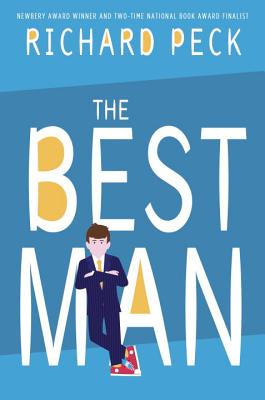
The Best Man

bestmanby Richard Peck
First sentence: “Boys aren’t too interested in weddings.”
Support your local independent bookstore: buy it there!
Review copy provided by the publisher.
Release date: September 20, 2016
Content: There’s some bullying and it’s not really action-heavy. But I’d give it to a 4th grader and up. It’ll be in the Middle Grade (grades 3-5) section of the bookstore.

Archer Magill is just trying to figure things out. As a 5th (and then 6th) grader, he’s kind of clueless. About girls, about friends, about life. And so, he’s looking for role models and he’s found three: his dad (who’s a really great dad), his grandpa (who’s pretty awesome), his Uncle Paul (who’s incredibly cool). And then, a student teacher, Mr. McLeod comes into his life.

Actually, this isn’t a book about an awesome male teacher, thank heavens. Event though there’s an awesome male teacher. No, it’s more about Life, and Figuring Things Out, and Friendship. And how other people’s lives intersect with ours. And the Chicago Cubs.  It’s a Slice of Life novel, one that is full of charming characters and a great family. And one that, refreshingly, treats a LGBT relationship as something that’s to be celebrated. No, our main character isn’t gay, it’s not a coming out book for kids. There’s no angst in this book. It’s a story where the LGBT relationship is a part of who the people are, and that’s okay.

It’s a funny, sweet, refreshingly charming novel, and I adored it.

Nine, Ten

ninetenby Nora Raleigh Baskin
First sentence: “Everyone will mention the same thing, and if they don’t, when you ask them, they will remember.”
Support your local independent bookstore: buy it there!
Review copy provided by the publisher.
Content: It handles the tragedy of 9/11 on a level that is appropriate for the 3rd-5th grade crowd. It’d also make an excellent read-aloud. It’s in the middle grade section (grades 3-5) of the bookstore.

Everyone (well, everyone of a certain age and older) knows the story of what happened on 9/11. But fifteen years on, there isn’t as many of the kids who know about that day. And so, Baskin helps introduce the tragedy through the stories of four eleven-year-old kids for the forty-eight hours before the planes hit. There’s Sergio, an African American kid from Brooklyn who is trying to make a better life for  himself but whose deadbeat dad is getting in the way. There’s Aimee, who has recently relocated from Chicago to L. A. and whose mother has a meeting in New York City that week. And there’s Will from Pennsylvania, whose father died in a freak accident and who is trying to get over that. And there’s Nadira, a Muslim girl from Ohio, who is trying to figure out the whole middle school thing. 9/11 changes each of their lives — though I’ll spoil it: no one has anyone they love die — in ways they could not have expected.

The thing I liked best was not so much the stories, or wondering how it would all play out (and wondering if Baskin would kill anyone). It was that Baskin caught the emotion of the day so very well. I was in Mississippi, having recently moved from DC, and I remember being caught up in the worry and horror and concern during it all. I wasn’t in the middle of it; I couldn’t imagine being in the middle of it. But, I, like many Americans, was affected by it. And Baskin caught that feeling perfectly.

I’m hoping this, along with Towers Falling, will spark a discussion about unity and how, no matter what we look like or believe, we can work to get past anger and mistrust and hate and be better citizens together. I hope, at the very least, that this one gets read and discussed.

The Adventurer’s Guide to Successful Escapes

adventurersguideby Wade Albert White
First sentence: “At Saint Lupin’s Institute for Perpetually Wicked and Hideously Unattractive Children, every orphan is treated with the same amount of disdain and neglect.”
Support your local independent bookstore: buy it there!
Release date: September 13, 2016
Full disclosure: I had dinner with the author at Children’s Institute, and think he’s delightful.
Review copy provided by the publisher. I met the author at Children’s Institute 4
Content: There’s some biggish words, and a wee bit of violence, and maybe some of the humor will go over the heads of the younger kids, but mostly it’s just fine for the middle grade (3-5th) grade set, which is where the book is located at the store.

Anne has spent her whole life at Saint Lupin’s Institute, working and wishing she knew where she came from. She has a plan: when she gets to leave when she turns 13 (everyone is kicked out because the Hierarchy stops supporting them), she’s going to go adventuring and looking for her past. However, when her birthday comes, the Matron denies Anne the right to leave. That starts a chain of events that leads Anne to accidentally stealing a gauntlet (a metal hand thingy) and a prophecy medallion, that starts a Rightful Heir Quest (an unheard of Level 13!), which gives Anne and her friends Penelope and Hiro, four days which to fulfill. It’s not an easy thing: solving riddles, finding weird robots, traveling by fireball, but someone’s got to do it. And maybe save the world (and pass Questing 101) while they’re at it.

I haven’t had this much fun reading a book since The Hero’s Guide to Saving Your Kingdom. It’s got the same sort of off-beat humor, full of puns and plain silliness. It’s different though; the world that Anne is on is one that isn’t fully fleshed out. It feels like an old-fashioned fantasy, but there’s robots and computer screens and elevators… and mention of an Old World. Is it scifi or dystopian?  I wasn’t sure. (Actually, I do have a working theory of the world, but I’m going to keep it to myself, until I figure out whether I’m right or not.) But, in spite of those questions, I enjoyed this one thoroughly. It was fun, it was funny, it was clever, and it was pretty much exactly what I wanted out of a middle grade fantasy.

I’ll definitely be picking up the next one when it comes out.

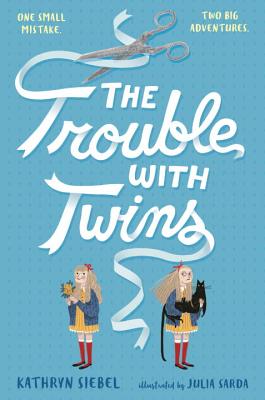
The Trouble with Twins

troublewithtwinsby Kathryn Siebel
First sentence: “And so it begins in front of the fire, the story of two twin sisters.”
Support your local independent bookstore: buy it there!
Content: There’s some neglectful treatment of kids and some awful parenting, but nothing physically harmful. It’s in the middle grade (grades 3-5) section of the bookstore.

Arabella and Henrietta are twins (in some distant past). Arabella is the beautiful, smart, sweet one and Henrietta is… not. (Before I get too much further, the better sister story, if maybe a bit more mature for this age group, is Jacob Have I Loved which is one of the more powerful reading memories I have as a child.) Henrietta is neglected, ignored, unloved. And so when she tries to get attention by cutting Arabella’s bangs off (they seem a bit old for those kind of shenanigans, but maybe that’s me projecting), she’s banished to Great-Aunt Priscilla’s house. Where she’s basically Cinderella. That is, until Arabella decides she misses her sister and goes looking.

It’s kind of a Lemony Snickett/Roald Dahl feeling book, where there’s bad adults (but not quite as bad as Dahl) who are neglectful and hate children and it’s the good, long-suffering child who gets the reward in the end. And in that light, it’s a good little book. The thing that got me was the intrusive narrator. Usually, I don’t mind them. But, this time the framing conversation between a mother and daughter just grated. I think it was meant to be cute, but it just didn’t work for me, and as a result the whole book fell flat.

I think I’ll see if any of my Dahl kids are interested in this one; maybe it’s just me being overly sensitive.

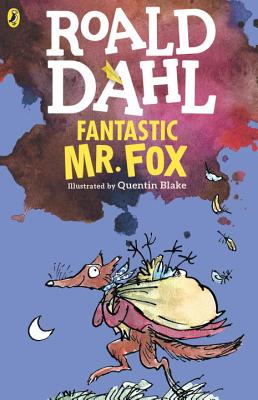
Fantastic Mr. Fox

fantasticmrfoxby Roald Dahl
First sentence: “Down in the valley there were three farms.”
Support your local independent bookstore: buy it there!
Content: It’s short, it’s sweet, and it’s simple. So, even though there are no children as protagonists, it’s in the Middle Grade (grades 3-5) section of the bookstore.

The plot is simple: Mr. Fox steals poultry from the farmers Boggis, Bunce and Bean. Who, according to the book, are awful, ugly (of course), greedy people. So, they decide that they will make it their business to get rid of Mr. Fox. But, he proves too clever by half, the end.

I really don’t have much more to add, since my opinion of it hasn’t changed in six years. But, I do want to mention the book group discussion. It was a LOT of fun. First off, the kids liked it a LOT more than I did, deciding that it was just a lot of silly fun. In the process of prepping for the book group, I came across this website called Teaching Children Philosophy. And they had a module on Fantastic Mr. Fox, which proved to be the jumping ground for a really interesting discussion. Which almost made the meh book worthwhile.

It’s been a LOT of fun doing the Dahl book club this year. The kids were great, and the discussions a ton of fun. Hopefully, I can find something just as grand next year.

The Girl Who Drank the Moon

girlwhodrankby Kelly Barnhill
First sentence: “Yes.”
Support your local independent bookstore: buy it there!
Review copy provided by the publisher.
Content: Although this is masquerading as a middle grade novel, it’s really an upper-middle-grade/mild YA novel. There’s not much, content-wise, that would be inappropriate for the younger set, I’m just not sure how well they’d follow the plot. It’s either for those contemplative readers who want to immerse themselves in a slow story, or older readers who are looking for something lyrical.  It’s in the middle grade (grades 3-5) section of the bookstore (though it could easily go in our YA — grades 6-8 — section).

It’s hard to know where to begin with this one. There’s a girl — Luna — who was a baby left beside the road by a town that believes unless they sacrifice one baby, the witch will destroy their village. There’s a witch — Xan — who has been rescuing the babies from the village for years, depositing them in homes where they are cared for. She takes Luna, and decides to raise her. There’s a Perpetually Tiny Dragon and a swamp monster. A madwoman in a tower, and a  young man who defies the town council. There’s a lot going on in this novel, and yet, there also isn’t a lot. It’s a very small story about home and family and doing what’s right over what’s convenient. But it’s a larger story, as well: about home and family and doing what’s right over what’s convenient.

I do have to admit that while I found the language beautiful and I thoroughly enjoyed the story, I did keep wondering what sort of kid was going to pick this one up. It’s so different from the standard Middle Grade fare (probably for a good reason): much slower, much more contemplative. I do hope it finds an audience, because it really is a beautiful story.

The Twits

thetwitsby Roald Dahl
First sentence: “What a lot of hairy-faced men there are around nowadays.”
Support your local independent bookstore: buy it there!
Content: This one’s slim, with lots of illustrations and simple words. It’s perfect for those younger readers who want an introduction to Dahl and for reluctant readers. It’s in the middle grade (grades 3-5) section of the bookstore.

For the record: I’m beginning to think that Dahl wrote kids books so he could be grumpy about parenting and social trends and disguise it as “humor” for kids.

This time, he’s upset about beards, about cruel adults (he’s always upset about cruel adults; I also think he thinks most adults are cruel), and about the mistreatment of animals (which is a new one).

The plot: the Twits are horrible people. They’re ugly (as are all horrible people in Dahl’s books), they treat each other horribly, they treat their pet monkeys abominably. and then they get their comeuppance. End of story.

And yet, it was funny. The Twits’ pranks on each other were pretty silly and (mostly) harmless. The way the monkeys got back was absolutely brilliant (if implausible), and I admit, I did laugh. (K on the other hand, would HATE this book. She has a real problem with humor at the expense of other people.)

I’ll be interested to see what the kids think of it at book group.

The Witches

witchesby Roald Dahl
First sentence: “In fairy-tales, witches always wear silly black hats and black cloaks, and they ride on broomsticks.”
Support your local independent bookstore: buy it there!
Content: It’s not as scary as I thought it would be, and surprisingly simple for the size. Heads up, though: grandma smokes a cigar. It’s in the middle grade (grades 3-5) section of the bookstore.

So, I remember reading this one at some point, and I had a violently negative reaction to it. I HATED it. So, I was a bit wary going in this time. But, since I picked this for the Roald Dahl book club, I needed a re-read going in.

And it’s…. weird. I was asked if it was “good”, and I said “It’s weird.” “Does that mean it’s bad? ” Nope. Just weird.

The basic plot? There are witches out there, and they look like us. Except they always wear gloves, and a wig (to cover their bald heads) and the have no toes. They hate children and make them disappear. They are, at all costs, to be avoided. So when our narrator (whose childhood sounds suspiciously like Dahl’s), accidentally ends up in a ballroom full of witches, he’s (understandably) terrified. Especially after he hears their master plan for the children of England: make a time-release mouse potion, put it in candy, and voila! No more children. They’ll all be mice.

Except our narrator doesn’t make it out in one piece: he’s caught and turned into a mouse. But, he can talk and he can still think like himself so he goes and convinces his grandma that he’s still her grandson. And informs her of the Grand Plan. Which they, unbelievably, thwart. But our narrator remains a mouse, which is just fine with him because then he won’t outlive his grandma.

Weird.

There are the usual Dahl themes: adults hating kids, and good kids being bullied (by the witches). But it really feels different from the other ones I’ve read. Matilda is darker, and Charlie is more didactic. I’m not quite sure what The Witches is other than… weird.  Was it supposed to scare kids? Was it supposed to just be amusing? (It wasn’t.)

This one’s going to be an interesting discussion at book group.

Towers Falling

towersfallingby Jewell Parker Rhodes
First sentence: “Pop groans.”
Support your local independent bookstore: buy it there!
Release date: July 12. 2016
Content: It’s simple enough that the younger set can understand it but complex enough that it won’t bore the older kids. It’ll be in the Middle Grade (grades 3-5) section of the bookstore.

Deja is starting over at a new school, but not by choice. Her family was evicted from their home in Brooklyn, and they’ve moved into a homeless shelter closer to Manhattan. It’s not a happy situation; her father suffers from headaches and can’t hold down a job, and her mother — an immigrant from Jamaica — can only work so many hours.

So, when Deja’s new school starts studying the terrorist attacks on the World Trade Center on 9/11, Deja wonders what on earth it has to do with her. But, as the weeks and months go on — and she learns more about the attacks that happened before she was born — she and her friends Ben and Sabeen learn that no one is unaffected by history.

Rhodes is doing a couple of things here: first, she’s telling the story of the towers falling for kids who may not know anything about it. Sure, it’s not super distant history, but there are still kids who aren’t really familiar with it. And I’m not sure how much it’s being taught in schools (C got it a lot, A got a lesson or two in 5th grade, and I’m not sure anyone at school has brought it up for K) anymore. So, there definitely is a need for a reminder. But, Rhodes has gone bigger than just “hey kids, this happened” history. She’s encompassing issues of kids being homeless, of religious tolerance (Sabeen is Muslim, and she and her family face discrimination because of that), of diversity. She strikes a nice balance in the book between teaching the kids and preaching to them, and  manages to be diverse and moral-centric without being didactic and moralistic.

It’s definitely a book worth checking out.

The BFG

thebfgby Roald Dahl
First sentence: “Sophie couldn’t sleep.”
Support your local independent bookstore: buy it there!
Content: There’s a small bit of violence, but for the most part, it’s easy enough for the youngest of the grades 3-5 set. It’s in the Middle Grade section of the bookstore.

Sophie is up late one night in her orphanage when she sees something coming down the street. That something turns out to be a giant, who plucks her out of the orphanage and takes her back to his land. He says it’s because he needs to keep her safe,  because there are other, bigger, badder giants around. And he’s not wrong: the giants back at the stomping ground ARE bigger, badder and meaner.

(And that’s where Dahl’s overall themes come in: the BFG is the “runt” of the pack and is constantly being picked on. He’s also more evolved, and smarter, and just better than those bullies.)

Sophie experiences life with the BFG, and together they decide that the other giants need to be stopped (mostly because they eat children; though the BFG’s argument for it was pretty persuasive…). So they go to the Queen (really, my favorite part), convince her of the existence of the giants, and get her help in stopping them.

Perhaps it’s just the order I’ve read these, but this one is now my favorite. I loved the Seuss-like wordplay that went on with the way the BFG talked. I liked the friendship between Sophie and the BFG, and I thought their solution to the problem was pretty ingenious. It’s a delightful book, much less dark than Matilda or as mean as Charlie. So far, this one is the best.