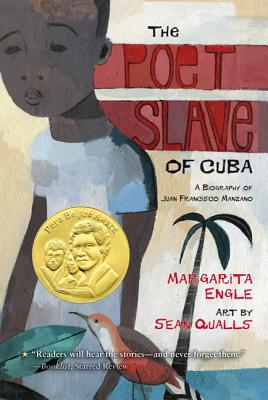
The Poet Slave

by Margarita Engle
First sentence: “My mind is a brush made of feathers”
Support your local independent bookstore: buy it there!
Content: There is talk of torture and beatings, but nothing graphic. It would be in the middle grade (grades 3-5) section of the bookstore.

This slim novel (sort-of; it’s touted as a biography, and it is biographical, but I’m not sure it really counts as a “biography”) depicts the childhood and early life of noted Cuban poet Juan Francisco Manzano, who was, for much of his life, a slave. Although the verse is spare, Engle doesn’t hold anything back: Juan was not only taken from his parents to be a pet of his first master, he was denied his freedom (his first master willed him his freedom at her death) and sold to a horrible woman who beat, tortured, and nearly killed Juan. The poems/chapters are told from varying points of view: Juan, his parents, his owners, and one of his master’s sons. They tell of his desire to learn, to express himself, and the punishments he received because of them. It’s heartbreaking.

Engle has captured not only the difficulties that Juan faced in his life, but his capacity for hope, for happiness, and for creativity. Her poetry is beautiful, and she allows Juan’s story to come through.

Definitely recommended.

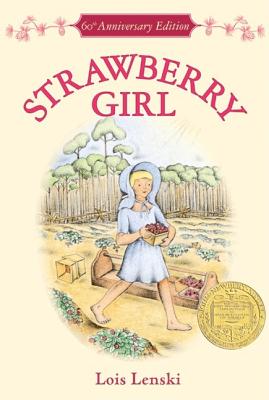
Strawberry Girl

by Lois Lenski
First sentence: “‘Thar goes our cow, Pa!’ said the little girl.”
Support your local independent bookstore: buy it there!
Content: It’s written in dialect, which might throw some readers off. It’s in the Newbery award section at the bookstore.

I remember reading this one when I was really young, maybe 2nd or third grade, when I was going through my pioneer stage. I was fascinated with old fashioned life, and the way settlers lived, and this one, though set in the early 1900s, fit that bill.

Birdie and her family have bought a house and land in mid-Florida, intending to start a strawberry farm and orange orchard. Their neighbors, the Slaters, who have lived on the land for several generations (though probably squatting, technically), have issues: they don’t like Birdie’s families uppity ways, their fences, their ambition. It’s only through long-suffering, hard work, and kindness that Birdie and her family make it through their first year,

Honestly, I think this one holds up pretty well. Lenski interviewed a lot of “Crackers”, original white settlers in Florida, and used their stories as a basis for this book, which gives it an understanding that would be missing if she hadn’t. I liked Birdie, her fire and her determination, and I was surprised at just how spiteful the Slaters were towards these outsiders. There’s also a strong class division running through the book — one I’m sure I didn’t pick up on as a kid — with Birdie’s family being able to afford nice things because they were disciplined. This plays into the “American dream” narrative — if you just work really hard, you’ll be rich — which I’m not sure is a good narrative to have around anymore. And the ending was surprisingly religious: you find God, you can be saved and change your evil ways. Even so, it was a sweet little book.

Module 4: The Grey King

Cooper, S. (1975). The Grey King. New York, NY: Scholastic.

Genre: Fantasy, Newbery winner. Definitely fantasy, as it pulls from mythology and uses magic. And a good example of a Newbery winner.

Book Summary: Will, who in an earlier book in the series realized he was an Old One, and tasked with protecting the world from the rising forces of the Dark, is convalescing in Wales, recovering from a bout of hepatitis. While there, he meets Bran, a strange local boy who helps Will fulfill part of a prophecy by stopping the Grey King from garnering his forces and waking the Sleepers in preparation for the final battle.

Impressions: This is the fourth in a series, so reading it as a stand-alone probably isn’t recommended. However, I routinely re-read the second, The Dark is Rising (which, incidentally, does work as a stand-alone), so I felt comfortable dipping into this world out of order. However, for those who approach this as a stand-alone will probably be lost. There is a lack of character development, especially with Will (because you’re already supposed to be familiar with him), but also Bran, though he has a greater character arc. Cooper is a master storyteller, deftly weaving personal concerns — the neighbor who is convinced that Will’s uncle’s dogs are killing his sheep — with a greater sense of menace and tension. There is a moment when Bran’s dog is killed, and the tension between Bran and Will is palpable, especially because, as a reader, you can relate to Bran’s frustration with being a player in a higher plan and struggling with a sense of a loss of freedom because of that. Cooper’s writing is tight and elegant as well, accessible enough for younger readers (though probably not as young as eight), but smart enough to keep an adult turning pages. My only issue is that in spite of the “lesson” on speaking Welsh, I know I still don’t pronounce the names right in my head. But that’s a minor quibble. It is also one of those Newbery winners that not only deserves the award — it really is an excellently written book — but has held up as a timeless story over the past 40 years.

Review: The School Library Journal wrote that, in spite of lacking in character development, the book added much to the high fantasy genre, with the  most intriguing thing being the dichotomy between the plain lives of the Welsh sheepmen and the higher, mythical role the land — and Will — plays around them.

Wilton, S. M. & Gerhardt, L.N. (1975, October). Book reviews. School Library Journal, 22 (2). 104-105.

Library Uses: I would put this one on a display of fantasy books, series books, or older Newbery winners that are still great to read.

Readalikes:

  • Before I give other recommendations, I ought to recommend the most obvious and suggest reading the rest of this series: Over Sea, Under Stone; The Dark is Rising; Greenwitch; and Silver on the Tree.
  • The Prydian Chronicles, beginning with The Book of Three, by Lloyd Alexander: While not specifically set in Wales, this series is probably the most like Susan Cooper’s books. It has the Welsh feel, the struggle between Dark and Light, and a male main character who finds out he is More than he originally thought.
  • The Raven Cycle, beginning with The Raven Boys, by Maggie Stiefvater: This one is loosely based on Welsh mythology, though Stiefvater says that Cooper’s books were an inspiration for it. A group of four boys and one girl, the daughter of psychics, set out looking for a dead Welsh king in the hills of Virginia. Conflict, magic, and epic writing follow.
  • The Merlin Saga, beginning with The Lost Years, by T. A. Barron: I found there is a lack of Welsh fantasy books for kids (though there is more for adults), so I tapped into the Arthurian side of Cooper’s books. Barron’s series is the definitive works for kids interested in Merlin and Arthurian legend. The books follow Merlin as he becomes a powerful wizard.

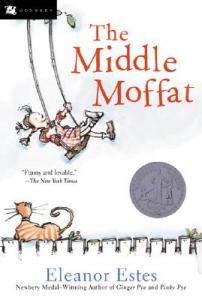
Module 2: The Middle Moffat

Estes. E. (1942). The Middle Moffat. New York, NY: Houghton Mifflin Harcourt.

Genre: Classic, realistic fiction. It is definitely a classic, not only because it was published more than 70 years ago, but also because it won a Newbery Honor, thereby bestowing upon it “classic” status. I’m not sure I entirely agree with that, but will discuss that more later. It is definitely realistic fiction, as there is no fantasy elements.

Book Summary:  Jane Moffat is the third of four Moffat children, but has decided that she’s the “middle one”, because she’s neither the oldest or the youngest or the oldest son (which describe her three siblings). Over the course of a year, Jane has a myriad of experiences as the Moffats get used to their new house after the death of their father: she makes, loses, and regains a best friend; she develops a good relationship with the town’s “oldest citizen” (he’s 99!); she plays  on a basketball team; and she better figures out her role in her family. 

Impressions: I desperately wanted to like this one. I generally do like stories like this: I adore All of a Kind Family and read the Betsy-Tacy books to all my daughters. I don’t mind the historical setting; I often find it fascinating to see how authors perceive their present and recent past (I’m thinking this was set in the 1930s, though I may be wrong). However, this one just didn’t click with me.  Perhaps it was because I just finished Beezus and Ramona before diving into this one, but Jane just fell flat. Even though I intellectually could see that Estes was trying to be humorous, like when the Moffats received a hand-me-down organ, and Jane was instant on having an organ recital, which ultimately failed due to overuse and because the organ was filled with moths. That, to be fair, should be funny. But, it just didn’t work for me. Intellectually, I could see that Jane was sweet and charming and tried hard, and  I wanted to like her and be interested in her experiences, but I just found I didn’t care. I can see value in the book; there are children who love this sort of story, and perhaps if I had read it when I was younger, I would have as well. 

Review: It was challenging finding a review of a book this old. I went with a blog post, from Into the Book, in which the reviewer gave The Middle Moffat a glowing review, stating “This book is a series of snapshots of these escapades, brilliantly portrayed in a way that draws readers in, and connects them to the lovable, clumsy ten-year old’s world.”  Additionally, she loved the serial nature of the book, and praised Estes’ writing, saying “What I love about Estes’s writing is that she grabs hold of those indescribable childlike emotions and impulses we all have experienced, masterfully putting them into words, capturing moments that allow us to re-live those happy Christmas mornings, those victories in an all-important sports competition, those moments when we make up with our best friend after a fight.”

Joyce, A. (2013, December 14). The Middle Moffat. Retrieved from: http://intothebook.net/the-middle-moffat-
eleanor-estes/.

Library Uses: It would be great in a display of classic books, Newbery books, or one one about stories featuring families. 

Readalikes:

  • The Penderwicks by Jane Birdsall: A more contemporary version of the Moffats, the Penderwicks are four sisters who have Mishaps and Adventures and are Absolutely Delightful. This one is similar in tone and subject, but has a more contemporary feel. 
  • All of  a Kind Family by Sydney Taylor:  Set in a slightly early time period than the Moffats, around World War I, this is the story of an immigrant Jewish family living in the Lower East Side of New York. They have a similar dynamic as the Moffat siblings, and the books are similarly about every day life.
  • The Misadventures of the Family Fletcher by Dana Alison Levy: Another contemporary family book, this one with all boys and LGBT themes, as the parents are a gay couple. It deals with the every day lives of the Fletcher family, but with a diverse twist.


Beezus and Ramona

by Beverly Cleary
First sentence: “Beatrice Quimby’s biggest problem was her little sister Ramona.”
Support your local independent bookstore: buy it there!
Content: It’s pretty simple text, and nothing objectionable. It’s in our classic chapter book section at the bookstore.

I adored the Ramona books when I was a kid. But, reading this, I realized I’d never read this one. I started with Ramona the Pest, and never really gave Beezus her due. Reading this — short vignettes from the year when Beezus was 9 to her 10th birthday — I realized why: Beezus is boring. She’s a Good Kid. She embroideries potholders for her aunt, she colors within the lines, she wants to read the “right” books. She’s. Boring. Ramona — with her active imagination, her loud, impulsive ways — is Fun. She’s the more interesting character to follow, and while Beezus is a great straight man (or sister, for that matter), she just isn’t terribly interesting as a character. (Yes, Ramona did steal this book from her sister.)

There is one lesson that I could have used as a kid, being the oldest and having not one but three squirrely younger siblings (though I suppose I was just as much of a terror as they were): you don’t always have to like your siblings. Sure, you’re always going to love them, and sure they’re always going to be there, but sometimes (and sometimes pretty often!) they’re going to do dumb, annoying, irritating, irrational, stupid stuff and it’s okay if you get mad at them.

(I’m Team Ramona, though. All the way.)

Audio book: The Wolf Hour

by Sarah Lewis Holmes
Read by David de Vries; Thérèse Plummer
Support your local independent bookstore: buy it there!
Listen at Libro.fm
Content: There is violence, though none of it is graphic. There are some biggish words, as well. It’s in the Middle Grade (grades 3-5) section of the bookstore.

Magia lives on the edge of the Puszcza — a huge, dark, magical forest — with her woodcutter father, mother, and siblings. Her mother has big dreams for everyone: Magia’s sister is going to be a healer, her brother a solder. And her mother wants Magia to be a singer. Except Magia wants to be a woodcutter like her father. But, she’s a good daughter, so she goes to music lessons with Miss Grand… and gets stuck in a story. And not a happy one at that.

I really liked this play and mashing of the Red Riding Hood and Three Little Pigs fairy tales. Actually, what I think I liked was the narration by deVries and Plummer. I loved listening to this one; it had the feel of an oral tale, and I loved how deVries and Plummer interpreted the text. Their narration kept me engaged with a text that I probably would have dismissed otherwise. But, because of that, I stuck through it. And while I wondered if there would be a happy  (or even hopeful) ending because Holmes kept the tension in the story going for a lot longer than I expected, it all does resolve well. Which was a nice touch.

In the end: surprisingly good.

Cybils Reading Round-Up, Part 2

Frogkisser!
by Garth Nix
First sentence: “The scream was very loud and went on for a very long time.”
Support your local independent bookstore: buy it there!
Content: There’s really nothing “objectionable”, but it just feels… older. It’s in the YA section (grades 6-8) of the bookstore, but I’m sure a fifth grader who really likes quests and/or fairy tales would enjoy it too.

Anya is a princess in a minor kingdom, whose parents have died and left her and her older sister to be raised by her stepmother (who is off doing…something) and her husband (whom Anya calls her “stepstepfather”), who is trying to take over the kingdom. So, Anya is sent on a Quest, nominally to find the ingredients to make a lip balm to turn Prince Duncan back from a frog, but ultimately, for control of her kingdom.

It’s a charming little tale; I enjoyed the fairy tale references (Snow White is a male wizard, etc.) and it was mildly funny, but honestly, it was just too long. I lost interested about 23 of the way through, and skipped to the end to find out how it all finished, and I don’t feel like I missed much. I’m sure it’s enjoyable; I just don’t have the patience for it right now.

Beyond the Doors
by David Neilsen
First sentence: “Edward Rothbaum was in a grumpy mood.”
Support your local independent bookstore: buy it there!
Content: It’s a bit odd; it’s long, but there are interior illustrations, so it’s like the publisher (what’s up Random House?!) couldn’t figure out if it was for the younger or older end of the middle grade spectrum. It’s in the Middle Grade (grades 3-5) section of the bookstore.

The Rothbaum’s mom has been missing for years, and then a freak fire leaves their dad in a coma. So they’re bundled off to their (previously unknown) Aunt Gladys’s house, where there are no doors and nothing to eat but cereal. And Gladys is a bit… off… as well. Through some digging, the Rothbaums discover the real secret: their grandfather discovered an ability to jump into memories, and has gotten stuck there. And it’s up to the kids to figure out how to solve the problem.

This was fun. Nothing super brilliant, but I liked the kids and the idea of memory jumping is a clever one.

A Face Like Glass
by Frances Hardinge
First sentence: “One dark season, Grandible became certain that there was something living in his domain within the cheese tunnels.”
Support your local independent bookstore: buy it there!
Content: It’s long and slow moving. So, maybe not for a reluctant reader. It’s in the Young Adult section (grades 6-8) of the bookstore.

Neverfell is an outsider in the world of Caverna, an abomination… because you can see her emotions on her face. So, when Neverfell gets caught up in court politics, the fate of Caverna lies within her hands.

I usually like Hardinge’s books, but this one just fell flat for me. I wanted to like it, and I liked parts of it, but it was just… too long. And it didn’t hold my interest. I would put it down for days and just not care enough to pick it back up. (I would have abandoned it, except for the Cybils.) It’s not that it was badly written, or a bad story… it just didn’t hold my interest. So maybe it was more me than anything else.

Dragon’s Green
by Scarlet Thomas
First sentence: “Mrs. Breathag Hide was exactly the kind of teacher who gives children nightmares.”
Support your local independent bookstore: buy it there!
Content: There are a few scary bits. It’s in the middle grade (grades 3-5) section of the bookstore.

Effie Trulove’s grandfather spent time teaching her about the magical world, and even though she’s not quite sure she believes him, it was spending time. But, he’s passed on, and suddenly Effie’s thrown into situations where she comes to realize that, yes, her grandfather wasn’t making things up: there really is magic. So with the help of her trusty new friends, she can defeat the Bad Guys (who are out to steal all the magic books), and figure out her place in the magic world.

I said, once, that silly names and magic don’t a fantasy make. And I think that holds here. The names bugged me (so very much), as did the gendering of  the friends (the boys were the Warrior and Scholar, the girls were the Witch and the Healer, though Effie was the Hero). I thought it would have more of a D&D feel, and be predictable that way, but it veered a bit from that, which was nice. It just… bugged me, in the end. I’m not sure I can really put my finger on why. But this was was most definitely not for me.

Miss Ellicott’s School for the Magically Minded

by Sage Blackwood
First sentence: “A secret nearly cost Chantel her life, on a dark summer morning when the rains ran down the stairstepped streets of Lightning Pass.”
Support your local independent bookstore: buy it there!
Content: There are some frighting parts. It’s in the middle grade (grades 3-5) section of the bookstore.

Chantel (pronounced shan-TAL not CHAN-tel) has grown up learning magic in Miss Ellicott’s orphanage/school. She’s quite talented at it, one of the best students, except she has a problem. All the magic users in their walled city-kingdom are supposed to be “shamefast and biddable”, and those are two things that Chantel, well, isn’t. It turns out to be a good thing though, for when Miss Ellicott and the rest of the kingdom’s seven sorceresses disappear, Chantel takes it upon herself to Figure Out and then Solve the problem, which grows to include an invasion, treachery, and a dragon.

On the one hand, this is a delightful magical tale, well and complexly told, by a very talented writer. I loved Blackwood’s Jinx series, and while this one is a stand-alone (hurrah!) it’s much more of the same elegant, interesting writing with a good dose of snark, something that I think the most reluctant readers will enjoy.

On the other hand, this is a fantastic allegory about the state of women throughout history. (Or at least, that’s what I saw.) I saw women taking their power and conforming it to the patriarchy (in this case, there was a king, but the men who ruled the kingdom were called The Patriarchs), working to maintain the Status Quo, because upending it is unthinkable. And then there was a girl who asked “WHY?” and started doing things differently, even though she was told — by the king, the patriarchs, the older women — that she Couldn’t. Still, she persisted, and Change — not just small change, but Large Sweeping Change. It was not only entertaining, but it was hopeful and empowering.

And I loved it.

Winterhouse

by Ben Gutterson
First sentence: “When Elizabeth Somers tugged open the gate to her aunt and uncle’s yard and saw and envelope taped to the front door of the shabby house she shared with them, she knew it was bad news.”
Support your local independent bookstore: buy it there!
Review copy provided by the publisher.
Release date: January 2, 2018
Content: There’s some mild scary parts. It will be in the middle grade (grades 3-5) section of the bookstore.

Elizabeth is an orphan (of course) living with her neglectful (of course) relatives when she (of course) gets a mysterious invitation to visit the Winterhouse hotel, a posh, somewhat charming (of course) hotel out in the middle of the country. Her aunt and uncle (of course) send her (they got a mysterious Christmas vacation out of it), glad (of course) to be rid of the Burden that she is. Once at Winterhouse, Elizabeth (of course) discovers the gigantic (of course) library, makes a friend in the genius inventor (of course) Freddy and the mysterious, eccentric (of course) owner Norbridge seems nice enough. There’s some other guests who are (of course) creepy, and a mystery looming which (of course) Elizabeth is drawn to solve.

All those of courses kind of make it seem as if I didn’t like this one, except event though the plot/concept seemed really familiar, and Been There Done That, I still enjoyed the book. I liked the puzzles that Freddy and Elizabeth solve. I liked the mysterious codes and word games that they played. I thought the ghost story was a bit much, but it didn’t bother me overly much. Maybe the story was a bit trite but Guterson knows how to engage a reader, and keep the pages turning. Which is possibly all a story really needs.

Just like Jackie

by Lindsey Stoddard
First sentence: “Before I know it I have Alex Carter’s nose blood on me.”
Support your local independent bookstore: buy it there!
Review copy provided by the publisher.
Content: There are a few “damn” and “dammit” and they say “effing”. It will be in the Middle Grade (grades 3-5) section of the bookstore.

For Robinson Hart’s entire eleven years, it’s just been her and her grandpa together. They’ve gotten along fine: her grandpa taught her how to tap the sugar maples and make syrup and how to fix cars. And even though they don’t match exactly — grandpa is black, and Robbie is lighter skinned — and even though grandpa doesn’t talk about Robbie’s mom, things are fine.

Until they aren’t.  Robbie has noticed that grandpa has started messing up words, forgetting things, putting things away wrong… and she’s sure that if she could just be a good kid, he would stop and things would go back to normal. Except Alex is a bully and Robbie can’t handle it, and she keeps fighting back (literally), which gets her into trouble.

This isn’t really a plot-heavy book. Robbie does learn some lessons about controlling anger, and that everyone has their own issues they’re dealing with. But what kept me coming back was the relationship between Robbie and her grandpa, and how worried and powerless she felt with her grandpa’s increasing Alzheimer’s. I also loved the friends that Robbie eventually realized were on her side. It was a slow process for her, and as a parent I was sometimes irritated at that. But, I realized that an 11-year-old might not see everything I could see, and I thought Stoddard captured that extremely well.

A very good book, overall.