Audiobook: The Kitchen Counter Cooking School

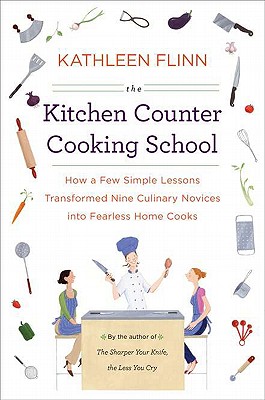
How a Few Simple Lessons Transformed Nine Culinary Novices into Fearless Home Cooks
by Kathleen Flinn
Read by Marguerite Gavin
ages: adult
Support your local independent bookstore: buy it there!

(Also a post for Weekend Cooking.)

I adored Flinn’s first book, The Sharper Your Knife, the Less You Cry, and was quite excited to tackle her next book.

Home from Paris and Le Cordon Bleu, author Flinn is wondering what to do with her life. She really has no interest in owning a restaurant, and is getting tired of people asking her when she’s going to open one (and on a similar line, when are she and her husband going to have a baby…). Then, in a grocery store, inspiration hits: she sees a woman whose grocery cart is full of processed foods, and the reason? Because she doesn’t feel she can cook. It’s intimidating. She doesn’t know how. It’s too hard. Thus, the Project is born: Flinn finds nine volunteers all who are generally insecure about cooking, and persuades them to come in for a series of lessons on cooking basics. Flinn’s goal: to give them the skills and confidence to cook and turn away from fast food and processed food.

I’ll tell you straight up: I learned a lot from this book. A lot. And that was listening to the audio version. I need to go out and purchase the book, so I can have it as a reference in my kitchen. She really does go over all the basics: knife skills, chicken, meat, vegetables, braising, roasting, soup, salad, vinaigrette… it’s all in there. And Flinn is a good teacher. I’m sure her nine volunteers learned a lot from the classes, but she was able to convey what was taught — with a few side trips, to Rome and some fancy dinner parties to raise money — through her words in a way that engaged and interested me. I ended up thinking about this as a practical Michael Pollan: while he spouts ideals (and good ones at that), Flinn actually gives people the tools to use in putting those ideals — eating real food, cooking with real ingredients — to use.

The woman who read the book grated on me at first; she has weird pauses in the middle of sentences that bothered me. Also: listening to recipes being read aloud isn’t that great, so I ended up skipping those. Even with those shortcomings (and they’re not even Flinn’s fault), it’s the best kind of food book: useful, interesting, yummy-sounding with dozens of good recipes that are easy to use. Hopefully, it’ll do for you what it did for me: inspire you to cook.

Audiobook: The Spellman Files

by Lisa Lutz
Read by Ari Graynor
ages: adult
Support your local independent bookstore: buy it there!

I first heard about the Spellmans through Jen Robinson who blogged about them a few years ago. She mentioned that they’re for people who love quirky characters, and since I’m all for that, I stuck it on my TBR list and let it sit.

One of the things I’m doing through my audiobook listening is going back through my age-old lists and finding ones that have been sitting there forever to listen to. This one definitely qualifies.

Twenty-eight year old Isabel Spellman grew up working in her parent’s PI buisness. Which means that she’s excellent at stakeouts, can pick a lock with the best of them, and has absolutely no respect for the privacy of others (yes, she really did run a credit check on ex-boyfriend #6). However, when she meets Daniel (ex-boyfriend #9), things get a little, well, sticky. After he breaks up with her, she decides she’s had Enough. But, before she’s allowed to quit the family buisness, her parents give her a 12-year-old cold case to “solve”. And, before that’s solved, a case closer to home pops up, one that may be the most important of Isabel’s life.

Okay, that makes it sound all dark and dangerous, and honestly: it’s not. This book is mostly an introduction to the Spellmans and all their quirkiness (why, yes, Mom does hire out someone to stake out Isabel, not to mention bugging her apartment). Mom and Dad don’t really play much of a role (except as ominous yet loveable background players); the more important figures in Isabel’s life are her lawyer brother David, her Uncle Ray, and her teenage sister Rae. Between the four of them — and the back-and-forthing they do — they drive what plot there is.

And there really isn’t much of one. It didn’t seem to matter, though: I was captivated by Isabel’s voice (and Graynor’s reading of her), her observations of her ex-boyfriends, the cases, and her family. It was a lot of fun to listen to.

That said, there is one glitch: I didn’t realize until the very end (when the credits said “adapted by”) that this was an abridged novel. Nooooo! Now I’m going to have to get the book and read it: I want to know what I missed!

In spite of that, it was quite an entertaining way to spend my time.

Audiobook: Bossypants

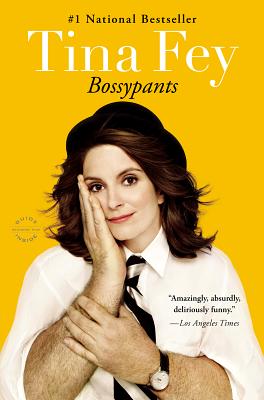
by Tina Fey
Read by the author
ages: adult
Support your local independent bookstore: buy it there!

I really don’t know why Tina Fey felt that she needed to write a memoir. Perhaps it’s because this is the last season of 30 Rock (I hope; I really can’t imagine the show without Alec Baldwin), and she wanted to try her hand at writing… something not television/movie related. That said, it’s a good book. She goes pretty much chronologically through her life: from a childhood in West Philadelphia, to college at the University of Virginia, to her time in Chicago with Second City, to her years at Saturday Night Life, to 30 Rock. In there, she fits her marriage and birth of her first child as well.

Like most comedy, it’s uneven. Some parts are horribly hilarious (like her Doomed Honeymoon), some parts she just lectures (about sexism in politics, for example) and the jokes fall flat (but perhaps they were meant to). That said, it was entertaining enough — Fey’s self-deprecating style is really pretty funny — to keep me sitting in the car listening long after I had gotten to where I was going. My favorite sections were about the development and production of 30 Rock, perhaps because I’ve been a fan of the show since it started. But, I found that’s where the biggest laughs were for me.

A note on the audiobook: on the one hand, I really enjoyed hearing Fey read her book. She did voices (her Alec Baldwin is really quite good), and we got the audio clip of her first Sarah Palin Saturday Night Live. She did mumble on occasion which bugged me until I checked the print version and realized that she was mumbling the asides. But she kept saying “check the pdf for this picture. Really. You won’t regret it.” I never did. I listen to the books in the car, and I’m not going to take the CDs out just so I can look at a picture. I did, however, check them out in the print edition. And they were, as she promised, quite hilarious.

So would I recommend the audio book for this one? Well, yes… if you’re like me and willing to check out the print edition for the extra laughs.

Audiobook: Water for Elephants

by Sarah Gruen
Read by David LeDoux and John Randolph Jones
ages: adult
Support your local independent bookstore: buy it there!

It’s no secret that I don’t do well with books on the bestseller list. And so it was with much trepidation that I picked this one up. (I say “much trepidation” but really it was curiosity and a sense that maybe the hype had died down…)

For the three of you who haven’t read it: it’s the Depression and Jacob Jankowski is a veterinary student at Cornell, just about to sit for his last final exams when his parents were killed in a tragic accident. This throws Jacob completely off course, and one fateful night, he jumps a train. It turns out to be the train for the Benzini Brothers Most Spectacular Show on Earth. And in one fell swoop  — and for three and half tumultuous months — Jacob’s life is changed.

First and foremost, this is a circus book. And it’s not a pretty picture. There’s Uncle Al, the ring master, who is vain and malicious. August, the animal trainer who is alternately charming and violent. And because these two are in charge, the whole environment of the circus is not healthy, to say the least. Jacob falls in with a dwarf named Walter; the relationship is rocky at first, but eventually they form a close friendship. And he falls in love with the lovely Marlena, the star of the Liberty Horse act, and August’s wife.

But where do the elephants come in? I have to admit that I was a tad disappointed there; the jacketflap (do audiobooks have jacketflaps?) implied that there was a bond between Jacob, Marlena and Rosie, the elephant the Benzini Brothers show picks up soon after Jacob joins on. But, I never really felt it. Sure, the elephant was the catalyst for much of what happened in the book, but really? I wish Jacob had done more, interacted more with the elephant. It seemed to me he spent much of his time running around, baffled as to what the heck was going on. And I did feel quite cheated by the climax. It was an honest twist, but I think Gruen misled us on purpose, which always gets my hackles up.

What really made the book for me was the present day segments, when Jacob was “ninety or ninety-three.” I have a friend who is currently studying gerontology, and keeps me up to date on her studies. Because of that, I had more sympathy for Jacob’s situation, being in a nursing home, and his concerns about getting old. He was alternately a sweetheart and a firecracker, and I adored him.

That said, I think that audio was the best way for me to experience this one. Both the narrators were excellent (LeDoux read the young Jacob; Jones the older one), and because of that I was able to really “see” the book in a way I don’t think I would have, had I read it.

I’m not sure if my good experience with this one will change my opinion on bestsellers. But I can say that this one was worth my time.

Audiobook: The Eyre Affair

by Jasper Fforde
read by Susan Duerden
ages: adult
Support your local independent bookstore: buy it there!

When I finished Jane Eyre a few years (well, five) back, someone told me that now I needed to read The Eyre Affair. I said okay, and stuck it on the TBR list, and then promptly forgot about it.

As I finished up my last audio book, I was looking through my old lists for a good audio book to read, and this one stood out. Why not give Jasper Fforde and Thursday Next a try?

I can safely say I’m torn about this novel. On the one hand, it was weirdly brilliant: why not create an alternative world, where in 1985 there’s time travel and interesting inventions; where planes aren’t used for commercial travel, and there’s a questionably moral corporation — Goliath — basically running England, and where the ending to Jane Eyre is that she goes off with her cousin to India. In this world, there are people called Litera Techs, SpecOps-27, who deal with crimes on literature. It’s a pretty mundane job, for the most part, especially for Crimean War veteran (the Russians and the English have been fighting this war for more than a century) Thursday Next. Then evil mastermind Archeron Hades steals the manuscript for Charles Dickens’ Martin Chuzzlewit and all hell breaks loose, and it’s up to Thursday to put it right.

The other really brilliant thing in this book was the names: from Archeron (and his brother Styx) Hades, to Thursday’s partners Victor Analogy and Bowden Cable and her ex-boyfriend Landon Parke-Lane (not to mention the Goliath head honcho Jack Schitt. Yes, that is exactly how you say it.) they are all brilliant. No, I didn’t get all the British references, but I got enough to find it amusing.

But, in the end, that’s all the book had: a great premise and some funny literary illusions. It took much too long in set up, getting around to the point of the novel; why was it called the Eyre Affair, when it was such a small part of the whole novel? I enjoyed the Shakespeare debates, but felt they didn’t really serve much purpose in the overall arc of the story. In fact, I could say that for a lot of the novel: it took too much time building the world, which was only sometimes fascinating, and then it took too much time wrapping up (and setting up the next one) in the end. It was just… too long.

A note about the reading: it was quite good. I probably had more patience for this book in audio form because Duerden was such a capable reader, creating a world for me with her voice that wouldn’t have otherwise existed. (Plus it helped that she tackled both the Welsh and the French with aplomb, something which I couldn’t have done on my own.)

So, cut 150 or so (just guessing here; a few discs would have been nice), and perhaps it’d be a really great novel.

Audiobook: At Home

by Bill Bryson
read by the author
ages: adult
Support your local independent bookstore: buy it there!

When Bill Bryson and his wife moved back to England, they purchased a rectory built in 1851. I’m not sure if he thought much of it when he first moved in, but after living there a while, he started thinking about how little he knew about his house, and the history that surrounded it. Thank heavens for his curiosity, because out of it was born this book:  a fascinating history of the world without leaving the home.

Initially, that sounds a bit dry as well as overly ambitious: how can one tell the history of the world through the house? The short answer: you can’t. What you can tell is a general history of how homes came to be what we find them today in Great Britain and the U. S. Bryson ends up focusing on those two countries, as well as mainly on the 19th-century, giving the book a much less ambitious perspective. And because Bryson is a thorough researcher and a masterful writer, this book — which is stuffed full of facts and people you can’t hope to begin to keep straight — is downright fascinating. From the history of how tea came to be England’s national drink, to the Eiffel Tower, to indoor plumbing and the telephone, to the rise of the middle class, to sexual repression in Victorian England: this book seriously has it all.

I listened to this one on audio, which possibly wasn’t the best way to interact with this book. (That, and Bill Bryson sounds nothing like I thought he would.) I kept wanting to flip back chapters, to reread earlier passages, to find earlier references to the people and circumstances that he refers back to. He does do a well enough job reminding the reader about who or what things were, but I still wanted to go back and see it for myself. That said, the information itself was fascinating. (I also wish I could have marked things, because for the life of me, I can’t remember half of what I heard.)

It’s fascinating not just because history is fascinating, but because Bryson makes it so. It’s  his snide asides (said in a dead-pan voice, so we know that he’s poking fun), and his brilliant observations, and the sheer amount of research that he did to write this book that really makes this book worth reading.

Then again, I’m not sure Bryson can write a book that isn’t worth reading.

Audiobook: The Help

by Katheryn Stockett
read by: Jenna Lamia, Bahni Turpin, Octavia Spencer, Cassandra Campbell
ages: adult
Support your local independent bookstore: buy it there!

I should probably start by admitting that I’m the last person in the universe to read this book. I’ve been avoiding it for years because, as you all know about me, I really don’t like hyped books. (I should amend that: what I don’t like is the hype surrounding a book. If I catch it before the hype, I may like it just fine.) I figured there was no way this one would live up to its reputation. That, and the subject matter: the relationships between white women and their black maids in 1960s Mississippi just seemed too, well, explosive. Better just to let things be.

Since you all basically know the plot — it’s about two maids, Aibileen and Minny and a white 20-something woman, Skeeter Phelan, and how they come to know each other, and then work together to get a book of memories of black maids published — I’ll just stick with my reactions to the book, as well as the audio production.

First off, this book did nothing to improve my impression of Mississippi. I haven’t had anything good to say about the state since our year there 10 years ago, and the white women in this book — from Skeeter’s overbearing mother to the spineless Elizabeth Leefolt to Hilly Holbrook (especially Hilly Holbrook) — did nothing to make me more sympathetic to the state and the people there.

I also wanted more. I wanted more Celia (and for her to find a friend in Skeeter; I was highly disappointed that didn’t happen), for the main characters to have more spine and stand up (I know: a very 21st-century attitude there), and for Hilly to get some sort of come-uppance (rather than the more true to life “she’ll just have to live with herself for the rest of her life” ending I did get).

That said, I loved the audio book. I think, in many ways, this was the right way for me to experience this book. There were parts that I would have gotten frustrated with if I’d just read it, but I found loving listening to. I adored the inflection the narrators would give to the sentences, the rich Southern accents (and yes, I did find myself speaking Southern more often than I should have), and the voices they’d give to the characters. (Octavia Spencer’s Celia was just perfect.) Because they made the book come alive for me, I was able to connect with it better, and let my objections (and annoyances) slide.

So, am I glad I read it? I guess. It did make for a really good book group discussion, and it was an interesting story. I didn’t absolutely love it, but it surprised me that I liked it as much as I did. Which isn’t a bad thing, in the end.

Audiobook: Second Fiddle

by Rosanne Parry
Read by Bri Knickerbocker
ages: 10+
First sentence: “If we had known it would eventually involve the KGB, the French National Police, and the Supreme Allied Commander in Europe, we would have left that body in the river and called the Polizei like any normal German citizen; but we were Americans and addicted to solving other people’s problems, so naturally, we got involved.”
Support your local independent bookstore: buy it there!
Review copy provided by the author.

It’s 1990 (oh, man, I AM getting old if 1990 can be counted as “historical fiction”…), and Jody, Giselle and Vivian are Americans living in Berlin, Germany. The wall has just fallen months before, but the 13-year-olds have more important things to think about: like preparing for a string trio competition in Paris and the fact that the military base is being dismantled (is that right? I’m lousy at military speak), which means that these best friends may never see each other again. They’ve planned for Paris to be one last adventure, but they have no idea how big that adventure will be.

Because right before they go, they witness the attempted murder of a Soviet soldier, whom they drag out of the river and take upon themselves to save. Of course everything gets complicated in ways that include a lot of lying on the girls’ part. But, it also is a grand adventure, one that, as we were listening, M and I wished we’d had.

Much like Parry’s Heart of a Shepherd, this book is subtle and quiet, even with all the running around. Although there are spies and military personnel and soldiers, the Paris that these girls experience is a quiet one, with artists and immigrant populations; with music and art and quirky bookshop owners. And to Parry’s credit, even though the book is set in the 1990s (making things much more complicated without cell phones and computers being so available), the book feels timeless: what girl doesn’t want to have an adventure with her friends? What girl doesn’t worry about the future? She also did a wonderful job portraying a country in transition; even though the girls were Americans and didn’t interact with Germans very much, you could get the sense that Berlin, at least, was hit hard by the wall coming down and they were struggling with that.

As for the narration: at first the reader’s voice bothered me. I felt like they were aiming too young, and the way she read grated on my nerves. I also wish she did voices, until she actually had a voice for the rescued Soviet soldier. Then I was glad she didn’t. But I became involved in the actual story and the annoyances with the reader went away. If I had this one in paper copy, I wouldn’t have been able to put it down.

Another good book by a talented writer.

Audiobook: The Wee Free Men

by Terry Pratchett
read by Stephen Briggs
ages: 9+
Support your local independent bookstore: buy it there!

I first read The Wee Free Men two years ago, and thoroughly enjoyed every bit of the time I spent with the book. It’s hilarious, adventuresome, cool, and Tiffany Aching, even when she’s just 11 years old, is a force to be reckoned with. There’s a power in her, a determination. I love that in this world, all it takes to be a witch is powers of observation and the knowledge that you’re the only one who can do anything about the situation.

There’s magic, of course, but it’s not flashy magic. It’s quite, subtle, and still there, even after you know how it’s done.

That said, I loved hearing this book read aloud. Even more so than when I read it. It’s fine reading it and all, but nothing — nothing! — is funnier than someone doing a spot-on Scottish accent for the Nac Mac Feegle. And the voice for Toad? So deadpan, so hilarious. I laughed. So hard. Often. And I actually got the section near the end when Tiffany goes up against the Queen; something which I remember eluding me when I read it. Perhaps because listening to it means I go through things more carefully than when I read them? Whatever it is, listening to the audiobook made this books so much more loveable and enjoyable than it already was.

Which means, of course, that I’m going to have to listen to the rest of the Tiffany Aching books.

Audiobook: The Lion, the Witch and the Wardrobe

by C. S. Lewis
ages: 7+
read by Michael York
Support your local independent bookstore: buy it there!

I don’t quite know where to start with this. I read the books for the first time in college, and I think I liked them. Though I’m nowhere near the Lewis devotee as some. (Including Hubby.) I saw the movie, but wasn’t impressed. And, honestly, I didn’t remember much about the story.

But, there had been some talk around the house about the Narnia books, mostly because we’d just watched The Voyage of the Dawn Treader movie. A and K were curious about the stories, so I picked up this one to listen to while we were on the trip.

And, to be thoroughly honest, it didn’t stick with me. Sure, I enjoyed it while I was listening to is, as did A and K. But, two weeks later (there is a reason I put posts up right after I finish things), all I can remember about the story was that it was nice. And that I was surprised at how little the Pevensie kids actually did. Mostly it involved them reacting to events, getting caught up in events and watching events unfold. Very rarely were they actual active participants in the story, which disappointed me.

But the younger girls enjoyed it, and Michael York did an admirable job reading it. And it kept everyone from arguing in the car for a few hours. So it wasn’t really time wasted.