The White Queen

by Philippa Gregory
ages: adult
First sentence: “My father is Sir Richard Woodville, Baron Rivers, an English nobleman, a landholder, and a supporter of the true Kings of England, the Lancastrian line.”
Support your local independent bookstore: buy it there!

I have to admit, first off, that I picked this book up after the Cybils on purpose. I wanted something sweeping, something grand, something intricate, and yes, something slightly skanky.

I got two of the four, plus lots of fighting, scheming and plotting, so I’m not disappointed.

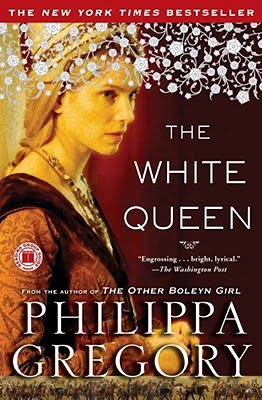
Gregory takes leave of the Tudors (oh, how we all love them), and turns her more than capable gaze to the family that preceded them: the Plantangents. Since I knew absolutely nothing about them, historically speaking, I was starting from scratch. The White Queen is the story of Elizabeth Woodville, a widow whose husband fought against Edward of York, and who fell in love with Edward after meeting him to appeal the loss of her lands to her former mother-in-law. They eventually marry, in secret, and when Edward finally fights his way to the kingship, she becomes queen. It’s not a pretty book, or a simple one. There’s a huge cast of characters, and it’s full of intricate plotting and planning and fighting and twisting. There’s no such thing as real loyalty; it’s every man, and every woman out for him/herself. And, at the center of every twist and turn, is Elizabeth.

All this twisting and turning has both its pros and cons. It’s good because it keeps the 400 page book moving, and the reader guessing: what is going to happen next, and where on earth is all this going? There’s enough plotting and backstabbing and turncoating in the book to entertain just about anyone. But, there’s also enough to confuse one, too. I kept flipping back to the beginning where there was a family tree, but it didn’t do much to keep everyone straight in my head. Neither did the Author’s Note at the end, though that at least provided some fascinating historical detail. In the end, I had to put aside all my questions of who, what and where and just throw myself into the novel.

Which worked for a while. But, around two-thirds of the way through, about the time that King Edward dies, it all fell apart for me. The mystery of the missing princes that the jacket flap promised, and that sounded so intriguing, was almost an afterthought to the novel. Things unraveled for Elizabeth, as queen, as a person, and yet, somehow, the book kept going. Until, finally, it just stopped. Which, of course, leaves room open for sequels. It’s not a “to be continued”, but it’s only just short of that.

It’s not as tight as some of Gregory’s other books, but there’s much of what her fans have come to love from her in the book. Even if it wasn’t exactly what I wanted, I did enjoy much of it. There’s just something about the scheming and plotting of the English royalty that makes for a good story. And, at the very least, this was that.

A Short History of Tractors in Ukrainian

by Marina Lewycka
ages: adult
First sentence: “Two years after my mother died, my father fell in love with a glamorous blond Ukrainian divorcee.”
Support your local independent bookstore: buy it there!

I really wanted to like this book. I’d heard good things about it, or at the very least okayish things. I picked it up at a Friends of the Library sale back in June, I think, and it’s been languishing on my TBR pile since then. I just really couldn’t get excited by the cover. Or the title. Or the back blurb. In fact, if it hadn’t have been one I’d chosen for the 2010 Challenge, I probably would have passed on it altogether.

As it turns out, I’m pretty much passing on it anyway. After one hundred pages, I was still wondering what the point was. I threw a feeler out on Twitter, and SuziQ at Whimpulsive bit: she said it was weird. And I had to agree.

The basic plot: two sisters, daughters of Ukrainian immigrants, are feuding after their mother’s death. Then their 84-year-old father falls in love (or lust), with a blond, 36-year-old Ukrainian divorcee (perhaps; I never could quite figure out if she really was) who’s using him to gain citizenship to the UK. This, of course, leads to tension between the dad and the daughters, which, interestingly enough, manages, in the end, to bring the family back together. Or, so I gathered.

See, I didn’t finish it really. I read the first 100 pages or so, then flitted about a bit, and then read the last 50. And I wasn’t impressed. I didn’t like the characters, didn’t sympathize with them (differing life situations, and I just wasn’t interested in their whining and moaning), and I was bored by the book. I have wondered, off and on, if too much YA has spoiled me for adult fiction; the pace was glacially slow; I kept wondering how on earth Lerwycka was going to fill 300 pages. Was there really that much story? I’m not sure there was.

But, obviously, I’m missing something here; it’s one of those that was nominated for a Man Booker Prize. And, obviously, I have different expectations from books than those who are on the Man Booker Prize committee.

Can’t say I’m too sorry about that.

Fried Green Tomatoes at the Whistle Stop Cafe

by Fannie Flagg
ages: adult
First sentence: “The Whistle Stop Cafe opened up last week, right next door to me at the post office, and owners Idgie Threadgoode and Ruth Jamison said business has been good ever since.”
Support your local independent bookstore: buy it there!

I don’t quite know where to start. Perhaps I should say that I saw the movie years and years ago, and while I liked it, I’m not sure it really stuck with me.

But when Cass said the book was one of her favorites, I figured I needed to give the story a second look. And I’m glad I did.

It’s not a book for 20-somethings, though the mystery underlying the vignettes might have some appeal. But that’s not what I got out of the story. In fact, I had a hard time picking out much of a story at all. That’s not to say I didn’t enjoy it. I did. But, it took me a while to realize that the book is a kind of fictionalized oral history. Once I accepted that, then I found I was able to enjoy the book more, taking the stories for what they were: reminiscences of a full life.

That I loved the characters helped as well. I looked as forward to visits with Mrs. Threadgoode as much as Evelyn did. I loved hearing about Whistle Stop, about all the characters — even with all the 1930s area Southern racism — and their antics. It’s a cozy book and a welcoming, homey one, too, one that makes you feel like you are a part of the community. It shows both the positives of small towns (how everyone bonds together in a crisis, the support systems, the community building) and the negatives (nosiness, lack of privacy, prejudice). It doesn’t sugarcoat anything, which, in turn, makes everything resonate more.

And then there’s Evelyn. Ah, the quintessential doormat middle-aged wife and mother. I think I enjoyed her “awakening” most of all. Firstly, because it came through the stories. And secondly, because I think she needed it. To find fire and want and to stop being so dang selfless all the time. Sometimes, it’s okay to do something for yourself, and to be angry at the injustice in the world.

It’s a wonderful book and I’m glad I had a chance to visit with it.

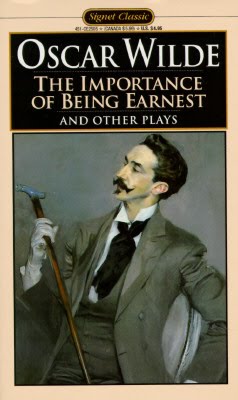
The Importance of Being Earnest

by Oscar Wilde
ages: adult
First sentence: “Did you hear what I was playing, Lane?”
I’d tell you to go buy it, but you can get this one online for free.

I really don’t have much idea what to say here. I’ve been a fan of the play for ages: my mom had a copy of a BBC production while I was growing up, and I remember watching and finding it hilarious. And I own the Colin Firth/Rupert Everett version which still makes me laugh. Judi Dench is so fabulous as Lady Bracknell.

So, I don’t really know what I expected to get out of reading the play, if I expected anything. I guess I was kind of curious to see how the movie version held up to the actual play, and I also figured since I loved it so much I should actually read the play. That, and I have decided that I really like Wilde’s writing. So, I wanted to read more of him.

And, the long and short of it: I like it better performed. That shouldn’t have come as a surprise; I have a terrible track record reading Shakespeare, and I don’t see why any play should be different. The lines weren’t as funny, the silliness of it all came off as banal rather than hilarious. I’m terrible at reading inflection and timing; I need narration. And while I enjoyed it, I didn’t love it like I love the movie. I did find out (and it’s to be expected) that the movie does take some liberties with the play, giving Lady Bracknell a past, and switching the ages of Jack and Algy around as examples, it’s really quite faithful to the original.

The play itself is a delightful spoof on Victorian England, on class restrictions, and on love in general. No matter how you get it, whether reading or watching, it’s quite worth your time.

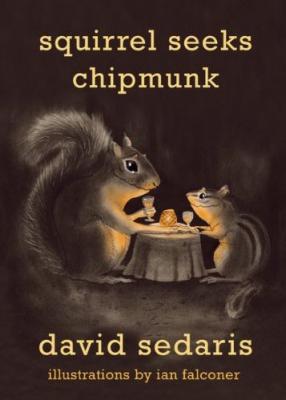
Squirrel Seeks Chipmunk

A Modest Bestiary
by David Sedaris
ages: adult
First sentence: “The cat had a party to attend, and went to the baboon to get herself groomed.”
Support your local independent bookstore: buy it there!

The number one rule in reviewing is never start a review saying you don’t like the genre. You do that and people will discredit everything you say after. Except… it’s really true in this case. Satire and I, we don’t get along. I am not a fan of the literary technique, I usually don’t “get it”, and I rarely find it funny.

And yet. I “got” this book, or at least most of it. It helps that Sedaris — again, whom I’ve had a bit of a rocky relationship with; I find him hilarious in person, but I don’t think his humor translates in writing for me — is poking fun at people we all know: hairdressers, complainers, obsessive parents, liberals, conservatives, intellectuals, vigilantes; no one is safe from the Sedaris’s caricaturization.

That’s not to say that every story works equally well, and truthfully, that may have been me. I really liked the ones I “got”, especially “The Cat and the Baboon,” “The Toad, the Turtle, and the Duck,” “The Parenting Storks” (an excerpt of which I heard on NPR, which led me to pick up the book in the first place), and “The Grieving Owl”. Each of these I found hilarious in their own way; possibly because the are the most accessible, and possibly because I found them funny, knowing people like that (though don’t we all).

Sedaris also balances between humanizing these animals and keeping them in the animal world: nothing really has a happily ever after, and the viciousness is often due to the nature of the animal: a baby stork falls from its nest presumably to its death, a bear is captured and forced to be a part of a circus, the crow eats the baby lamb’s eyeballs. It’s a reminder that, no matter how pretty we try to make it, nature is a cruel, vicious place. And the moral? Nobody’s exempt, no matter what you think.

It’s a weird little collection of stories, and not for everyone. But as far as satire goes, it’s quite good.

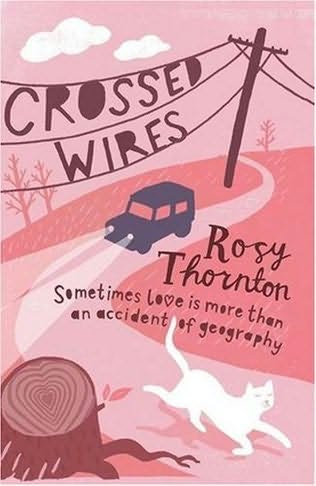
Crossed Wires

by Rosy Thornton
ages: adult
First sentence: “
I’ll still tell you to support your local indie bookstore, but you can’t buy it there. (Maybe you can order it? Or buy one of her other books?) Check it out on Amazon.
Review copy provided by the author.

It started off uneventfully. (Don’t all good love stories begin that way?)

Single-mom Mina, who works the phones at a Sheffield call center for auto insurance, just happens to get the call where single-dad (and Cambridge professor) Peter reports that he’s crashed his car into a stump. You wouldn’t think anything would come of this one-time, chance encounter. Especially since Mina has her hands full with her 10-year-old daughter, Sal, and her younger sister, Jess, who’s never around. And Peter, with his 9-year-old twins, is still kind of mourning the death of his wife several years back. But, when Peter (who tends to be incredibly accident-prone) crashes his car yet again, he calls and asks for Mina which begins a phone relationship that slowly develops into something more.

It’s an understated little book; both Peter and Mina dance around their relationship. It’s really only a friendship, but one of those friendships that mean something. Someone you come to rely on and find comfort in. It doesn’t matter that they live miles apart, have completely separate lives. In fact, as a reader, you don’t really care that you’re reading a fluff romance book in which there is, in fact, no romance. It’s more a life book: watching Mina deal with her ups and downs; watching Peter as he muddles through, and then how they reach out to each other to try and find something to hold on to. The writing is charming, the characters are ones you want to move in next door to. It’s Britishness at its finest, where you want to grab a cup of tea and a comfy blanket and curl up with a good book.

And it’s just the book to do that with.

Girl in Translation

by Jean Kwok
ages: adult
First sentence: “A sheet of melting ice lay over the concrete.”
Support your local independent bookstore: buy it there!

Nice.

I’m not sure I’m supposed to sum up an immigrant girl’s horrific-and-yet transcendent American experience in one word, especially nice, but there it is.

I found this book to be… nice.

It’s beautifully written, true. And it tells an untold story: of what can happen to immigrants (legal in this case) when they come to America. It’s the story of the American dream: how a girl’s ambition, and how one thing — in her case, being smart and having a “talent” for school — can change the fortunes of just about anyone, especially with hard work and a few lucky breaks. There’s also a love story, tragic and bittersweet.

We follow Kimberly Chang as she and her mother arrive in New York, fresh from Hong Kong, hoping for a better life. They’re under the patronage (thumb?) of the mother’s older sister, Patricia, who sets them up with a job — being finishers at a clothing factory, being paid by the skirt — and an apartment — in an abandoned building with roaches, no heating, and half the windows gone. It’s a rough adjustment for Kim, although she has some grasp of English, she is not prepared for school in Brooklyn. Her grade fall, she skips school, and it’s really only through the chance grace of a friendly gesture that gets her to go and stay. Which, in the end, is what saves her.

There’s some lovely writing in the book, and small touches here and there — like they way Kwok wrote what Kim heard as opposed to what the real word was, when she was just learning (“Where’s your accent note?”) — that I found to be charming. It covers a lot of time, eight years, as Kimberly goes through middle school and high school. There are lots of downs, understandably, but there are ups as well.

But, in the end, I felt that it was going for depth, for heartache, for the chance to move the reader and all I felt was that it was tragic, and yet how nice that she was able to overcome it all. How nice that it all mostly worked out. How nice that she was brilliant and had opportunities. How… nice.

There are worse things, though. At least it was nice.

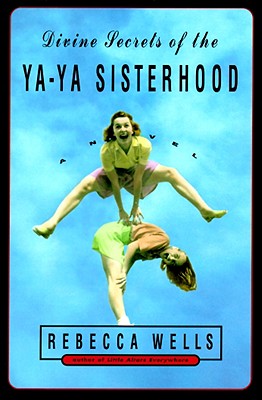
Divine Secrets of the Ya-Ya Sisterhood

by Rebecca Wells
ages: adult
First sentence: “Sidda is a girl again in the hot heart of Louisiana, the bayou world of Catholic saints and voodoo queens.”

I’ve seen this around for years (I think I’ve even seen the movie), and I always thought, off hand, that it would be an interesting book to read. Mother-daughter relationships, the South, and a promise to laugh and cry and be swept away.

And I tried to read it. I tried to like it. I tried. But…

*yawn*

I didn’t even make it 100 pages in, and I was bored stiff. Bored with Sidda and her whining. Bored with her attempts to find love and embrace life. Bored with the story. I did like Vivi as an adult; she had spunk and a fiery spirit, but there just wasn’t enough of her. I’m sure if I had given it time, I may have even grown to like the flashbacks to the Ya-Yas childhood. But the jumping around in time was bugging me, and I bailed after Vivi and Caro were scrubbing the Virgin Mary from Cuba white again.

Enough. I don’t have time to deal with this, and I exercised my right to stop reading.

Sometimes, doing that is really quite liberating.

Miss Pettigrew Lives For a Day

by Winifred Watson
ages: adult
First sentence: “Miss Pettigrew pushed open the door of the employment agency and went in as the clock struck a quarter past nine.”
Support your local independent bookstore: buy it there!

This book totally and completely charmed me.

It the story of basically twenty-four hours in the life of Miss Guinevere Pettigrew — forty years old, spinster, very bad governess — which she inadvertently (she answered the wrong ad at the employment agency) ends up spending with London socialite Delysia LaFosse — scatterbrained, sweet, and very indecisive — and it changes her life. Instead of being dowdy and proper, she experiences how “the other half lives”, and learns to let her primness and dowdiness go.

There’s so much to enjoy: from Miss Pettigrew’s initial hesitance with the entire situation, her realization that she’s very much out of her element, to her brazen embracing of that life, and her guiding poor Delysia through it. Miss Pettigrew is not really educated or even all that witty, but she’s got a good head on her shoulders and isn’t afraid — after an adjustment and acceptance of her present situation — to use it.

The book isn’t as delightfully funny as the movie (yes, I saw that first), and there’s a tad bit of racism in it that made me slightly uncomfortable (it was written in the 1930s, but that’s no excuse), and I do have to wonder at the “make yourself up and the world will be better”. But for the moments of pure pleasure, and because thoroughly charming that everything is forgiven. Especially since I read the book with a huge smile on my face.

Completely and utterly charming.

The Girl in Hyacinth Blue

by Susan Vreeland
ages: adult
First sentence: “Cornelius Engelbrecht invented himself.”
Support your local independent bookstore: buy it there!

I first read this book when it initially came out, back in 1999. I think I was drawn to it because it was Vermeer, and back in those days I was very much into art and artists. It was only three years, after all, since we had gone to the National Gallery and seen the Vermeer exhibition, which was a remarkable (if crowded) experience.

I hadn’t looked at it or even much thought about it since then — I remember liking it, but that’s about it — and so when a friend brought me a copy, having picked it for our in-person book group, I was more than happy to read it again.

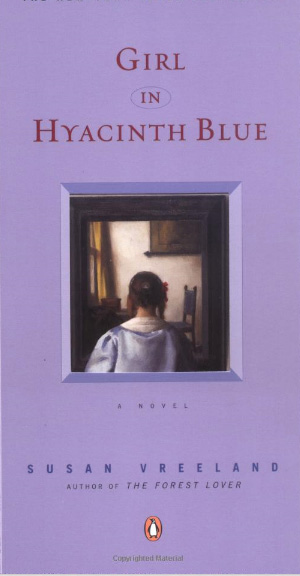
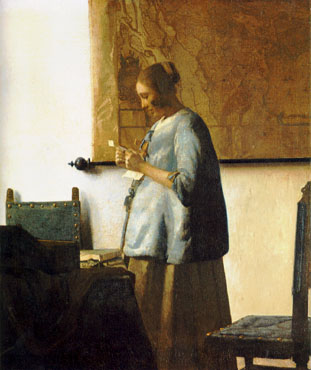
It’s basically the story of a painting of Vermeer’s — one of a girl swathed in hyacinth blue, sitting, looking out a window, her sewing forgotten — as told backward through time, beginning with the present and ending with the painter and subject. It’s a collection of short stories, each one standing uniquely on their own, but work that much better as a collective whole. (As an aside: like novels in verse, I tend to like short stories better if they’re linked to each other somehow.) There are female and male protagonists, there are art lovers and those for whom the painting is an afterthought. There are villains and saints, lovers and merchants. It’s an eclectic bunch. But, perhaps, that’s the point.

I think the most interesting thing about this novel is the way the people interact with the art. Perhaps it’s best to explain this through my favorite story, Morningshine. This tells the story of a farmer’s wife during a winter flood in a small town in the Netherlands. She’s trying to make things meet, while her husband’s away repairing the dikes, and she discovers that someone has left the painting and a baby in their boat. She falls in love with both, and takes it as her personal mission to save them. She adores the painting, finding solace and satisfaction and peace in the simple beauty of something so unnecessary. The art touches her life, intersects with it, making it better. Of course, she ends up selling it: they are poor, after all, and the flood has all but devastated the potential to have crops that year. Better sell something unnecessary than starve. But for the fleeting days that she had the painting, her life was better, somehow.

It’s all like that: simple stories about simple people. The writing is simple, too: not simplistic, but almost poetic; it felt like every word had a use, something which always impresses me when I come across it. It’s not an earth-shattering book, in much the same way that Vermeer’s art isn’t earth-shattering. That doesn’t mean it’s not very nice to experience. Because it is.