The Fairy Godmother

by Mercedes Lackey
ages: adult
First sentence: “This is not the way to spend a beautiful spring morning! Elena Klovis thought, as she peered around the pile of bandboxes in her arms.”
Support your local independent bookstore: buy it there!

Elena was supposed to be stuck in a tale. You know, the one where she sleeps by the fireplace, spending her days doing all sorts of grudge work for her step-mother and step-sisters? And then she gets to go to the ball and marry a prince?

Except, she doesn’t.

She turns 21, and her step-mother and -sisters decide that this part of the Kingdom isn’t doing them any favors (not to mention that their debts are mounting), so they take off and leave Elena the house. Which the debtors then claim. Elena figures that she can’t do any worse in life, and so tries to get hired out.

And that’s when her life gets interesting. She is picked up as an Apprentice to the Fairy Godmother. See, in the 500 Kindgoms, there’s this thing called The Tradition: magic that is pushing, pulling, forcing people into tales. And it’s the Godmother’s role to direct, push, pull, prod and help people into, along in, or out of these stories. The best part of the book, I think, was working with Elena as she learned about the magic and how to manipulate the stories. The Tradition is a powerful thing, and if one doesn’t think about what one wishes, or even says, dire consequences abound. There were clever asides to several fairy tales, as well as the categorization of characters. It’s all very organized and delineated, which made me smile.

Of course, there has to be a love interest, and that shows up in the form of Alexander, the stubborn prince who ends up as a donkey for several chapters. He’s arrogant, angry and conceited, but eventually learns his lesson and takes on his own destiny, which includes breaking tradition and falling in love with a Godmother. I expected things to slow way down, but Lackey has got her books down (she should after as many as she’s written), and managed to throw a couple of steamy sex scenes in there as well as giving us a big finale to end on, both which served to, um, keep my interest.

It’s fluff, but it’s fun, enjoyable fantasy fluff. And I can’t say anything bad about that at all.

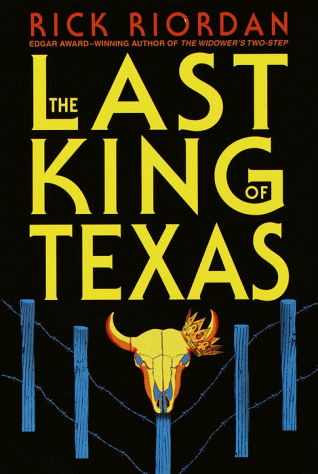
The Last King of Texas

by Rick Riordan
ages: adult
First sentence: “Dr. David Mitchell waved me toward the dead professor’s chair.”
Support your local independent bookstore; buy it there!

My in-person book group is reading The Red Pyramid for their selection this month. Since I’ve long since devoured everything Riordan’s written for kids, and since I usually include the sentence “he’s also written a mystery series for adults but I’ve never read them” while talking about Riordan, I figured the least I could do is find out what the whole mystery series for adults is about.

Our erstwhile hero is Dr. Jackson Navarre, Ph.D. in Medieval Studies, also known as “Tres” (Spanish for three, not “Tray”; a mistake I was making). Tres is also a private investigator. In fact, that’s the reason he moved back to San Antonio, after years in the Bay Area. He’s offered a position at UTSA, in part because of his P.I. job: the man who had the position right before Tres ended up being shot to death in his house, after receiving several death threats via letter. Then, in the middle of the interview, a pipe bomb is delivered, exploding shortly thereafter. Of course Tres takes the job. It’s a series of twists and turns from there, as we explore the gritty underbelly of 1990s San Antonio. This is the third in the series (the first published in hardback, and the first my library has. I love Riordan, but not enough to hunt down the first two Tres Navarre books), but works just fine as an introduction to the world of Tres. There are a lot of characters to juggle, but Riordan manages that beautifully; Tres is easy to like, as are many of the other characters. Even the baddies are well-drawn, and have intriguing and complex motivations for their actions.

It’s vintage Riordan, to say the least. Not as funny as his books for children, but still quick-witted and engaging. It’s quite the homage to San Antonio; even though it’s rough and edgy, there’s an undercurrent of love and admiration for Riordan’s hometown. Probably most importantly, it’s brilliantly plotted (which is something that Riordan always does well); there’s enough information in the book to make the mystery solvable if you follow the clues (I didn’t call it!), but there’s also enough twists and turns to make the book exciting. Sure, it’s clunky in spots, but it’s also a page turner from the point a pipe bomb explodes into the first chapter until the final reveal at the end.

Which it to say: it’s Percy Jackson awesomeness for adults.

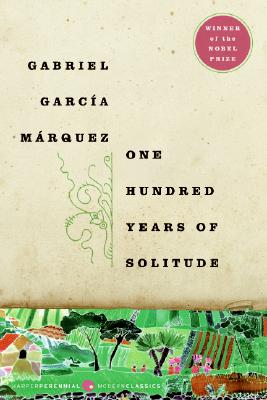
One Hundred Years of Solitude

by Gabriel Garcia Marquez
ages: adult
First sentence: “Many years later, as he faced the firing squad, Colonel Aureliano Buendia was to remember that distand afternoon when his father took him to discover ice.”

The short story? Magical realism and I just don’t get along. I don’t know what it is; you’d think with all the fantasy books I read that I’d love the subtle of play between reality and magic, but it just doesn’t work for me. I find it grating and somewhat annoying and confusing and just plain irritating.

Also: I really don’t trust books that were part of the Oprah Book Club.

The long story? I’ve heard about Gabriel Garcia Marquez for years and years, and always figured, since he was so highly acclaimed, that I ought to read him. So, when I finally got the opportunity, I was quite interested. And yet, it didn’t take me long to realize that this book is completely incomprehensible (to me). It was flipping between time and memory and the plot was utterly confusing. I wasn’t getting much out of the lives of the characters.

So, halfway through when I couldn’t see a way out of this muddle that Marquez had gotten me into, I bailed. Without a backward glance.

Because magical realism and I are just not friends. At all.

Their Eyes Were Watching God

by Zora Neale Hurston
ages: adult
First sentence: “Ships at a distance have every man’s wish on board.”
Support your local independent bookstore: buy it there!

I really didn’t know what to expect when I started this book. Honestly. I hadn’t heard much about it, and I only knew Zora Hurston from Zora and Me which I read last fall.

So, my impressions…

Shall I get the negative over with? The dialect dialogue drove me nuts. Random sample: “Dat’s jealousy and malice. Some uh dem very mens wants tuh do whut dey claim deys skeered Tea Cake is doin’.” Not too bad on it’s own, but pages and pages of it pulled me out of the flow of the novel. Every single time. I do have a couple prejudices when going into novels, and dialect is one of them. (Present tense in the other.) However, I am proud of myself: I kept going in spite of being pulled out of the novel.

Mostly because the writing (when it was in English and not Southern) was so gorgeous. Random sample:

“So, gradually, she pressed her teeth together and learned to hush. The spirit of the marriage left the bedroom and took to living in the parlor. It was there to shake hands whenever company came to visit, but it never went back inside the bedroom again. So she put something in there to represent the spirit like a Virgin Mary image in a church. The bed was no longer a daisy-field for her and Joe to play in. It was a place where she went and laid down when she was sleepy and tired.”

So simple and yet so evocative. The whole book — the narration, anyway — was like that. Simply gorgeous, poetic. And the story about a woman coming into her own, finding her own path to happiness in the face of expectations and overbearing/abusive husbands. It’s a testament to the resilience of women, the inner strength a woman has when faced with Life.

And for that, the book is more than worth reading.

Naked Heat

by Richard Castle
ages: adult
First sentence: “Nikki Heat pondered red lights and why they seemed to las so much longer when there was no traffic.”
Support your local independent bookstore: buy it there!

Oh, you knew this review was coming.

Yep.

I figured, since I’ve already caved into the publicity machine that is ABC, and the meta-ness of it all (and am really kind of finding it all fun and games), what the heck. Why not read the second one?

Besides, it’s a really good book to read when I’m on the elliptical at the gym: engaging, but not hard to follow.

As far as the book itself: I think it holds up better than the first book as a novel. Sure, it’s still in-jokes from the series (the book opener is lifted pretty much straight from the season 3 TV opener), and the basic plot lifts from a few episodes of season 2 Castle. The murder is of a gossip columnist, which ends up being a triple murder/suicide. There’s some nice twists and turns in the plot, and the outcome didn’t really become obvious until nearly the end. It was plotted much more evenly as well; it was more character- and plot-driven, and relied less on the reader knowing the background of the show. This is a book I could see non-Castle fans picking up and actually liking on its own terms. That’s not to say there isn’t the jabs and in-jokes (in fact, what made me laugh the hardest was the moonlighting profession they assigned to Jameson Rook. Too, too perfect).

Additionally, it’s much less about wish-fulfillment on the part of Castle, the character, and more about getting the story across. In other words, Nikki comes off as more of a real character this time — she’s smart and resourceful (and remember that episode where Castle has Alexis duct tape him to the chair? That’s important.) and while she does a lot of saving Castle’s butt (coming to his rescue at least twice), they’re also working more as a team than they did in the first book. The sex is dialed way back (though there is a couple of scenes; they are just briefer and less “steamy”), and it’s more about building an actual relationship between the two characters.

So, the discussion I ended up in with Hubby was about whether or not there will be more. On the show, they’ve kind of abandoned Castle’s premise for following Beckett around, and — if I remember right — he’s not done much writing this season. So, is ABC going to keep churning out the Nikki Heat books if there’s no reference to them in the show? Hubby seems to think that they could put out as many as they like independent of the TV show, but I think that the books lose much of their charm if you divorce them from the fun of the weekly episodes. Either way, I’ll probably keep reading them until they stop being brain candy.

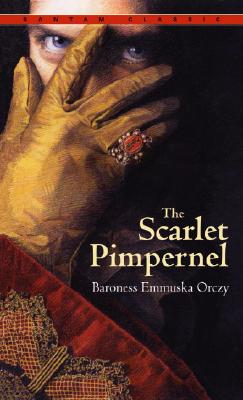
The Scarlet Pimpernel

by Baroness Orczy
ages: adult(ish)
First sentence: “A surging, seething, murmuring crowd, of beings that are human only in name, for to the eye and ear they seem naught but savage creatures, animated by vile passions and by the lust of vengeance and of hate.”
Support your local independent bookstore: buy it there!

I’ve heard about this book for years. YEARS, I tell you. From people who love it mostly; I don’t remember hearing much bad about the book. And so, when finally given the push to pick it up and read it (for the in-person book group), I was quite intrigued, to say the least.

Thankfully, I’d been forewarned about the first few chapters; had I not been, I’d have thrown in the towel. As far as gripping beginnings go, this one is terrible. Horrid. Confusing and distracting, it’s supposed to set the mood, but doesn’t really do much for the story. Sure, I get that the Baroness was trying to emulate the novels of the time period (it’s set in 1792), but it was a really, really bad way to get one into an adventure/mystery novel.

Once we settled on Lady Marguerite Blakeney and her husband, the foppish Sir Percy, the story picks up. For those of you who haven’t read it (people tell you they love the book, but they never tell you what it’s about!), it’s the middle of the French revolution, and about a year int’ Marguerite’s, who’s French, and Percy’s marriage. There’s been a bit of an estrangement between them ever since it came out that Marguerite inadvertently said something which sent a couple of nobles to the guillotine. On top of that, she’s incredibly clever and fashionable and Sir Percy is, well…. not. In the backdrop of all this, the folk hero The Scarlet Pimpernel has been, under the cover of night (and under French police chief — I think; I was never quite sure — Chauvelin’s nose) rescuing and transporting condemned French nobles to the relative safety of English shores. This infuriates Chauvelin, of course, who sets out — blackmailing Marguerite along the way — to discover the identity of The Scarlet Pimpernel and get Rid of Him Once and For All.

Not a bad bit of plot, there; except that it seemed to go everywhere and nowhere at once. It seemed that the world was so populated with people flitting in and out that, while it felt busy and it felt like things were progressing, it never gave anyone a chance to really shine as a character. There are pages and pages of nothing, until the book’s nearly over when we finally figure out (called it!) who the Scarlet Pimpernel is and the adventure part begins. Except, since we’re seeing it through Marguerite’s eyes, it never really goes anywhere either. Speaking of Marguerite, there was a lot of hysterical clinging and wishing and crying on her part, which got old quite quickly. And, in the end, the real point of the plot was not really to figure out the Scarlet Pimpernel, or to criticize the French Revolution, but rather a simple love story: to reunite Percy and Marguerite.

Which is okay, I guess. It just didn’t work as well for me as I had hoped.

Heat Wave

by Richard Castle
ages: adult
First sentence: “It was always the same for her when she arrived to meet the body.”
Support your local independent bookstore: buy it there!

“Oh, Melissa,” you say. “We know that you are really eclectic in your reading. But, a book written by the main character of a TV show. Really? Isn’t that a bit meta for your tastes?”

Yes. Yes, it is. And yet, it sat out there in cyberspace, it’s sultry cover calling to me, piquing my interest. Eventually, I had to cave in.

“Yes, but it can’t have been a good book. It’s written by a fictional person!”

Well, it wasn’t fine literature, that’s true. And I’m not sure it wasn’t even a good mystery, since I called it about halfway through. It did feel pretty pedestrian as far as books go. But, it was fun, and that’s all I was expecting. I’m guessing the screenwriters wrote it, by the way.

“What makes you say that? Nathan Fillion’s headshot’s on the back cover… they went pretty far keeping the illusion that Richard Castle ‘wrote’ the book.”

I know! And that’s one of the things I liked (besides Nathan Fillion’s headshot on the back cover). It really was an in-joke kind of things for fans of the series. Scenes in the book that were lifted straight from episodes; in many ways it was a mash-up of Castle, season one. Aside from Nikki Heat thoroughly beating up a bad guy while buck naked, of course. (Though honestly, I wouldn’t mind seeing Stana Katic pull that off…)

“So, if it’s just a bunch of scenes from episodes thrown together by the screenwriters, is there even a plot?”

Yes, it does have a plot. Nikki Heat is a NYPD detective and the latest murder is millionaire developer Matthew Starr. Jameson Rook is a celebrity journalist following Nikki around to get background for an article he’s writing. As they investigate Starr’s murder, things unravel about his background, his wife, and his business, centering in on the $60 million art collection in his house. Of course, lives are put on the line, banter is had, and sparks fly. It’s not as fun as the show, and I got annoyed with a few things — like calling Detectives Raley and Ochoa “Roach” — but mostly, it’s was just fluffy fun.

“Even if it is fun, why should we, who don’t really watch Castle or follow Nathan Fillion obsessively on Twitter, read it?”

My response: Why aren’t you? It’s quite fun as TV goes. Great writing, pretty good stories, it’s some serious fun. Seriously, though, if you’re not a fan of the show, I really don’t know why you’d pick up the book. Unless you really, really like mysteries and will read just about anything. But, if you’re a fan (or even if you only just watch the show), it’s a quick, fun, fluffy read.

“*sigh* That means you’re going to read the sequel, doesn’t it?”

Yep. It does.

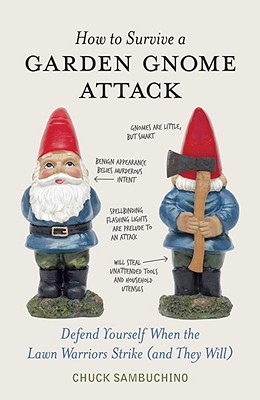
How to Survive a Garden Gnome Attack

Defend Yourself When the Lawn Warriors Strike (and They Will)
by Chuck Sambuchino
ages: adult
First sentence: “Keep reading if you want to live.”
Support your local independent bookstore: buy it there!

You know you have that zombie invasion handbook sitting on your bookshelf. (Or maybe it’s hidden in your personal safe?) But really, zombie invasion? That’s so not happening. The real threat? Those stupid garden gnomes you have in your yard (or if not you, your neighbors). (Yes, I do have one in my backyard, thankyouverymuch.) Thankfully, Chuck Sambuchino has done the research necessary to help you protect yourself (and your friends and neighbors, should you choose to share).

I found this one through Whimpulsive, and knew I had to find a copy for myself. It sounded so hilarious. And in many ways– mostly because it reads like a 1950s bomb shelter advert — it was hilariously funny. There are instructions, illustrated with pictures of gnomes in various attack modes (too funny!), on how to asses the risk of attack and protect and defend oneself against the homicidal maniacs. It’s too far-fetched to even remotely be realistic, but, it also takes itself seriously enough that I could sense myself almost being convinced: yes, I do need to fortify my house! Then I’d do a double-take: it’s only silliness. Ah, the power of propaganda.

At the very least, it’s a fun way to spend an hour. I think I’m going to go check my garden gnome now, though. Just in case.

A Tree Grows in Brooklyn

by Betty Smith
ages: adult
First sentence: “Serene was a word you can put to Brooklyn, New York.”
Support your local independent bookstore: buy it there!

I’ve heard about this book for years, mostly from people who absolutely love it. So, while I knew next to nothing about this going in, I did know it was beloved by many, many people whose opinions I respect.

Happily, it lived up to my expectations. As the Anna Quindlen pointed out in the forward, this book is both about nothing and about everything. It’s so hard to summarize: how do you take a childhood and distill it down into a few pithy sentences? It’s semi-autobiographical, Betty Smith’s childhood was probably not unlike that of her main character, Francie Nolan. It’s a childhood in Brooklyn, New York; but it’s not a glorified childhood: Smith holds nothing back. There’s poverty, discrimination, abuse, drunkenness, attempted rape, murder, death. It’s life, in all its griminess, for all to see. And yet, for all that, it’s not depressing.

In fact, while I hesitate to call it lyrical, it is thoughtful and very evocative, of both a life and a place and a time. There were parts to make me laugh, parts to make me think, and while I think it kind of petered out at the end, it petered out in a hopeful note (I was actually very happy there wasn’t an epilogue; that would have killed the book entirely). I found it to be a very touching portrait of a life, and now I understand what everyone is talking about.

Daughter of the Forest

by Juliet Marillier
ages: adult
First sentence: “Three children lay on the rocks at the water’s edge.”
Support your local independent bookstore: buy it there!

Sorcha is the seventh child and only daughter of Lord Colum of Sevenwaters. She’s led an idyllic childhood, for the most part (aside from her mother’s death with Sorcha’s birth, and her father’s unwillingness to show any affection towards her after that), in ancient Erin, playing and exploring with her brothers in the forest behind their home. Then, as she hits the cusp of adulthood, her father remarries an enchantress who, for various reasons, becomes jealous of Sorcha and her brothers. When, in a moment of spite she turns the brothers into swans, Sorcha is devastated. And, even more so when she finds out the only way to break the curse is to sew shirts of a thistle plant without speaking until she’s done. It’s not an easy task, and only the love she has for her brothers can see it through.

A grand, sweeping retelling of the Brother’s Grimm tale, The Six Swans, it has a little bit of everything: magic, faeries, and, of course, romance. It’s set in ancient Britain/Ireland, which allows Marillier to explore the tension between the old ways and the newer religion. A grand book.

When Kelly suggested this as a buddy read, I jumped at the chance. She has the first part of our conversation at her blog; come back and read the rest when you’re done!

—————

Melissa: I agree: when it’s done well, it’s a joy to read. And I thought Mariller balanced the fantasy and the history quite well. Have you read anything else by her?

Kelly: I have read Wildwood Dancing, which is a young adult novel that is also a fairy tale retelling. I quite liked it, so I am happy to have finally read something else by her. All of her books look really good, actually, and I even ‘collected’ her for a while because I just figured I was going to like her. I don’t have everything by her, obviously, because I have only actually read one book by her until this one. I think she is going to continue to be an author I enjoy. What do you think?

Melissa: I also read Wildwood Dancing, but I loathed it. Seriously. Which, I suppose, was part of my subconscious hesitation to read this one. But, I‘m glad I gave her a second chance; I liked this one a lot better. (And it’s unusual for me to like an adult book better than a YA one!) What did you think about the brothers, and the love triangle (of sorts)? Did it work for you?

Kelly: Really? I really like fairy tale re-tellings… They are one of my favourite parts of fantasy, so it is hard for me to find one I don’t like. I actually read a couple in the last few years that share the same fairy tale with Wildwood Dancing. Anyway, I really liked Connor. There was something compelling about him, but there were times near the end of the book where I was a bit shaken in that liking. Then, there was one conversation that he had with Sorcha and it made him appear better in my eyes again. I think that all of the brothers added something to the story and to their family. Do you mean Sorcha and her brothers as the triangle or Sorcha and the other two brothers?

Melissa: I generally like fairy tale re-tellings; I just had issues with Wildwood Dancing in particular. I liked Conor as well, though I’m not sure he was my favorite brother. I agree: there was a time near the end of the book when I wondered what he was doing. He was very out of character, and I’m not sure I quite bought the reasoning for it. I liked Sorcha’s relationship with Finbar at the beginning, and I found it interesting how the enchantment affected him. I liked Liam, as well; I felt he was a good eldest brother, fair and firm and yet loving. And I meant the love triangle with the British brothers. Did it work for you?

Kelly: I am not sure which brother was my favourite… Finbar was for a while in the beginning, but then he changed and I was never entirely sure what to make of him. He was a very brooding character. There were times where I felt really bad for him. As to the love triangle, I am not really sure. When it all played out, it seemed to make sense… And, I liked Red more than Simon. I think if the triangle wasn’t there it would have been a very different book and then I am not sure exactly how it would work out. I suppose it made sense for me and really, it was more the Fair Folk than the people themselves for a while there. Speaking of the Fair Folk, do you think the step-mother and the woman that constantly appeared to Sorcha really were the same people?

Melissa: Wow, I never even thought about that. Two sides of the same coin? I didn’t get that vibe, though I did feel like the step-mother was a part of the Fair Folk. I really liked Simon, for what it’s worth, though I can see the appeal of Red. I agree about it being a different book, though, without the love triangle. In this case, it made the book a better one. Anything else?

Kelly: I think the Fair Folk and her step-mother will be explained more in the second book. Then we will know if our thoughts are correct. See, I liked Red better. I knew that Simon would be upset, but Red was a more interesting character. Simon might have been, too, if the circumstances were different and we got to know him a bit better, but it is hard to say. I think that is most of the story covered without giving too much away. It was fun, though. I am glad we read this book together because otherwise I may never have got through it!

Melissa: Me, too; it’s always good to have extra motivation.