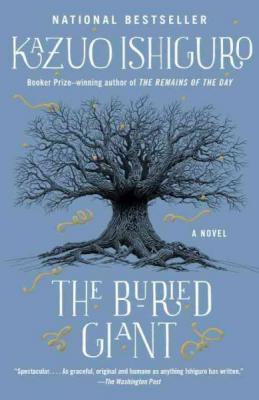
Audio book: The Buried Giant

buriedgiantby Kazuo Ishiguro
Read by: David Horovitch
Support your local independent bookstore: buy it there!
Content: There’s some violence and mild sexual elements. But, no worse than any Tolkein book. In fact, if you’ve made it through LOTR, you will probably really like this one.

Axl and Beatrice have had a long, good life. Or, at least as much as they can remember. They live in a cave dwelling in Britain, in the time after the Romans left and Arthur’s peace with the Saxons is waning. They’re not quite content, and so they determine that they need to head to a nearby village to see their son — whom they only can barely remember having — because he’s anxiously waiting for them.

They have no idea how their journey will go, or the people they will meet (an elder Sir Gawain among them, much to my delight), and how it will all change them.

I’m not sure how much more of the actual plot I want to divulge. Much like LOTR (which this strongly reminded me of), the plot is less important than the journey. Axl and Beatrice’s journey — though we never really got inside Beatrice’s head, which disappointed me — was a grand one, like Odysseus, or Frodo. The people the met, the friendships they made, the emotional journey they took as well as the physical one all had a mythological quality to it.

I’m sure you can find a lot of deeper meaning in the story as well. But for me, listening to it on my way to and from Dallas (the narrator was excellent, once I got used to his cadence), it was more a long oral narrative, a story to be heard by the firelight over several nights, a story to capture the imagination and to be swept up in.

Which means it’s being told by a master storyteller. And I loved every minute.

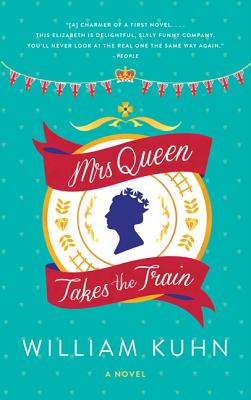
Mrs. Queen Takes the Train

mrsqueenby William Kuhn
First sentence: “Several years ago, on a dark afternoon in December, Her Magesty Elizabeth the Second, by the Grace of God, of the United Kingdom, Northern Ireland, and Her Other Realms and Territories Queen, Head of the Commonwealth of Nations, Defender of Faith, Duchess of Edinbugh, Countess of Merioneth, Baroness Greenwich, Duke of Lancaster, Lord of Mann, Duke of Normandy sat at her desk, frowning at a computer screen..”
Support your local independent bookstore: buy it there!
Content: There’s a few f-bombs (maybe a half dozen?). But other than that, it’s pretty clean. It’s in the adult fiction section of the bookstore.

You would think, from the title and first sentence, that this is a story about Queen Elizabeth and you would be right. She is most definitely a character. However, I’m not entirely sure she’s the main character, or rather just a plot device. The basic plot is this: The Queen gets down one December day, and then goes missing. Six people — her lady in waiting, Lady Anne; her dresser, Shirley; her butler, William; a member of her security team, Luke; an employee at the Mews, the horse stables, Rebecca; and an employee of the shop where The Queen gets her cheese, Rajiv — all, for various reasons, go looking for her. It’s much less about The Queen and the reasons she left than it is about the politics of the royal household, and the lives of those looking for her.

Which isn’t to say it was bad. It wasn’t. But it wasn’t as good as I had hoped, either. The parts with The Queen out and wandering around, connecting anonymously with people were really intriguing and quite fun. The rest of it — the backstories, the drama, the relationship building — not so much. There were several times when I considered bailing on this — it just took way too long to get going — but I didn’t because it was for book group. I think I just wanted it to be more… fun. And much less drama-y.

I just wasn’t thrilled with it in the end.

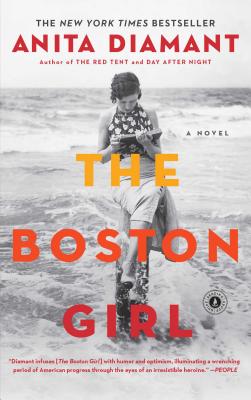
Audiobook: The Boston Girl

bostongirlby Anita Diamant
Read by: Linda Lavin
Support your local independent bookstore: buy it there!
Content: There are some mild swear words and references to drinking and smoking. It’s in the adult fiction section of the bookstore.

Addie Baum is the daughter of Eastern European immigrants, who came to American when the persecution became too bad back home. Addie was born in 1900 in Boston, and grew up in a world wholly different from that her parents, and even her older sisters (the youngest who was 14 years older than Addie), knew. It was a world where Addie went to school instead of getting married young and having babies. A world where she held a job and chose love for herself. A fascinating, modern world, but one that put her at odds with her parents — especially her mother — and the way of life they had always known.

I loved this one from the start. It begins as a series of reflections of an 85-year-old Addie in response to the question asked by her 22-year-old granddaughter: “How did you get to be the woman you are today?” The whole novel felt like a personal history, complete with asides that a grandmother would say in the telling. And while it covered Addie’s whole life, the focus was on her formative years from when she was 15 until she met and married her husband. The opportunities she had (because of the people she met), her struggles with family and religion and men, her jobs and the experiences she had because of them. It was a fascinating slice of life.

And the narrator was perfect. She caught that personal history vibe and ran with it; so very often I could almost see Addie, sitting in her living room, telling this story to an interested granddaughter. No, she didn’t do voices, though she had a good Boston accent overall, but I don’t think it was needed for this. The way Lavin read it was just perfect.

As was this story.

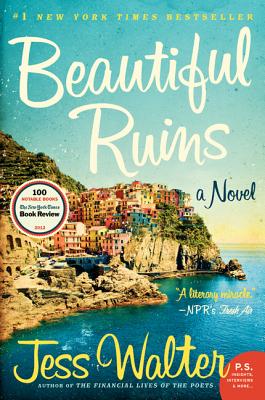
Audiobook: Beautiful Ruins

beautiful ruinsby Jess Walter
Read by: Edoardo Ballerini
Support your local independent bookstore: buy it there!
Content: There is a bit of sex, and a lot of swearing, including a bunch of f-bombs. It’s in the adult section of the bookstore.

It’s April 1962, and Pasquale has just returned home to his small seaside village of Porto Vergogna to run his deceased father’s hotel, Hotel Adequate View. It’s a nothing of a hotel in a nothing of a village, and he pretty much feels like he’s at a dead end. Then the beautiful American actress Dee Moray shows up on Pasquale’s doorstep.

Thinking she has cancer, Dee’s on leave from the Richard Burton/Elizabeth Taylor production from Cleopatra. She takes refuge at Pasquale’s hotel while he tries to figure out who sent her and why she was there.

Flash forward fifty years, when Pasquale shows up in Hollywood at the famous producer Michael Dean’s office, looking for Dee. And in and around those two events there is a story. Between flashbacks and flash forwards and a few side trips, Walter spills out Dee and Pasquale’s story, from his affair with an older woman (that resulted in a child) to her affair with Richard Burton (that resulted in a child) and the consequences of their decisions.

It was a bit more meandering than I like my books to be. There were several sections that if I had read this in print, I would have skipped. And so, listening to it on audio, I kind of got impatient. However, the narrator was brilliant. Didn’t matter the accent, he was there and so, so good. In fact, it’s what kept me listening throughout the book. Eventually, I did bail, during the epilogue-like part because I just lost interest.

There were parts that I did enjoy, threads of the larger story that I did connect with. But mostly, other than the narrator, I wasn’t that thrilled with the book. It’s just wasn’t my sort of story.

Prayers for Sale

by Sandra Dallas
First sentence: “The old woman peered past the red geraniums in her deep front window at the figure lingering in the moon-white snow at the gate.”
Support your local independent bookstore: buy it there!
Content: There’s some harsh violence against women in the beginning, but other than that, it’s mostly just more mature themes. It’d be in the adult fiction section of the bookstore.

This is one of those moments when I am grateful for my book group, because they introduce me to books I wouldn’t otherwise pick up. I had previously read Sandra Dallas and thought she was okay, but I wasn’t prepared for the storm of emotions that this one brought on.

It’s the early 1900s and Hennie Comfort is a long time resident of Upper Swan, a gold mining camp in the mountains of Colorado. She’s 86 and she’s loved her long life up in the mountains. So much so that she doesn’t want to go down and live with her daughter. She’s determined to get the most out of these last few months she has. And then she meets Nit. The wife of a new worker on the drudge boat, Nit is suffering from lots of things: being new, obviously, but also from the stillborn death of her first baby. Hennie reaches out to her as a mother-figure and a friend, and they form a bond. It’s through that bond that we learn about Hennie’s past (and a bit of Nit’s as well) and her life.

It’s a glorious novel, one that celebrates all aspects of women-hood. It made me long for a connection like Hennie and Nit had (they bonded over quilting; it also made me wish I was into that). Hennie’s stories were so rich, her life so full, and yet she probably didn’t feel that way in the midst of it all. I loved that it was straight-forward, that Hennie was open and loving and accepting, and yet wasn’t entirely perfect either. She had her struggles and her faults and her doubts. It gave me hope that maybe I can pull off a decent life in the end.

A full, rich work of historical fiction.

The Martian

by Andy Weir
First sentence: “I’m pretty much f***ed.”
Support your local independent bookstore: buy it there!
Content: As you can tell from the first sentence, the big content issue with this book is LANGUAGE. If you have problems with that, then this book isn’t for you. It’s in the science fiction section of the bookstore.

Mark Watney was one of six astronauts sent to Mars as part of an exploratory and scientific mission. He’s a botanist and was trained to be the fix-it guy, and he was expecting to spend 31 days on the planet with his crewmates and then head home. Then, six days in, a storm kicked up, and an accident happened and he was considered dead. So, the captain made the decision to leave him. Turns out, though, that he wasn’t dead.

Thus starts 368 pages of the best problem solving novel I’ve ever read. Seriously. Weir throws all sorts of things — most of them being normal, every day sorts of things; there’s not many super extreme situations here — at Watney and has him figure out how to survive. You wouldn’t think it would make for a fascinating, gripping novel but it does. Part of this is because Watney is a hilarious (if foul) narrator. He’s SO snarky, and laugh-out-loud hilarious, which helps diffuse the tension in the novel. It also makes it a very practical book, which makes me wonder how much of it is actually accurate science. (I gather, from the author notes at the end, quite a lot.) I kept turning the pages (and staying up late) wondering just what the heck was going to happen next.

I don’t usually go in for books that have a lot of hype or even a movie coming out, but this one is definitely worth all the buzz surrounding it.

Audiobook: How to Be Both

by Ali Smith
Read by John Banks
Support your local independent bookstore: buy it there!
Content: There’s probably six or so f-bombs spread through the whole book. It’s in the adult fiction section of the bookstore.

I knew very little about this book before picking it up, only that it made for an excellent book group discussion in one of the book groups at the store, and that a couple people on staff really loved it. It was enough for me to use my last audiobooks.com credit to get the audio. The other thing I knew was that this book is two novellas in one, and that half the books printed have one first, and the other half are reversed. You don’t know, previous to picking it up, whose story you will get first.

The two stories are interconnected looks at art and perception. One is contemporary, the story of a mother-daughter relationship. The other is a stream-of-consciousness from the perspective of an Italian Renaissance painter in the 1400s. I really don’t want to say much more than that, except I read it Camera-Eyes, and I thoroughly enjoyed the way the two stories weaved together. It gave me much to think about.

Also, once I got used to the narrator (and the book), I thoroughly enjoyed listening to this one. I enjoyed his style, and that he didn’t try to do falsetto female voices. Everything was pretty matter-of-fact, which took a bit to fall into the groove with, but once I did, was quite lovely.

An excellent read.

Siddhartha

by Herman Hesse
First sentence: “In the shadow of the house, in the sun on the riverbank by the boats, in the shadow of the sal-tree forest, in the shadow of the fig tree, Siddhartha, the beautiful brahmin’s son, the young falcon, grew up with his friend, the brahmin’s son Govinda.”
Support your local independent bookstore: buy it there!
Content: It’s dense. And there’s some illusion to sex, though nothing graphic. It’s in the adult fiction section of the bookstore.

I picked this up because I was looking for something to fill out one of my last bingo squares, one on a religion I knew very little about. I picked Buddhism, mostly because it’s the one I know the least about (though I do know some). A friend suggested this, even though it’s written by a Westerner, because it’s an accessible read for Westerners about a Buddha-like character and Buddhist thought.

It’s basically the life journey of Siddhartha, a young, well-to-do man in India (I’m assuming). He starts out with everything and then gives it up to join the shramanas, a group the eschews material things in search of knowledge and nirvana. He leads that life for a while, until he sees a beautiful woman, and he gives up his path for the path of material things and love. He finds happiness for a while, but eventually gives that up for a simpler life of service and meditation by a river.

I’m not sure I fully got what this book was supposed to teach me. It’s one of those that I think will be different at different stages of your life, and that multiple readings will lend to more insights. I’m glad I read it, even if I didn’t fully understand it. It’s definitely given me something to think about.

Room With a View

by E. M. Forester
First sentence: “‘The Signora had no business to do it,’ said Miss Barttlet, ‘no business at all.'”
Support your local independent bookstore: buy it there!
Content:  There’s some mild swearing, but not much at all. It’s dated, and English, but not too difficult to understand. It’s in the adult fiction section of the bookstore.

I don’t know when I first read this one; probably sometime soon after the Merchant Ivory movie (which I own still on videotape!) came out in the 1980. I don’t know when I got the copy I own, either. (A duo with Howard’s End). I do know that it’s loved enough that it’s falling apart.

And it’s well worth it.

I love Lucy’s innocence and Charlotte’s fussbudget-ness and George’s impulsiveness and Mr. Emerson’s progressiveness and Cecil’s snobbishness. I love Forester’s commentary on the Victorian English upperclass. I love it all. (And yes, I do firmly have the movie in mind when I read.)

I don’t have much more to say; this has been one of my comfort reads in the past, and it was absolutely delightful revisiting it again after being away for so long.

Audiobook: My Brilliant Friend

by Elena Ferrante
Translated by: Ann Goldstein
Read by: Hillary Huber
Support your local independent bookstore: buy it there!
Content: There’s a few mild swear words and some frank talk about not-quite sex. It’s incredibly slow with a lot of narration rather than dialogue, but I’d give it to a high schooler who was interested in historical fiction. It’s in the adult section of the bookstore.

I picked this one up because I’ve heard good things about Ferrante from our translation book club (they only read works in translation), and because I needed a book in translation for my bingo card.  (Which I’m going to end up being three squares short from getting a blackout. I read a lot.) I didn’t know much about it, going in, so I didn’t think I had any expectations. (I did however, expect to really enjoy the narrator, which I did.)

What it turned out to be was a very slow, intricate, detailed portrait of a girl, Elena, in a neighborhood in Naples, Italy, and her (somewhat obsessive) relationship with her best friend, Lila. This first book is a lot of set up: their lives — Lila is the daughter of a shoe repairman; Elena the daughter of a porter, whose mother has a wandering eye and limp and is cruel — and their relationship — mostly competitive, mostly on the side of Elena — to each other. They meet in elementary school, where Lina is the smartest and the best. But because she is poorer than Elena and because her parents won’t be bullied by the teacher (there was a lot of bullying by people in this), Lina drops out of school while Elena continues.

And yet, everything Elena does is because she wants to seem important to Lina. She wants Lina to look at her and feel like she Needs Elena in her life. And yet, for the most part, she doesn’t.

I’m still not sure how I feel about this one. On the one hand, I adored Huber’s narration, the way she embodied the characters (and how effortlessly the Italian names and places came off her tongue). She really is a talented reader, and I love listening to her. But, I’m not sure I figured out what was so great about the novel. I was interested enough to keep reading; the character’s lives were intriguing and, yeah, I guess I did want to hear what Elena and Lina would do next. But, in the end, I don’t know if I cared. I finished the book and kind of went, “Huh.” Maybe it’s because I don’t read a lot of books like this (both translated as well as adult fiction), but it just kind of washed over me.

Not that it was bad. It just wasn’t something I was terribly enthusiastic about.