The Testaments

by Margaret Atwood
First sentence: “Only dead people are allowed to have statues, but I have been given one while still alive.”
Support your local independent bookstore: buy it there!
Others in the series: The Handmaid’s Tale
Content: There is an instance of sexual assault, some violence (some of which is pretty graphic), and instances of swearing, including multiple f-bombs. It’s in the adult fiction section of the bookstore.

I’m going to preface this with a couple of caveats: I haven’t read The Handmaid’s Tale in about 10 years, though I have kids who have read it more recently and have talked to me about it. I remember basic plot points of the book, but not specifics. And, I have not (yet; I’m kind of curious now that I’ve finished this one) watched the series on Hulu. I think having watched the series and/or having read the book more recently may have an impact on your opinion of this one.

The Testaments follows three women: Aunt Lydia, who was there at the beginning of Gilead, and chose to become part of the founding structure of the regime; Agnes Jemima, who was born in Gilead and was raised to believe in its teachings; and Daisy, who was born in Gilead, but whose mother, a Handmaid, escaped north to Canada and who was raised by a couple there. The narratives intertwine and go back and forth through time; we find out through Aunt Lydia what happened when Giliead was formed, and the choices she made to become in the position of power she is currently in. We find out through Agnes what is being taught to the generation of girls that has since been born. and the challenges they face. And from Daisy, we find out not only what the rest of the world thinks of Gilead, but the future of it.

It’s a fascinating book to read, though I’m not entirely sure it’s 1) coherent with the world Atwood put out in the Handmaid’s Tale (see above caveat) and 2) necessary. It’s really all about the downfall of Gilead, because in Atwood’s view, no matter how “pure” or “righteous” your intent setting out, we are all human and, therefore, corrupt, and any system of government built upon anything but basic human rights for all is bound to fall. I’m not sure how I feel about that — it seems easy to believe that the Commander in charge of Gilead, Commander Judd, was inherently corrupt from the start and just did all this as a power grab and because he’d like any excuse to “marry” and kill off a series of increasingly younger brides. It’s disgusting, but I’m not sure it serves a purpose except to prove that all men who crave power are disgusting and corrupt. (Which may or may not be the case.)

But it’s Atwood, and her writing is engaging, and the storytelling interesting, and while it’s not as harrowing as Handmaid’s Tale was when I first read it, it’s definitely got a bit of a warning: dismiss the power of women at your own peril.

And maybe this is the book we need for this time in history.

Audiobook: The Sun is a Compass

by Caroline Van Hemert
Read by Xe Sands
Support your local independent bookstore: buy it there!
Or listen at Libro.fm
Content: There’s some swearing, including several f-bombs. It’s in the creative non-fiction section of the bookstore.

I picked this one out of my audiobook stash primarily because I’m a sucker for travel books, and this one — in which Caroline and her husband Patrick traverse from Bellingham, Washington to the Arctic Circle entirely on foot and boat over the course of six months –seemed to fit the bill.

A biologist by trade, Van Hemert also grew up in Alaska, and has had a need for adventure — or to at least be in the outdoors — her whole life. And she found a kindred spirit in Patrick, who (if I remember right) built his own cabin in Alaska (though he grew up on the East Coast) and lived in it for a year between high school and college. They are the sort of people to decide to spend six months trekking 4000 miles and then write a book about it.

I don’t mean to sound bitter (if I do); they are amazing people. And I’m glad that there are people like them out there. I’m not sure this one worked entirely in audio; while I was transfixed with the story, I was a bit frustrated I didn’t have a map. The places she was talking about (aside from Bellingham; I know where that is) were foreign to me. Sure, I could have stopped the book and Googled it, but I listen while I drive, and it wasn’t practical. That said, I did enjoy her story, the ups and downs of six months of backwoods hiking, and the reminder that the world is a big, wild place that has been here (and will be here) a lot longer than we humans.

Best Friends

by Shannon Hale and LeUyen Pham
Support your local independent bookstore: buy it there!
Others in the series: Real Friends
Content: There’s some uncomfortable parts with anxiety, and a bit of “romance” with boys and girls. It’s in the middle grade graphic graphic novel section of the bookstore.

Picking up where Real Friends left off, with the summer before Shannon’s sixth grade year. She’s convinced that she’s going to have a great year: they’re the oldest kids in school, she’s best friends with the most popular girl in school, and maybe she’s got it all figured out. Except, she doesn’t, not really. Friendship — especially in sixth grade in the 1980s — is a minefield. And being popular has costs.

Much like Real Friends, this one is full of heart and humor and insight. My poor sixth grade self, awkward and not knowing how on earth to fit in, completely empathized with Shannon’s plight. And it was nice that she used excerpts (polished up, of course) from a novel she wrote in sixth grade. It made for a nice balance to the drama of the contemporary story. Pham’s art, of course, was perfect for the story, especially when dealing with Shannon’s anxiety. It’s a perfect compliment for Real Friends, and a wonderful exploration of what real friendship means.

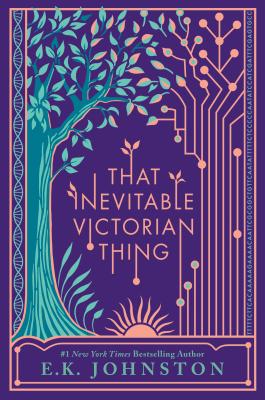
That Inevitable Victorian Thing

by E. K. Johnston
First sentence: “Helena Marcus had not given much though to her marriage.”
Support your local independent bookstore: buy it there!
Content: There’s some mild swearing, including a couple of f-bombs. It’s in the Teen (grades 9+ section of the bookstore).

In the world of this book, the British Empire has taken over the world (mostly, except for the States, which has basically dissolved into ruin), and the way marriages are made are done by entering genetic codes into the computer. (At least, that’s the way I understood it.) There’s room for love matches, but mostly the society wants the best genetic diversity, so most people match through the genetic system. I was never really able to pinpoint time — the girls were still “debuting” into society, there were corsets and balls, but there was also an internet-like thing, airplanes, trains and cars. It was a weird mashup of historical and futuristic.

There are three characters — Helena, who’s basically promised to August, the son of some sort of shipping mangnate, and Margaret, who’s the crown princess, but she’s in disguise. It’s set in Canada, whichi is nice… but nothing really happens. I read about 2/3 of this, and got frustrated with the lack of things happening — I think she was going for an Austen-like feel, but it just wasn’t doing it for me — and then skipped to the end. I’m not sure I missed much.

I liked the idea of this, but the execution just fell short.

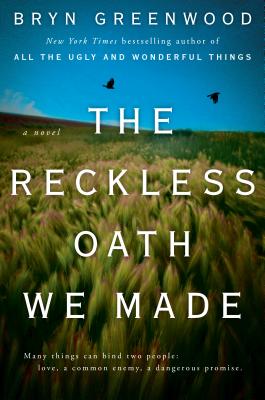
Audiobook: The Reckless Oath We Made

by Bryn Greenwood
Read by Alex McKenna, Kirby Heyborne, and a full cast
Support your local independent bookstore: buy it there!
Or listen at Libro.fm
Content: There is a lot of swearing, including multiple f-bombs, some drug use and drinking, and one tasteful sex scene. It’s in the adult fiction section of the bookstore.

Zee hasn’t had the best life: her mother is a hoarder, a habit only made worse by her father being sent to prison for a robbery gone wrong when Zee was eight. For most of her 26 years, it’s been her and her sister against the world. And Zee — whether by waiting tables or by running marijuana from Colorado for the wrong sort of people — is going to make it work. Somehow.

But then, she meets Gentry. An autistic man who speaks in Middle English and abides by a Code of Chivalry who was told by one of his voices — the witch — that he is to be Zee’s Champion. It doesn’t make much sense to Zee, but when her sister is kidnapped from the El Dorado prison during an outbreak, Gentry is the only person Zee can turn to.

From there starts a heartbreakingly sweet and tender story of the love that grows between Zee and Gentry. But it’s more than a love story (which it is, at its heart), it’s a story of trust and family and forgiveness. The audio is wonderfully done; I loved both of the main narrators — Zee and Gentry — but also all the side characters that got chapters in this wild, compelling story. And yes, the ending made me cry. There was so much heart and acceptance and love in this book that I couldn’t help but fall in love with the characters. Maybe it was an “I wouldn’t have liked it if I had read it” book (the audio really is excellent), but I think it’s just a really good story. Or at least my kind of good story.

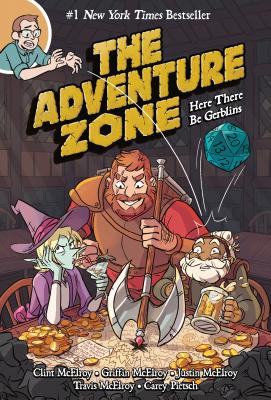
The Adventure Zone: Here There Be Gerblins

by Clint McElroy, Griffin McElroy, Justin McElroy, Travis McElroy, and Carey Pietsch
Support your local independent bookstore: buy it there!
Content: It’s violent, but not overly so, and there are multiple instances of f-bombs. It’s in the graphic novel section of the bookstore.

In an interesting twist on things, this graphic novel is based on a podcast, in which the McElroy family gets together and plays Dungeons and Dragons. I’ve never listened to the podcast, though I did dip into it a little bit just to see how much like the podcast the graphic novel was, but I thought this one sounded interesting. What they did, essentially, was pull out the threads of the story from their game, and make it into a straight-up story. (For the most part. Griffin, who’s the dungeon master, shows up as the DM on occasion to direct the action.)

And for the most part, this was fun. It holds up as a story of three adventurers — and elf, a dwarf, and a human — who are on a rescue mission which turns into something bigger than they thought. They interact with wild and weird (and often hilarious) characters, like the bad bodyguard Barry Bluejeans, or the boss gerblin, or the female orc that has a bigger, more encompassing purpose.

It’s silly, and I think it’ll especially resonate with people who have either listened to the podcast or played a lot of D&D. But it still worked for me.

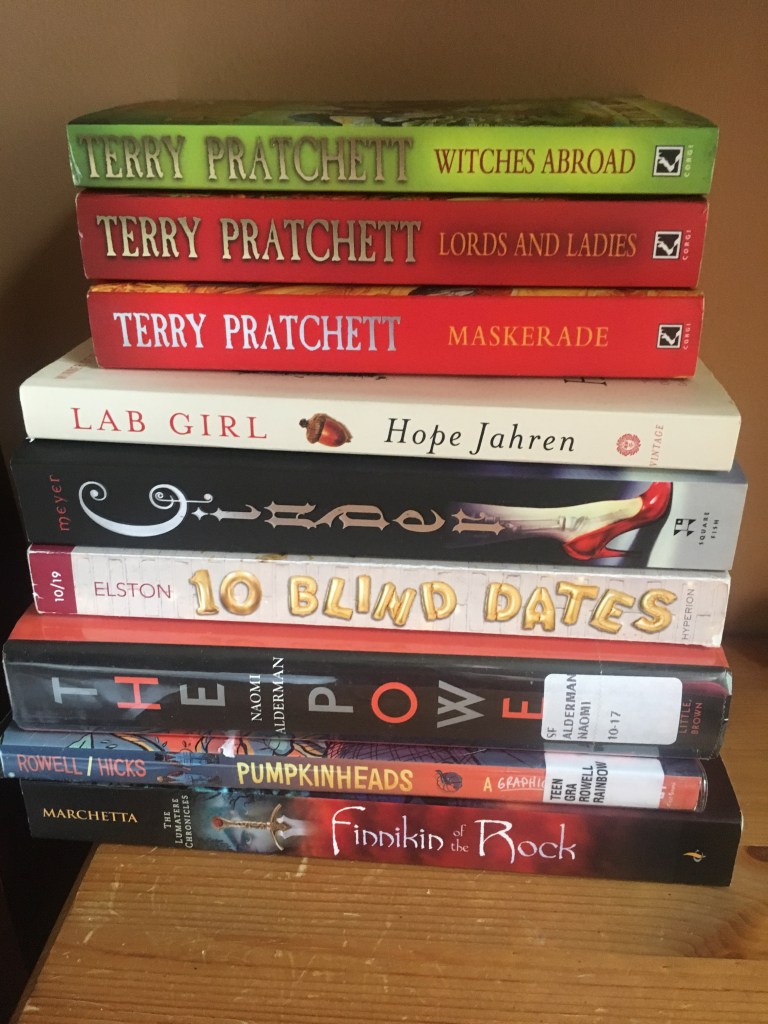
State of the TBR Pile: September 2019

First order of business: If you write about children’s books (from picture books to YA) ANYWHERE (Goodreads, blog, YouTube — though I guess that’s not writing — Instagram) you should seriously consider applying to help judge the Cybils awards this year. I’ve been helping out for more than a decade now, and I have met some of the best people through the Cybils, as well as read some of the best books. Yes, it’s a time commitment, but it’s a FUN one, and one I love being a part of. For more information about applying, go here.

And now, for the state of the TBR Pile:

Witches Abroad by Terry Pratchett
Lords and Ladies by Terry Pratchett
Maskerade by Terry Pratchett
Lab Girl by Hope Jahren
Cinder by Marissa Meyer
The Power by Naomi Alderman
Pumpkinheads by Rainbow Rowell and Faith Erin Hicks
Finnikin of the Rock by Melina Marchetta

The irony of this pile is that the books I’ve chosen to read while recovering from knee surgery (which is NO fun) weren’t even on this pile to begin with. Ah. Bookish people problems.

What are you looking forward to reading?

Some Places More than Others

by Renee Watson
First sentence: “‘New York City is no place or a little girl,’ Mom says.”
Support your local independent bookstore: buy it there!
Review copy provided by the publisher.
Content: There’s some arguing, but mostly it’s pretty good for the age group — 8-12 — that it’s aimed for. It’s in the Middle Grade (grades 3-5) section of the bookstore.

Amara wants one thing for her 12th birthday: to go see her father’s home and family in New York City. She’d love to go by herself, but she’ll take going with her father on a business trip. The problem? Her father hasn’t spoken to her grandfather in 12 years, since Amara was born and her grandmother passed away.

It takes a while (probably a bit longer than it should for the pacing in the book, but that’s being nitpick-y), but Amara is on her way to Harlem to see her grandfather, aunt, and cousins (whom she has only spoken to). It’s awkward, especially since her cousins are 14 and 16 and don’t really want to hang out with her. Amara has a few adventures (and mis-adventures) and learns about her own personal history as well as African American history in Harlem.

I enjoyed the book, mostly for the history as well as the class tensions between Amara — who is decidedly upper middle class — and her cousins — who are not. I liked Amara as a character, and I think Watson got the middle grade voice right, even if the pacing was slightly off.

In the end, it was a sweet story about learning the importance of where you (or your people) came from.

Autopsy of a Boring Wife

by Marie-Renee Lavoie
translated by Arielle Aaronson
First sentence: “I’ve always thought it terribly pretentious to gather all your loved ones in one place in order to say: the two of us, right new right now and in spite of the overwhelming statistics, declare that we, temporarily bonded by the illusion of eternity, we are FOREVER.”
Support your local independent bookstore: buy it there!
Content: There’s talk of sex and some swearing, including f-bombs. It’s in the adult fiction section of the bookstore.

The publisher is calling this a “Quebecois Bridget Jones Diary” so I went in expecting a quirky heroine who’s a bit of a hot mess and trying to get her life in order. I expected it to be funny. It’s neither of those things.

On the eve of their 25th anniversary (which seems like not a long enough time, considering they have three kids and two are out of college and only one is starting college… I suppose their oldest could be 23, but he seemed older than that.), Diane’s husband tells her he’s leaving her. She’s boring, he says, and he’s found Better Love with his 30-year-old secretary. At age 48 (again, seems young, but that’s just me), Diane has NO idea what to do with her life, which had (even though she has a full-time job) revolved around her husband and children.

What follows is a pretty interesting (though not funny) exploration of the five stages of grief from a woman who is mourning the loss of her marriage. It wasn’t until the end that I realized it: Diane went through each stage as she tried to right her life back and tried to figure out where to go from here. It was thoughtful, yes, and bittersweet, but nothing like what I was expecting.

Which doesn’t make it bad. It just isn’t what the publisher promised.

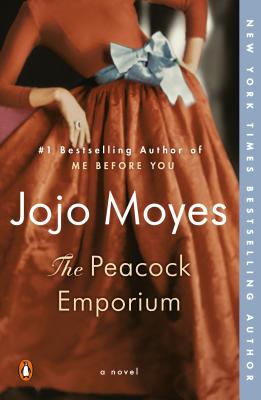
The Peacock Emporium

by Jojo Moyes
First sentence: “It was the third time in a week that the air-conditioning had gone out at the Hospital de Clinicas, and the heat was so heavy that the nurses had taken to holding battery-operated plastic fans over the intensive-care patients in an effort to keep them cool.”
Support your local independent bookstore: buy it there!
Review copy provided by the publisher.
Content: There’s some swearing, including f-bombs, and some talk of sex. It’s in the Fiction section of the bookstore.

The plot of this is kind of hard to describe. It’s a mother-daughter story — Suzanna has always lived with the shadow of her mother’s flighty-ness; she left Suzanna’s dad and ran off with a salesman, and then died shortly thereafter. And it’s about class — because of her mother, and long memories of the town, Suzanna’s always felt like an outsider in her privileged English family. It’s about relationships and choices: Suzanna’s husband, Nick, has been on her case to have a baby, which she’s not happy about. It’s about friendship: Opening up her “Peacock Emporium” in the small town where she grew up, Suzanna makes a good friend in Jessie, and discovers what it Means To Live. And it’s about new love: Argentinian Alejandro moves to town and Suzanna realizes that maybe she’s been with the wrong man for 10 years.

I didn’t dislike it; I finished it, after all. And Moyes is a good writer. This one kept jumping back and forth in time, which made it kind of difficult to tell ages and time periods, but I didn’t mind it all too much. I didn’t love it, though. I guess nothing happened for most of the book, and then everything came down in the last 100 pages and maybe it felt rushed? I’m not entirely sure. I read this in bits and pieces over several months, which also may have contributed to me not really getting into the book.

Or maybe it’s just that adult fiction, sometimes, just doesn’t do things as well as it could. Not the best book out there, but not the worst either.