KidlitCon: In Which I Wander around Minneapolis

Like last year, I had had marvelous, wonderful, amazing,
exhausting time at KidlitCon 2010. And like last year, the best part of it all was the times in which a group of us — three, four, seven, a dozen — sat around chatting and drinking (well, them, not me) and talking about everything from books to blogs to politics to TV. The reason I want to keep going to these is not so much because I learn at the conferences — though I do; I came home with ideas and ruminations on publisher-blogger relationships, how to improve my blog, and the desire to actually read more of what I love and not worry so much about what is popular — but because the people, the community, of kidlit bloggers and authors is so wonderful.

I got in Friday, which was an amazingly beautiful day, and did some wandering around. None of which was planned — I was looking for the hotel, but forgot to get the address/directions, and so spent a good part of my morning wandering downtown looking for it, and then (once I found it), went looking for the Mississippi River… in the completely wrong direction. The upside? I found some lovely fall trees.

I met up with Pam (Mother Reader), Liz (A Chair, A Fireplace and A Teacozy), and Laura (Pinot and Prose) for lunch and drinks and stimulating conversation before heading over to the Loft for the first session: a very hilarious, very interesting (even for a non-writer) discussion with Maggie Stiefvater and her two critiquing partners Brenna Yovanoff, and Tessa Gratton. I’m sure there was some deep discussion and interesting nuggets, but I never got past how funny they all were. I also sat in the back, which was not conducive to getting pictures.

I didn’t get any pictures from the Saturday sessions, either (ha, but other people did! Check out the photos on Flickr); I was too busy listening and talking and didn’t remember that I should have taken pictures. But, I did snap one of Maggie this time.

She spoke about the 8 things she’s learned about blogging. The best-remembered (re-tweeted) advice? Never blog tired, sick or drunk. You wouldn’t think it needs to be said, but it does.

(That said, I’m breaking her rules right now, being both tired and sick. But I’m not drunk, so I figure that counts for something.)

I’m not going to sum up all the sessions I attended, but a few highlights:

  • In the Blogging the Backlist, Charlotte (Charlotte’s Library) mentioned that when she blogs about books she loves, she feels that it gives her readers as sense of her personality. I need to find a balance between blogging the “hot” books, as well as blogging books that I love.
  • The publisher’s panel after lunch was a great discussion about the relationship between publishers, authors and bloggers. Things publishers look for in a blog: a readily available (top right hand corner, please) statement of what you like to read. That you have a pet turtle (or in my case, that I stay home with my girls and like to read, period), is not helpful. Also have your email address available.
  • That said, there was some discussion about when a review of a new book should go up. Publishers, for obvious reasons, want buzz right around the review date. And yet, they’re also looking for blogs that go beyond the “me too” reviews. I think there’s value in reviews 3 or 6 months, or even a year (or five), after a book is published, because I’m writing to spread the love of reading and books, and not to sell them. It’s a conflict that I’m not sure will ever be resolved.
  • The session in which a couple of the authors from From the Mixed-Up Files
    was interesting, even if it wasn’t really applicable to me. I just think it’s wonderful to see middle grade books and authors finding a (bigger) place in the kidlitosphere.
  • I didn’t go to the Book Tour session, but I followed it on Twitter. The one thing that I got out of it is that I need to be better with researching authors before asking questions. And not asking generic “did you always want to be a writer” questions. I do okay with some authors, but not so great with others. I’m curious: if you do author interviews, how do you come up with questions for them?

Dinner afterward was a blast. I managed to snag a picture of our table, which was hopping with lively discussion. Going clockwise from the lower left hand corner: Janet Fox, Jacqueline Houtman, Liz, Charlotte, me, Carol Rasco (who has the most wonderful Arkansas accent; I loved sitting next to her and listening to her talk), Jen Robinson, Maureen (Confessions of a Bibliovore), and Pam.

I did eventually find the river, in case you were wondering…

I’m sure as the week goes on, there will be more highlights put up. I’ll try and link to them as I find them. At any rate, many, many thanks go out to our wonderful trio of organizers: Brian Farrey (Flux), Andrew Karre (Carolrhoda Books) and Ben Barnhart (Milkweed Editions), and held at The Loft, which was an amazing building in its own right. They did a fantastic job.

Here’s looking forward to Seattle next year!

Marcelo in the Real World

by Francisco X. Stork
ages: 15+
First sentence: “‘Marcelo, are you ready?'”
Support your local independent bookstore: buy it there!

It took me too long to get to this book.

Seriously.

I don’t know why it took me so long — perhaps it was a bit of the “if it’s that hyped, it can’t be that good”phobia I have — but honestly, you think after nearly six years of blogging, I’d have learned to trust you all. Because when you say a book is good, the book is good. (Which means, I suppose, I should cave and read Maze Runner soon.)

For the ten out there who haven’t read the book, it’s the summer before seventeen-year-old Marcelo Sandoval’s senior year. He’s on the autism spectrum; he likes to tell people his “condition” is closest to Asperger Syndrome, but even that doesn’t describe it fully. It takes a while for him to process interactions with other people. He hears something akin to music in his head, something he can’t quite describe to other people. His fixation is religion, though he loves working with the ponies at Paterson, a school for disabled children. Life is good, or at least as good as Marcelo wants it.

Then his father, who has never really accepted there is anything “wrong” with Marcelo, decides that Marcelo has been disadvantaged by living in a bubble world at Paterson, and that what he needs is a good dose of the real world. He arranges for Marcelo to work in the mail room at his law firm, something which Marcelo doesn’t really want to do. And yet, because his father is insistent, it’s what he ends up doing. And, for good or ill — or maybe a little bit of both — he ends up experiencing a little bit of the real world.

Written from Marcelo’s point of view, and in Marcelo’s voice, readers are invited into his world, a place I found amazing. Marcelo is comfortable with who he is, and he tries so hard to understand the world around him. His explorations of religion were fascinating, as is, as he gets deeper into the real world, his questions about beauty, about sex and about human interactions. (Yes, it’s frank, and there is some language, but nothing ever felt gratuitous.) There’s a bit of a legal mystery and romance to add to the inner dialogue that Marcleo has. It’s a deep book, one full of difficult questions and tough answers. And yet, as I finished it, I was surprised at the love and the hope that radiated from it, which brought tears to my eyes.

In short: absolutely wonderful.

The Red Umbrella

by Christina Diaz Gonzalez
ages: 11+
First sentence: “I watched as a white heron circled the beach and then headed north toward the open waters of the tropics.”
Support your local independent bookstore: buy it there!

Lucia’s life isn’t all that bad. Sure, her mother is a bit overprotective, not letting her wear makeup or cut her hair short like the fashionable girls. Ans sure, her little brother Frankie is annoying. But, she has her best friend to giggle over boys with, her father has a good job, and Castro’s revolution hasn’t reached her home town of Puerto Mejares, Cuba.

Then one day, it does, and Lucia’s world turns upside down. Her father is resistant to participating in the revolution, and Lucia inadvertently sees things she shouldn’t have. After a couple of show-downs with the soldiers, Lucia’s parents do the unthinkable: they choose to send Lucia and Frankie to the U.S. for asylum, by themselves. They can only hope that their parents will be able to join them later.

The first half of the book deals with the situation in Cuba, and it’s a dire one. It reminded me of the books I’ve read about the Iranian revolution: controlling, threatening, and very scary, especially for an American, because we’ve never experienced anything like it. There’s a couple of instances, near brushes with rape and death, that made me wonder if this really is a middle grade book. But it’s all very tasteful — barely brushing the surface — and it adds to the tension in the book.

The second half is about Lucia and Frankie in America — specifically Grand Island, Nebraska. They struggle to fit in at first, but the couple they are placed with, Mr. and Mrs. Baxter, are kind and well-meaning, and eventually they find a place. The struggle then becomes with being in American and keeping themselves Cuba. And for Lucia, desperately missing home and her parents. It’s tough, but they do find a way to balance everything.

It’s an interesting novel, and addresses something I’d not heard of before in the exile of Cuban children during the revolution. Well-written and well-developed, it’s an excellent book.

Touch Blue

by Cynthia Lord
ages: 9+
First sentence: “‘The ferry’s coming!'”
Support your local independent bookstore: buy it there!

This is on my pile for Cybils reading, but Jen’s recent review prompted me to pull it off the pile sooner rather than later. And I’m so glad I did.

Tess lives in Bethsaida, a small fishing island off the coast of Maine. It’s so small, that they only have a one-room school, where her mother is the teacher. And because lobstering is no longer what it used to be, people keep moving off, and the state of Maine is threatening to close the school, which means Tess and her family would have to move.

That is, until Reverend Beal comes up with the idea to take on foster children. If they add as many children as those that have moved out, maybe they could save the school. Tess’s family is one of those who take on a foster child, a 13-year-old boy named Aaron. She hopes, and wishes, that this will be exactly what her family and the island (and maybe even Aaron) needs. But then, sometimes, everything you wish for doesn’t always turn out the way you’ve planned.

It’s a quiet book, one where the characters and setting are forefront, and shine like they should. Lord’s writing captured the quiet homeyness of island living — both the positive and the negative; there were some wonderfully nosy characters. She also captured the idea of finding a place; Aaron is a wonderfully complex character, someone who wants and needs a home, but is reluctant, because of his past, to dive in headfirst and give everything over to Tess and her family. It’s a slow process, one with bumps and hiccups, but because you care about the characters, you want it to succeed.

And with some luck, it will.

(Just for the record: because this is a Cybils nominee, I’ve been asked to make sure y’all know this is my opinion only, and not that of the panel.)

Library Loot 2010-37

Another big pile of Cybils books. I’m going to try and squeeze in all the other reading I’d love to do, too. Though if y’all would stop reading and blogging until I can, I’d really appreciate it. Then again, I could just make peace with the fact that I’ll never catch up. There are just too many books and not enough time.

Picture Books:

Hip Hop Dog, by Chris Raschka/Illus. by Valdimir Radunsky
Mathilda and the Orange Balloon, by Randall de Seve/Illus. by Jen Corace
Otis & Sydney and the Best Birthday Ever, by Laura Numeroff/Illus. by Dan Andreasen
Dotty, by Erica S. Perl/Illus. by Julia Denos
Roawr!, by Barbara Joosee/Illus. by Jan Jutte
The Ride: The Legend of Betsy Dowdy, by Kitty Griffin/Illus. by Marjorie Priceman

Middle Grade:
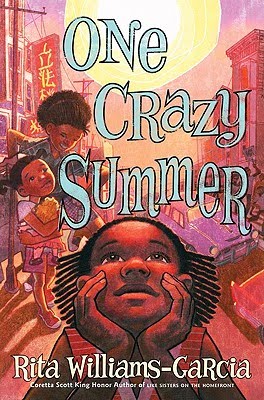
One Crazy Summer, by Rita Williams-Garcia
Clementine, Friend of the Week, by Sarah Pennypacker
Boys without Names, by Kashmira Sheth
Seaglass Summer, by Snjali Banerjee
Shooting Kabul, by N. H. Senzai

Young Adult:
StarCrossed, by Elizabeth C. Bunce

The roundup is either at Adventures of an Intrepid Reader or The Captive Reader. Obligatory FTC note: the links are provided through my Amazon Associates account. If you click through and actually purchase one of these books, I’ll get a teeny, tiny payment. But, since no one ever does, and it’s SO much easier using the associates account to put up these links, I’m going to keep doing it.

Happyface

by Stephen Edmond
ages: 14+
First sentence: “Write what you see and draw what you feel.”
Support your local independent bookstore: buy it there!

Meet Happyface. He’s attempting to reinvent himself in the wake of some pretty traumatic events. His family used to be “typical”: mom, dad, two sons, but events, and bad choices caused that to fall apart. Will that stop Happyface? No! Formerly a shy, artistic, computer-game and comic geek, he’s using the move to a new town (into an apartment with his mother) as a chance to start over.

First off: get new friends.

Happyface is the nickname that the object of his idolization, Gretchen, gave him. He’s trying so hard to be happy, to be friendly, to be likable, that she dubs him “happyface”, and it sticks. In fact, as the book unfolds, we learn a lot about Gretchen, her friends Karma and Misty Moon, her ex-boyfriend Trevor, and even about Happyface’s ex-BFF, Chloe, but not much about Happyface himself (including his name). He’s a mystery, keeping everything close to his chest and away from both the other characters as well as the reader. The conflict comes from this reluctance to reveal anything: because he’s not willing to talk about what happened in his family or his past, it ends up sabotaging his friendships. Captivating in its style — journal entries that include both prose and art — your heart aches for this boy, muddling through trying to make it all work, even as you can see it falling apart around him.

(Is it wrong that I just wanted to send them all to therapy?)

Countdown

by Deborah Wiles
ages: 10+
First sentence: “I am eleven years old and I am invisible.”
Support your local independent bookstore: buy it there!

It’s the fall of 1962, and there’s tension in the air. Fifth-grader Franny Chapman is not quite sure what’s going on with her best friend; her Uncle Otts seems to be not quite there anymore, instead spending more and more time fighting an old war in his head. Her mother is distracted, her father is gone, her older sister is choosing to spend time with her college friends and leaving Franny behind. Even her teacher has skipped her every single time when it’s her turn to read aloud in school.

On top of all that, the president — John F. Kennedy, for those of us who didn’t do well in history — has just informed the country that the Soviet Union is sending missiles to Cuba that have the potential to blow the entire country up. Franny only wants to be worried about going to her first boy-girl party, not whether or not she’s going to live to see tomorrow.

This book is billed as a “documentary novel”; the narrative is interspersed with pictures and quotes and clippings (there’s a Fallout Shelter Instruction Manual!), presumably to give the reader (who, we assume, didn’t do well in history either) some frame of reference. And taken separately, both the non-fiction parts and the fiction parts were interesting. I kind of liked Franny, and her struggles. I wanted to smack her mom, and I kind of felt that Wiles was playing up an early-60s mom stereotype: the bridge-playing, cigarette-smoking, mostly absent mom who was a very strict disciplinarian when she was around, and yet somehow had a soft heart for her children, though her son saw it more. (We’ve come a long way, baby.) And I liked the non-fiction parts as well. The quotes, the bios of notable people, the pictures were all fascinating to look at.

I just think this book tried to do too much in combining both. The narrative felt interrupted to me, and I didn’t get the sense of foreboding about the Cuban Missile Crisis that I think the author wanted us to get. In some ways, I think this would have worked better as a straight-up non-fiction book, like Marching for Freedom or Claudette Colvin. Combined with quotes and interviews, this could have been a compelling book. (I’d love to see one done from a Cuban perspective, personally.) But as it is, the book fell short in many ways for me. It tried to do too much (there’s even a faint subplot about the race issues in the country at the time, but it was never developed enough to do much with), and because of that, it didn’t do enough.

Which is just too bad.

(Just for the record: because this is a Cybils nominee, I’ve been asked to make sure y’all know this is my opinion only, and not that of the panel.)

The Fool’s Girl

by Celia Rees
ages: 14+
First sentence: “Have you seen a city under sack?”
Support your local independent bookstore: buy it there!
Review copy sent to me by the publisher.

Ever wonder what happens after the end of Twelfth Night? You know, how everyone is happily married, how the “bad” guy conveniently disappears? What happens next? Is it really happily ever after?

Well, not exactly. Celia Rees takes the ending of Twelfth Night — the play conveniently summed up for those of us who are unfamiliar with it — and spins it out. It’s no longer a comedy; even though Feste is still around, he’s not the comic relief. In fact, there isn’t any comic relief. Violetta, Viola’s daughter, is in exile from Ilyria after her mother’s disappearance and the country is overrun, and her father killed, because of the coup her uncle Sebastian and Malvolio directed. She makes her way to London, where she runs into
a certain playwright, Will Shakespeare, and enlists his help in finding Malvolio and restoring her to her country.

It’s an interesting idea; I’ve wondered about Shakespeare’s comedies in the past, especially since so many of them are only comedies by the slimmest margin. A turn of the hand, and everything falls into tragedy. And yet, this book didn’t grab me. I picked it up and put it down a few times, trying to get into the story. Once I pushed past chapter three, the story picked up a bit. Shakespeare came into play — Rees’s take on Shakespeare was intriguing; he was a gentleman and a hard-working genius, not a scoundrel or a fraud as I have seen him portrayed elsewhere — and the pace picked up a bit.

Except that scoundrels and frauds are more interesting. That’s the biggest problem with this book: everyone’s bland. Shakespeare’s only mildly interesting, Feste’s annoying. Violetta’s bland, there’s no chemistry between her and the love of her life, Stephano. In fact, with about 70 pages to go, I decided I Just. Didn’t. Care. and abandoned it. (Yeah, I read the ending first, so I’m counting it as a finish.) I like what-ifs, and I like adventure, and I like mystery. But it all has to be pretty spectacular in order to get me past characters who don’t grab my attention.

And this one just didn’t.

Library Loot 2010-36

Two reasons why this is so long this week. One: it’s Cybils season (only a couple more days to put in your nominations…), so the middle grade section is a list of books I need to read sooner rather than later. And secondly, I started volunteering at the public library (finally, yay!). I thoroughly enjoy this, but… I see a book, I WANT the book, and because it’s the library, I take home the book. The question is: when am I going to find time to READ the book???

Picture Books:
Elsie’s Bird, by Jane Yolen/Illus. by David Small
Creak! Said the Bed, by Phyllis Root/Illus. by Regan Dunnick
The Little Green Goose, by Adele Sansone/Illus. by Anke Faust
Muddy As a Duck Puddle and Other American Similes, by Laurie Lawlor/Illus. by Ethan Long
Hey, Rabbit!, by Sergio Ruzzier
Alfie Runs Away, by Kenneth M. Cadow/Illus. by Lauren Castillo

Middle Grade:
Year of the Tiger, by Alison Lloyd
The Red Umbrella, by Christinaq Diaz Gonzalez
Touch Blue, by Cynthia Lord

Young Adult:
The Princess and the Snowbird, by Mette Ivie Harrision
Castle in the Air, by Diana Wynne Jones
Evermore: The Immortals, by Alyson Noel
Behemoth, by Scott Westerfeld

The roundup is either at Adventures of an Intrepid Reader or The Captive Reader. Obligatory FTC note: the links are provided through my Amazon Associates account. If you click through and actually purchase one of these books, I’ll get a teeny, tiny payment. But, since no one ever does, and it’s SO much easier using the associates account to put up these links, I’m going to keep doing it.

Extraordinary

by Nancy Werlin
ages: 13+
First sentence: “You are ready for your mission, then, little one?”
Support your local independent bookstore: buy it there!
Review copy sent to me by the publisher.

At first glance, this book has a fascinating premise. What if the faeries made a bargain with a human, one that they felt sure they would be able to cash in on. And yet, because of the confidence of his descendants, the faeries have found that the bargain wasn’t as easy to fill as they thought it would be. They’re slowly dying, and they need to find an ordinary girl. And if they can’t find her, they need to make her ordinary, as soon as possible.

Enter Phoebe Rothschild.

She’s the daughter of the powerful Catherine Rothschild, and feels like she’s just average. Especially next to her beautiful friend, Mallory. Sure, when Phoebe first met Mallory, she was an awkward 7th grader. But she has blossomed into a beautiful, confident young woman, and Phoebe feels… ordinary next to her. Enter Mallory’s older brother Ryland, suave, sophisticated, and interested in Phoebe. How can he be since she’s so ordinary? Little does she know that it’s all a trap, and that it will take all of her ordinariness to get her out of it, and save those who truly love her.

It’s an interesting premise, sure. And it would even could have worked: you find out about the faerie’s plan and what led them to such desperate measures slowly, over the course of the book. And because you know more than Phoebe, there’s a certain fascination as you watch it all play out. The problem lies not in the idea, or even in the plotting, but in the writing. It’s clunky. The dialogue is clunky. The narrative is clunky. It’s so much more tell than show. Phoebe felt this way, and yet there was nothing to back it up. Phoebe was angry, and so ranted for several paragraphs, using periods the whole way. (“I am so mad.”) Phoebe couldn’t wrap her brain around that; and perhaps because I knew it was faerie glamor, I felt like smacking her. In short: I lost interest. By the time of the ultimate climax, one that was supposed to be Moving and Touching, I found I just didn’t care.

It sure is an interesting premise, though.