Cybils Call for Judges

I sent out a tweet about this when the call first came out, but I thought I’d put up a reminder before it all closes.

It’s time to apply to be a Cybils Judge!

And every year I sit on pins and needles, hoping my application will be accepted, because it really is the most fun you will ever have. (Well, maybe not THE most, but for kidlit bookish types, a close second.)

And don’t worry if you don’t get to be part of the judging…. Nominations for the award open up October 1, and anyone can nominate their favorite books.

Maybe that’s the best part.

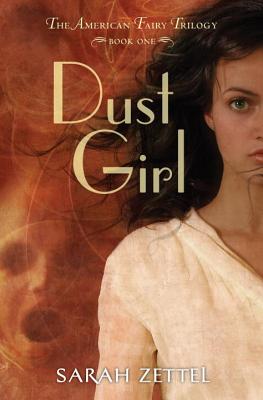
Dust Girl

by Sarah Zettel
ages: 12+
First sentence: “Once upon a time, I was a girl called Callie.”
Support your local independent bookstore: buy it there!
Review copy provided by my place of employment.

It’s the heart of the Great Depression, and in Slow Run, Kansas, Callie LeRoux and her mother are struggling to survive. She’s the daughter of a single mom, living in a run-down hotel, and to make things worse (considering the time period), she’s half African-American. Then, one day (Sunday, April 14, 1935, to be exact), she learns — quite by accident — that she’s not exactly who she thought she was.

She is the daughter of a human mother, yes. But her father is a faerie prince.

This knowledge doesn’t come all at once, and Callie doesn’t readily believe it. The things she does know is that the Seelie have taken her mother, and Callie wants — no, needs — to get her back. She sets off on an adventure with a hobo named Jack, determined to get her mother back.

I’ll say this up front: it’s the first in a series, and it reads like a first in a series. There’s a lot of exposition and getting things going, and the actual plot doesn’t really begin until the book is nearly done. That said, the whole world that Zettel built is excellent. It’s a unique choice to involve race in the whole faerie world: the Unseelie are black; the Seelie… well, not so much. Not only are there human vs. faerie elements, but race also comes into play. And this makes it unusual for a fantasy novel.

Callie and Jack are also, for the most part, interesting characters. I think Callie becomes more interesting as the book progresses, especially when she finally faces her father’s family. Which makes me intrigued with this story, and curious to know where Zettel plans for it to go.

It’s not brilliant, but it’s solid, and it’s definitely worth the time.

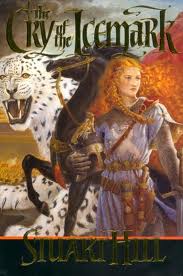
The Cry of the Icemark

by Stuart Hill
ages: 13+
First sentence: “Thirrin Freer Strong-in-the-Arm Lindenshield carried her names with ease.”

Aside from the horrid cover, I really wanted to like this one. I thought it would be like Tamora Pierce’s Lionsong novels: a strong girl, a warrior girl, leading her people in a fight against Incredible Odds.

And maybe it is.

However, I couldn’t read it. I gave it 50 pages to grab me (maybe I should have held in there longer?), but it didn’t. Part of it was that Thirrin was supposed to be 13, and yet she was acting like an 18-year-old. (Which isn’t new; I mean, how often in fantasy novels do 13-year-olds actually act like a 13 year old does?) Part of it was the ridiculous names (Primplepuss????). Part of it was that Thirrin’s father, the king, never spoke, but shouted, guffawed, hollered, and bellowed.

But, mostly, it was because I am tired of authors telling me what is going on. Thirrin thought this. Thirrin did that. Thirrin wants this. Thirrin thinks that.

*sigh*

I just want to read a story where I can interact with the characters, enjoy the plot, and be SHOWN what is going on.

And that is really why I bailed on this one.

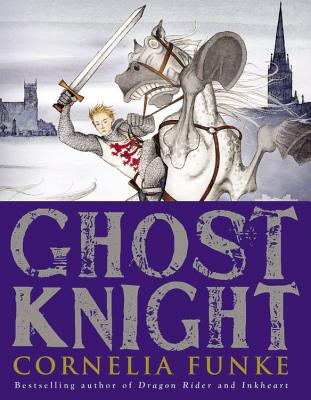
Ghost Knight

by Cornelia Funke
ages: 9-12
First sentence: “I was eleven when my mother sent me to boarding school in Salisbury.”
Support your local independent bookstore: buy it there!

Jon Whitcroft, at war with his mother’s fiance (his father died years before), is sent away to boarding school. He feels it’s a punishment because his mother loves The Beard, as Jon has dubbed him, better. So, Jon expects to hate his time at school. But that was before he met Ella, made friends with Angus and Stu, and started seeing ghosts.

Turns out there’s a ghost of a old baron, Stourton, who has vowed to kill every Hartgill — Jon’s mother’s maiden name — who shows up at the school. And Jon’s his next target. The only way to stop him? William Longspee, bastard son of Richard the Lionheart, and sworn defender of those in need. Sure, he’s a ghost too, but since when has that ever stopped anyone?

This wasn’t a bad little ghost story. Which is to say that it wasn’t great, either. I think I’ve read a run of books that had telling vs. showing issues, and I have to admit that it’s driving me batty. Sure, this one was pitched as a man telling his reflections of a year at boarding school, and so maybe the telling can be forgiven. But, on the other hand, why tell it that way? Why give us the assurance that it would turn out all right? I think the tension, the story would have been greater if we didn’t know that the story would end happily, that perhaps Jon and his friends were in a danger that they couldn’t get out of. But Funke gave us that out, and I thought the book suffered for it.

Even so, it’s a decent walk through history, and I enjoyed Ella, Jon and Longspee as characters. It just wasn’t as great as I’d hoped it would be.

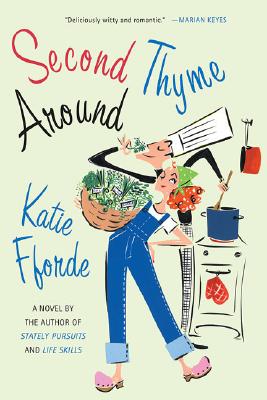
Second Thyme Around

by Katie Fford
ages: adult
First sentence: “Well? Are you going to come in?”
Support your local independent bookstore: buy it there!

Ten years ago Perdita’s life fell apart. Sure, she was young — only 19 — but she loved Lucas. And even though their marriage wasn’t much of anything, he didn’t need to slap her in the face by running off with an older woman.

Now, Perdita has gotten her life together and owns a vegetable supply business, growing unique and unusual high-end vegetables for the local spa and high-end restaurant. Sure, she doesn’t have a boyfriend, but who needs one when her business and her relationship with her elderly next-door neighbor and close friend, Kitty, takes up so much of her time. So, it comes as a bit of a shock when Lucas shows up in the kitchen of the high-end restaurant she supplies, having taken over. Since when did he become a chef (especially since he was a stock broker last she knew)? And while he’s as abrasive and bossy as ever, since when did he develop a nice streak?

I picked this up because I wanted something fluffy, something fun, something romantic, and something British. On those counts, it succeeded quite nicely. It was quite fluffy, it was somewhat romantic, and it was definitely British.

But I’m not sure it held up as a story. Aside from the fact that it wasn’t insta-love (yay!), I didn’t get the chemistry between Lucas and Perdita. She spent the whole book hating him, thinking he was just boorish and domineering (which he was), and then, boom: she was back in bed with him. What makes them think that this time around they’d be able to make it work? Sure, she’s ten years older, but I wasn’t convinced that they’d be good together. Or even that they wanted to be together. It didn’t make sense.

Aside from that problem (major though it is), it was a fun little diversion. I just wish it could have been better.

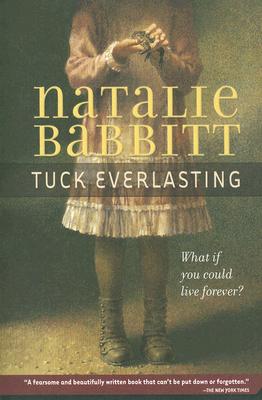
Tuck Everlasting

by Natalie Babbitt
ages: 10+
First sentence: “The first week of August hangs at the very top of summer, the top of the live-long year, like the highest seat of a Ferris wheel when it pauses in its turning.
Support your local independent bookstore: buy it there!

Once upon a time, there was a young girl named Winnie. She lived in a nondescript house next to a nondescript woods in a nondescript town. Then, one August day, she wanders into the woods and discovers a boy drinking from a spring. she wants to take a drink, too, which leads the boy to totally flip out. And then he, and his brother and mom, take her home with them.

To explain that the spring is really not good: it makes you live forever.

Let me stop there for a minute. I remember reading this, not as a child, but 10 or so years ago, when we got the 25th edition of the book. Hubby loved it, I read it and remember really enjoying it as well. Granted, M was only 4 at the time, and C was a baby.

This time, all I could think of was: what the heck! They KIDNAP her, she grows to LIKE THEM (Stockholm Syndrome, anyone?) and helps them escape. In what universe is this not a horror story???

I see the value of this book: there are a ton of ideas to talk about; C read it for her 6th grade language arts class last year, and I think it’d be a good book to teach. But as a story? I felt the writing was pedestrian, the characters unsympathetic, and the whole thing quite creepy.

But a classic?

I’m going to get creamed for this, but I don’t think it is. (Or maybe it is, if only for the themes.)

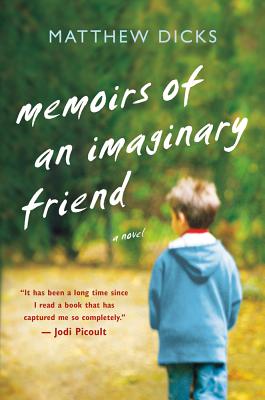
Memoirs of an Imaginary Friend

by Matthew Dicks
ages: adult
First sentence: “Here’s what I know:”
Support your local independent bookstore: buy it there!
Review copy provided by my place of employment.
Release date: August 21, 2012

I’m kind of at a loss where to begin with this one. The owner at the bookstore handed it to me because it looks vaguely YA(ish), and imaginary friends have something to with kids, right?

But that isn’t what this novel is at all.

In a fascinating approach to things, Dicks has written a novel from the imaginary friend’s point of view. And, much in the way a fantasy writer creates a world, Dicks has created a whole world for Budo, nine-year-old Max’s friend, to reside in. First off: just because Max is the only one who can see him, does not mean that Budo isn’t real. He can see our world, experience our world, he just can’t interact with other people. He can, however, interact with other imaginary friends, and from doing that, he’s realized two things: 1) Max imagined him very well, because next to some of the other friends, Budo looks almost real; and 2) he’s quite old — being six — and that is unusual. Most other imaginary friends don’t last that long.

It starts out oddly; you don’t know quite where Dicks is going with this story, especially since it becomes very clear early on that Max has some form of autism. Although it’s never said outright, most of the signs are there. But as the story goes on, you realize that it’s because Max is autistic that Budo exists. And that fact becomes crucial to the plot.

I’ll be straight with you: I got to a certain point in the book, and I was afraid I’d have to abandon it because one character was abusing Max. That is not the case. There are scary, and sad, things going on, but it’s not abuse, thankfully. Because the book is remarkable. Not only for the world building, but for the heartbreakingly honest way Budo reacts to the situations with Max, and ends up being the unsung hero. I rarely think books are “heartwarming”, but I do think that of this one. Heartwarming, creative, unique.

Amazing. It will make you want to believe in imaginary friends all over again.


One of My Favorite Things About Vacation

We know a LOT of people in a LOT of different places, but no more so than in Utah. Because of that, I was focusing on family, but I tweeted when we got into Provo, and happily, Suey at It’s All About Books responded. Not to let an opportunity to put a face to a blog name (especially one I’ve been following for more than 5 years!),  we arranged a meeting. At the very lovely Provo Library (seriously! I wish we had libraries like this in Wichita!) too.  

(She kind of looks scared of me. I promise she wasn’t.)

Anyway, we had a grand time talking for about an hour before I had to dash off (to go bowling at BYU with the family) again. I wish we’d had longer, but the demands of vacation and all that… I am glad we had a chance to meet!

Wonder

by R. J. Palacio
ages: 9+
First sentence: “I know I’m not an ordinary ten-year-old kid.”
Support your local independent bookstore: buy it there!

I’ve seen this one around for months — it has been on the New York Times Bestselling list, after all; and that’s not mentioning all the blogs I’ve seen it at — but for some reason, I’ve just never felt compelled to read it before now. Perhaps it’s because I figured it was one of the “those books”, feel-good stories about kids with disabilities that are supposed to enlighten me while making me somehow grateful I don’t have to go through that.

And in many ways it was that book.

August is an ordinary kid in many ways: he likes Star Wars, he enjoys reading and hanging out with his friends. Sure, he’s been home schooled, but that’s because he’s had so many surgeries that going to school wouldn’t have been practical. See, he has a condition that isn’t one of those you can hide: it affects his face. So, first impressions are not good.

But, now he’s starting fifth grade, and in addition to all the ups and downs, conflicts and highlights that go with fifth grade, August has to deal with a whole new set of people seeing his face, and judging him before they even get a chance to know him.

Of course, there will be kids (and parents) who can’t get past August’s facial anomalies. Of course, there will be bullies and problems and Things To Overcome. And, of course, August will Rise Above It All.

But — and this surprised me — it was also not that book.

There was a matter of fact-ness to this book that helped surpass the whole agenda for me. August was clearly an amazing kid, not because he’s special but because he’s not. He faces the world as any other ten-year-old boy would, and it’s everyone else — from his parents to his sister to his friends — who endow him with difference. I appreciated having the book from August’s point of view, but I also liked the chapters where we got to see him through different eyes (for the most part; there were a couple of times when I wondered why Palacio chose a specific character to move the story along). It was in doing this that Palacio got her main point across: that we are all people, no matter what we look like.

As an interesting side note: A picked up this other book the other day, and even though it’s not usually what she reads, she began reading this. There’s a friend of hers at school who is like August (though it’s his hands and arms, not his face), and she was interested in the idea that something like what her friend has would make a good book. I’m looking forward to talking to her about it when she finishes.

And, perhaps, that’s the best thing that can be said about Wonder: it will inspire conversation and discussion among those who read it.

KidlitCon 2012

I’m taking a break from my vacation to register for this! Hope to see you there! (from the Kidlitosphere website🙂

Well.  It’s finally happened.  We are ready to show you the wonders of New York City the only way we know how.  Yes folks, it is time to register for KidLitCon 2012!
The sixth annual KidLitCon will be held in the heart of New York City on September 28th and 29th, 2012. It will be held within the main branch of New York Public Library, the Stephen A. Schwarzman Building.
Your host will be myself (Elizabeth Bird of A Fuse #8 Production) along with Monica Edinger (Educating Alice) and Liz Burns (A Chair, a Fireplace, and a Tea Cozy) who are assisting me in a multitude of ways.
In the same vein as last year’s con we are expanding the conference into two days with a special “pre-conference” on Friday.  Friday events will include special visits to the publishers of New York City with blogger previews of their upcoming seasons.  Publishers will be assigned on a random basis to all attendees.  The final list of publishers is currently being hammered out.
Registration will max out at 175 attendees.
The New Money:
Before September 21st:

  • $55 Full Conference, including pre-con, Friday dinner, and Saturday con
  • $35 Pre-Conference without dinner
  • $0 Saturday Conference
  • $55 Pre-Conference with dinner (special guest speaker: Grace Lin)
  • $50 Friday dinner (extra diner or only)

Please note that there will be no Saturday dinner.  However, we are working on a Kidlit Drink Night here in town for that very evening.  Information to come.
The last day to register is September 21st.
The Pre-con: Includes a dinner.
Conference Day: Lunch.
If space is still available, onsite registration will be possible for $80. Pre-con price remains the same.
Attendees looking to share hotels with other attendees may indicate this fact on the registration page.  We will attempt to link you with someone who may also wish to share a room.  You may find a list of Midtown Manhattan Hotels here.
The Stephen A. Schwarzman Building is located between 40th and 42nd Street, directly facing 5th Avenue.  A map and directions to the library can be found here.
We hope to see you in September!
Register here.