My Basmati Bat Mitzvah

by Paula L. Freedman
First sentence: “When Ben-o came over on Saturday for movie nigt, my dad answered the door wearing gray silk pajama bottoms and his Math Teachers Play by the Numbers T-shirt, an unlit pip clenched between his teeth.”
Support your local independent bookstore: buy it there!
Review copy snagged from the ARC shelves at my place of employment.
Content: There’s a lot of questions about religion and God in this. Plus some 7th-grade kissing. If we had it at the bookstore I’d probably waffle between putting it in the Middle Grade (grades 3-5) and YA (6-8) sections. It could easily go either place.

Tara Feinstein is your typical New York City middle schooler. She has two best friends, Rebecca and Ben-o (thusly named in fourth grade when there was a Ben D., even though he’s since moved away), and is looking forward to 7th grade. She’s been attending Hebrew School for the past few years — her mother, who is Indian, decided that Tara needed to get in touch with her Jewish (from her father) side — and is wondering whether or not to go through with her bat mitzvah in December. And like a typical middle schooler (at least one in my house), she has questions. About whether or not going through a bat mitzvah is somehow denying the Indian side of her. About whether or not there is a god. About why Ben-o is acting so strange and Rebecca seems to be hanging out with a girl that Tara just Doesn’t Like. Typical middle schooler stuff.

There really isn’t much overall conflict in this. Mostly it’s like life: a series of ups and downs. Tara and Rebecca accidentally ruin a priceless heirloom sari that Tara’s been given by her aunt. The new friend Rebecca has turns out to be a bit of a kleptomaniac. Ben-o turns out to like like Tara, but covers it up by hanging out with another girl, which is confusing to say the least. So, there is Drama (which, on the one hand, will make this book imminently relatable to everyone, but I was a bit Done With, only because there’s so much middle school Drama in my own house that it was a bit overkill for me).

What I did enjoy was the melding of the cultures. How Tara’s Indian aunt called Tara’s Jewish grandmother “Ruthie-ji”. Or that the grandmother would bring a matzoh ball soup to a Diwali celebration. Or the way Tara melded the two at her bat mitzvah: wearing a dress made out of the ruined sari and serving Indian food. What better way to celebrate the good things in all cultures and traditions? I also enjoyed her musings about God and the afterlife and religious traditions. It’s that which kept me reading in spite of my Drama overload. And it’s was those elements that made the book good (for me).

I Love I Hate I Miss My Sister

by Amélie Sarn, translated from French by Y. Maudet
First sentence: “The women walk slowly, heads down.”
Support your local independent bookstore: buy it there!
Release date: Augst 5, 2014
Review copy snagged from the ARC shelves at my place of employment.
Content: There is violence, some mild swearing, and some teen drinking and smoking. I’ll probably put this in the Teen (grades 9+) section of the bookstore, though I wouldn’t hesitate to give it to a 7th- or 8th-grader who is interested.

Sohane Chebli is many things: 18 years old, a daughter, a sister, a scholar, French, and a Muslim. She lives in an apartment complex full of others of  Algerian heritage, and mostly she and her younger sister (by 11 months), Djelila, get along with their neighbors, schoolmates, and each other just fine.

Then, during Sohane’s senior year, a few young Muslim men take it on themselves to start harassing Djelila because she dresses in jeans and tighter shirts. Because she wears makeup. Because she smokes with her friends. And Sohane, whose path has become more conservative — she wears the hijab — doesn’t step in to defend her sister. Partially because Sohane thinks her sister is wrong for following a path away from Islam. And partially because Sohane’s been expelled from school, due to a French law banning all religious symbols, for wearing the hijab.

I’m going to spoil a bit — it’s not too bad, because from the beginning,  you know this — but Djelila is killed by the Muslim boys for her refusal to conform to their expectations. And it’s that paired with the other side of the coin: Sohane’s constant discrimination for wearing the hijab. (Not that I mean to compare murder with discrimination.) But it got me thinking: why do we feel a need to tell others how to behave? Why did these boys feel compelled to not only shame, but eventually kill a girl for not following her/their religion to the letter? Why did people refuse to see Sohane’s hijab wearing as an expression of her religion, instead interpreting it as an act of repression? It’s a thought-provoking book.

And it’s written well, in tight, short chapters. It took a bit for me to catch the rhythm of the book because it’s translated, but once I did, I was hooked. And I wasn’t disappointed, in the end.

Re-read: Graceling

by Kristin Cashore
First sentence: “In these dungeons the darkness was complete, but Katsa had a map in her mind.”
Support your local independent bookstore: buy it there!
Content: There’s some tasteful sex, a lot of violence, and you need to be somewhat more mature to understand what Leck is capable of in order for it to have its full impact. It’s in the Teen section (grades 9+) of the bookstore, but I wouldn’t hesitate to give it to an 8th grader who was interested.

For June’s YAcker book, we picked Bitterblue, but one thing led to another, and we ended up making a summer project of reading Cashore’s trilogy. I’m not one for re-reading books, but since I hadn’t picked this one up in 5 years, I thought, in order to be an intelligent participant, I needed to reread it.

And, oh, it was just as wonderful as it was the first time.

I don’t have much more to say (the above link takes you to my initial review) that won’t be said when the YAckers post our discussion. But let me say this: I love Kasta. Her fierceness, her depth of emotion, her contrariness. And I love her with Po. I love their team, I love their relationship. I love how Cashore describes them together.

And I love Bitterblue. I’d forgotten that, not having reread this when Bitterblue came out. But, she’s so small and so fierce, and I love her.

48 Hour Reading Challenge Starting Line

And.. I’m off. I’m aiming for 24 hours, but I’m also going out tonight and going to the roller derby tomorrow and to see The Fault in Our Stars tomorrow night (too bad I can’t count that as “reading”). I’m hopeful, though, that I can get enough reading in between all that.

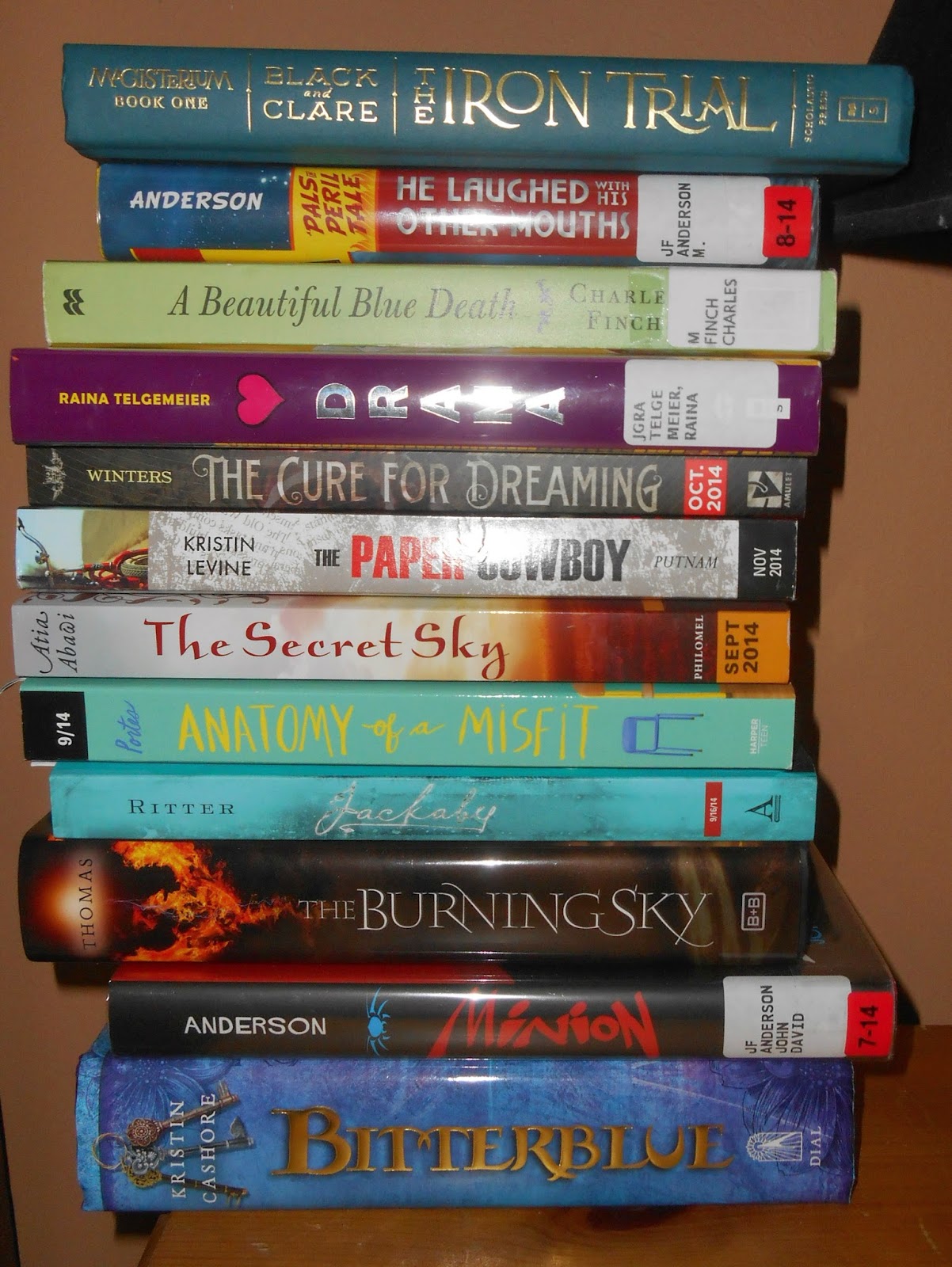
Here’s my #WeNeedDiverseBooks pile that I’m working from this weekend:

Actually, I’m not reading The Great Greene Heist. I ended up with two copies, so I’m giving one of them away. For anyone who comments on any post this weekend, I’ll put you in a drawing for it. Just make sure I can get ahold of you Sunday night. 🙂

Also: I’m aiming to give $1 for every hour (or $25 whichever is greater) to RIF at the end of this. Just because I’ve been doing that the past few years, and it keeps me motivated to read.

Happy reading!

The Riverman

by Aaron Starmer
First sentence: “Every town has a lost child.”
Support your local independent bookstore: buy it there!
Content: There’s some alcohol usage and talk of murdered children. Also, it feels really adult in its sensibilities. It’s in the middle grade (grades 3-5) section of the bookstore, but I’m not happy with that. On the other hand, it’ll languish in the YA (grades 6-8) section too, so I might just leave it where it is.

Alistair Cleary  is the kind of kid who blends in. He’s not popular at his middle school, but he’s not reviled, either. His best friend is a gamer — which is quite unusual, since it’s the fall of 1989 — but Alistair has managed to escape certain geek doom. He’s content to slide through life. Until Fiona decides that it’s Alistair who needs to write her sad tale down.

And what a tale: Fiona insists that she’s been going to this imaginary land, Aquavania, which is absolutely real. She’s added months to her life in her trips (which become years later in the book). And that her friends in Aquavania — who also happen to be real people in the Solid World — are disappearing because someone called the Riverman is sucking their souls away.

I had Issues with this book. It compelled me enough to finish it, sure, but it was one of those books that I threw across the room when I was done. I’ve been trying for days to figure out how to write about my issues, and to boil my problems with the book down into a neat, concise package, but I don’t think I can. There will be spoilers.

My initial problems come from the incongruity between the cover and the book itself. The cover screams middle grade, but the content is very… adult. On some level, I feel like Starmer should have gone all the way, made this incredibly dark and sinister, used the metaphor that he was building — that Aquavania is a crutch for Fiona, who uses it to escape horrible things in her life — and made it an adult book.

But, even though that is the set up for most of the book, Starmer doesn’t follow through. He pulls what I have come to think of as a bait-and-switch, a “HA! It’s Really REAL” moment. For which he has given us no basis in the rest of the book. Our narrator, Alistair, believes Fiona is making it up. He believes in the dark understory, so I do too. And so it’s incredibly unsatisfying (for me as an adult; would an older kid?) to have the rug pulled out from underneath you.

I’m sure there I have other complaints (did it really need to be set in 1989? REALLY?), but that’s the main one. Going in, I didn’t know what to expect, but by the end I hoped for a lot more than what I got.

The Geography of You and Me

by Jennifer E. Smith
First sentence: “On the first day of September, the world went dark.”
Support your local independent bookstore: buy it there!
Review copy sent to my boss by the Little, Brown people, and she passed it off to me.
Content: There’s kissing. And a wee bit of swearing. Mostly it’s just sweet. It was in the Teen section (grades 9+) but after finishing it, I moved it to the YA section (grades 6-8) and it fits there just fine.

Lucy is the youngest child of well-off parents, living in an upscale apartment in Manhattan. Owen is the only child of parents who were once drifters, and whose mother recently died in a freak accident. His dad — who isn’t doing so well — is now the superintendent of Lucy’s building. They would have never met, except they were both in the elevator when the power went out. It was a chance meeting, but one that expanded into a night spent wandering a darkened New York City, and then falling asleep on the rooftop.

The next morning, though, Owen is gone when Lucy wakes up, and they never really quite connect again. Lucy’s parents move her to Scotland; Owen’s dad is fired and they’re headed west, looking for jobs. They figure they’ll never see each other again. Except, Owen starts sending her postcards. And so, they start a tentative long-distance relationship. One with its ups and downs.

It’s not a spoiler to say that this one has a hopefully ever after. It’s not happy, per se — Lucy and Owen still live a great distance away — but it’s hopeful that they can make it work. And it’s not a spoiler to say that it’s not a terribly deep book. There’s no issues, really, and no angst. It’s mostly just a sweet journey of two people figuring out they really really like each other.

It’s enjoyable fluff, though. Sweet and charming. And I found that’s exactly what I needed to make me smile.

First Sunday Daughter Reviews: June 2014

School’s out, and it’s summertime. Which, at our house, interestingly enough, means less reading not more. Partially because we have a garden (and a yard and flowerbeds) that need tending, partially because I work three days a week and the kids are home alone (basically) which means they watch more TV than is good for them (even though I do give them “READ” as a pre-TV “chore”), and partially because they just want to be outside. I don’t blame them.

M, when she had a day off, picked this up, because it was laying around (I happened to have been reading it; thankfully, she’s a fast reader):

She liked it. I don’t think she’s invested in the series at all, but she enjoyed reading this (huge) conclusion. She’s also reading

as part of the Nerdfighter’s Book Club.

A was wandering around, looking for something to read, and I happened to have picked up this:

When she saw that, she was VERY excited. She’s enjoying it immensely, saying that Lila and Ella are “awesome”.

And K picked out this

for Hubby to read to her. I was a bit surprised; it’s not something I’d think for her to pick. But, so far, she’s really enjoying Howl and Sophie and the story.

As for my bookgroup, I’m rereading this

and enjoying it as much as I did the first time around. I do hope people come (I don’t know if I can convince A to read it), though I’ve just about given up hope people will. I’ll keep the group through the summer, just so we can say we have it. But then, I might just have to reconsider doing it at all. We’re going to try a summer reading program similar to the one the library does, and we’re also riding the John Green wave and doing a book group for teens (really: for anyone who wants to read the books). But, a book group for kids may just have been a pipe dream of mine.

What are your kids reading this summer?

May 2014 Round-Up

School is out, summer is pretty much here; I just spent yesterday mowing the lawn and planting the garden, and didn’t get a speck of reading done. Thankfully, next weekend is the 48 Hour Book Challenge, and I’ve been putting together my pile of diverse books to read. I’m also looking forward to a summer of rereading John Green’s books so I can lead our summer book group for teens (and others). (I’m also being dragged — not unwillingly — to The Fault in Our Stars next weekend.) And the YAckers have decided to make a summer project of reading the Graceling series. It’s been too long since I’ve visited those books.

As for this past month, my favorite was:

The Great Greene Heist

I’m not just saying that because we’re in the middle of the #GreatGreeneChallenge at work. I honestly thought the book was a lot of fun.

Middle Grade:

Mouseheart
The Secret Hum of a Daisy

Non-fiction:

Lifesaving Lessons
The World’s Strongest Librarian

Graphic Novels:

Explorer: The Lost Islands
Fairy Tale Comics
Primates
The Return of Zita the Spacegirl
The Lost Boy
Hilda and the Bird Parade

Adult:

So Long a Letter

YA:

All these Things I’ve Done
Dorothy Must Die
Half Bad
The Inventor’s Secret
The Road Home

What were your favorite reads this month?

Graphic Novel Round-up, May 2014

Hilda and the Bird Parade
by Luke Pearson
Support your local independent bookstore: buy it there!
Content: It’s a bit intense at parts, with Hilda getting lost and some interesting monsters. But that’s it. It’s in the middle grade graphic novel section of the bookstore.

I don’t think this was a first in a series — googling Luke Pearson led me to a number of other Hilda titles. But it’s a perfect place to start. Hilda is a spunky, blue-haired girl who has been raised in the mountains before her mother moved them to Trolberg. Hilda doesn’t like the confines of the city, mostly because her mother never lets her go anywhere anymore.

Then, on the day of the Bird Parade, Hilda is invited out by some classmates. They take her to all of the (not-so) cool spots, but she bails on them when they start throwing stones at a raven. She rescues the raven, who 1) happens to talk, and 2) has amnesia. They wander the city and have adventures while the raven tries to get his memory back.

That plot summary doesn’t do Hilda any justice. It’s an absolutely adorable book. Sweet and fun, full of action and adventure as well as playing off of Norse myths (which seem to be the in-thing these days). I loved it, K loved it, Hubby loved it. I’m definitely going to get more Hilda books and see what other adventures she has.

Fairy Tale Comics
edited by Chris Duffy

Support your local independent bookstore: buy it there!
Content: Fairy tales, in their original form, are quite violent and weird. While this collection tones it down, there’s still some violence and weirdness. That said, K didn’t have any problems with it, though she didn’t “get” some of it. It’s in the fairy tale section of the bookstore, but I’m wondering if it’d get more exposure with the middle grade graphic novels.
Fairy tales are weird. (Or as the narrator in A Tale Dark and Grimm would say, “awesome”.) And what better way to showcase the weirdness than to get a bunch of illustrators to reinterpret ? different fairy tales in graphic novel form?
On the one hand, this is a terrific way to get reluctant/struggling readers interested in fairy tales. K picked it up, and thoroughly enjoyed perusing the pages, reading all the stories. Also, in its favor, there is a Japanese folk tale, a Br’er Rabbit story, and  tale from 1001 Nights, though it was too heavy on the Grimm for my taste. Even so, some of the tales were cleverly re-imagined — The 12 Dancing Princesses (Emily Carroll), Give Me the Shudders (David Mazzucchelli), Little Red Riding Hood (Gigi D. G.), and The Boy Who Drew Cats (Luke Pearson)  were among my favorites.

Others, though, were not as well done. Snow White (Jaime Hernandez) was just weird (then again, so is the fairy tale) and Rapunzel (Raina Telgemeier) disappointingly “borrowed” from Rapunzel’s Revenge/Tangled. I think I was also hoping for more of the unusual ones, Snow White and Rose Red or something from Hans Christian Anderson, or my favorite French tale The White Cat. It was very much, for the most part, the known tales retold, and while that was all fine and good, I was hoping for something… more.

The Lost Boy
by Greg Ruth
Support your local independent bookstore: buy it there!
Content: This has gone back and forth between the teen graphic novels and the middle grade graphic novels. It’s not as kid-friendly — it’s intense, and a bit difficult for the eye to follow — as some others we have in middle grade, but it’s a bit simplistic — it’s a straight-up fantasy-adventure — for teen.

When his family moves into a new house, Nathaniel Castle (just call him Nate) has no idea what’s in store for him. When, under a loose floorboard, he finds an envelope with his name on it next to an old-fashioned tape recorder, he can’t resist the odd message — Find Him — and the lure of a mystery. Little does he know that he will be dragged into solving a 50-year-old disappearance of a local boy, Walt, and be immersed in a world where dolls and insects talk, and a mysterious force called the Vespertine is trying to take over.

The art in this one is gorgeous: done in shades of black and white, it’s realistic, even in the fantasy elements. No cartoons here. And that gives it a seriousness that I don’t think the story would have otherwise had. It’s quite eerie and chilling in parts. That said, it’s also a straight-up adventure; the hero does win the day, with some help of his friend Tabitha, and all is happily-ever-after, even though there’s a slightly ominous coda.

I do hope Ruth writes another one, though. I’m quite fascinated by this world he’s created.

Explorer: the Lost Islands
edited by Kazu Kibuishi
Support your local independent bookstore: buy it there!
Content: There’s some weird stuff going on, but none of it is inappropriate for the younger reader. (K handled it just fine.) It’d be in the middle grade graphic novel section of the bookstore, if we carried it.

I picked this up solely because of Kibuishi’s name (why, yes, I AM waiting impatiently for the next Amulet installment) without knowing anything about it, or this series. (I guess it is a series, since this says Book 2 on it..) It turns out it’s a series of short stories from a handful of artists on a theme, this one being “islands”.

Like any other short story collection (see above!), it’s a wide range of stories ranging from the silly — a group of bunnies on an island who work until someone invents a robot that will do all of their jobs (but it has disastrous results) to the weird — Kibuishi’s Moby Dick-esque story or Chrystin Garland’s weird devil-party (I know there’s a term for this, but it’s escaping me. There were touching ones — particularly “Desert Island Playlist” from Dave Roman & Raina Telgemeir, that illustrates how the past, present, and future are all necessary in one’s life. Or “Loah” by Michel Gagne, which is a gorgeously illustrated story of how differences matter.

It’s a good solid collection, and it makes me want to hunt out the first one in the series to see what the theme and stories are. A great introduction, too, to a wide range of artists.

Mouseheart

by Lisa Fielder, illustrated by Vivienene To
First sentence: “The young rat prince knew he was taking a monumental risk.”
Support your local independent bookstore: buy it there!
Review copy given me by our Simon & Schuster rep, via my boss.
Content: There are some mild scary parts, and some mild violence, but really, it’s quite happy in the middle grade (grades 3-5) section of the bookstore.

I have to admit that I was a little turned off by the cover. It just looks so…. I don’t know. Juvenile, maybe. Or lame, perhaps. But, either way, I was completely unprepared for the awesome found inside.

I do have to qualify the word “awesome”: if you don’t like fantasy or talking rats, you may not find this awesome at all. The thing is: usually I don’t either. I liked  The Tale of Despereaux well enough, and Mrs. Frisby and the Rats of NIMH okay, but I didn’t like Redwall, and I have studiously stayed away from the Warriors series. So, talking animals, not exactly my thing.

But the story of a pet-store bred mouse, Hopper, who — ends up beneath the subways of Brooklyn in the sewers — got to me. Perhaps it was his insecure optimism that won my heart over. Or the fact that his sister, Pinkie, was a bully and my mom-sense (kind of like Spidey-sense) kicked in. Or perhaps it was that he found a civilization of rats underground that has a tentative peace with feral cats. Or maybe it was the prophecy of the Chosen One, and the complications that brings.

What I really enjoyed was the way that Fiedler had the rats interact with the human world. How they taught themselves to read, and how Hopper figured out the subway system. How they used cast-off items (and some scavenged ones, too) to furnish their world. It was fantastic.

Maybe, too, I was just in the mood for a straight-up fantasy adventure with talking rats and a mouse with a heart of gold. I didn’t know that I was, but I found I couldn’t put this one down.