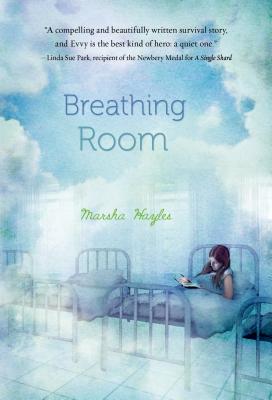
Breathing Room

by Marsha Hayles
First sentence: “Father jerked the car to the side of the road and stopped.”
Support your local independent bookstore: buy it there!
Content: There are some unsettling moments and a couple of characters die. The book would be in the middle grade (grades 3-5) section of the bookstore if we had it.

I know I’m not supposed to start a post like this, but: I wasn’t terribly thrilled about reading a book about a girl with tuberculosis in the 1940s. The main character, Evvy, is shipped off to a sanatorium because she has TB and her family hopes she can be cured. And it was surprisingly engaging and actually kind of gripping. I’ve not read many sick kids books (tending toward the cancer end of them), but I was fascinated not only by the treatments used in the 1940s, but just the general mood of the book. Evvy wanted to get better, and her body was fighting her, so there was that conflict. There was a camaraderie between the girls in the ward, but they were sick, so things that were outside of their control constantly interfered in their lives. It made for a very good story.

I was also fascinated by the historical pictures that the author put at the beginning of every chapter, as well as the small details she included in the book. It wasn’t anything that slowed the story down, but it added an extra layer to the story that I didn’t expect.

It really was a good read, and one I’m glad I did.

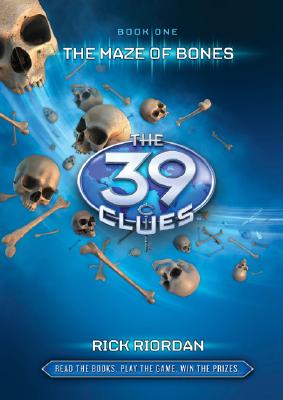
Module 13: The 39 Clues: The Maze of Bones

Riordan, R. (2008). The 39 clues: The maze of bones. New York, NY: Scholastic Press.

Genre: Multi-author series book, realistic fiction, puzzle book.

Book Summary: Amy and Dan Cahill have always been the favorites of Grace, the matriarch of the huge Cahill family. Now, upon her death, they (and other members of the vast extended Cahill family) are given a choice: $1 million in inheritance, or the first of 39 clues that will give the winner power and access to the Cahill family’s vast secrets. Of course, Amy and Dan take the clue, which leads them on a wild and often dangerous race against the other members of their family (who are sufficiently horrible) as they try to figure out the clue and where to go.

Impressions: This was so much fun! (Of course: Rick Riordan wrote it.) I’ve said this before: Riordan knows how to pace a book (or at least did when he was writing the original Percy Jackson series; he’s not been as tight lately) and knows how to keep a reader turning pages. And this one was no exception. I liked the play between Amy and Dan — they really felt like siblings, sometimes fighting but usually cooperating to reach a shared goal while looking out for each other. I can see why kids liked this, and wanted to read more. My only drawback is that Riordan didn’t write the whole series (each book was a different author), so I wonder if the characterizations of Amy and Dan would change slightly with each book.

Review: While Grossman kind of disdained the premise behind the series and the “focus-grouped, manufactured quality” of the books, he praised Riordan’s writing: “the premise of “The Maze of Bones” is dramatic and instantly engaging.” Ultimately, though, he was underwhelmed by the idea behind the series, writing, “It’s a story about people born into the most privileged family in the world, who then set out to become the most important people in history. Whatever happened to just owning your own chocolate factory?”

Grossman, A. (2008, November 7). First prize: World domination.  New York Times. Retrieved from: https://www.nytimes.com/2008/11/09/books/review/Grossman-t.html

Uses: This would be good for a summer reading group (one that reads the first in a series? Maybe just a 39 clues club? I might use this idea one summer) for 3-5th grade kids.

Readalikes:

  • York: The Shadow Cipher by Laura Ruby — Siblings Tess and Theo Biederman and their friend Jamie Cruz follow clues left by genius inventors — the Morningstars — in a quest, full of danger and intrigue, to hopefully save their apartment building. The stakes may begin small, but they soon realize there is much more at stake.
  • Chasing Vermeer by Blue Balliet — A Vermeer painting — A Lady Writing — has been stolen. Demands that Vermeer’s paintings be reassessed have been issued as a ransom. Two sixth grade students — Calder and Petra — start looking at information in new and unique ways, taking no coincidence for granted, and solve the mystery finding the painting and catching the thief in the end.
  • The Mysterious Benedict Society by Trenton Lee Stewart — Four gifted children pass a test to go on a secret mission to take down the Learning Institute for the Very Enlightened. I haven’t read it (yet; I picked it for my summer reading group this year), but it sounds fun.

Audiobook: Children of Blood and Bone

by Tomi Adeyemi
Read by: Bahni Turpin
Support your local independent bookstore: buy it there!
Listen to it on Libro.fm
Content: There’s a lot of violence, some of it intense. It’s in the YA section (grades 6-8) of the bookstore.

Imagine a world in which magic existed, but the non-magic users (who happened to be in power) were afraid of what magic can do, so they (well, he: the king) did everything they could to stamp it out. They killed the magi — adults who were at full power — and suppressed the children of the magi. These children, Diviners, were never able to fully come into their power, they were discriminated against, and their families taxed beyond what they can afford.

This is the world that Zélie, a Diviner, was raised in. She remembered the raids, when her mother was taken and killed and her father (who is not a magi) beaten. She remembers the stories her mother told about magic and the gods, and has all but lost her faith that it can ever come back. That is, until she meets Amari, the daughter of the king that ordered the raids. Amari has stolen a magic scroll, an artifact that, in the right hands, can bring magic back. And she’s on the run. She teams up with Zélie and Zélie’s brother, Zane. And together they are determined to bring magic back.

Except it’s not as easy as that. Amari’s brother, the crown prince Inan, is on their tale, determined to stop them. And nothing — NOTHING — goes to plan.

It’s a huge book, but it’s a fast-paced one; Adeyemi definitely knows how to plot to keep a reader engaged and the pages turning. Or, in my case, a listener listening. It helps that my favorite narrator, Turpin, read this book, and as always, was fantastic at it. It’s such an excellent performance, one that immersed me into the world of Orïsha (and it helped with all the foreign names and places too!) and the story.

And what a story! There were moments that I was afraid Adeyemi would disappoint me (especially toward the end), but she pulled off a spectacular ending, and still left enough undone for a sequel (which I can’t wait for).

Remarkable. And definitely worth the hype.

Rebound

by Kwame Alexander
First sentence: “It was the summer when Now and Laters cost a nickel and The Fantastic Four, a buck.
Support your local independent bookstore: buy it there!”
Others in the series: Crossover
Review copy provided by the publisher.
Content: There’s some drug dealing and stealing, but it’s all incidental to the plot. There’s a wee bit of romance. Crossover is in the Newbery section, and so I might put this one next to Booked in the Middle grade (grades 3-5 section) or I might move it to the YA section (grades 6-8) where it feels like it should go.

Even though this one is a pre-quel to Crossover, you really should read that one first.

It’s 1988 and Charlie Bell, the father of the characters in the Crossover, has just lost his father to a major heart attack. It’s the end of his 7th grade year and the loss — and the subsequent grief of both him and his mother — has put Charlie at odds with the world. He doesn’t want to deal with school or friends or his mother, even though he tries to put his father’s death out of his head; all he wants to do is sit and read his comic books. But then, he gets mixed up a bit with his friends older brother, and gets caught stealing (nothing major though), so his mom ships him off to DC to his grandparents (his father’s parents) for the summer.

It’s there that he learns how to deal with his dad’s death, and finds a passion for basketball that stays with him the rest of his life.

I’ve become a fan of Alexander’s in the years since his Newbery win, and this is no exception. It’s a lot geekier than his other books — there are comic poems, to reflect Charlie’s love of the comic book, and he’s not a suave as his kids turn out to be. But, it still has Alexander’s signature poetic style, and it tells the story of a kid coming to terms with his grief extremely well. I loved the 1980s references (throwback to high school!) and I thought Alexander handled the girl characters much better in this one (in fact, Charlie’s cousin, Roxie, is pretty amazing!).

An excellent read.

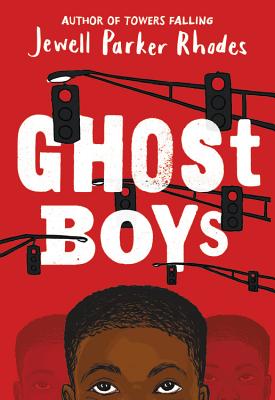
Ghost Boys

by Jewell Parker Rhodes
First sentence: “How small I look.”
Support your local independent bookstore: buy it there!
Review copy provided by the publisher.
Release date: April 18, 2018
Content: There are some tough issues here, but all the violence is either handled delicately or is off stage. The publisher has it for 10 and up, so I will probably shelve it in the YA section (grades 6-8) at the bookstore, but it would be good for curious 4th and 5th graders.

Twelve-year-old Jerome is shot by a white police officer while playing in the park. He had a toy gun, and the officer thought he was being threatened and therefore shot Jerome. If that sounds familiar, it’s intentional.

The book isn’t about the shooting, exactly. It’s told from Jerome’s perspective, after his death. He’s a ghost, hanging around, angry he is dead, and wondering what his purpose is. From there, we learn in flashbacks how he came to be shot, as well as following the preliminary hearing (in which the white officer gets off), and learn about Emmett Till’s murder in Mississippi in 1955. The point of the novel, however, isn’t about the story. It’s about the feelings this kind of murder generate. The sadness and anger in Jerome’s family. The questioning by the daughter of the officer. The sheer number of black boys that have been murdered. But also hopeful feelings: the friendships that come out of a tragedy like this.

While it’s a bit on the heavy-handed side, I think that was done intentionally. Rhodes wants to get her readers — many of whom are young — thinking about why this happens. About underlying racism. About seeing the “other” as, well, not “other”. And I think she wants to get a dialogue going, because if we don’t talk about these things, our culture won’t change and black men and boys will keep getting murdered.

It’s a quick read, and definitely a worthwhile one for kids (and adults!) to read.

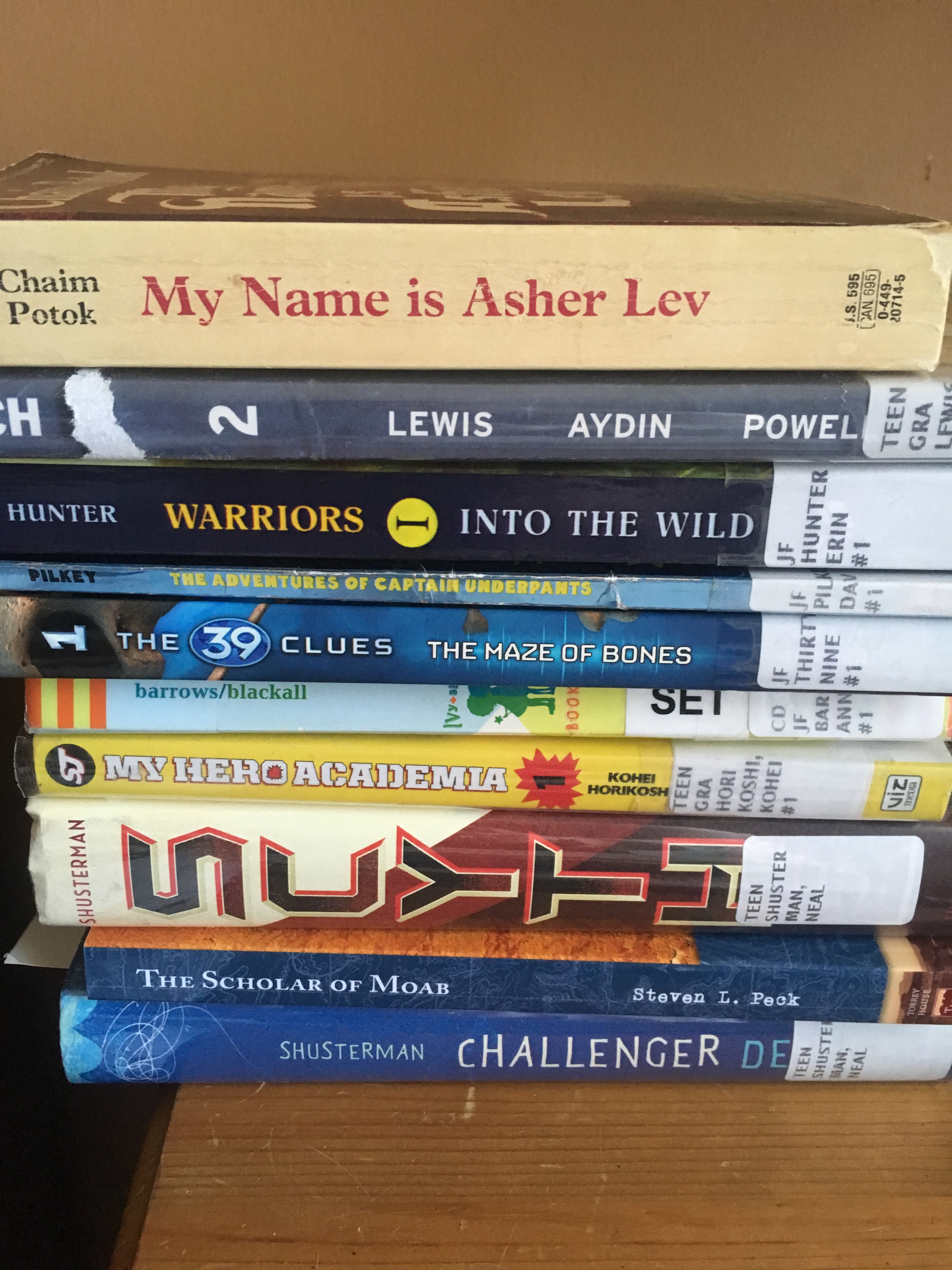
State of the TBR Pile: April 2018

I gave up and cleared off my TBR pile. The only things on there are books I *have* to read.  Everything else is gone. Well, not gone. But moved to a different pile on a different shelf in my room.

Here’s what survived the purge:

My Name is Asher Lev by Chaim Potok
March: Book 2 by John Lewis
Warriors: Into the Wild by Erin Hunter
The Adventures of Captain Underpants by Dav Pilkey
The 39 Clues: Maze of Bones by Rick Riordan
Ivy & Bean by Annie Barrows
My Hero Academia by Kohei Horikoshi
Scythe by Neal Schusterman
The Scholar of Moab by Stephen L. Peck
Challenger Deep by Neal Schusterman

What’s on your TBR pile?

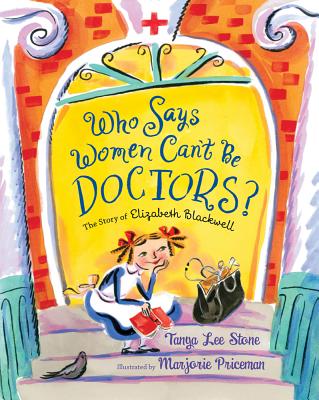
Module 12: Who Says Women Can’t Be Doctors?

Stone, T.L. (2013). Who says women can’t be doctors?. New York, NY: Christy Ottaviano Books.

Genre: Non-fiction, picture book biography.

Book Summary: The story of how Elizabeth Blackwell grew up (generally speaking), scientifically-minded, and was encouraged to be a doctor by a friend. However, she met with incredible resistance from the medical community (sucah as it was in the 1840s), but with support and encouragement from her family, finally found a medical school to accept her. She studied hard, graduated at the top of her class (had she done less, she probably wouldn’t have had any respect), and became a respected doctor (among women), paving the way for other women to get medical degrees.

Impressions: I enjoy stories about women overcoming obstacles (and there are so many for us to overcome!) but I really enjoyed the way that Stone approached this. It’s basic enough that a four-year-old could understand it, using simpler sentences and smaller words but still getting the point — that Blackwell had to overcome obstacles in order to become a doctor — across loud and clear. The illustrations help, especially on the two-page spread when Blackwell is getting her rejections: the “nos” (and there are 28 of them for each of her 28 rejections) cover the page, over a picture of Blackwell looking dejected. And then, turning the page, Elizabeth his jubilant with a huge “YES” next to her. It’s very effective. The book only goes through Blackwell’s graduation from medical school, but author’s note at the end detailed the rest of her life, and the works she did for women’s health and to encourage other women to go to medical school.

Review: New York Times book editor Pamela Paul reviewed a collection of books for Women’s History Month, including this one, which she called “[a] sharp, witty biography”, praising Stone for her approach to Blackwell’s life, noting that it engages the modern reader by beginning with “You might find this hard to believe, but there once was a time when girls weren’t allowed to become doctors.” She also praises Priceman’s goache (I learned a word: a goache is an opaque watercolor, one type of watermedia, paint consisting of pigment, water, a binding agent (usually dextrin or gum arabic)) illustrations, writing  “Petersoninfuses her bright gouaches with energy and dynamism. (They’re also awfully pretty and appealing.)” Overall, it was a glowing review.

Paul, P. (2013, March 27). Women’s history month: ‘Who says women can’t be doctors?’ and more.  New York Times. Retrieved from: https://www.nytimes.com/2013/03/27/books/who-says-women-cant-be-doctors-and-more.html

Uses: This one is simple enough to use in a pre-school storytime (though I’m not sure how well they’d understand it; parents would enjoy it though), or on a display during women’s history month, or a general feminism display.

Readalikes:

  • Mary Walker Wears the Pants: The True Story of the Doctor, Reformer, and Civil War Hero, by Cheryl Harness, illustrated by Carlo Molinari – Another story, just as well written, about a woman doctor — Mary Walker, who practiced in the 1860s — who was a women’s rights advocate, an abolitionist, and got arrested for wearing pants (she refused to wear dresses). She eventually became the first woman assistant surgeon for the U. S. Army.
  • Mae Among the Stars by Roda Ahmed, illustrated by Stasia Burrington – The story of Mae Jemison, who became the first African American female astronaut at NASA, flying the space shuttle Endeavor. The book is about her path to becoming an astronaut: the obstacles she faced (not only as a woman, but as an African American), and how she worked to overcome them with determination and intelligence to succeed at her dreams.
  • Shark Lady: The True Story of How Eugenie Clark Became the Ocean’s Most Fearless Scientist by Jess Keating, illustrated by Marta Álvarez Miguéns – This one follows a similar theme: Clark was captivated by sharks as a child, was discouraged from becoming a marine scientist. She eventually became known for her work with sharks, as well as discovering several new species of fish.

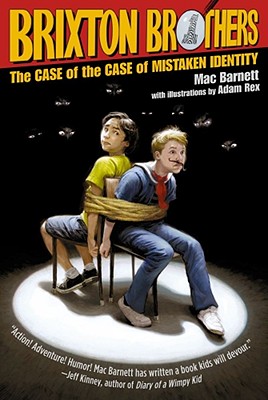
The Brixton Brothers: The Case of the Mistaken Identity

by Mac Barnett
First sentence: “Steve Brixton, a.k.a. Steve, was reading on his too-small bed.”
Support your local independent bookstore: buy it there!
Content: There are some slight intense moments, offset by humor. It would probably be in the middle grade (grades 3-5) section of the bookstore, but I think it could be an upper beginning chapter: there are short chapters, big print, and lots of illustrations.

Steve Brixton has always wanted to be a detective like the ones he’s always reading about. But it isn’t until  his teacher gives him an impromptu research paper assignment about American Quilting, that Steve gets  to see some, well, detective action. He’s set upon by Librarians (the bad sort) and Goons and he and his friend have to figure out who has stolen the Top Secret Codes from this historic quilt (I think… the plot wasn’t really the point of this one).

Goodness this was funny. Especially if you’ve read a lot of Hardy Boys/Nancy Drew books. Steve and his friend, Dana, are always getting into scrapes they have to get out of, and somehow (even though neither are terribly bright) figure out the mystery in the end. (My favorite exchanges were of the Steve: “Hey, chum” and Dana: “Don’t call me chum” variety. Every. Single. Time.) It was kind of a lame mystery — the solution was pretty obvious — but I don’t think the mystery is the point of these.

Even so, it was a ton of fun.

Shine

by Lauren Myracle
First sentence: “Patrick’s house was a ghost.”
Support your local independent bookstore: buy it there!
Content: This one has drug use and drinking by teenagers and a pretty graphic rape scene. It would be in the Teen (grades 9+) section of the bookstore if we had it.

Cat’s former best friend, Patrick, has been found at the local convenience mart beaten and tied up to a gas pump, left for dead. The local sheriff is calling it a hate crime, since Patrick is gay, and that it was probably some out of towners who did it. He was right about the hate crime part, but Cat’s convinced it’s someone in the small, southern town of Black Creek, North Carolina. So, she sets out to find out who, which means facing her brother’s friends and her past.

Oh, this was a hard book. It’s a mystery — sort of — but more, it’s a portrayal of what poverty and toxic masculinity can do to people. It turns them to meth, makes them suspicious of each other, makes them feel like they can just take things without any sort of consequences. There’s rape in this — and that was SUCH a difficult scene to get through — and just plain hopelessness. I think Myracle gave it a happy-ish ending in order to alleviate a lot of the general bleak feel of the novel (I certainly was expecting a different ending). I did figure out who committed the crime a little more than halfway through, and I even figured out why, but I kept reading because I wanted to see how it all would play out. Myracle did an excellent job with Cat’s character development — she went from a hurt, scared girl into a more confident one, facing down the boy who raped her and her brother’s friends for their various “boys will be boys” infractions.

It’s just a very hard read, emotionally.

Dreadful Young Ladies and Other Stories

by Kelly Barnhill
First sentence: “The day she buried her husband — a good man, by all accounts, though shy, not given to drink or foolishness; not one for speeding tickets or illegal parking or cheating on his taxes; not one for carousing at the county fair, or tomcatting with the other men from the glass factory; which is to say, he was utterly unkonwn in town: a cipher; a cold, blank space — Agnes Sorensen arrived at the front steps of Our lady of the Snows.”
Support your local independent bookstore: buy it there!
Review copy provided by the publisher.
Content: There are more mature themes and some swearing (though I’m not remembering any f-bombs). It’s in the Science Fiction/Fantasy section of the bookstore.

I have a tortured history with short stories. I want to like them, but I find them much like poetry: I don’t get them. They’re words, and often pretty words, but I just don’t… well… understand them. (Even Neil Gaiman’s stories, which I seem to have a bit more affinity for.) And this collection was more of the same: I liked the stories, but I need someone else to read them and then explain them to me. (Especially the title story. I know it’s a metaphor, and I’m sure I’ll smack my head when someone tells me what it’s a metaphor for, but right now, I’m a bit lost.)

Barnhill is a gorgeous crafter of sentences, and this is no exception. She has a beautiful way with words, and it does pull you into the story. I especially liked the final story, which is more of a novella (which could be why), because the world that Barnhill built — a comet flies by once every 25 years and endows pre-born children with magical powers which a minister then harnesses for his own means — was so fascinating, but also because the writing was just so beautiful.

And maybe, someday, I’ll figure out how to read short stories and actually understand.