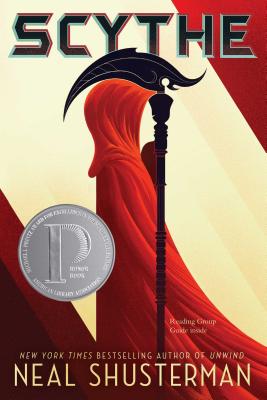
Scythe

by Neal Shusterman
First sentence: “We must, by law, keep a record fo the innocents we kill.”
Support your local independent bookstore: buy it there!
Content: There is, by the very nature of the book, violence. Some of it is graphic. There is also mild swearing. It’s in the YA section (grades 6-8) of the bookstore, but, like Hunger Games, I’d be wary about giving it to overly sensitive kids.

My co-workers have been on my case to read this since it first came out. A couple of them love it (and Shusterman), but I just didn’t have time. (Sometimes, when I need to sell a book at work, I rely on other people’s opinions rather than just reading it myself, since I won’t have time to read all the books. Unfortunately.) But then, it won a Cybils award, and was picked for my online book club (and then they picked it for one of my in-person book clubs), so I figured it was about time I read this.

And, oh wow, everyone was right. This is an excellent piece of speculative fiction.

The basic premise is this: in the future we will have figured out how to defeat disease and death, thereby becoming immortal (pretty much). However, the earth couldn’t handle the subsequent population growth, so a group of people — called scythes — were organized to deal with that. They have a set of commandments, are outside the general law, and basically get to decide when people should die. There are rules governing that, as well — they have quotas they have to meet and can’t go over, and they can’t do it with forethought or malice. The book follows two teenagers, Citra and Rowan, who were chosen as a scythe’s apprentices. As it follows them through the year of their apprenticeship, it’s fascinating reading about their scythe and his philosophies, and then the difference between scythe philosophies (including a radical one who was just horrid). There is a bit of a romance(ish), but that didn’t really go anywhere (thankfully). Mostly it’s about humanity and the meaning of immortality, and how one deals with the power over life and death. There is definitely much to think about and talk about in this book.
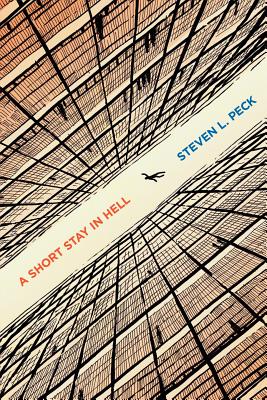
A Short Stay in Hell

by Stephen Peck
First sentence: “Although I have loved many, there has been only one genuine love in my near-eternally stretched life — Rachel who fell to the bottom of the library without me.”
Support your local independent bookstore: buy it there!
Content: There’s some violence. It would be in the adult fiction section of the bookstore, if we carried it.

This was not the Stephen Peck book I set out to read. I was supposed to read Scholar of Moab, but about 1/3 into that, the apostrophes were driving me nuts (they were in the wrong place — do’nt as opposed to don’t — and while I understood why they were that way, it didn’t stop it from pulling me out of the story) and so Russell threw this book at me and said I might like it better.

The idea behind it is that everyone’s idea of the afterlife is wrong (except for the Zoroastrians). And our main character, who was a good Mormon in this life, is in hell. Which happens to be a big library, containing every possible book that could ever be written. Which means, it’s very very very very very large. The idea for him to get out of hell is to find the book containing his story, except that’s an impossible task. (Well not impossible, just very very very hard.) It follows him as he meets people, is part of a university, finds and loses his love, gets captured by a wack job, falls for days, and on and on. It’s an exercise in trying to grasp what infinity means (spoiler: you can’t).

And while I liked it enough to finish it (it was short, which helped), I’m not sure I get what makes Peck such a great writer. Maybe it’s because I’m too literal a reader (plausible), and his works are full of symbolism and metaphor and satire, all of which escape me. Give me a good plot, some great characters, and decent writing and I’m happy.

At least I tried.

State of the TBR Pile – June 2018

I have one more month (more or less) to read all the books before my summer class starts. Which means, I ought to stop piling new books on my pile, and just read these already!

Girl Mans Up by M-E Girard
Charlie Hernandez & the League of Shadows by Ryan Calejo
Skulduggery Pleasant by Derek Landy
Muse of Nightmares by Laini Taylor
Sea Witch by Sarah Henning
The DarkDeep by Ally Condie and Brendan Reichs
Moonrise by Sarah Crossan
Sky in the Deep by Adrienne Young
The Secret of the Old Clock by Carolyn Keene
The Westing Game by Ellen Raskin
The Great Shelby Holmes by Elizabeth Eulberg
The Mysterious Benedict Society by Trenton Lee Stewart

What are you looking forward to on your TBR pile?

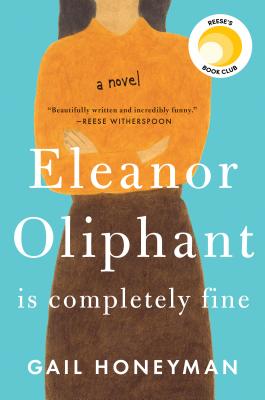
Audio book: Eleanor Oliphant is Completely Fine

by Gail Honeyman
Read by Cathleen McCarron
Support your local independent bookstore: buy it there!
Listen at Libro.fm
Content: There is some disturbing material, and quite a few f-bombs. It’s in the adult fiction section of the bookstore.

Eleanor Oliphant is fine. She has a job — the same job she’s had since she graduated from university — as a finance clerk in a graphic design firm. She goes to work, she comes home, gets drunk on weekends, and talks to her mom (which is not a pleasant experience) on Wednesday nights. She has food, shelter, and work. It’s not a bad life.

Then, one day, she sees a musician that she decides she wants to have a relationship with, so she starts changing herself superficially. And at pretty much the same time, she ends up talking to Raymond, an IT guy in the building, and purely by happenstance, they end up helping an older gentleman who took a bad fall outside a store. And suddenly Eleanor’s life opens up.

This was such a delightful book! It has dark undertones with emotional and physical abuse, but it wasn’t graphic, and it played a role in Eleanor’s growth arc. As a character, she was delightful to spend time with, and the other characters that Honeyman populated the book with were absolutely charming. I appreciated that Raymond and Eleanor developed a close friendship, but not a romance (though that door wasn’t completely shut). That, and the narrator was absolutely delightful! It was one of the those books that I found myself immersed in, and one I didn’t want to get out of the car when I was listening.

An excellent read.

145th Street

by Walter Dean Myers
First sentence: “The way I see it, things happen on 145th Street that don’t happen anywhere else in the world.”
Support your local independent bookstore: buy it there!
Content: There’s violence but the stories are short and to the point. It’s in the YA section (grades 6-8) of the bookstore.

I’ll be honest here. I’m not a fan of short stories, and I had to read one for class, and I’ve never read Walter Dean Myers, so I picked this one. All the stories surround people on this street in New York (in Harlem?), their lives and experiences. But, as I sit back and think about this, what comes to mind are the stories in Bronx Masquerade. Which means this one just kind of went in but slid right out. I’m pretty sure I looked at the words and turned the pages, but I can’t, for the life of me, remember what I read.

I’m sure that’s not because Myers isn’t a good writer. It’s more I’m not a great reader of short stories.

Scarlett Hart: Monster Hunter

by Marcus Sedgwick and Thomas Taylor
First sentence: “The Academy announced that another monster is on the loose.”
Support your local independent bookstore: buy it there!
Content: There’s some precarious situations, but not much else. It’s in the middle grade graphic novel section of the bookstore.

It’s been a while since I’ve read a graphic novel that was this fun. Scarlett Hart is the daughter of two former monster hunters, who died in the line of duty. Even though she’s underage, and could lose her home to the Academy if they find out, she is a talented monster hunter, and with the help of her trusty butler, Napoleon, has been taking on the monsters in London.

There has been an uptick in monsters lately, though, and the dastardly (which really is the best word) Count Stankovic is out to discredit Scarlett (and get her permanently banned from the Academy). However, treachery lies deeper than that, and soon London is under attack. Can Scarlett stop it before everything is destroyed?

Seriously. This is just so much fun. It’s got a great steampunk feel, with cars and some other great inventions. It’s got a lot of humor — Napoleon and his relationship with his car! — as well as some great action sequences as well. It was just a delight to read. And I wouldn’t mind revisiting Scarlett and her world again!

Monthly Round-up: May 2018

This month flew by! May is always so busy… and this was no exception. I have another month break before class starts up again, so I have another month to read what I want. Yay!

My favorite this month:

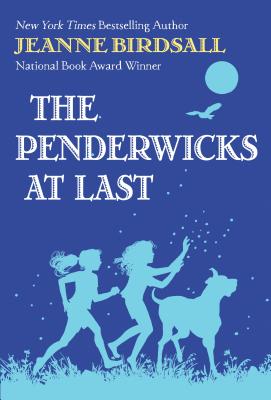
The Penderwicks at Last

Such a very fitting ending.

And the rest:

Middle Grade:

Dying to Meet You
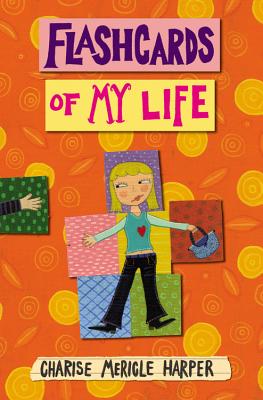
Flashcards of My Life
Bob
Amal Unbound
The Adventures of a Girl Called Bicycle

YA:

The Astonishing Life of Octavian Nothing, Volume 1
Love & Luck
Legendary
Bronx Masquerade

Graphic Novels:

My Hero Academia
March Book 2 and 3

Non-Fiction:

Escape! The Story of the Great Houdini
Imprisoned

What were some of your favorites this month?

Bronx Masquerade

by Nikki Grimes
First sentence: “I ain’t particular about doing homework, you understand.”
Support your local independent bookstore: buy it there!
Content: There’s some tough situations, but nothing “objectionable”. The format — short stories with poetry — is great for reluctant readers, as well. It would be in the young adult (grades 6-8) section of the bookstore.

I read this back during my poetry section of class and was expecting a novel in verse. While I don’t think it’s that, it is a fascinating look into the power of poetry. Set in the Bronx (obviously), the book follows a group of students in an English class as they study the Harlem Renaissance, and then decide they want to try writing poetry themselves. That turns into an Open Mike Friday once a month, which morphs into once a week, as the various students — black, Latnix, and white — learn to express themselves and understand other people throughout the year. Interspersed with commentary from our “narrator” Tyrone, it’s a good look at how poetry not only can help people express ideas and feelings they couldn’t otherwise, it also is a way to understand other people.

I liked how we got a peek into a bunch of different lives, even if that meant we didn’t get to delve deeply into one person. I think the purpose of the novel was to explore connections that poetry makes, not so much to explore one person, and once I realized that, I was able to enjoy the book more. I’ve never read anything by Nikki Grimes before, though I’ve heard a lot about her, and this made me curious. I’ll definitely have to check more of it out.

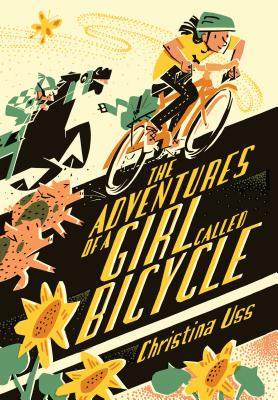
The Adventures of a Girl Called Bicycle

by Christina Uss
First sentence: “The front door to the Mostly Silent Monastery was missing.”
Support your local independent bookstore: buy it there!
Review copy provided by the publisher.
Release date: June 5, 2018
Content: It’s got a few fantasy elements, but is more realistic fiction. It’s probably longer than emerging readers can mange, but I think it’d make a great read-aloud. It will be in the middle grade section (grades 3-5) of the bookstore.

This book, for a myriad of reasons, is highly implausible. A 12 year old girl biking alone across the country? Making friends with  a ghost? Ending up with a super high-tech bicycle? Attending the Kentucky Derby for free? All probably not going to happen. However, that doesn’t mean this first book by Uss, an avid biker herself (she biked across the U. S.!) any less enjoyable. Bicycle is a delightful character to spend a book with as she branches out (maybe in an overly extreme way) and tries to make friends and experience things for herself. Though, to be fair, I wouldn’t want to be sent to the Friendship Farm, either. It’s incredibly charming and ultimately heart-warming and inspiring as Bicycle (and Uss) finds the best parts of this vast country.

(One small quibble: if Bicycle was going through Kansas in late May/early June, she wouldn’t pass fields of sunflowers… that’s more an August/September thing. At least it wasn’t corn fields, though.)

Hand this to anyone who wishes they had the time and freedom to see the country the slow way.


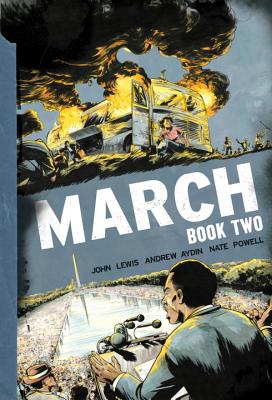
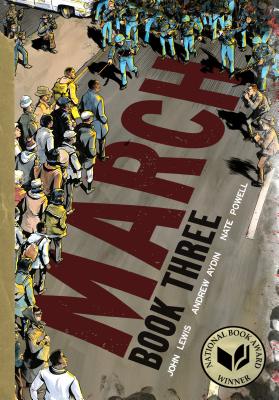
March (Book Two and Three)

by John Lewis, Andrew Aydin, and Nate Powell
First sentence: “Brother John — Good to see you.”
Support your local independent bookstore: buy it there (book 2, book 3).
Others in the series: March (Book One)
Content: There is a lot of violence, and use of the n-word. It’s in the non-fiction area of the graphic novel section of the bookstore.

This picks up where March (Book One) leaves off. Lewis is part of student non-violent protests in Nashville in the early 1960s, but soon leaves that to join the Freedom Riders: a group of African Americans who, in 1961-1962, put supposed desegregation to the test. They rode Greyhound buses though the south, stopping at cities in Virginia, Georgia, Alabama, and Mississippi, with — as you would guess — pretty disastrous results. They were yelled at, beaten, arrested, thrown in jail, loaded up in cars and left in Klan territory, and the buses were blown up… let’s just say that, in short, white people in the south were TERRIBLE people.

All through this, Lewis (and others) preached the gospel of non-violence (which just makes white people look like terrorists. Really.): they didn’t fight back, they didn’t talk back, they just exercised their right (!) to do what they feel they had a right to do.

The book also follows Lewis through the March on Washington in 1963. (I didn’t know he was there, or even that he spoke! In fact, there’s a side note by him that out of everyone who spoke, he was the only one still living.) It was fascinating, learning about the politics behind that march, and about Robert Kennedy’s change of heart as well.

It’s a well-done graphic novel, one that is still very timely to read. As a white person, it definitely made me more aware of what people went through in the 1960s to get just basic rights, and I’m more aware now of how those rights aren’t still completely equal

March (Book Three) picks up after the church bombing the beginning of 1964 and goes through the march from Selma to Birmingham. My thoughts are pretty much the same as after reading book two: white people are so entrenched in their “way of life” that they can’t abide by change at all. And the thing I kept coming back to was that, in the intervening 54 years, that white people are still entrenched in their “way of life”, we just call it by different things now. It’s still racism. And it still is wrong. This one was difficult to read, and made me think, over and over, that an eye for an eye just makes everyone blind. I hope I’d have the courage to stand up to those who use their power to make others “less than”, those who call others “animals” or “dirty” or “from s-hole countries”, those who want to abuse their power to keep themselves in power… even if it means sacrificing my life. John Lewis and all those who stood by him are true heroes, and I wish there were more people like them now.

Excellent.