Untold

by Sarah Rees Brennan
ages: 12+
First sentence: “Welcome to Sorry-in-the-Vale.”
Support your local independent bookstore: buy it there!
Others in the series: Unspoken
Review copy greedily stolen from the package the publisher sent to the bookstore, then hoarded on my shelves until I finally devoured it.

To catch up (spoilers for Unspoken, obviously.):
1. Kami’s imaginary friend, Jared, is real.
2. He’s part of an old sorcerer family.
3. Who used to rule Sorry-in-the-Vale
4. His uncle, Rob, is more than slightly batty, and is killing people because blood gives him power.
5. Kami wants to stop him.

In many ways, this is very much a second book in a trilogy. The first was a brilliant set up. This one, while still interesting and laugh-out-loud funny at times,  had the feel that everything is building toward some grand conclusion. Though we never quite get to it in this book.

That’s not to say that it’s a bad book. On the contrary, it’s actually quite good. Even though I felt like I was spinning my wheels — will Kami and Jared get together? Will Lillian ever stop being a Royal Snob?  Will Angela and Holly work out their differences? Will Ash ever grow a backbone? — it was done in a way that I didn’t mind the spinning. At all. It was also because I adore Kami. I hate to call her plucky, but she really is. She’s smart, and determined, and bossy, and willing to do ANYTHING for her family, friends, and town. I love her.

And the ending? Oh. My. Gosh.  If I wasn’t already convinced that endings can make or break a book, I would be now. The ending is brilliant. And painful. Because now I have to WAIT for the next book.

It was worth it, though.

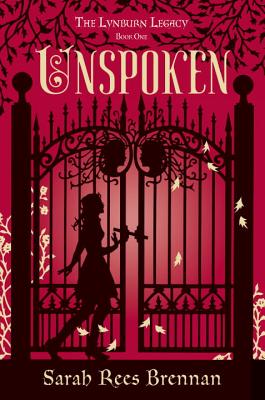
Unspoken

by Sarah Rees Brennan
ages: 12+
First sentence: “Every town in England has a story.”
Support your local independent bookstore: buy it there!

Kami has an imaginary friend.  She has had him in her head, talking to her, keeping her company for as long as she can remember. She’s learned not to talk about him, because people in her small English Village, Sorry-in-the-Vale, tend to think she’s a bit crazy, but he’s there and she’s learned to live with it.

Not for one moment did she ever think that 1) he was really real and 2) he’d show up in her village.

Kami is also an aspiring investigative reporter, something which won me over immediately. I loved her spunk and her gumption, and her Nancy Drew/Veronica Mars/His Girl Friday determination to get to the bottom of the story. Because in Sorry-in-the-Vale there are a LOT of secrets that no one is willing to tell.

To be honest, that kind of bugged me for a lot of the book: the fact that Brennan hinted at secrets, and hinted at secrets, and hinted at secrets, but the reader was as CLUELESS to understanding them as Kami was. I wanted more information, but it wasn’t enough of an annoyance to make me throw the book across the room. No, what kept me reading was the witty writing — the balance between humor, romance, and suspense — and the characters. I adored the girls: Kami, of course, but also her friends Holly and Angela. And the guys weren’t that bad either.

And when the secrets were finally revealed, I understood why Brennan approached it the way she did. She has a way of keeping me engaged, turning pages, until her satisfying-yet-frustratingly-open conclusion.

I can’t wait for the next one!

Shadow of Night

by Deborah Harkness
ages: adult
First sentence: “We arrived in an undignified heap of witch and vampire.”
Support your local independent bookstore: buy it there!
Others in the series: Discovery of Witches

How about this for a brief teaser: if you liked Diana Gabaldon’s Outlander, you’ll probably really like this one.

The long explanation is a lot more complicated, however. There were elements of Shadow of Night that I really liked. And there were some that I didn’t. But my major problem with the book — and this is one I have with many works of “adult” fiction — is that I thought a good third to half of this book was wholly unnecessary.

Because of the conflicts set up in Discovery of Witches (which I won’t go into, but partially are caused by the love Matthew and Diana have for each other; witches and vampires aren’t supposed to mate.), and because Diana needs help figuring out what kind of witch she is (and to control her magic), they end up in the past. In England, circa 1590, to be exact. Which brings me (so soon?) to problem number one: too often, I felt Harkness was using her status as a historian to show off. I got the sense that she set the book in the past not because it best served the story (though in some ways, it did), but because she KNOWS STUFF and wanted to share. Too often I was pulled out of the story because of some name dropping (though Diana has a moment of exasperation, wondering out of all the people in England in the past, how come Matthew knows all the famous ones. That kind of helped.) and historical elements. It was hard for me to enjoy the past because she kept pulling me out of it with details about clothes, food, the weather, and blasted Christopher Marlow.

Anyway. Matthew and Diana aren’t in England very long before they cause a ruckus and get sent to Sept Tours, Matthew’s ancestral home. Where his dead father is still very much alive. And who forces them to get married. (In way too many pages. Followed by many, many more pages of [not graphic, or even titillating] married sex.) Back to England they go, where (in some of the best passages) Diana begins to figure out that she’s a unique sort of witch, and gets a handle on her magic. Oh, and manages to get pregnant by the vampire.

Before you think that Harkness went all Breaking Dawn on us, she didn’t. Oh, sure, there are influences there: Matthew is just as protective and oppressive as Edward; apparently it’s in a vampire’s “nature”. The difference is that rather than being pushed around, Diana takes him on. Thank heavens for that; in many, many ways, Diana as a character is the best part of this novel. She’s strong, interesting, clever, inquisitive, and plain fun to be around as a character.

There’s more, of course: It’s a nearly 600 page book, and Harkness finds ways to fill them out. And it’s not a bad book, per se: I did finish it. Because even with all the extra historical stuff, and the poor plotting (for my YA-saturated brain), I am invested in Matthew and Diana’s story. Which means, I’m already asking when the next one will be out.

If you’re still interested in this one after all that, I’m offering a giveaway of this book. I’ll even throw in a set of five pins, and a temporary tattoo. Maybe you’ll like it more than I did. You have until Friday, July 13th (ooooh, auspicious) to enter.

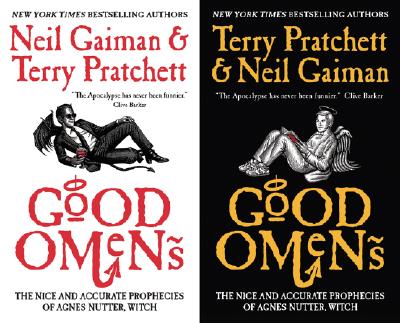
Good Omens

by Terry Pratchett and Neil Gaiman
ages: adult
First sentence: “It was a nice day.”
Support your local independent bookstore: buy it there!

This is one of those “everything but the kitchen sink” kind of books. There’s witches (who carry bread knives around for protection, because that’s the sort of witch they are) and witch hunters. Prophetesses (well, one: who wrote the Nice and Accurate Prophecies of Agnes Nutter, which is surprisingly correct) and anti-Christs (well, one. He’s eleven.). Demons and angels. Not to mention the four riders of the Apocalypse, as well as several telephone salespeople.

And all are headed toward Lower Tadfield. Because, of course, that’s where the End of the World/The Great War/Impending Doom is going to take place.

I adore Gaiman and Pratchett separately, so I figure together (and, yes, it was about time I read this book!) they’d be brilliant. And they were. So much so, that I think I missed a good 60% of the jokes. Completely. It’s not that I didn’t like the book: I did. I laughed at parts, I kept turning pages, I did love bits and pieces of it. But really (and Hubby says it’s because I haven’t seen The Omen, nor do I have plans to), I felt like I was sitting in on a conversation where I got some of what was being talked about, but was, for the most part, left completely out to pasture.

Which means, although it’s brilliant (I really did like the forward and afterward in my 2006 edition), it’s not my favorite Gaiman or Pratchett.

True Sisters

by Sandra Dallas
ages: adult
First sentence: “The two sisters leaned forward, their hadns flat against the rear of the handcart, waiting, fidgeting, impatient.”
Support your local independent bookstore: buy it there!

When this book came into the store last week, they all looked at the jacket flap copy, said “It’s Mormon,” and then looked pointedly in my direction. I took a look at the book, said “It’s the Martin Handcart Company,” and took one home.

See, my ancestors — my grandmother’s grandmother, I think — came over with the Martin Handcart company. I listened to my grandmother tell me stories of hardship and survival. It’s part of my heritage. And even though I’ve never picked up a Sandra Dallas book in my life (um, she’s popular, right?), I needed to see what this woman — someone who is outside of my “tribe”, for lack of a better word — was going to do with my heritage.

The basic story is that of the Martin Handcart Company — a group of immigrants from Great Britain (and Scandinavia, something which she omitted much to my disappointment), who for economic reasons made and pushed handcarts across the plains from Iowa to Utah. It was an ill-fated trip from the start: the handcarts were made of green wood, and weren’t very sturdy; they left late; and winter in Wyoming came early. Out of the 650 that started, more than 100 died before making it to Salt Lake City.

Dallas focuses on four women: Anne, whose husband is a member but who has refused to join the church; Jessie, an unmarried woman with two brothers making it over on their own; Ella, a pregnant woman who is crossing with her husband and sister; and Louisa a young wife of one of the company’s leaders. Their stories never really intersect — I kind of was expecting them to, given the title — but, rather, the narrative switches to follow each one as they cross the plains and experience trials and hardships and setbacks and miracles.

While it wasn’t a great novel — she never really got much tension going, and it seemed as if she was just checking things off a list (mention Joseph Smith? Check. Polygamy? Check. Hardship? Check.) — it was a good one, and she did treat the Mormons sympathetically. I liked how she had characters along the whole spectrum of faith: men who were overbearing and overly zealous to men who were sympathetic and supportive; women who were doubters, ones who were strong (both physically and mentally), and ones who were blindly following their husbands. It gave a more nuanced picture of our faith — unlike books in the past, we are neither all always gung-ho about the edicts we’ve been given, nor are we all dissenters.

It’s not a great book, but it’s a good one, something which I wasn’t expecting.

Demonglass

by Rachel Hawkins
ages: 12+
First sentence: “At a normal high school, having class outside on a gorgeous May day is usually pretty awesome.”
Support your local independent bookstore: buy it there!
Others in the series: Hex Hall


When we last left Sophie, she had figured out who was killing off the witches, but not in time to save Elodie, one of those popular girls/dark witches. (She wasn’t exactly the nicest person around, but she didn’t really deserve to die…) Oh, and she discovered that Archer Cross, love of her life, was actually a member of L’Occhio di Dio (aka, The Eye, an organization that’s out to eradicate the world of Prodigium), and they can never see each other again. In other words: life sucks.

So, how about summer vacation in England? (That makes everything better, right?)

She finally gets to meet her demon/warlock/powerful dude dad, who comes to Hex Hall to take Sophie away from the frying pan and into the fire. Sure, they place they’re staying (Thorne Abbey) is huge and gorgeous and English, but there’s trouble brewing. There are two demons staying at the abbey, which means someone is “breeding” them. Then, there’s an attempt on Sophie’s life. And, to make matters worse, Archer saunters back into her life. Just when she thought she was getting over him, and learning to like the guy she’s betrothed to (don’t ask), Cal.

This book is just as full of smart, magical nonsense as Hex Hall was. And I’ll have to add Hawkins to my list of people who know how to write a kiss, because there were some seriously swoon-worthy parts of this one. They are snarky fun, books that are meant to be read in one sitting, engrossing and hilarious, with pretty wicked twists and turns.

Awesome.

Hex Hall

by Rachel Hawkins
ages: 12+
First sentence: “Felicia Miller was crying in the bathroom.”
Support your local independent bookstore: buy it there!

Back in the fall, I was invited by the lovely Laura at A Jane of All Reads to participate in a book group. We read YA books, snark quite a bit, and then post about it on our blogs (so you all can be jealous?).

This month was mine to be Keeper of the Book, and the one out of my nominations that was chosen was the “smart magical nonsense” of Hex Hall.

So: the basic plot for those of you with your heads under rocks…. Sophie Mercer is a witch. She’s been raised for the past 16 years by her human mom, but after a prom night gone bad (don’t ask), she’s shipped off to juvie for Prodigium (that is: fairies, witches and shapeshifters): boarding school Hex Hall. There, she makes a best friend in Jenna, her pink-loving vampire roommate; develops a wild crush on the hottest warlock on campus, Archer Cross; makes enemies of the only other dark witches (read: the popular girls); and eventually crosses paths with a demon. Part boarding school story, part teen crush, part mystery, and all sorts of awesomeness, Hex Hall is quite the fun read.

This is what the three of us who read it (and Demonglass and Spell Bound) had to say about it (spoilers, obviously, ahead):

Me: So… I’ve finished both Hex Hall and Demon Glass, and I’m trying to figure out a way to get Spell Bound without having to buy it (if I can find one of the two copies we’re supposed to have it at work, I’m going to check it out there). So, if y’all want to start discussing any (or all?) of the trilogy, be my guests. 🙂

Sya: I have it on my kindle and plan on reading it before the hex hall discussion.

Donna: I’m almost done with mine. I’m ambivalent. I’m entertained but I’m not blown away by it or anything…. Just finished and read the teaser for the next book. If there’s more Cal, I may read on. He’s awesome. Overall the whole book reminded me a bit of Mari Mancusi’s titles in tone and voice but not as satirical. Entertaining but still not blown away. Did like the ending though.

Sya: I think that that’s kind of the point – it’s solidly entertaining without being even remotely challenging. And yes, there’s quite a lot more Cal in book two and he’s particularly swoonsome on a regular basis.

Me: I agree with Sya: it’s good, fluffy, magical chick-lit. I don’t think it’s supposed to blow you away. And I agree, too, Donna: the ending was quite good. Did you see any of it coming? Also: what think ye about the love triangle nonsense (it develops more in book 2)?

Sya: I think the love triangle is a bit of a non starter… It’s not been played up as that much of a plot point as far as I can see (I’ve just started the third book) so far.

Melissa: Oh, good. Actually, I was worried about that (in the third book); I didn’t want it to become your typical YA-we-can’t-just-have-one-love-interest thing.

Sya: I really am right at the beginning of the third one so out could come into play. Will keep you posted.

Me: Thanks! (I really do need to get my hands on that one…) I have higher hopes than mediocre YA tropes for it.

Donna: I saw the big baddie ending up being someone close to Sophie. I just didn’t have it pinned down as who. As for Alice, she didn’t sit right although I didn’t see the entire thing coming. It’s not too often I see something coming full force. When I do then it’s really bad! I didn’t even realize there was a love triangle, unless you count Elodie-Sophie-Archer. And I found it slightly hypocritical of Archer to rank on Sophie’s name for the ‘ie’ when he’s dating the Cliff Notes version of Melodie.

Sya: I kind of figured that Alice didn’t have the best of intentions but I was still taken aback by the ending and liked the way it set things up for book two. On the love triangle front, it’s a bit more prevalent in the third book but still in a sort of background way and doesn’t detract from the rather exciting and sinister story.

Me: Donna: “And I found it slightly hypocritical of Archer to rank on Sophie’s name for the ‘ie’ when he’s dating the Cliff Notes version of Melodie.” HA! I totally agree. Sya: Rather exciting and sinister??? I need to find that one.

Sya: I just finished it. I thought it was completely awesome – such a lot of fun and actually even a wee bit moving in places. Great way to end the series.

We kind of got off-topic there. Back to Hex Hall…

Sya: I’m not quite sure what thread I should be posting my Hex Hall thoughts so I’m jumping in here. I thought the book was great. I read it for the second time for this discussion and followed it up with the second and third in the series. And I really enjoyed the whole lot. Sophie is a fun and believable protagonist, pleasingly flawed and endlessly entertaining. The mean girls are particularly fun to read and Archer is a bonafide hottie – played by Ethan Peck in my head (also, Sophie’s dad? Totally Richard Armitage. Obvs). Cal is also rather scrummy and I actually really liked his character arc as the trilogy continued. In fact, I was pleased that in a trilogy that is essentially light reading the characters really did display some depth. The plot itself kept me reading and while I could see that Alice wasn’t all she seemed, I didn’t really see the whole demon-family thing coming. The writing was fluid and pleasingly visual – I had a really good sense of what Hex Hall looked like – and all in all I’d recommend these books. Will be interested to see what Rachel Hawkins comes up with next.

Me: I agree about the depth of the characters. In my mind, these are a lot like Ally Carter’s books: a lot of fun, but smart, engaging fun. Entertaining, without making you feel guilty. And proof that brain-candy doesn’t have to be written badly, or just hit the same note over and over and over again. I also like that it’s basically clean, geared toward the age group, without pandering and talking down.

Donna: I grew a little tired of Carter’s Gallagher girls books but that quirk kind of wore off. I’d have to keep reading the HEX HALL series to see if I’d feel the same way but since I’m more amenable to this Mancusi-ish quirk it might have more staying power for me. The GG series kind if got away from me and went a little too quirky.

Me: Mancusi-ish quirk”??? And I wasn’t thinking so much Gallagher girls as Heist Society, which I like better, anyway. (*sigh* Hale. *swoon*)

Donna: Mancusi is really over the top but in a way it’s really palatable for me. It’s probably totally personal as she and I share a Lost Boys love and she satirizes current camps to no end so the joke ran longer for me. Haven’t read Heist Society and I think I got to book 2 in GG before I didn’t feel much of a need to keep reading. I may have read three.

And that ends our discussion… we get a little scatterbrained when talking, no? Have you read Hex Hall (or any of the sequels — my reviews coming next week)? What did you think?

(Participants in this discussion: Sya @ The Mountains of Instead and Donna @ Bites)

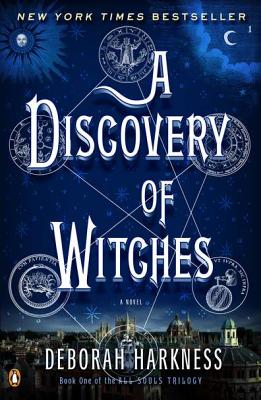
A Discovery of Witches

by Deborah Harkness
ages: adult
First sentence: “The leather-bound volume was nothing remarkable.”
Support your local independent bookstore: buy it there!

Although I liked this one quite a bit — more than I was expecting, actually — by the end of it, I was quite torn. So, let’s just say, up front, that my enjoyment of this one was tempered by some hangups.

The good:
I loved the world that Harkness created. It’s basically our world, except it’s inhabited by vampires, witches, and daemons. They’re generally brilliant, generally long-lived, and generally go unnoticed by humans. Our main character, Diana, is a witch who, ever since her parents’ deaths when she was 7, has shunned her magic. She’s a historian of 17th-century science, which means she dabbles in Alchemy. She’s pretty content with her life. Until she meets Matthew. Who is a vampire.

Which brings me to good point number 2: Harkness has a debt to owe to Stephenie Meyer, but she one-ups her. Matthew is 1500 years old, which makes him incredibly fascinating. (And I suppose it’s kind of creepy that a 1500 year old would fall in love with a 37 year old?) There’s a lot of history in this book, and no accident that Diana, as a historian, is fascinated by Matthew.

The bad:
It’s still True Love, and while it’s not as stifling as Edward and Bella’s love, it’s still pretty sappy. (What is it with vampires and a reluctance to have sex?) There’s also that element of over-protectiveness that drove me batty in the Twilight series. The only difference is that Diana can — and does — hold her own as a witch, though it takes her most of the book to do so. She also struggles against Matthew’s edicts, which helps with the whole damsel-in-distress thing. That, and the fact that she’s in REAL danger as opposed to supposed danger helps temper Matthew’s irritating behavior.

The good:
The plot is intriguing and complex: there’s a lost manuscript that all the “creatures” (as they call themselves) are longing to get their hands on. But, more importantly, there’s the forbidden love (really?) between Diana and Matthew: it seems the creatures aren’t suppose to cross-mate because of an age old (like centuries) covenant that the creatures made with each other. This leads to a lot of things, the most important being an impending “war” between the creatures who are okay with Diana and Matthew’s love and those who are not.

The bad:
On some levels, the idea of anyone being able to love anyone they want is a good story. But my main complaint with this book is that it’s 576 pages, and they don’t get to the point until the last 1/4. The plot pacing is bad as well: it’ll be interesting, then Harkness will divert into pages and pages of wine, food and romancing (M contended that if she cut out all the bits about wine, she would have lost about 75 pages…), none of which had anything to do with the plot. More than once, I nearly lost patience with the book.

That said, I’m invested now, and I’m interested in where Harkness is going to go with the sequel. Hopefully, it won’t be nearly as long. (Then again, she’s a historian, so I’m not really expecting a more tightly written book. Just hoping.)

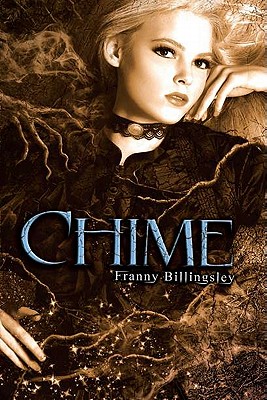
Chime

by Franny Billingsley
ages: 14+
First sentence: “I’ve confessed to everything and I’d like to be hanged.”
Support your local independent bookstore: buy it there!

If I were being totally honest, I’d say that this book didn’t grab me from the beginning. I would admit to being completely confused for about the first third of the book, struggling with it, but still mesmerized by the way Billingsley was telling the story. It was tantalizing in its potential, which kept me going.

And I’m so happy I did.

In the Swampsea there are two kinds of people: those who can see the Old Ones — the spirits of nature and the monsters — and those who can’t. Generally speaking, those who can see the Old Ones are witches. Sure, there’s the Chime Child, a person who is born on the stroke of midnight and whose purpose is to sit in on the trials of the witches, who can see the Old Ones. But no one else. So, that must mean that Briony Larken, who can, is a witch. At least, that’s what Stepmother always said. There’s even proof: Briony called up the wind, which made her twin sister Rose fall and that’s why she’s not completely normal. And Briony called up Mucky Face, the spirit of the river, to injure Stepmother which made her sick, and would have killed her if the arsenic didn’t.

No, Briony isn’t happy. And she can’t love. Not even her sister. Not even her father, who has left his children alone for so long. But then Eldric comes along, bringing with him light, and laughter, and perhaps most importantly, change.

It’s a complex book, as Billingsly peels back the layers of not only the story but also Briony’s psyche. There’s mystery: about Stepmother’s death, about Briony, about Eldric, about Father. That doesn’t even mention the one that Rose carries and drops hints about all through the book. And there’s romance. It’s not a fiery one, full of sparks and swoons, but rather my favorite kind: one where the characters start slowly, are friends first, and then grow into something more.

And the ending? Let me say that I don’t cry easily at books, and this one made me weep.

Very much worth the accolades it’s getting.

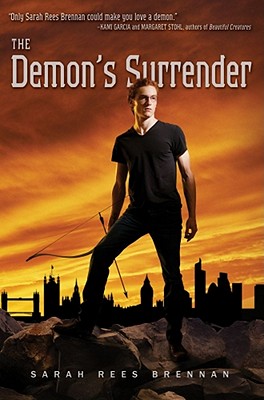
The Demon’s Surrender

by Sarah Rees Brennan

ages: 14+

First sentence: “Magic was like a special guest in Sin’s life.”

Support your local independent bookstore: buy it there!

There are many things I enjoy about this trilogy (the other two being The Demon’s Lexicon and The Demon’s Covenant): there’s action, there’s romance, there’s magic. It’s a grand package. But the think I think I most enjoy is that every book is written from a different point of view, something which ramps up the tension, and makes even the old information seem fresh.

Take the opening chapter of this book, for instance. It takes us back to a scene that happened in the first book (something which I was grateful for, actually, since my notorious bad memory and I have a hard time remembering details when it’s been a while since I’ve read this book). But it didn’t seem repetitive or even old because Brennan told the scene from the perspective of Goblin Market dancer, and supposed new leader, Sin.

This whole story, with its inevitable climax was told from Sin’s perspective, and that was the absolute right way to tell it. Though it’s not entirely her story, as evidenced by the cover: it’s also very much Alan’s story as well. I’ve come to realize over the course of the trilogy that it’s a complex, messy book: there’s no simple black and white story here. This is something which, at the beginning of every book, I struggle with: I want to trust characters, and there really isn’t anyone to trust. There is a greater good overarching everything, but getting there is in no way simple. I came to realize that, in the end, it’s lust for power, greed, and using people for personal gain (whether that’s just possession or killing) that is the real “bad guy.” Which means there’s a moral to the story, but it’s not one that’s heavy handed or even blatantly obvious. Both marks of excellent storytelling.

That said, there are some delicious characters to hate, some very intense moments, and Brennan knows how to write swoon-worthy romance (and yet not let it take over the book). All of which makes this trilogy worth reading.