Redshirts

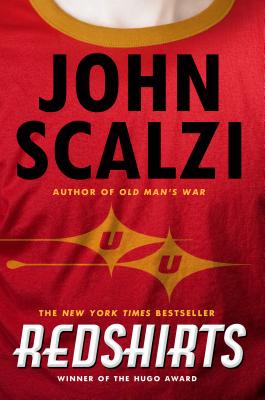
redshirtsby John Scalzi
First sentence: “From the top of the large boulder he sat on, Ensign Tom Davis looked across the expanse of the cave toward Captain Lucius Abertnathy, Science Officer Q’eeng and Chief Engineer Paul West perched on a second, larger boulder, and thought, Well, this sucks.”
Support your local independent bookstore: buy it there!
Content: Aside from the number of deaths (some of which were gruesome) and a bunch of swearing (including a lot of f-bombs), it’s fairly accessible. I’d give it to any nerdy geek (teen and up) who’s interested.  It’s in the Science Fiction/Fantasy section of the bookstore.

Things are a bit weird on the starship Intrepid. Sure, they’re the flagship of the Universal Union, but they’re experiencing a higher than average number of deaths. Mostly of new ensigns. And no one seems to know why it’s happening. Sure, they’ve figured out it’s always the newbies, and that going with certain crew members either ensures your safety (or demise). But there’s really no rhyme or reason to it. When five new ensigns  — Dahl, Duvall, Hester, Hanson, and Finn — get assigned to the Intrepid, they’re thrown into the weirdness of it all. Except that they (especially Dahl) really like their lives and want to continue to live. Thankfully, there’s one person on the Intrepid — a hermit named Jensen — who has things sort of figured out. It’s all just a lot weirder than anyone was expecting.

First: I’m not really a Trekkie. Sure, I watched some of TNG and most of Deep Space 9. I’m fluent in Trek, I know what’s going on, but I’m not a super huge mega fan or anything. All that is to say that even if you’re not a Trekkie, and you only know the basic fringes of the show (especially the original show), you’ll get what Scalzi is parodying here. And that is enough to have enormous amounts of fun with this. No, it’s not side-splitting hilarious, but it is amusing. And entertaining. It’s not deep (though the epilogues are clever and sweet), but it’s fun. The characters are delightful (mostly), and it’s fascinating watching the meta upon meta plot unfold. In short: it’s a well-written romp through a genre that sometimes takes itself way too seriously.

And sometimes that is exactly what you need.

Nomad

nomadby William Alexander
First sentence: “Nadia Antonovna Kollontai, the ambassador of her world, was not on her world.”
Support your local independent bookstore: buy it there!
Review copy provided by the publisher.
Others in the series (though I’ve not read it): Ambassador
Content: There’s some intense moments, and maybe some difficult made-up words, but I’d give it to a 4th grader or higher. It would be in the middle grade (grades 3-5) sections of the bookstore.

I didn’t know what to expect heading into  William Alexander’s latest. From the cover, something in space, most likely. What I got was an epic adventure that involved aliens, space travel, time travel, and kids learning to put aside biases and learning to work together. There’s also a side story (which was never truly fleshed out to my satisfaction, but it didn’t deter from my overall enjoyment) about deporting illegal immigrants and how that affects people. In short: there’s a lot packed into this one.

From what I understand, Gabe and Nadia’s story begins in Ambassador, but since this is a Cybils book (I could have checked it out, but I honestly didn’t know until after I’d finished Nomad) I just dove right in. And aside from some initial getting used to the world that Alexander had created — a world in which aliens from all over space and time meet together in a dream space that you get to by, well, dreaming — I fell headfirst into the story and thoroughly enjoyed my time there.

I really enjoyed the problem-solving aspect of this as well. Nadia has been in space for 40 years (and hasn’t aged; isn’t speed-of-light travel fun?) and has to learn how to get along without her sight (she lost it in a failed experiment). She didn’t moan or whine about it; she just tackled the problem and looked for solutions. Gabe was the same way with being put into a new situation with being the Ambassador of Earth. He needed to learn the rules and guidelines and how to cooperate with people who are vastly different from him, and he did.

The only thing I didn’t think fit exactly was the subplot involving Gabe’s dad being deported. It did give Alexander an excuse to use a holding area near the border in Arizona, and to spotlight the awful conditions that immigrants (especially children) were being held in. But, other than that, it really didn’t serve much of a purpose to the overall story.

But even with that one little quibble, it was a delightful book, one I’m glad I read.

(Just for the record: because this is a Cybils nominee, I’ve been asked to make sure y’all know this is my opinion only, and not that of the panel.)

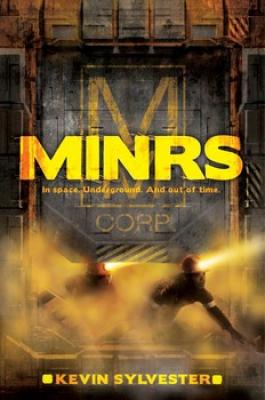
MiNRS

minrsby Kevin Sylvester
First sentence: “The Earth blinked, and was gone.”
Support your local independent bookstore: buy it there!
Content: There’s a lot of death, some of it a little graphic, especially in the beginning. I’d give it to an advanced 4th grader and up, as long as they were okay with the violence.

It’s a future where the people of the world were going to die from an asteroid hit, until a brilliant scientist, Harold Melman, figures out how to nudge it away. And then, the ice melts and they discover that there’s a ton of resources — ones that the Earth is running out of — to be had. So, Melman Mining Corp sends families up to inhabit the asteroid, to mine the minerals and ore, and ship it back to earth.

Fast forward several years later. A Blackout is coming — the asteroid and the Earth will be on opposite sides of the sun and there won’t be any communication possible. And in the middle of this, the mining colony is attacked. Brutally bombed. Everyone killed except for Christopher Nichols and a few other kids. No one (read: the bombers) knows they’re alive. And so, they not only have to figure out how to stop those responsible for the bombs, but keep themselves alive. (In more ways than one.)

This was a trip and a half. It’s a good adventure novel: figuring out how to survive in the mines, the internal conflict between those who just want to survive and those who want to attack, and the inevitable betrayal. It’s a unique premise (for the most part; I have read other kill all the adults and make the kids survive books this year) with the future and science. And even with the love triangle (of sorts), it was a good science fiction book.

My only real complaint is that I was hoping for a stand-alone, and while the conflict mostly resolves, there’s a pretty big cliff hanger that sets up at least a sequel. Other than that, though, it’s spot on.

(Just for the record: because this is a Cybils nominee, I’ve been asked to make sure y’all know this is my opinion only, and not that of the panel.)


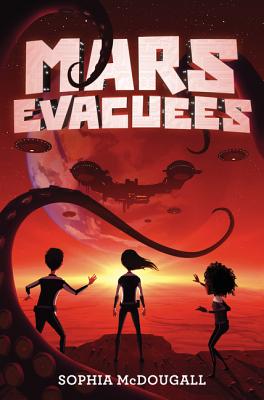
Mars Evacuees

marsevacueesby Sophia McDougall
First sentence: “When the polar ice advanced as far as Nottingham, my school was closed and I was evacuated to Mars.”
Support your local independent bookstore: buy it there!
Content: There’s several mild swear words and some violence (including bullying). It would be in the middle grade (grades 3-5) section of the bookstore.

It’s sometime in the future, and the Earth has shared its home with an alien species, the Morrors. The problem? The Morrors are changing the nature of the earth, freezing it over, and that’s got the humans mad. So, they started waging war against the Morrors, trying to kick them out. But it’s not working, mostly because they’re invisible to the human eye.

So, the humans are resorting to evacuating a select group of kids to Mars to train for combat. Alice Dare, whose mother is a star fighter pilot in this war, is one of those kids.

At first, it seems to be like any other boarding school: there are bullies, and Alice makes some friends — another English girl named Josephine and an annoying boy named Carl and his younger brother Noel — and everything seems to be going okay. Then, one day, all the adults disappear.

Most of the school goes haywire, but Josephine and Alice (along with Carl, Noel, and their robot teacher Goldfish) decide that what they really need to do is go find the adults. What they end up finding is a whole lot of trouble.

Oh. My. Gosh. I know the summary didn’t do this justice because it was the most awesome I’ve read in a long time. It’s smart, it’s funny, there’s fantastic characters, it’s packed with adventure, it’s diverse. It kept me hooked from page one through the conclusion. (And while there’s a sequel, this one stands on its own.) It was just so. much. fun.  Seriously.

(Just for the record: because this is a Cybils nominee, I’ve been asked to make sure y’all know this is my opinion only, and not that of the panel.)

The Martian

by Andy Weir
First sentence: “I’m pretty much f***ed.”
Support your local independent bookstore: buy it there!
Content: As you can tell from the first sentence, the big content issue with this book is LANGUAGE. If you have problems with that, then this book isn’t for you. It’s in the science fiction section of the bookstore.

Mark Watney was one of six astronauts sent to Mars as part of an exploratory and scientific mission. He’s a botanist and was trained to be the fix-it guy, and he was expecting to spend 31 days on the planet with his crewmates and then head home. Then, six days in, a storm kicked up, and an accident happened and he was considered dead. So, the captain made the decision to leave him. Turns out, though, that he wasn’t dead.

Thus starts 368 pages of the best problem solving novel I’ve ever read. Seriously. Weir throws all sorts of things — most of them being normal, every day sorts of things; there’s not many super extreme situations here — at Watney and has him figure out how to survive. You wouldn’t think it would make for a fascinating, gripping novel but it does. Part of this is because Watney is a hilarious (if foul) narrator. He’s SO snarky, and laugh-out-loud hilarious, which helps diffuse the tension in the novel. It also makes it a very practical book, which makes me wonder how much of it is actually accurate science. (I gather, from the author notes at the end, quite a lot.) I kept turning the pages (and staying up late) wondering just what the heck was going to happen next.

I don’t usually go in for books that have a lot of hype or even a movie coming out, but this one is definitely worth all the buzz surrounding it.

Full Cicada Moon

by Marilyn Hilton
First sentence: “I wish we had flown to Vermont instead of riding on a bus, train, train, bus all the way from Berkeley.”
Support your local independent bookstore: buy it there!
Review copy sent to me by the publisher rep.
Content: There isn’t anything objectionable, and it’s a novel in verse so it’d be appropriate for the younger readers. Good for conversation as well. It’ll be in the middle grade (grades 3-5) section of the bookstore.

Mimi Yoshiko Oliver is obsessed with space. It’s 1969, the height of the space race, and she wants to be an astronaut. The problem? She’s a girl. No one takes her desire seriously, especially in her school in Vermont. It also doesn’t help that she’s Afro-Asian, one of the only people of color in an all-white community.

As she goes through seventh grade and the beginning of eighth, Hilton gives us Mimi’s struggles and triumphs, from her attempts to get into shop class — there are some pretty strong gender norms in the late 1960s —
to her struggles to make friends. There are lots of stories about racism in the south in the 1960s. It was actually quite refreshing to be reminded that even northerners had issues with civil rights.

It’s a lovely novel in verse, as well. Hilton captured Mimi’s sense of wonder an awe at the world around her as well as her desire to go into space. It wasn’t overly detailed, something which might bother some readers but I found I didn’t mind. Perhaps it’s because I’m older, and I remember what it was like (sort-of). But, I also think it was a conscious choice on Hilton’s part to make it more accessible to those reading it. So, on the one hand, it’s historical fiction. But the other, it didn’t really feel all that much like it.

Even so, I thoroughly enjoyed spending time with Mimi and her family, as they adjust to a new home, broaden their horizons, and have a memorable year.

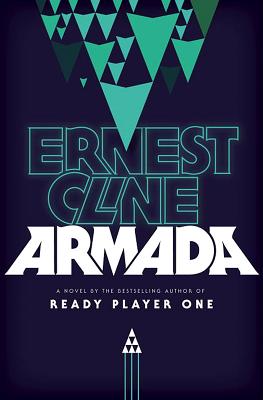
Armada

by Ernest Cline
First sentence: “I was staring out the classroom window and daydreaming of adventure when I spotted the flying saucer.”
Support your local independent bookstore: buy it there!
Release date: July 14, 2015
Review copy pilfered off the ARC shelves at my place of employment.
Content: There’s a lot of swearing, of all sorts. If you have a problem with that, then you probably shouldn’t be reading this. It’ll be in the Science Fiction/Fantasy section of the bookstore.

When I was a kid, one of my favorite movies to quote was The Last Starfighter. (I know: there’s no accounting for taste.) I swear my brothers and I watched it over and over again the summer of 1985 or 1986) and there were lines that incorporated themselves into our everyday lingo (“I’ve always wanted to fight a desperate battle against incredible odds.”). But, when I tried to show it to my kids, I cringed: it’s a pretty bad movie.

So, when I started Armada by Ernest Cline, I cringed: he’s pretty much riffing off the idea behind Last Starfighter (and Ender’s Game): video games, believe it or not, have been training for the impending alien invasion, and since the mid-1970s (it’s set in 2017, as far as I could figure), the top players of the game Armada have been recruited to serve as the Earth’s Defense.

Zack Lightman is one of those players. He’s been obsessed with games, and specifically Armada, since was was old enough to realize that his father — who died when Zack was barely one — was a gamer and Zack wanted to emulate him. Zack’s crawled up the ranks in Armada, until he’s the 6th highest ranked player in the world. And then: he sees a spaceship, one straight from Armada. That’s when his life gets really weird.

Like Ready Player One, this one has a litmus test. If you like/get the following passage, this book is probably for you:

In that moment, I felt like Luke Skywalker surveying a hanger full of A-, Y-, and X-Wing Fighters just before the Battle of Yavin. Or Captain Apollo, climbing into the cockpit of his Viper on the Galactica‘s flight deck. Ender Wigging arriving at Battle School. Or Alex Rogan, clutching his Star League uniform, staring wide-eyed at a hanger full of Gunstars.

I won’t give away too much more of the plot except to say this:  it took a while to get into it, but I was glad I kept with it. I liked the direction that Cline took it in the end.  A good read.

The Jupiter Pirates: Hunt for the Hydra

by Jason Fry
First sentence: “Tycho Hashoone was doing his math homework when the alarms started shrieking.”
Support your local independent bookstore: buy it there!
Content: There’s some intense moments, and a lot of off-screen deaths. And the names are pretty challenging to sound out. But, it’s a short book that reads quickly, and would be in the middle grade (grades 3-5) section of the bookstore, though I think 6-8th graders would enjoy it as well.

Tycho is part of one of the great pirating families of the Jupiter alliance. They’ve been capturing ships for booty for generations, flying the same starship, the Comet, making their name and their living. The captainship is handed down from parent to child, and the current captain, Diocletia, is Tycho’s mom. Which means that Tycho, his twin sister Yana, and their older brother, Carlo, are all in competition to be the next captain.

Lest you think that’s the focus of the book, it’s not. Even though their competition is a huge part. No, the real story is the disappearance of Jovian privateers (as the pirates are now called). When the Hashoones capture a freighter that happens to have an Earth diplomat on it (Jupiter and Earth have been at war for decades), that sets off a chain of events that will involve the Hashoones figuring out the dirty politics behind the disappearances.

On the one hand, this is freaking cool. Pirates! In Space! (or as A pointed out, a book version of Treasure Planet.) And, I like the world building that Fry did. He’s come up with some creative ideas for the future, and I liked the way the privateers/pirates balanced politics with business, just on the legal side of outlaw.

But.

The writing was pedestrian, the competition side of the story took up too much time and what I came to consider the “real” story took too long to develop  and was wrapped up too quickly. (Though that last scene was pretty dang awesome.) While I really enjoyed that this was a family business, Fry was juggling too many characters so I felt like I never really got to know any of them. And maybe this is all quibbling — I mean, will kids really care? — but it made the book a less-than-stellar read for me.

Cleopatra in Space

Book One: Target Practice
by Mike Maihack
Support your local independent bookstore: buy it there!
Content: There’s some violence, but nothing terribly graphic. What struck me is that there is a lot of exposition (with long words) in this one. I’m not sure if K understood everything that went on, but she got the gist of it. Which is what graphic novels are great at.

It’s her 15th birthday, Cleopatra (yes, that Cleopatra) doesn’t want to go through with her party. The ceremony, the pomp, the everything. So, she sneaks away from her tutor, and discovers a portal to a future time and place that is being besieged by a tyrannical dictator. The prophecies declare that she will be the Savior of the world, but first: she has to go to academy to figure things out.

It’s essentially a fish-out-of-water story; BCE girl meets futuristic technology. I liked how she found everything boring, until she got to combat training. She took to that immediately. She’s a girl of action, and she’s smart and tough — when it comes to combat. She’s not a scholar and that’s okay. The only thing that was a bit disconcerting was the whole talking cats. Cats in this world have evolved to the point where they kind of run things. And it’s a bit weird. But that just may be me.

In the end, it reminded me a lot of Zita the Spacegirl — both in the content as well as the artistic style — which is a good thing. And I’m curious to see where Maihack goes next.

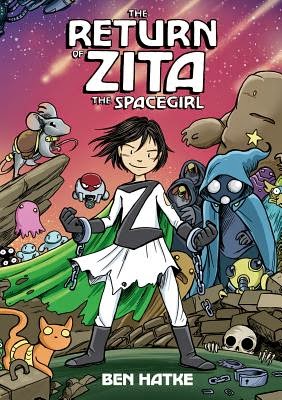
The Return of Zita

by Ben Hatke
Support your local independent bookstore: buy it there!
Others in the series: Zita the Spacegirl, Legends of Zita the Spacegirl,

The last words (if you haven’t read the other two, go do it now) of Legends of Zita are “Gotcha!” And so, we find Zita, at the opening of this one, in front of the Court of Dungeon World, being “tried” for her “crimes”. But, then she finds out that the leader of the dungeon world — who also happens to be a Screed — is planning on getting a jump crystal and taking over Earth. Which means: he must be stopped. Though how on earth is Zita supposed to do this when she’s stuck in the deepest dungeon on the Dungeon World?

Well, with her friends of course.

In some ways, this is a crowded book: everyone Zita has met since the beginning of her adventures shows up. Sometimes, that’s a wonderful, surprising thing. Other times, it seems a bit forced. But I’m not sure how much I cared. Zita has heart and spunk, and I could plausibly believe that everyone (!) would come to her rescue and aid. The art, as always, is fantastic; it may not be sweepingly gorgeous,but Hatke knows how to blend text and illustration to make the action move forward, and to build intensity. And it’s accessible to the kids, which is what really matters. (K said: “You know how many times I’ve read this since we got it? TEN TIMES!”)

It’s a bittersweet ending, with Zita having to leave her friends. And I like how Hatke handled that as well. It’s such a superb series, from start to end. It makes me happy to be able to pick it up and read it all straight through  now, without having to wait.