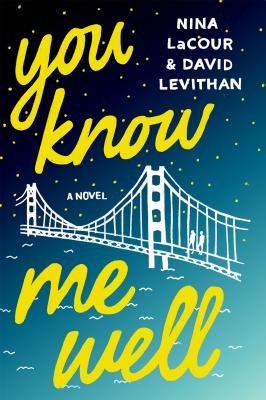
You Know Me Well

youknowmewellby Nina LaCour and David Levithan
First sentence: “Right now, my parents think I’m sleeping on the couch at my best friend Ryan’s house, safely tucked into a suburban silence.”
Support your local independent bookstore: buy it there!
Release date: June 7, 2016
Review copy provided by the publisher.
Content: There’s illusions to sex (but none actual), some underage drinking, and lots of f-bombs. It’ll be in the Teen section (grades 9+) of the bookstore.

Mark and Kate have sat next to each other in Calculus all year, but it isn’t until a June night at the beginning of Pride week in downtown San Francisco that they actually see each other. Mark is suffering from heartbreak: he’s been in love with his best friend for years, but his best friend isn’t really comfortable coming out as gay. Kate is supposed to be meeting this girl, the cousin of her best friend, but her anxiety takes over and she’s bolted. Between the two of them, maybe they can figure out their lives, their future, and which direction to go from here.

The thing that impressed me most about this was that it was less about the romance — although there was romance — and more about how Kate and Mark developed their friendship. It was about them needing a change from their lives and finding something new in a new person, something that allowed them to become More than they already were. It was about them being there for each other, not romantically, but as a good friend. And it was about jealousy that we all feel when our friends do something new or something different without us, about how sometimes that’s the hardest part of growing.

I liked how it felt seamless between Kate and Mark’s parts; that characters who showed up in one part felt authentic in the other, how LaCour and Levithan balanced their character’s stories. And, as a cis-gender straight person, I was able to find things to relate to. Life really is universal.

Quite good.

More Lumberjanes

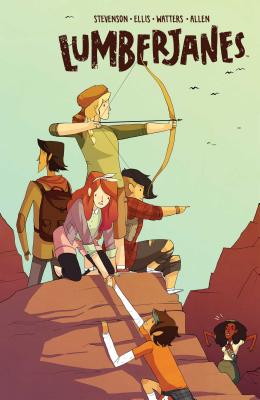
lumberjanes2Lumberjanes, Vol 2: Friendship to the Max
Lumberjanes, Vol 3: A Terrible Plan
by Noelle Stevenson & Grace Ellis
Support your local independent bookstore: buy vol 2 here, and buy vol 3 here!
Content: There’s some violence, a bit of kissing, but mostly, it’s okay for ages 10 and up. It’s in the teen graphic novel section of the bookstore.
Others in the series: Beware the Kitten Holy

A, K, and I all fell head over heels for the Lumberjanes, so we ran out and go volumes 2 and 3 in quick succession. Both are individual story arcs in their own right, so it’s really not something you need to read in order (though I suppose it helps). In Friendship, our illustrious Lumberjanes find out that there’s a Greek God in their midst, one whose set upon causing mischief, and they have to figure out how to stop them. It’s definitely my favorite of the three; there’s a ton of humor and action, and Jen (their illustrious cabin leader) even gets to play a pivotal role.

However, none of us really got into a Terrible Plan all that much. Mal and Molly are off on a picnic and end up following the Bear Lady down a portal into another dimension. They’re off trying to figure out their relationship (and how to get back) while the others are trying to earn badges. That, actually, was my favorite part: April, Jo, and Ripley trying to decorate cakes, make beds, dance, and just do Anything that doesn’t involve the Supernatural. Pretty funny stuff. But the art changed, and it while doesn’t seem like that should really make a difference, it did. It was more difficult to get into the story line, and to connect with the characters when they didn’t look like they were supposed to.

Maybe that’s nitpicking, and I’ll probably check out the next Lumberjanes (assuming there is one). But, the first two volumes are definitely the best.

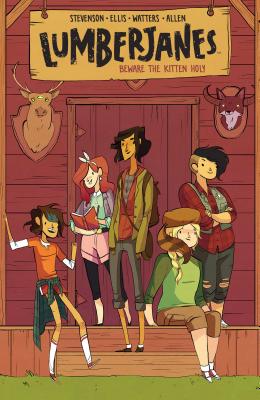
Lumberjanes, Vol. 1: Beware the Kitten Holy

lumberjanes1by Noelle Stevenson, Grace Ellis, Brooke Allen
Support your local independent bookstore: buy it there!
Content: There’s a bit of violence, but nothing super gory. And no language. I’ve moved this series back and forth between Middle Grade Graphic Novels and Teen Graphic Novels. It’s okay for fourth grade and up, but it’s doing better in Teen Graphic Novels, so I’ll leave it there.

The third collection in this series came out a couple weeks ago, and I was reminded that hey, I really ought to give this one a try. So I picked up the first volume (I suppose I could have sauntered down to the local comic book shop) at the library, just to see.

Oh my Holy Kitten, it’s SO much awesome. Five friends at Miss Quinzella Thiskwin Penniquiqul Thistle Crumpet’s Camp for Hardcore Lady Types, who happen to solve supernatural mysteries using math, science, and strategy? How can this not be awesome? I’ve been trying to figure out a way to handsell it — SO MUCH AWESOME doesn’t cut it, really — because the appeal isn’t in the plot. It’s Ripley, who is a ball full of fury and cookies (and is my favorite). It’s in Mal with her “What the junk?” swears and attitude. It’s in the spoofing of the Girl Scouts, and the boys camp where they like things tidy and bake cookies. It’s in the subtle LGBTQ undertones. It’s in the silly camp badges and the Adventure Time-y art. It’s that I gave it to A and K, saying I needed someone to gush over this with, and they loved it.

It’s really just the best thing ever.

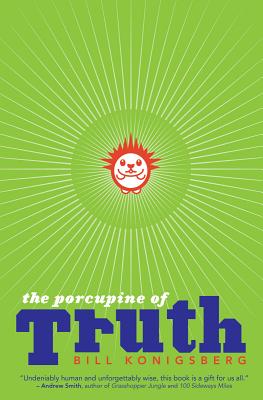
The Porcupine of Truth

by Bill Konigsburg
First sentence: “The Billings Zoo has no animals.”
Support your local independent bookstore: buy it there!
Content: There’s a lot of swearing, including multiple f-bombs. It’s in the Teen (grades 9+) section of the bookstore.

Carson Smith has drawn the short stick for the summer: he’s stuck in Billings, Montana with his mom. They’ve moved back to take care of his dying, alcoholic father whom Carson hasn’t seen in 14 years. It’s not exactly the Ideal Summer at all.

Then Carson, completely by chance, meets Aisha and strikes up a friendship. No romance here: Aisha’s a lesbian who has been kicked out of the house by her super religious dad. She’s having a winner of a summer too, so she moves in with Carson and his parents. Everything is shaping out to be a complete Win until Carson and Aisha start nosing through boxes in the basement and uncover some clues to Carson’s grandfather’s disappearance back in the early 1980s. One thing leads to another and soon Carson and Aisha are on a road trip to find Carson’s grandfather.

This was a hard book for me to read, as a religious person. Mostly because Carson and Aisha are incredibly hostile — for good reason, I think — toward organized religion. I can understand why: too often people hide behind Religion, using it to justify their prejudices and to promote hate. But not everyone does, and I was made uncomfortable by the broad strokes: all people who are “religious” are bigots.

Thankfully, there is growth with these characters, and I appreciated that. I appreciated that, overall, Konigsberg treated everything thoughtfully and carefeull. Which meant that no one was truly black and white and that both Carson and Aisha learned things along the way.

There’s a lot to think about in this book, and I do think it’s a story, with all its broken people and hurtful relationships, that needs to be told. I just wish religion and religious people came off better.

A quick aside: Konigsberg stopped by the store as part of his Porcupines for Trevor tour. While it wasn’t super well-attended, we got a small crowd and we sat in a circle talking about religion and the LGBTQ community. It was a very interesting (and civil) discussion, one that I was glad we had.

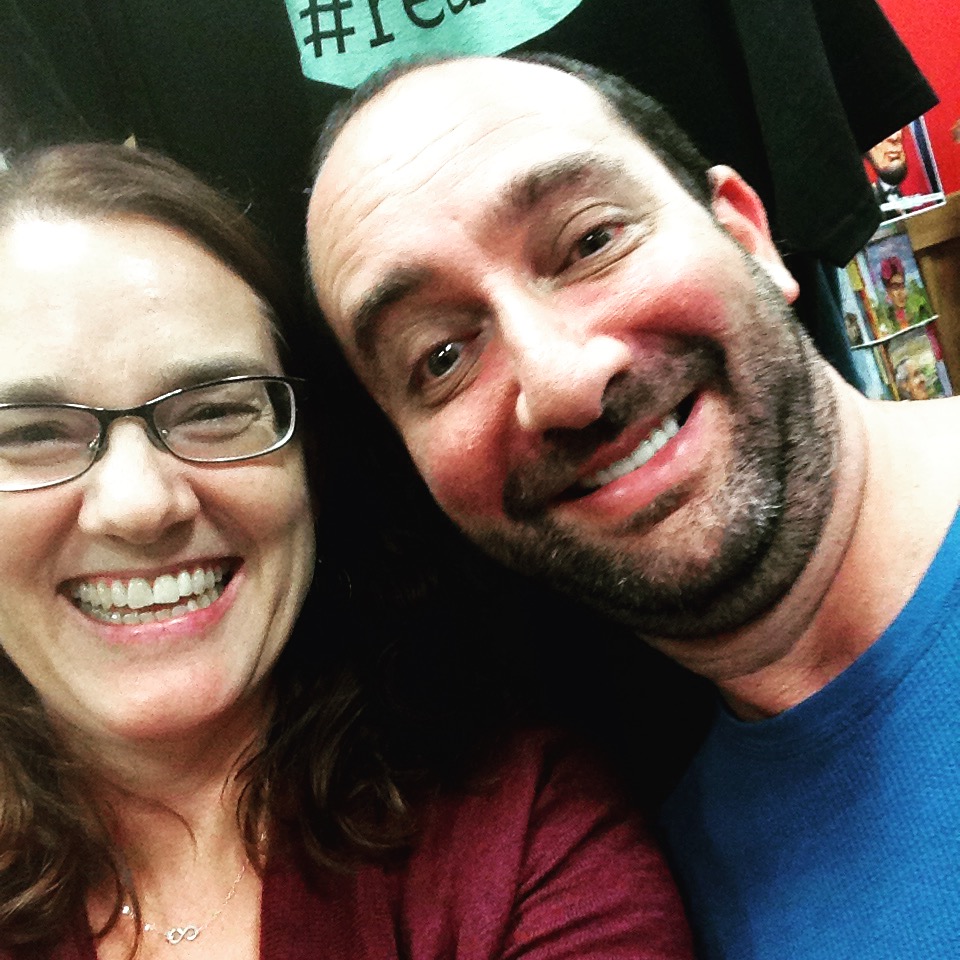
Also: we took a selfie. He was very kind, and very, very tired.

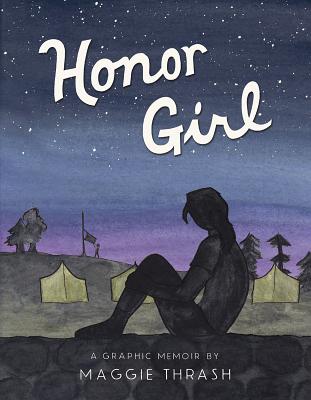
Honor Girl

by Maggie Thrash
Support your local independent bookstore: buy it there!
Content: There’s about a half-dozen f-bombs scattered throughout the book. It’s in the teen graphic novel section of the bookstore.

It’s the summer of 2000, and Maggie is 15. She’s been going to the same summer camp in Kentucky — Camp Bellflower — since she was little, the same camp her mother and grandmother both went to. There was a lot of tradition in the camp, including that of Honor Girl: the one senior camper that was supposed to embody all the Tradition of the camp.

There are very few books, I think, that truly capture what a 15-year-old girl is really like, in all her angst and insecurity. And Thrash’s graphic memoir hits the nail on the head. It’s spot-on. From the drama between her and another girl over who will get their shooting D.E. (a mark of excellence) first to the rumors that fly around the camp about anyone and everyone. But, for Maggie, her summer is wrapped up in a crush she has on one of the counselors, Erin. Does she like Maggie back? Is Maggie even supposed to like one of the counselors? What does it all mean?

The answer is, ultimately and honestly, that she doesn’t know. There is no grand Coming Out moment. There are some moments when I wanted to smack those running the camp, when they discriminated against Maggie for exploring who she is. But, mostly, it was just one slice of a moment in time, when a girl fell in love and didn’t really know what to do about that. And that was something I found I could relate to.

I’m glad Thrash decided that her story needed to be told.

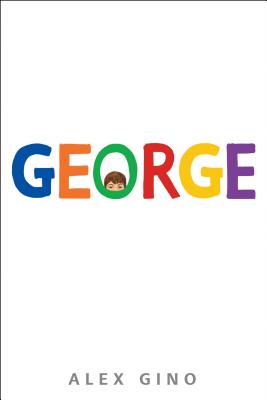
George

by Alex Gino
First sentence: “George pulled a silver house key out of the smallest pocket of a large red backpack.”
Support your local independent bookstore: buy it there!
Review copy provided by the publisher rep.
Content: There’s a lot to talk about and think about here; be prepared for questions. Content-wise, however, it’s simply written,  and so is in the middle grade (grades 3-5) section of the bookstore.

I don’t quite know what I expected from this. It’s got an agenda from the beginning: it’s the first middle grade book about a transgender female child. So, from the start, there’s that underlying the entire book.

There isn’t much plot. George is physically a boy, but identifies as a girl. It’s a secret she keeps from everyone. Except that, as the fourth grade is putting on a play of Charlotte’s Web and George would love to be Charlotte. And she wants to be Charlotte. Which means, in a round about way, being brave and informing people of her true self.

It’s a very open, accepting book; there are bullies, true, but mostly people are accepting once George comes out and confesses her true self. It’s quite liberating.

But, that’s all it is. It’s an important book, true, and an open-minded one. But it’s not really a good book. It’s kind of pedestrian, language-wise, and there’s way too much that’s told and not enough shown. I always felt like I was on the outside, looking in (maybe that was on purpose), and I never quite connected with the story, either. Not that I don’t understand its importance; I do.

I’m just not sure I liked it.

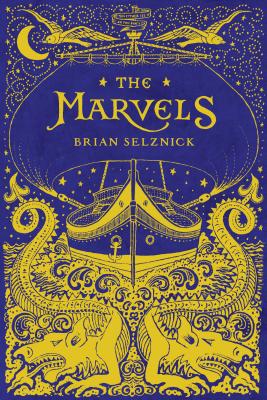
The Marvels

by Brian Selznick
First sentence (which comes about 400 pages in): “Joseph was lost.”
Support your local bookstore: buy it there!
Review copy provided by the publisher.
Release date: September 15, 2015
Content: It’s a huge book, which will be daunting. But 2/3 of it is pictures. And the text section may be a big confusing for younger readers. There is some smoking by adults, but other than that, there’s nothing that would stop me from giving this to a precocious 9- or 10-year-old. It will be in the Middle Grade (grades 3-5) section of the bookstore.

I don’t usually like to write about books months before they come out. But, since this is the first one I finished for the 48 hour book challenge, I figured it was okay.

I’m also going to be coy and not tell you too much about the book. I knew very little about it going in, and I think that’s the best way to experience it.

That said, I liked this one nearly as much as Hugo. It’s about the theater and family and truth in storytelling. Selznick’s art is gorgeous, as always, and even though the text section starts out a bit confusing, stick with it. It’s completely worth it at the end. Oh: and read the afterword. It makes everything that much better.

There’s really not much else to say, except: I can’t wait to share it with everyone else.

Two Transgender Books

I thought about reviewing them separately, but then I realized that the authors of the two books actually dated at one point, and I think Simon & Schuster kind of meant for them to be a pair. So, here they are, together.

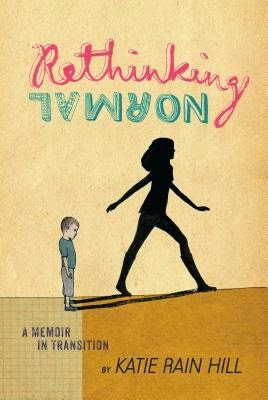
Rethinking Normal
by Katie Rain Hill (with Ariel Schrag)
First sentence: “I really, really hate flies.”
Support your local independent bookstore: buy it there!
Content: There are a few f-bombs, and some frank talk about genetalia. Also, some frank talk about having sex, though it’s not graphic. That, and the subject matter (which isn’t necessarily not for younger kids, but maybe parents want to have a chat with the younger set while they read this), put this in the Teen section (grades 9+) of the bookstore.

Katie is a trans girl. Which means — if I get this correctly — she was assigned the male gender at birth, named Luke by her parents, and as she grew up, she felt increasingly at odds with her physical body. She didn’t feel “male”; she was attracted to males, but wanted them to see her as a woman. This is the story of her journey.

It’s not an easy one for her. For her first few years, she was okay, but as she grew older, she became depressed. She didn’t know what was wrong with her, or why she didn’t feel comfortable in her body. Why she wasn’t compelled to do traditional “guy” things. She went to therapists, but they didn’t help. Most just threw medication at her. It wasn’t until she was 13 that she discovered a transgender website that opened the doors to what she was experiencing. She found a support group, a doctor who was willing to take her seriously (turns out that she was intersexual; she had high levels of estrogen in her body and undeveloped ovaries as well as a penis), and she was on the path to becoming who she truly felt she was.

I was hoping, I think, for this to shed some light on transgender(ism? Can I say that?) for me. It didn’t; but then I think my expectations were too high. One person’s story is going to shed light on just that: one person’s story. And even though the writing style was overly casual (imagine Katie sitting down and just rambling her story at you), I was fascinating by her experiences. And ashamed; this was set down in Oklahoma, and unfortunately, the religious people Katie knew did not treat her well. That always makes me feel sad; I do hope that there would be more acceptance and charity and kindness in these sorts of stories.

I am glad Katie wrote this book, though. The first step to making the unknown more knowable is to learn someone’s story. And this book does just that.

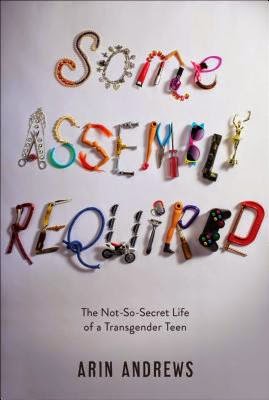
Some Assembly Required
by Arin Anderson (with Joshua Lyon)
First sentence: “Getting dumped at prom sucks.”
Support your local independent bookstore: buy it there!
Content: Same as above.

I didn’t have as positive an experience with this one. I’m not quite sure why, so this is mostly going to be me ruminating about why I bailed on this memoir, when I found the other one fascinating

First off, Arin is a trans boy, which means he was assigned the female gender (and had female body parts) when he was born. He struggled with this, but unlike Katie, his struggles seemed to come off as “I don’t like the clothes/pageants my mother is putting me in.” He was a tomboy as a child, even though he enjoyed the dance classes his mother insisted he take. He didn’t want anything to do with anything else about being a girl, and was repulsed when his body started to change.

I’m not asking for a justification or an explanation, but this seems weak to me. Especially in the light of the experiences Katie had. The way Arin presented himself (to me) came off as much more shallow. Or maybe it was because I’m a woman, and I had some of the same struggles with expectations and my body image. (I just turned feminist instead of trans, though…) I wanted to know what made his experience DIFFERENT from mine. How I could have a similar reaction to clothes/pageants/activities/my body changing and NOT be trans. Maybe I was expecting too much

Growing up in Oklahoma, Arin had a tough time. He came out as bi, and then trans, both of which were strongly rejected by the community, the religious school he was attending, and his mother.  (Of course, since religious people are closed-minded, duh.) In the end it was the the way these so-called Christians treated him that made me put down the book.

But, I also had to admit that my perception of Arin was skewed from the beginning; he shows up in Katie’s book, and while she isn’t cruel, he comes off as a whiny, clingy, needy boy. I couldn’t shake that image as I tried to read this one.

So, maybe the best thing is to pick one or the other, and immerse oneself in that individual story, recognizing that it’s just that: one individual story. Even so, it’s something that isn’t talked about much, and both of these books would be good for discussion.

I’ll Give You the Sun

by Jandy Nelson
First sentence: “This is how it all begins.”
Support your local independent bookstore: buy it there!
Content: There is some teen drinking, a (non-graphic) rape scene, and several f-bombs. That, and because of the subject matter, puts it in the Teen section (grades 9+) of the bookstore.

Noah and Jude are twins, separate people but connected in thought and purpose (generally). So much so that they’ve become NoahandJude, pratically inseparable. That is, until the summer they turn 14. Then everything starts to fall apart. Jude becomes “wild”; Noah retreats into his own world until a new boy shows up next door. They end up “dividing” their parents, each vying for the other parent’s attention and love. On top of that, they are fiercely competing to get into the local prestigious art high school. It’s a mess.

Two years later, things aren’t much better. Jude made it into the school; Noah (who was arguably the better artist) did not. They’re still dealing with the aftermath of their mother’s fatal accident. They harbor secrets. And they’re no longer NoahandJude. They’re not even Noah and Jude. They’re two separate planets, who never talk to each other. It’s different from what it was before, but no better.

Did I mention that Jude sees the ghost of her dead grandmother, and senses the presence of her dead mom?

It’s thanks to the two ghosts that Jude searches out Guillermo, sculptor extraordinaire and Latino Mystical Guide, and finds not only salvation but True Love.

Yeah, the book derailed just about there.

For the record: everyone in this book is a Tortured Soul Needing Redemption. And they all find it together. I did enjoy Guillermo — in fact, he was the most interesting character — but that doesn’t change the fact that his role in the book was to cause a change in the white people around him. He was Passionate Lover, he was Father Figure, he was Spiritual Guide. And sometimes he was a living-breathing person, but those times were rare.

And don’t even get me started on the whole Soul Mate thing. Ugh.

What saved this book from being Truly Horrible was the writing — Nelson paints the world vividly, and I do have to admit that there was some good chemistry between Jude and her Soul Mate, even if that’s a trite trope and needs to be done away with. But what I really loved was the art. I loved Guillermo’s giant sculptures and the way Nelson depicted the process of art. I loved Noah’s chapters and the way he’d come up with paintings for everything. I loved how she considered fashion an art.

In the end, I did respect what Nelson was trying to do. But it’s not a perfect book by any means.

Audiobook: Neil Patrick Harris: Choose Your Own Autobiography

by Neil Patrick Harris
Read by the author.
Support your local independent bookstore: buy it there!
Content: There are eight f-bombs (yes, I counted) and some frank (but not graphic) descriptions of his sexual experiences as he was trying to figure himself out. It’s in the adult biography section of the bookstore, but if you’ve got an interested teen, it’s a lot of fun and quite accessible.

I’m a sucker for celebrity bios. I really am. I love the peek into their lives and their histories, and I’ll devour their histories. I’m curious and a bit of a voyeur. (but not a stalker. Yet.)

So, I was probably going to read Neil Patrick Harris’s bio anyway. But when I got wind of the premise — it was going to be a choose your own adventure book! I LOVED those! — I knew I had to read it.

It comes in two formats: print and audio, and for this experience I chose audio. (Event though I ended up picking up the print book as well. Just to see.) And what an experience it is. On the one hand, I missed out on the whole “choose your own” part; it’s kind of hard to do that with audio. And one of the reasons I wanted to see what the print book was like. Instead of leaping through the book following one path (some of which include fake deaths by sand trap — somehow Joss Whedon was responsible for that one — or avalanche — Big Bird’s fault — or death by bowling ball) or another (where he/you end up overweight and working in a Schlotzsky’s), he reads it straight through. So, it gets a little difficult to tell which is Truth (so, I thought the bit about Katy Perry and the homophobe at the pre-Superbowl Party was fake until C informed me otherwise) and what was Fiction.

But the positives completely offset the negatives in this listening experience. For one: it’s NEIL PATRICK HARRIS narrating. And he’s brilliant. More than brilliant: phenomenal.  Voices (I LOVE his announcer voice) and clips (the best one is the audio of 13-year-old Neil doing a speech on optimism). And (in my favorite section) the vocal annotation of David Burtka in the chapter on how they met which just slayed me with adorableness.

I could go on and on raving about this one. I loved every moment I spent listening to it. The format (using second person instead of presenting it as “this is my life”) involved me, and on top of that NPH has a wonderful sense of humor and gratitude about his life. Maybe it’s not great literature, but it was a truly enjoyable book to read/listen to.