Two Transgender Books

I thought about reviewing them separately, but then I realized that the authors of the two books actually dated at one point, and I think Simon & Schuster kind of meant for them to be a pair. So, here they are, together.

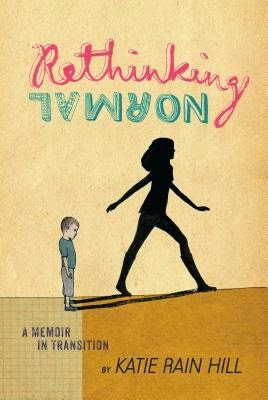
Rethinking Normal
by Katie Rain Hill (with Ariel Schrag)
First sentence: “I really, really hate flies.”
Support your local independent bookstore: buy it there!
Content: There are a few f-bombs, and some frank talk about genetalia. Also, some frank talk about having sex, though it’s not graphic. That, and the subject matter (which isn’t necessarily not for younger kids, but maybe parents want to have a chat with the younger set while they read this), put this in the Teen section (grades 9+) of the bookstore.

Katie is a trans girl. Which means — if I get this correctly — she was assigned the male gender at birth, named Luke by her parents, and as she grew up, she felt increasingly at odds with her physical body. She didn’t feel “male”; she was attracted to males, but wanted them to see her as a woman. This is the story of her journey.

It’s not an easy one for her. For her first few years, she was okay, but as she grew older, she became depressed. She didn’t know what was wrong with her, or why she didn’t feel comfortable in her body. Why she wasn’t compelled to do traditional “guy” things. She went to therapists, but they didn’t help. Most just threw medication at her. It wasn’t until she was 13 that she discovered a transgender website that opened the doors to what she was experiencing. She found a support group, a doctor who was willing to take her seriously (turns out that she was intersexual; she had high levels of estrogen in her body and undeveloped ovaries as well as a penis), and she was on the path to becoming who she truly felt she was.

I was hoping, I think, for this to shed some light on transgender(ism? Can I say that?) for me. It didn’t; but then I think my expectations were too high. One person’s story is going to shed light on just that: one person’s story. And even though the writing style was overly casual (imagine Katie sitting down and just rambling her story at you), I was fascinating by her experiences. And ashamed; this was set down in Oklahoma, and unfortunately, the religious people Katie knew did not treat her well. That always makes me feel sad; I do hope that there would be more acceptance and charity and kindness in these sorts of stories.

I am glad Katie wrote this book, though. The first step to making the unknown more knowable is to learn someone’s story. And this book does just that.

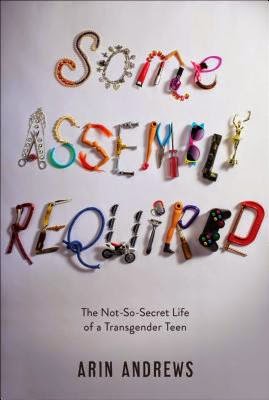
Some Assembly Required
by Arin Anderson (with Joshua Lyon)
First sentence: “Getting dumped at prom sucks.”
Support your local independent bookstore: buy it there!
Content: Same as above.

I didn’t have as positive an experience with this one. I’m not quite sure why, so this is mostly going to be me ruminating about why I bailed on this memoir, when I found the other one fascinating

First off, Arin is a trans boy, which means he was assigned the female gender (and had female body parts) when he was born. He struggled with this, but unlike Katie, his struggles seemed to come off as “I don’t like the clothes/pageants my mother is putting me in.” He was a tomboy as a child, even though he enjoyed the dance classes his mother insisted he take. He didn’t want anything to do with anything else about being a girl, and was repulsed when his body started to change.

I’m not asking for a justification or an explanation, but this seems weak to me. Especially in the light of the experiences Katie had. The way Arin presented himself (to me) came off as much more shallow. Or maybe it was because I’m a woman, and I had some of the same struggles with expectations and my body image. (I just turned feminist instead of trans, though…) I wanted to know what made his experience DIFFERENT from mine. How I could have a similar reaction to clothes/pageants/activities/my body changing and NOT be trans. Maybe I was expecting too much

Growing up in Oklahoma, Arin had a tough time. He came out as bi, and then trans, both of which were strongly rejected by the community, the religious school he was attending, and his mother.  (Of course, since religious people are closed-minded, duh.) In the end it was the the way these so-called Christians treated him that made me put down the book.

But, I also had to admit that my perception of Arin was skewed from the beginning; he shows up in Katie’s book, and while she isn’t cruel, he comes off as a whiny, clingy, needy boy. I couldn’t shake that image as I tried to read this one.

So, maybe the best thing is to pick one or the other, and immerse oneself in that individual story, recognizing that it’s just that: one individual story. Even so, it’s something that isn’t talked about much, and both of these books would be good for discussion.

I’ll Give You the Sun

by Jandy Nelson
First sentence: “This is how it all begins.”
Support your local independent bookstore: buy it there!
Content: There is some teen drinking, a (non-graphic) rape scene, and several f-bombs. That, and because of the subject matter, puts it in the Teen section (grades 9+) of the bookstore.

Noah and Jude are twins, separate people but connected in thought and purpose (generally). So much so that they’ve become NoahandJude, pratically inseparable. That is, until the summer they turn 14. Then everything starts to fall apart. Jude becomes “wild”; Noah retreats into his own world until a new boy shows up next door. They end up “dividing” their parents, each vying for the other parent’s attention and love. On top of that, they are fiercely competing to get into the local prestigious art high school. It’s a mess.

Two years later, things aren’t much better. Jude made it into the school; Noah (who was arguably the better artist) did not. They’re still dealing with the aftermath of their mother’s fatal accident. They harbor secrets. And they’re no longer NoahandJude. They’re not even Noah and Jude. They’re two separate planets, who never talk to each other. It’s different from what it was before, but no better.

Did I mention that Jude sees the ghost of her dead grandmother, and senses the presence of her dead mom?

It’s thanks to the two ghosts that Jude searches out Guillermo, sculptor extraordinaire and Latino Mystical Guide, and finds not only salvation but True Love.

Yeah, the book derailed just about there.

For the record: everyone in this book is a Tortured Soul Needing Redemption. And they all find it together. I did enjoy Guillermo — in fact, he was the most interesting character — but that doesn’t change the fact that his role in the book was to cause a change in the white people around him. He was Passionate Lover, he was Father Figure, he was Spiritual Guide. And sometimes he was a living-breathing person, but those times were rare.

And don’t even get me started on the whole Soul Mate thing. Ugh.

What saved this book from being Truly Horrible was the writing — Nelson paints the world vividly, and I do have to admit that there was some good chemistry between Jude and her Soul Mate, even if that’s a trite trope and needs to be done away with. But what I really loved was the art. I loved Guillermo’s giant sculptures and the way Nelson depicted the process of art. I loved Noah’s chapters and the way he’d come up with paintings for everything. I loved how she considered fashion an art.

In the end, I did respect what Nelson was trying to do. But it’s not a perfect book by any means.

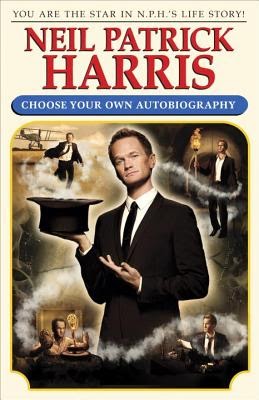
Audiobook: Neil Patrick Harris: Choose Your Own Autobiography

by Neil Patrick Harris
Read by the author.
Support your local independent bookstore: buy it there!
Content: There are eight f-bombs (yes, I counted) and some frank (but not graphic) descriptions of his sexual experiences as he was trying to figure himself out. It’s in the adult biography section of the bookstore, but if you’ve got an interested teen, it’s a lot of fun and quite accessible.

I’m a sucker for celebrity bios. I really am. I love the peek into their lives and their histories, and I’ll devour their histories. I’m curious and a bit of a voyeur. (but not a stalker. Yet.)

So, I was probably going to read Neil Patrick Harris’s bio anyway. But when I got wind of the premise — it was going to be a choose your own adventure book! I LOVED those! — I knew I had to read it.

It comes in two formats: print and audio, and for this experience I chose audio. (Event though I ended up picking up the print book as well. Just to see.) And what an experience it is. On the one hand, I missed out on the whole “choose your own” part; it’s kind of hard to do that with audio. And one of the reasons I wanted to see what the print book was like. Instead of leaping through the book following one path (some of which include fake deaths by sand trap — somehow Joss Whedon was responsible for that one — or avalanche — Big Bird’s fault — or death by bowling ball) or another (where he/you end up overweight and working in a Schlotzsky’s), he reads it straight through. So, it gets a little difficult to tell which is Truth (so, I thought the bit about Katy Perry and the homophobe at the pre-Superbowl Party was fake until C informed me otherwise) and what was Fiction.

But the positives completely offset the negatives in this listening experience. For one: it’s NEIL PATRICK HARRIS narrating. And he’s brilliant. More than brilliant: phenomenal.  Voices (I LOVE his announcer voice) and clips (the best one is the audio of 13-year-old Neil doing a speech on optimism). And (in my favorite section) the vocal annotation of David Burtka in the chapter on how they met which just slayed me with adorableness.

I could go on and on raving about this one. I loved every moment I spent listening to it. The format (using second person instead of presenting it as “this is my life”) involved me, and on top of that NPH has a wonderful sense of humor and gratitude about his life. Maybe it’s not great literature, but it was a truly enjoyable book to read/listen to.

Graphic Novel Roundup – Raina Telgemeir Edition

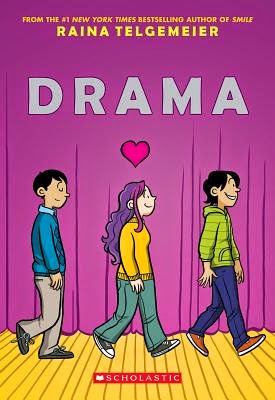
Drama
Support your local independent bookstore: buy it there!
Content: There’s middle school drama, but other than that, it’s pretty tame. It’s in the teen graphic novel section of the bookstore, but only because it feels a bit mature for the middle grade section.

Callie is a theater nerd. She’s not one to be on stage — she can’t sing, and her acting needs some work — but she LOVES being backstage, helping create the sets. And so, for the middle school production (middle school!) of Moon over Mississippi, she’s been assigned to be in charge of the sets. That’s overwhelming enough, but Callie’s personal life has taken a turn for the confusing. She thought she was getting somewhere with her long-time crush, but he went back to his girlfriend (who’s not terribly nice). And then a set of twin brothers show up in her life to just confuse things more.

I really liked Telgemeir’s depiction of middle school (spot on!) and the theater program (again, spot on!). I loved Callie’s spunk and drive and her longing to feel accepted and belong. And even though it was Callie’s story, I thought that all her friends — from the twins to her best friend, Liz — were fully developed. (Though there were some stereotypes, the mean girl girlfriend being one.) My only real complaint was the inclusion that all guys who do theater (at least on-stage) are gay. It’s a stereotype, and although there are gay boys who do theater, not all theater boys (even on-stage) are gay. I know I’m nitpicking, but here in Kansas, that’s the kind of stereotype that really takes hold and so parents discourage boys from participating in the arts because of it. I would have appreciated one character, at least, who wasn’t part of that.

Even so, it was a lot of fun to read.

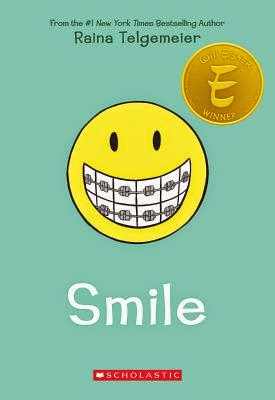
Smile
Support your local independent bookstore: buy it there!
Content: much the same as Drama; it’s got some themes that are a bit old for the younger elementary crowd, but there’s not much “objectionable”. It’s in the Teen Graphic Novel section, mostly because it seems to do better there.

Every once in a while, there’s an author (or in this case an author/artist) who gets the middle grade years so absolutely perfectly. The awkwardness, the challenges with friends, the wanting to be liked and not feeling liked.

Telgemeier is one of those people. It’s loosely based on her early teen years, and tells the story of how she lost her two front teeth in an accident and the dental work it took to make her smile what it is today. But it’s also the story of acceptance (inner and outer) and the things we’ll do and put up with so we don’t feel alone.

One thing I liked (well, I liked lots of things) was that the middle and high school Telgemeier drew was a diverse one. From her friends to the boys she liked, there were all shades of skin. And it wasn’t  this one’s the “black friend” or the “Asian friend”. They were all just friends — well, sort of; some of her friends, as A pointed out when she read it, were not very nice — and it wasn’t like Telgemeier was forcing a diverse world on things. It felt natural.

And, on top of that, she set it in 1989, which was a lot of fun to revisit.

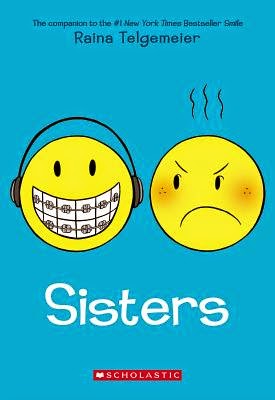
Sisters
Support your local independent bookstore: buy it there!
Content: This one is “tamer” (not that the other two are wild) than the previous two books, and has a more universal appeal, being about sibling rivalry. It’s in the middle grade graphic novel section of the store.

This is another memoir(ish) graphic novel, that takes place during Smile (though you don’t need to read that one to enjoy this one). It’s centered on Raina’s relationship with her younger sister, Amara. It has their backstory, their relationship as siblings as well as a road trip (yay road trip!) to visit cousins in Colorado for a family reunion.

It’s not an easy relationship, the one between Raina and Amara. There’s jealousy, age difference, interest differences, and (of course) just plain sibling rivalry. It’s the usual stuff: hitting, yelling, punching, name-calling. But an event on the road trip (I knew they were useful!), helps the sisters see that maybe it’s okay if they’re different. They can still get along.

I think, out of the three, this one was the least angsty, the least middle-school drama-y, and my personal favorite. Not only because I still remember fighting with my siblings, but because I’ve got all these girls around here who fight and squabble and don’t get along. Maybe, someday, they’ll figure it out. So, this one hit home in a way the other two didn’t.

A word on her art: it’s a bit cartoon-y (that’s the techincal term), but I thought it fit her story-telling style. It’s not terribly detailed, but it served it’s purpose, and the bright colors drew the eye in.

I handed all three of these off to the girls and they enjoyed them as much as I did. I’m glad we finally got around to reading her work!

Afterworlds

by Scott Westerfeld
First sentence: “The most important email that Darcy Patel ever wrote was three paragraphs long.”
Support your local independent bookstore: buy it there!
Release date: September 23, 2014
Content: There’s some grizzly murders, terrorists, and a lot of swearing. Plus the huge length and the amount of patience it’s going to take to get through this one, and I’m not sure it’s for the faint of heart. It’s in the teen (grades 9+) section of the bookstore.

I picked this up because it’s the New Scott Westerfeld. I haven’t read everything he’s written, but I have loved (more or less) everything I read by him. (Also: I’ve met him, at KidlitCon in Seattle. He was pretty chill.) Even so, I didn’t know what to expect. And this was nothing like I’ve ever read before.

It’s really two books in one. Half of it is a ghost/terrorist/murder story. Lizzie, a high school senior, is traveling back to California after visiting her father, and some terrorists attack her airplane. She survives by playing dead, and soon discovers that she can see ghosts. But it’s more than that: she is a psychopomp, a valkyrie, a person who helps the dead find peace. And she’s in love with the underworld’s lord, Yamaraj.

The second half of the story is about Darcy, a recently graduated girl, who “wrote” the Lizzie half of the book during NANOWRIMO her senior year, and got it snapped up by a major publisher for 6 figures. Suddenly, her life is turned upside down, and she decides that college is not an option. Instead, she moves to New York and is thrust head first into the world of YA publishing. It’s a fictional account because Darcy is a fictional person, but very it much felt like an inside peek into the life of a writer.

I liked each of the stories individually; Westerfeld knows how to plot, and how to hold a reader’s interest. The Lizzie story was sufficiently chilling (while also being a bit swoony) and had some clever and interesting takes on the afterworld. And the Darcy story was well-done as well; Westerfeld caught the uncertainty of a first-time published author as well as the excitement and naivete of someone just out of high school facing the Big Wide World.

But, what I enjoyed most, and what kept me reading, was the connection between the two parts. I loved seeing Darcy angst over her book, and how different parts of her life fit into the book. I loved reading about how parts of the story were changed and adapted. And I loved all the different teasers about the end, and how it could have been different. I’m not a writer but I loved seeing how the author and the story are tied up together and the effort it takes to write a story.

I don’t know how well this is going to go over with non-Westerfeld fans; I do hope it goes over well. There’s a couple of good stories here. And I’d be more than happy to read more of Darcy and Lizzie’s story.

The Misadventures of the Family Fletcher

by Dana Alison Levy
First sentence: “Eli sat on the wooden porch steps, crammed in with his brothers, while Pap fiddled with the camera.”
Support your local independent bookstore: buy it there!
Review copy given to me by our Random House Children’s rep.
Content:  The typeface is pretty big and the words are simple without being simplistic. Also, there’s a hint of liking girls, but no real romance. I’d say it’s pretty happy in the Middle Grade (grades 3-5) section of the bookstore.

I’ve been sitting here thinking about how to pitch this one (especially in conservative Kansas), and I think I’ve come up with it: it’s The Penderwicks, but with boys.

The similarities are there: a classic, homespun feel; a family of four siblings ranging from the cute young one (Frog, age 6, in this case) to the wise, older one (Sam, just starting 6th grade); simple, true-to-life challenges, rather than huge conflict; and a charming, whimsical feel that just makes you smile when you’re done reading.

The book follows the Fletcher family — Dad, a history teacher; Papa, who stays at home and does consulting work while the boys are at school; and their sons, Sam and Frog (who is Indian, by the way), but also Jax (age 10 and African American) and Eli (also age 10, but Jax is older by some months) — through the course of a year. As I said, none of the conflicts are huge and overarching, (except, perhaps, their grumpy neighbor Mr. Wilson) but rather small, realistic ones. Eli deals with a starting a new school for “scholarly minded” students and realizes pretty early on that he hates it. Jax deals with a best friend who is growing up and whose interests are changing. Sam is dealing with being on the cusp of teenager hood as well as the idea that something he discovered he likes — acting — may not be “cool”. And Frog has to deal with his family not believing him when he says he has a new friend whose name is Ladybug.

It’s a charming, sweet little book, one that I think will be able to reach a number of readers. In fact, the diversity of this one is my second favorite thing about it (my first favorite being the old-fashioned feel). I loved how Levy had a hugely diverse cast and showed how everyone is just. like. me. (Duh.) But she did it in such a way that wasn’t preachy. And I loved that.

In fact, I want to hand this one to all the kids and say: “You know that person who is different from you? This will help you understand them.” I’m not sure that will sell this book, so I may just have to stick to “Penderwicks with boys.” I just hope kids read this one.

The Vacationers

by Emma Straub
First sentence: “Leaving always came as a surprise, no matter how long the dates had been looming on the calendar.”
Support your local independent bookstore: buy it there!
Content: There are a dozen (or so) f-bombs, some graphic talk about sex and some actual sex (which isn’t graphic). It’s in the adult fiction section of the library.

The Posts are falling apart. Their marriage is suffering because of Jim’s affair (with a woman younger than his son). Their 28-year-old son, Bobby, is a loser. And their daughter, Sylvia, who has just graduated and is off to college, hates living with her parents. So Frannie does the only thing she knows how: rents a house in Mallorca (an island off of Spain) and forces everyone — including her best friend Charles and his husband, as well as her son’s girlfriend — on vacation for two weeks.

It’s such an adorable fantasy. You know? Life is falling apart, so let’s rent a beach house and miraculously everything will get better. Not real life. Or at least my real life.

It was very voyeuristic, this book. I really didn’t care much about Jim’s inner life, or his lust for the editorial assistant he had an affair with. Or Bobby’s relationship with Carmen (who I liked, in spite of the book’s efforts to make me despise her). Or even Sylvia’s inner angst and obsession with losing her virginity. (Which she does, on the beach, to a beautiful Mallorcan boy.) No: the people I was most interested in were Charles and Lawrence because they were the most stable, the most reasonable, the most… well, likable. They were trying to adopt a baby, and there were some struggles with belonging. But if the whole book had been from their perspective, it would have seemed much less snobby. Annoying.

The thing that really kept me reading, however, was that Straub did a wonderful job capturing place and food. Maybe not perfectly, but enough that I was interested in knowing more about Mallorca and I could almost imagine the food.

It’s too bad that I had to experience such a lovely place and read about such lovely food with such crass characters.

The Summer Prince

by Alaya Dawn Johnson
First sentence: “When I was eight, my papai took me to the park to watch a king die.”
Support your local independent bookstore: buy it there!
Content: I was initially thinking that this would be good for those who like Uglies; there’s about the same amount of swearing. But the reason it’s in the Teen section (grades 9+) is because there’s a lot of allusions to sex, including a couple (tasteful) sex scenes.

June Costa is the best artist in Palmeres Três. Or so she thinks; she just hasn’t had a chance to prove it yet. And in this, a moon year in which her futuristic, matriarchal society chooses a one-year Summer King to “rule”, she will have that chance. It starts innocently: her best friend, Gil, falls in love with the summer king, Enki. And she does, too, though she tells herself that it’s mostly about the art. And what art June and Enki create. Ever more elaborate, they end up sparking a revolution of sorts between the technophiles and the isolationists; the government, made up of women they call “Aunties”, has placed strict regulations on what kind of tech can be in the city.

It was this tech element that reminded me so much of Uglies. But, I think Johnson was pointing out the value of art and the power of love, even in a futuristic (and while not dystopian, certainly not perfect) society. It’s a very thought-provoking novel, one that winds and unfurls instead of proceeding in a linear fashion. And it was this winding that kept me most interested. Johnson chose to build her futuristic Brazilian society in bits and chunks throughout the entire book, dropping hints and clues about what happened to get the world to this point along the way. And the society she built was equally as fascinating, with all its machinations and political scheming.

But, ultimately, it was June and Enki and Gil (and June’s competition/friend, Bebel) that kept me reading in the end. I cared about what happened to them, how this year played out for the summer king and his newfound friends. I found myself moved by the ending, and thinking about the book long after I turned the last page.

Will Grayson, Will Grayson

by John Green and David Levithan
First sentence: “When I was little, my dad used to tell me, ‘Will, you can pick your friends, and you can pick your nose, but you can’t pick your friend’s nose.'”
Support your local independent bookstore: buy it there!
Content: There’s a lot of swearing in this one. A. Lot. So, it’s in the Teen section (grades 9+) of the bookstore.

I think the last time I read this, four years ago, I cheated on the review. It’s like I had nothing original to say. And perhaps, because I read it when everyone else was reading it, I didn’t.

So, I decided it deserves a proper review.

Will Grayson (1) is one of those people who just kind of goes with the flow. His best friend, for better or worse, is Tiny Cooper — who is anything but tiny — and he is the sort of person who creates drama. In fact, he’s written a musical, aptly title Tiny Dancer, about his life and is staging  it.

Will Grayson (2) is on medication for clinical depression, and by any account is less than enjoyable to be with. He has exactly three friends (sort of) but is harboring a crush on his on-line friend, Isaac. So when Isaac suggests that they meet up in Chicago, WG2 jumps at the chance

Except, Isaac isn’t real. And, WG2 meets WG1 (and Tiny) instead. And, lives were changed. Mostly for the better.

A lot of what there is to be said about this book is about the format. Green wrote WG1 and Levithan wrote WG2, and at the beginning, you can tell. It’s jarring traveling back and forth between the Will Graysons, but after they meet things become easier. And more fluid. I love how Tiny goes back and forth between the Wills but still ends up being Tiny. I also love the inclusiveness of this novel. That being gay is not an Event. It’s more who you are. And that’s okay. I also love that there’s a terrific example of non-romantic love. (Watch this video for what I mean.) While it’s not my favorite John Green book, I found myself touched by the end, by Tiny’s inclusiveness, and by his friends’ ultimate desire to help him realize that he matters. And by extension, that we all matter.

I’m glad I had an opportunity to reread it.

13 Books with LGBTQ Characters

I was fishing around for ideas for a book list this month, and C pointed out that Obama had proclaimed June LGBTQ Pride Month. She suggested I should do a list of books with good LGBTQ characters. I don’t read them often, but I thought that was a great idea.

Everything Leads to You, by Nina LaCour: The story of a Southern California girl who has recently graduated and is trying to figure out what to do next. She just happens to like girls. “I loved this book. Wholeheartedly and unabashedly. I loved the peek into the way movies work, the facts behind the fantasy. I loved the way Emi thought about characters and set design. And I loved how sometimes she let fantasy overtake her reality. The characters were so real, so deep, so complex, that I couldn’t help but be drawn into their lives.”

Will Grayson, Will Grayson, by John Green and David Levithan: The story of two boys with the same name, one who is gay, and one who isn’t (but whose best friend, Tiny, is gay). I’m rereading this one for my John Green book group, and thoroughly enjoying it. I think it’s not just that Tiny Cooper is a wonderful contradiction, he’s a person who has thoroughly accepted himself for who he is. And that’s so refreshing.

Beauty Queens, by Libba Bray: “On the surface, the book is terribly shallow and stereotypical. Bray has lumped every single cultural reference and stereotype she could think of in this book: there is a lesbian, transgender, bisexual, stupid Southerner, aggressive Texan, Indian-American, black contestant. Honestly: none of the characters are likable, and the plot was fairly simplistic, which almost made it hard to get through.But, when you read it as a satire, the book works brilliantly.”

Aristotle and Dante Discover the Secrets of the Universe, by Benjamin Alire Saenz: A story of two boys in south Texas who realizes that their friendship is something more. I didn’t have a very good first reaction to this one, partially because it was so very guy, I think. I did like, however, the acceptance of Dante’s parents to his coming out. And the juxtaposition of that with the violence done to Dante by others in his down. I’m still not sure it needed to be an 80s book, though.

Tell the Wolves I’m Home, by Carol Rifka Brun: The one adult book on this  doesn’t have a gay main character, but a beloved rather a beloved uncle who died of AIDS and the way that effects the family. “What I did like, however, was the exploration of June’s relationships. Not only with her uncle and his boyfriend, but also with her mother and sister as well. June’s perceptions of all those relationships were — partially because she’s 14 — off, sometimes drastically. And it’s a growing process for her to realize that everything isn’t quite how she perceives, that the truth of everything is multilayered and complex.”

On the Count of Three (aka The Bermudez Triangle), by Maureen Johnson: I’ve been trying to get people to read this one for a while now, because I remember it being a good book about friendship. There are three friends, one of whom is gay and is dating one of the other friends, and keeping it secret from the third. “It’s a good book; not my favorite of Johnson’s but a good, solid story, one where friends stick it out through thick and thin, and realize that sometimes being friends — just being friends — and having friends is the most important thing.”

Better Nate than Ever, by Tim Federle: Okay, so Nate isn’t openly gay; he’s just interested in musicals. And that’s a stereotype that drives me nuts; you can be straight and like musicals just like you can be gay and hate them. But I’m throwing it in, anyway. “Even with all the cliches and stereotypes, this wasn’t a terrible book. I think what saved it, for me at least, was Nate himself. Federle caught the voice of an awkward, insecure, hopeful kid someone who has been beaten down his whole life, and yet still remains optimistic about everything. He’s adorable, and heart-warming, and just plain fun. It was this that kept me reading, and when I finished, it was this that made the book a good one for me.”

Putting Makeup on the Fat Boy, by Bill Wright: A gay teen with a troubled life makes good. Sounds cheezy, but “even though this boy faces more challenges than you can shake a stick at (being a gay teenin NYC isn’t the cakewalk that you would suppose it is…), he is hopeful and optimistic and confident that he can do what it takes to be successful. It was ….well…. if not inspiring, then at least affirming.”

Grasshopper Jungle, by Andrew Smith: I’ll be up front here: this book is not for everyone. I didn’t particularly like it. BUT there are some positives: “That said, there were things to admire: actual sentences that made me laugh aloud. Or the fact that Austin’s (and Robby’s for that matter) sexuality was just a thing, and not an “issue”. Or six-foot-tall unstoppable praying mantises.”

Ash, by Malinda Lo: A retelling of Cinderella, where Cinderella doesn’t fall in love with the prince. “It’s similar enough to the fairy tale that you can recognize it for what it is. But Lo has created a world that is unique on it’s own, from the weaving in of original fairy tales and folk wisdom, to the twists on the love story.”

And as a bonus, some books with LGBTQ Parents:

Lola and the Boy Next Door, by Stephanie Perkins. “Lola’s two dads are also a delight: it’s nice to have a gay couple shown as stable and loving without making a big deal about it. (Additionally: they’re great characters in their own right.) “

Penny Dreadful, by Laurel Snyder. It’s a smallish part, but one of Penny’s friends, Twent, has two moms. Again, it’s just presented as a way to live life, and even though it’s small, it’s meaningful in that it’s just a fact of life.

The Misadventures of the Family Fletcher, by Dana Alison Levy: I haven’t read this one (yet). But from what I’ve heard about it  — it made this summer’s Indie Next list — it sounds delightful. And they just happen to have two dads. “Peppered with life lessons about learning to admit you were wrong, trying something new, and standing up for your family, this book will make you feel like you are inside a group hug.” —Sara Hines, Eight Cousins, Falmouth, MA”

What did I miss?