Audiobook: The Paris Novel

by Ruth Reichl
Read by Kiiri Sandy
Support your local independent bookstore: buy it there!
Or listen at Libro.fm
Content: There is mention of sexual abuse to a child, as well as just general bad parenting. It’s in the Fiction section of the bookstore.

Stella was raised by a single mom, who was not reliable. She was flaky and inconsistent and as a result, Stella became very routinized. She had rules she followed, and systems to make her life make sense. And then, in the early 1980s, Stella’s mother dies and leaves her money with specific instructions to go to Paris until the money runs out. So, Stella does. And, she sets about living in Paris like in New York – very frugally. That is until she wanders into a second-hand clothing shop and tries on the Perfect Dress. She can’t afford it, but the shop owner talks her into it, promising she could return it the next day. She also promises that Stella’s life will change. And it does. She meets Jules and through him, the whole world of Paris opens up and eventually completely changes Stella’s life.

This was a delightful little novel. I could tell that Reichl was a food writer – food was incredibly important to the story, both to the plot and just in the descriptions of the food. I felt like I could have been in Paris, enjoying the food that Stella had. That was part of what I enjoyed about the book – the descriptions of Paris in the early 1980s – it was someplace that someone could go and live for months on very little, and still enjoy so much. It was also a story about enjoying life to the fullest; Stella discovers that the limiting way she had been living her life was soulless, and to really Live, one needed not only to Enjoy the finer things but also to Follow Your Dreams.

Sandy was also an excellent narrator. She brought the characters to life and was able to make the whole Paris world feel full and vibrant. In the end, I thought it was a very enjoyable read.

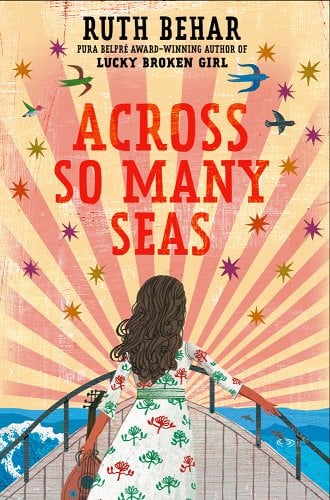
Across So Many Seas

by Ruth Behar
First sentence: “The sound of trumpets coming from the direction of our town gates tears me from sleep, my dreams forgotten as I jolt out of bed.”
Support your local independent bookstore: buy it there!
Content: There are some instances of hatred toward Jews, deaths of parents, and overly strict fathers. It’s in the Middle Grade (grades 3-5) section of the bookstore.

These inter-connected short stories follow girls in the same Sephardic Jewish family from their exile in Spain in 1492, to their lives in Turkey and one girl’s exile from there to Cuba, to finally landing in Miami in present times. Three of the stories follow a direct mother-daughter line; the fourth is their ancestor in Spain. While there isn’t much of a plot except for these girls’ experiences, there is a lot of history here, much of which I didn’t know. 

Behar is a talented writer, capturing quite a lot in a few words. It’s an elegant little book, and I appreciated that it was interconnected stories rather than trying to be one long novel. It was just enough to keep me interested and yet dense enough that I felt I connected with the characters are well as learning something new. 

I’m not entirely sure it’s for kids, but maybe some out there will find an interest in this story. It’s a good one. 

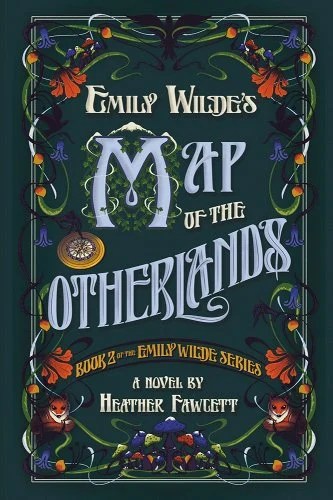
Audiobook: Emily Wilde’s Map of the Otherlands

by Heather Fawcett
Read by Ell Potter & Michael Dodds
Support your local independent bookstore: buy it there!
Or listen at Libro.fm
Others in the series: Emily Wilde’s Encyclopaedia of Faeries
Content: There are some dangerous moments and an off-screen sex scene. For some reason, it’s in the Romance section of the bookstore, which I disagree with. (While it has a romance, it’s not Romance!)

Spoilers for the first one, obviously.

It’s a little while after the events of the last book, and Emily and Wendell have settled back into teaching (such as it is, for Wendell) at Cambridge. But, soon after his birthday, he starts feeling ill, and his faerie magic goes haywire. It turns out that his stepmother -who overthrew his father and killed his entire family for the throne – is stepping up her assassination plan. This concerns Emily and she’s more than ever determined to find the Nexus and get Wendell back to his realm so he can off his stepmother. This involves a trip to the Alps, this time with the department head and Emily’s niece in tow. As they try to unravel the mystery of the Nexus, Wendell slowly deteriorates. Will they be able to find it and get him back to his realm in time?

Much like the first book, this is utterly delightful. The combination of historical fiction and faerie magic is charming, and Emily is a delightful narrator to be our guide through this world. It’s doubly delightful on audiobook with Potter doing an admirable job capturing all the characters and the intricacies of the plot. I loved the twists and turns in this one, and I liked that Fawcett allowed Emily to save Wendell by using her own wits, and not relying on magic to get her out of trouble.

I don’t know if this is it for Wendell and Emily – the book had a logical end to the story – but I’d happily follow them on more adventures! Such a good series.

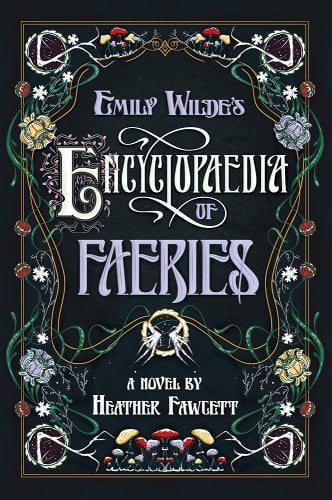
Audiobook: Emily Wilde’s Encyclopaedia of Faeries

by Heather Fawcett
Read by Ell Potter & Michael Dodds
Support your local independent bookstore: buy it there!
Or listen at Libro.fm
Content: There are some intense moments, and it’s a bit slow at times. It’s in the Science Fiction/ Fantasy section of the bookstore.

Emily Wilde has been working on her Encyclopedia of Faeries, documenting as many as she can, for years. And she’s finally gotten funding to go do a field study of the Hidden Ones in Hrafnsvik. She arrives just as winter’s beginning, and because she’s not a terribly personable person, she gets off on the wrong foot. Enter Wendell Bambleby, her colleague from Cambridge, who has followed her to Hrafnsvik. Together – unwillingly at first, on Emily’s part – they win over the villagers, gather stories of the faeries, and quite possibly fall in love.

This one was utterly delightful, particularly on audio. I think I would have liked it in print, but on audio, the story just popped. Both of the narrators were excellent, capturing Emily’s and Wendell’s personalities, as well as those of the villagers around them. (Side note: the jacket blurb for this book calls Emily “curmudgeonly”, but she’s not. It’s never explicitly stated, but the character is most likely on the autism spectrum.) Although the plot is super loose – at one point, Emily wakes up a faerie king and gets trapped in the frozen faerie lands – it’s still a delightful read.

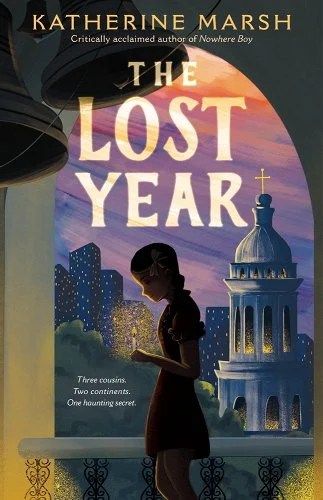
The Lost Year

by Katherine Marsh
First sentence: “Dark Beast Ganon charged.”
Support your local independent bookstore: buy it there!
Content: There is talk of starvation and the deaths of children. It’s in the YA section (grades 6-8) of the bookstore. I read this book for the Cybils, and this reflects my opinion and not that of the whole panel.

It’s spring of 2020, which means that Matthew is trapped in his home due to the COVID-19 pandemic. He’s bored out of his mind, mostly because his great-grandmother – whom they call GG – has come to live with them and his mom is super strict about not interacting with anyone because of the pandemic. He has his Switch, until his mom decides that he needs more to do than sit playing games, and tasks him with helping GG go through her stuff.

When he finds a black and white picture of her and another girl, he slowly gets GG to open up about her childhood in Ukraine and the famine that plagued the country in the early 1930s. Told in alternating voices – we hear Matthew’s story as well as Helen’s, a first-generation American immigrant – and Mila’s – the daughter of a Communist official – stories.

I really liked this one. I liked the parallels between the early days of the pandemic and the Ukranian famine of 1932/1933. I liked how Marsh made each of the three characters come alive on the page, and made the historical parts relevant to today. And even though there is conflict, as a a reader, you can see all the various perspectives. In the end, after all, we’re all just trying to survive somehow.

It’s a good story, and one I think kids who like Jennifer Nielsen or Alan Gratz will enjoy.

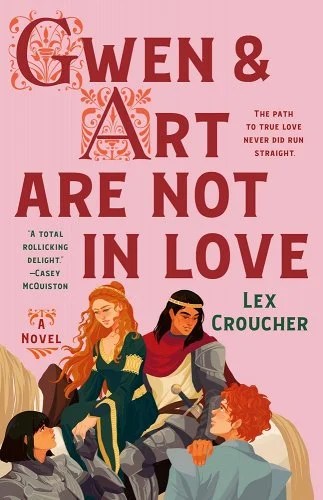
Audiobook: Gwen & Art Are Not in Love

by Lex Croucher
Read by: Alex Singh & Sarah Ovens
Support your local independent bookstore: buy it there!
Or listen at Libro.fm
Content: There is swearing, including multiple f-bombs, and talking about an older teenager getting drunk. It’s in the Teen section (grades 9+) of the bookstore.

Gwen is a princess in Camelot (not that Gwen, though), and the only thing she does NOT want to do is marry her betrothed, Arthur. She’d much rather spend her days in her routine, and pine after Lady Bridget Leclair, the first lady knight. It’s a good thing she discovers that Arthur feels much the same about their marriage as she does, primarily because he likes boys, and is developing a crush on Gwen’s brother Gabriel. 

There are other plot points in this book – like the threat of unrest by the “cultist” (the people who think that there really used to be magic back in Arthurian times), and some personal growth on the part of both Gwen and Arthur, but mostly it’s just four queer teens romping about in medieval England. 

And you know what? That was a ton of fun. It’s kind of like a queer A Knight’s Tale – not especially historically accurate, but a lot of fun anyway. I loved the narrators and the changing perspectives, and it was just a lot of fun to listen to. Plus: it is a spin on the Arthurian tale, which I’m always here for. 

Highly recommended. 

Freewater

by Amina Luqman-Dawson
First sentence: “Sanzi had broken yet another rule, but she didn’t care.”
Support your local independent bookstore: buy it there!
Content: There is violence against human beings – beatings and whippings, talk of removing fingers, and violence in the wild. It is in the Middle Grade section of the bookstore.

Homer is an enslaved boy at a plantation in the south. When we first meet him and his sister, Ada, they are running for their freedom. They’re supposed to be with their mother, but Homer insisted that they go back for his friend, Anna. Which meant that their mother, Rose, was caught. Homer and Ada kept running and found their way into the swamp. From there, they met some formemrly enslaved Black people as well as free Black people in their free community, deep within the swamp: Freewater.

This is less the story of Homer and Ada’s escape – that really only takes a chapter or two – and more of them learning to live free. Homer is obsessed with going back for his mom and works toward being able to do that. Ada is just a 7-year-old getting underfoot. They meet other children: Billy, who is a formerly enslaved person like them, and Sanzi and Juna who were born free in Freewater. Sanzi wants nothing except to be like Suleman – a tracker and explorer. Juna is a homebody and from all accounts, her mother’s “favorite”. We follow them as they experience life in Freewater.

I hate to say it, but I felt like this book was more Important than, well, Good. It is important: these stories of slavery need to be told. While people need to be shown as what they were: often cruel, but sometimes some of them were kind (if misguided). The struggles of Black people need to be told, and their joys and successes – like building a whole community in a swamp! – need to be written down. (The book is based on a real place, which is quite remarkable.)

But I wasn’t engaged. I slogged through until the very end, when it got exciting, as the children (and a couple of adults) raided the plantation wedding (wreaking havoc) during a wedding to rescue Homer’s mother. Luqman-Dawson captured the tension of doing that and made the stakes relatively high.

It was just a chore getting to that point. So, while I see the Importance and Value of this book and am glad it’s out there for people to read, it will not be my favorite.

Isla to Island

by Alexis Castellanos
Support your local independent bookstore: buy it there!
Content: There is some depiction of violence. It’s in the Middle Grade Graphic Novel section of the bookstore.

IN this wordless graphic novel, we follow the story of Mari, who was born in Cuba in the early 1950s and had a happy life with her parents. That is until Castro took over and Mari’s parents began to fear they weren’t safe. So, they sent Mari to New York to live with a nice older couple – stangers, as part of the Peter Pan program, though you don’t find that our until the afterword until they could find a way to leave as well. Mari was thrown into situations that she couldn’t understand; school in New York was nothing like school in ba. It wasn’t until she find the library, and books about plants, that she begins to feel at home.

This is a gorgeously drawn graphic novel; it has to be since there are no words (to very few). Castellanos knows how to portray emotion through facial expressions and body language so I felt I got the story without needing to have words. Perhaps the best thing was that when Mari traveled to Cuba, the world changed from full color to black and white. It was a very effective tool for portraying how isolated and out of place she felt.

Very highly recommended.

The Door of No Return

by Kwame Alexander
First sentence: “There was even a time… many seasons ago… when our people were the sole supplier of the purest and most valuable gold in the world…”
Support your local independent bookstore: buy it there!
Release date: September 27, 2022
Content: There is some violence, some of which is kind of graphic. It will be in the YA section (grades 6-8) of the bookstore.

In this novel in verse, Alexander follows, Kofi, a young man in an African village in Western Africa. He has a good life: he goes to school and is being taught English, even though he doesn’t think he needs it. He has a girl he likes and a cousin with who he’s antagonistic. It’s not a bad life. Things start going badly when Kofi’s older brother accidentally kills the prince of a neighboring village in a contest. He didn’t mean to, he feels bad about it, but his village elders absolve him of any wrongdoing. But, the neighboring village doesn’t see things that way and eventually men from the village take Kofi and his brother hostage.

This is the first of a trilogy, following Kofi (I assume through his experiences. So, it’s slow to start. We get to know Kofi and his family and village, all the better to feel it when Kofi is captured. It’s historical, so you can guess that where Kofi ends up is on a slave ship. it’s laying the groundwork to show that those who were enslaved were people, with lives, dreams, and desires, and Alexander does a fantastic job showing that. It’s showing the slave trade as less simplistic, not to say that there are any White saviors here (there aren’t), but that it wasn’t as simple as White people kidnapping Africans and taking them from their home and family. LIke much of what Alexander does, it’s done excellently with short poems that are evocative so that a reader gets an emotional punch when Kofi is taken.

It’s excellent, but I wouldn’t expect anything else.

Salt Magic

by Hope Larson and Rebecca Mock
Support your local independent bookstore: buy it there!
Content: There is some death and it’s mostly adult problems. It’s in the middle grade section of the bookstore because it’s not quite adult either.

It’s 1919, and Vonceil’s older brother Eber has just come home from the war. She thought it would be just like before he left: they would be best buds. But he comes back changed, more serious, and marries his sweetheart right away, which makes Vonceil mad. And then Greda shows up. She’s a woman Eber met in France who has come to pick up what she thought they had When she finds out that Eber is married, she reveals that she’s a witch, and curses their family’s farm. Vonceil realizes that it’s her responsibility to fix the problem, so sets off after Greda to write the wrong.

It’s part historical fiction, Oklahoma in the early 1900s, but it’s mostly a fairy tale as Vonceil learns Greda’s story and faces down witches n her quest to support her family.

It’s a fun graphic novel, and I enjoyed the story. But, I wonder if it’s one that kids will really like? It’s a fairy tale, yes, set in America, which is unique. But it’s also about adults with very adult problems. It also lacks in the diversity department; there’s exactly one non-white character. Maybe it’ll find its audience somewhere. I didn’t dislike it but it wasn’t the best one either.