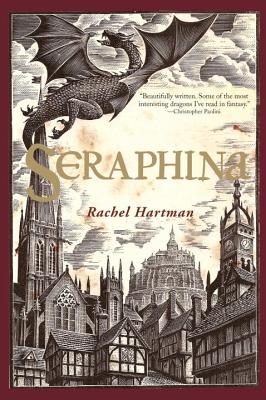
Seraphina

by Rachel Hartman
ages: 13+
First sentence: “I remember being born.”
Support your local independent bookstore: buy it there!
Release date: July 10, 2012
Review copy provided by my place of employment.

I should get the gushing out of the way first: I have read books about dragons, some of which were really clever, but I have never seen dragons like this.

And that blew. me. away.

I have struggled with how to sum this novel up, but am completely at a loss. There is so much going on, much of which is best left to be discovered as you go, that a summary is almost impossible. This is what I can tell you: the main character is Seraphina, a sixteen-year-old assistant chief musician in the castle. Except she has a secret, one that will cost her her life if revealed. The country is Goredd, which has been at peace with the dragons for forty years. It’s a tentative peace, one which is hanging by the slimmest of threads. There is prejudice against the dragons rampant in the populace of Goredd, a fire that is barely constrained. And so when Prince Rufus is found beheaded, it’s everyone’s — from the military down to the common people — assumption that the dragons did it, and there are people calling for blood.

And then there are the dragons. They walk among the humans, as humans: learning, teaching, advising, observing. Granted, they stand out to the humans; dragons are more rational, less emotional, mathematically minded, and not at all spontaneous. But, even though they are differences, it’s their ability to mimic humans that is the root of all the prejudice and terror in Goredd.

Really, that’s all you need to know to start. Know this as well: this is an excellent first novel. It’s a rich, rich world that Hartman has created, full of religion, politics, romance, music, and action. And while it works as the start of a trilogy, it also stands on it’s own, bringing the story arc to a satisfying conclusion, while leaving threads open to pursue in later books.

But really, read this one for the dragons. You’ll never see them like this again.

Audiobook: The Wee Free Men

by Terry Pratchett
read by Stephen Briggs
ages: 9+
Support your local independent bookstore: buy it there!

I first read The Wee Free Men two years ago, and thoroughly enjoyed every bit of the time I spent with the book. It’s hilarious, adventuresome, cool, and Tiffany Aching, even when she’s just 11 years old, is a force to be reckoned with. There’s a power in her, a determination. I love that in this world, all it takes to be a witch is powers of observation and the knowledge that you’re the only one who can do anything about the situation.

There’s magic, of course, but it’s not flashy magic. It’s quite, subtle, and still there, even after you know how it’s done.

That said, I loved hearing this book read aloud. Even more so than when I read it. It’s fine reading it and all, but nothing — nothing! — is funnier than someone doing a spot-on Scottish accent for the Nac Mac Feegle. And the voice for Toad? So deadpan, so hilarious. I laughed. So hard. Often. And I actually got the section near the end when Tiffany goes up against the Queen; something which I remember eluding me when I read it. Perhaps because listening to it means I go through things more carefully than when I read them? Whatever it is, listening to the audiobook made this books so much more loveable and enjoyable than it already was.

Which means, of course, that I’m going to have to listen to the rest of the Tiffany Aching books.

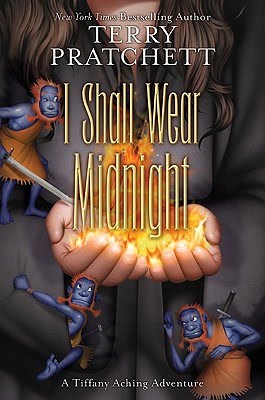
I Shall Wear Midnight

by Terry Pratchett
ages: 13+
First sentence: “Why was it, Tiffany Aching wondered, that people liked noise so much?”
Support your local independent bookstore: buy it there!

Tiffany Aching has discovered that she was a witch, gone through training, accidentally joined a dance she shouldn’t have and had to kiss the winter as a result. Now, she’s back at the Chalk, a sixteen-year-old girl, trying to manage her stead as a witch. It’s not going too horribly: she’s managing to get the things done that need doing. Until one day, things start to unravel. It began with a beating of a young girl by her father, and the rough music started. Then it morphed into something grander: Roland’s engagement to Letitia, daughter of an uppity Duchess, the Baron’s death, and a growing resentment and fear of witches. It turned out that Tiffany had accidentally let out something quite evil, something which, if left to roam, will result in the demise of all the witches. And it’s up to her to make things right again.

I know it sounds dark, and there are some dark moments, but this book is so wonderfully affirming, so incredibly hopeful, that it isn’t the dark bits that stand out. While it’s not as hilarious as some of the other books in the series, it’s still quite amusing. And Tiffany really, truly grows into her own. She has to give up some things, and learn some things, and make some difficult decisions, but she does it all. And she makes some new friends, looking past prejudice and bad first impressions to see that everyone is wonderfully more complicated and interesting that we give them credit for at first.

A perfect ending for an excellent series.

Wintersmith

by Terry Pratchett
ages: 12+
First sentence (not including the Nac Mac Feegle glossary): “When the storm came, it hit the hills like a hammer.”

I got this email from Laura from Life after Jane yesterday that I haven’t been able to stop thinking about. She says,

You never get just a story with Pratchett. You get life lessons and a unique way of looking at things. I’ve heard him called the Douglas Adams of fantasy fiction but I have to disagree. If you ever read any of the Hitchhiker’s Guide series you’ll notice that fabulous and witty as it is, Adams clearly didn’t like people. With Pratchett I’m always amazed how he can poke fun at the silly, pettiness of people while at the same time expressing a very real and warm love of them. I always finish his books feeling that he has a very profound point and that he really just adores everything and everyone.

I haven’t been able to stop thinking about it because she’s absolutely right. It’s the reason why his books are so delightful — even if they’re not quite as soaring as the other books in the series — why you find yourself laughing out loud or nodding in agreement: because Pratchett cares, and it comes across in the writing.

Like the other two books in the Tiffany Aching adventures, the plot really isn’t what matters. It’s the characters — in this one we have the Wintersmith and Roland, who are both infatuated with Tiffany, even if she’s not really that interested, and Nanny Ogg whom you just want to hug, as well as ones from the other books — and the little nuggets of wisdom or humor that are littered throughout. My mom said that she thought these were good “girl” books, but I’ll take it a step further: these are just good books.

And Pratchett is definitely a good writer.

Buy it at: Amazon, Powell’s or your local independent bookstore.

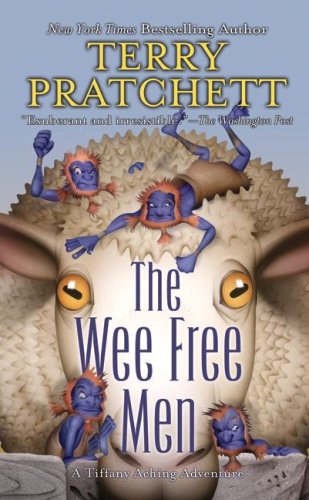
The Wee Free Men

by Terry Pratchett
ages: 12+
First sentence: “Some things start before other things.”

 Yes, I’m here in Cincinnati, enjoying the lull in the reunion (there’s an awesome uncle who make a great playmate, and the rest of us thoroughly enjoy the downtime… though they do come away really wound up)… it’s been fun being with family.
And I managed to get a bit of reading done in the cracks. In fact, it was kind of hard to get it read because I’d leave it lying around, and I’d come back and find it had been snatched up by one family member or another. Which is a testament to how fun this little novel is.
Tiffany is a nine year old girl, the daughter of sheepherder, who isn’t really noticed by much of anything, especially now that Granny Aching has died. That is, until the day when she saw a monster come out of the river. She hit the monster with a frying pan, and the path of her life was changed: she was a witch. That, and her younger brother was stolen by the Queen of Faeries. Tiffany, being the sort of girl she is, decides not to wait for help, and tackles the problem head-on… with the help of the Nac Mac Feegle, the Wee Free men.
But this book isn’t about plot, really. It’s a wonderful example of character- and world-building. The characters — from Tiffany down to the Nac Mac Feegle — are fully drawn and exciting and interesting and engaging. Which makes the book thoroughly entertaining.
I’m going to have to leave it at that… this has taken me a lot longer than I thought it would, mostly because conversation around me is more interesting than the review I’m writing. Needless to say, I’m going to read the next two in the Tiffany Aching series. Terry Pratchett is definately an author — and Discworld a world — worth checking out.

East

I had a hard time finishing this book by Edith Pattou. Not because of the book, though. Because my life wouldn’t let me sit down and just savor this book like a wanted to. I finally did, about 3/4 of the way through, because it was just too compelling. So, I let the home and Christmas stuff wait for a night. 🙂

The story is a retelling of the old fairy tale East of the Sun and West of the Moon. When I first read about this book in Chinaberry, I had no idea about the fairy tale, so we checked it out from the libarary as well. It’s a simple Norweigan fairy tale, one I think I’ve heard before. A white bear takes a girl from a poor family in exchange for wealth. He then takes her to live with him in his enchanted castle. It’s a fairly uneventful time, except that every night, someone comes to sleep with her in the bed. After a while, she aches to go home, and the white bear relents, with one condition: she must not be alone with her mother. She breaks this condition, tells her mother about the stranger in the bed, and her mother gives her a candle. Back at the castle she lights the candle and sees that it’s a man in the bed with her. Unfortunatly, though, with this act, she seals his fate: he’s taken away to marry the troll queen in the castle east of the sun and west of the moon. The girl then sets out to search for the man (whom she realized, too late, was the white bear). She walks for ages, picks up a golden spinning wheel, loom and harp, until the north wind takes her to the castle. There she trades the wheel, loom and harp for visits to the prince, finally succeeding in waking him up and breaking the troll queen’s curse.

East follows the basic fairy tale fairly well, but since I wasn’t attached to the original tale, I had no problems with Pattou’s changes to the story. She fleshes out the family, giving them reasons and motivations behind the departure of the girl (Rose, in the book). The relationship between Rose and the white bear is fleshed out. And the whole journey to find the bear is completely different. Rather than relying on magic, Rose relys on friends, common sense, and plain old inginuity. And, yes, she finally succeeds in the end, and it’s a completely satsifying success. Even the little (mostly unecessary) epilogue in the end doesn’t detract from the great ending to the story.

It was a wonderful book. Perhaps it was good that it took me so long to read. Maybe I enjoyed it more that way.