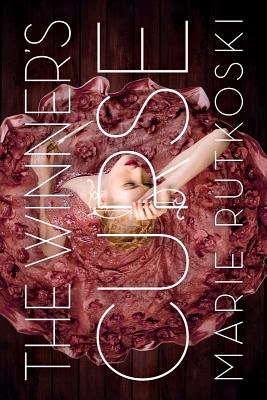
The Winner’s Curse

by Marie Rutkoski
First sentence: “She shouldn’t have been tempted.”
Support your local independent bookstore: buy it there!
Review copy pilfered from the ARC shelves at the bookstore.
Content: There is some violence, an attempted rape scene, some mild swearing, and a lot of politics. It’s in the YA section (grades 6-8th) of the bookstore.

Ever since I finished this book, I’ve been trying to think up a book talk about it. Some 30-second summary that I can give to entice people to want to read it. But I can’t. It’s partially because I’m enthralled with the book and once I start talking about it I just want to keep going and tell everyone ALL the good bits. And it’s partially because this one is REALLY hard to sum up.

I’m going to try, though.

It’s set in the fantasy world of Valoria, an empire of warriors loosely based on ancient Rome. Ten years ago they conquered Haran and enslaved all the people (they didn’t kill, of course). This is the world that Kestrel has grown up in. Her mother died when she was a young girl and her father — the general who led the invasion of Haran — has mostly raised her. He wants her to join the army — one of the two choices a Valorian girl has; it’s either that or get married — but Kestrel has resisted. Partially because she’s devoted to her music (taboo in Valorian society; music is for the slaves) and partially because she’s no good at it. What she is good at, however, is gambling.

I’m going to stop here and say that Kestrel is one of the more interesting characters I’ve read about, and one of the reasons I really liked this book. She wasn’t a “kick butt” heroine in the “traditional” fantasy sense of the word; she sucks at swordplay, is more interested in protecting her hands than learning how to slit a throat. But she is cunning. And observant. And willing to take risks and use what she knows (or deduces) to win a hand, whether that be in her game of choice, or in her life.

In fact, watching her strategize and manipulate the people around her was one of the most enjoyable aspects of this book. She’s not cruel — she’s actually sympathetic to the Haran rebellion that comes up — but she has her priorities, and she will do anything (anything!) to fill them. And even though it’s the first in a trilogy, this story line wraps up quite nicely.

The only weak leak is the Haran slave, Arin, that Kestrel falls in love with. He’s pretty much a one-dimensional character, and the love story felt, well, weak. Thankfully, there’s some nice twists near the end that fill it out much nicer. And maybe Arin will become more complex and fleshed out in later books.

Even with that minor quibble, I more than thoroughly enjoyed reading this one. I’m hooked.

How to Catch a Bogle

by Catherine Jinks
First line: “The front door was painted black, with a shiny brass knocker that made a satisfying noise when Alfred used it.”
Support your local independent bookstore: buy it there!
Review copy off the ARC shelves at my place of employment.
Content: There’s a few mild swear words and some very intense moments. I’d put it in the middle grade (3-5th grade) section of the bookstore, but I’d be wary about giving it to a sensitive younger kid.

Imagine a Dickensian London, complete with orphans, pickpockets, unsavory doctors, toshers, and blackmailing landladies. And then add… bogles.

What are bogles, you might ask?

Well, it’s what our fair heroine, Birdie, and her master, Arthur, call the paranormal creatures that they get rid of for the people of  London town. Not everyone believes in them, but Arthur and Birdie know one thing: if there’s children disappearing, it’s most likely a bogle.

(I’ll let you read the book to find out how to catch them, though.)

There isn’t much plot to this one in terms of plot; Birdie and Arthur catch bogles until they meet a woman of Society who decides that bogle catching is an unsuitable occupation for a girl. (Birdie objects.) They catch more bogles until things become Sufficiently Dangerous (that’s when the unsavory doctor comes in). There’s a bit of excitement, a kidnapping, and some hauntings before it’s all over. No, this one’s mostly about atmosphere. It’s a dark book — bogles are not nice creatures — and very  much the dirty London of Dickens’ time.

I loved it.

I know: I don’t usually like atmospheric books, or Dickens for that matter. But the combination of a clever take on the paranormal and the plucky character of Birdie was enough of a combination for me to fall head over heels for this one. It’s a perfect stand alone story (though it — like many this Cybils season — says it’s a “Book one”), one that is perfect for those who love historical fiction as well as the paranormal.

(Just for the record: because this is a Cybils nominee, I’ve been asked to make sure y’all know this is my opinion only, and not that of the panel.)

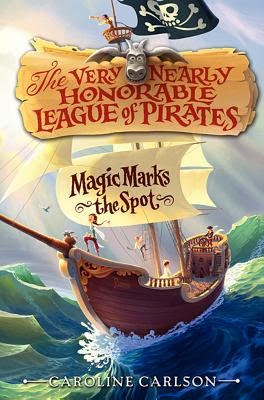
Magic Marks the Spot

The Very Nearly Honorable League of Pirates, Book 1

by Caroline Carlson
First sentence: “Ever since the letter had arrived from Miss Pimm’s, Hilary had spent more and more time talking to the gargoyle.”
Support your local independent bookstore: buy it there!
Review copy provided by the publisher for the Cybils
Content: There’s a couple of swordfights where no one gets injured. For a pirate book, it’s really quite tame. It’s shelved in the middle grade (3-5th grade) section of the bookstore.
Hilary Westfield has one dream: to become a pirate. Unfortunately the league of pirates in Augusta has one rule: no girls. Girls are sent to Miss Pimm’s finishing school, because that’s Where Girls Go. Thankfully, Hilary has Pluck and Determination and doesn’t let the Rules stop her. (This book insists you talk about Things in Capital Letters.) As soon as she gets a chance, she runs away from Miss Pimm’s and finds a pirate — Jasper, the Terror of the South Seas — who doesn’t care that she’s a girl. 
There’s more to this book — magic and treasure and an Enchantress and a Wicked Parent — but really, what I loved most about this book was that Hilary set out to be a pirate and succeeded ON HER OWN TERMS. No dressing up like a boy. No bowing to Tradition. No Resigning Oneself to her Fate and Making the Best of It. Nope. Not for Hilary. She (and her talking gargoyle, whom I really loved) decided that they wanted to be pirates, and Dang It, they became pirates. 
I liked this one an awful lot, mostly because of the above reason. But — aside from the unnecessary letters that were written in cursive, which is a real turn-off for kids These Days; the book got much better after I started skipping them — I really enjoyed all of it. There was humor (Miss Greyson, the governess/chaperone, was hilarious), sword fighting, a wee bit of romance (but not overstated; it was between the adults), and most of all Hilary being Awesome.
Yeah, it was a bit slow at the start, and I really don’t like that it’s yet another one in a series, but I thought the story wrapped up well enough, and I’d be willing to see where Hilary’s piratical adventures take her. 

(Just for the record: because this is a Cybils nominee, I’ve been asked to make sure y’all know this is my opinion only, and not that of the panel.)

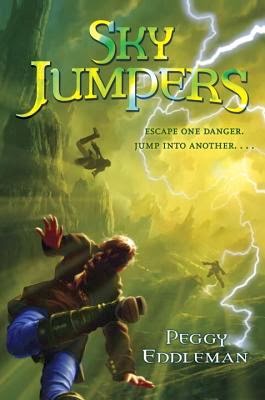
Sky Jumpers

by Peggy Eddleman
First sentence: “You would think I’d never jumped off a cliff before, based on how long I stood there.”
Support your local independent bookstore: buy it there!
Review copy snagged from the ARC shelves at my place of employment.
Content: There are some intense moments, but other than that, it’s pretty tame. It’s shelved in the middle grade (3-5th grade) section of the bookstore.

It’s a future after World War III, which devastated the world. The scientists thought they were doing good in creating “green” bombs, but (because, you know, BOMBS) it still wiped out many cities and destroyed most of the population. In addition, they changed the properties of metal and magnets, and while they made some ground more fertile, it made other places toxic. And — perhaps worst of all — it created the Bomb’s Breath: pockets of air that if you breathe, it’ll kill you.

This is the world that Hope has grown up in.

Living with her adoptive parents in White Rock, a town in a fertile valley, she has discovered that the thing that is most highly prized is Inventing. Since the war destroyed all our technology, it’s up to everyone, really, to invent gadgets and come up with ideas to make life less, well, primitive. Except Hop is terrible at it. What she’s good at is being daring: she’s figured out that if you hold your breath in the Bomb’s Breath you won’t die and that the thicker air has a slowing quality to it. She has taking to jumping off cliffs (sans parachute) through the Bomb’s Breath for fun. (No, she didn’t ask permission.)

Then, one day in winter, some bandits infiltrate their previously safe town and take hostages, demanding access to the town’s one true commodity: the antibiotic they’ve developed. The only hope for the town — since their guard and the weapons are guarding the next town over — is to go fetch the guard back. And the only way to do this is to go over the mountain and through the Bomb’s Breath. And the only one who can do this is Hope.

I’m a bit torn on this one.

On the one hand: I love Eddleman’s take on the dystopian genre. It’s so overdone that it really needs something unique to grab my interest. And Eddleman did just that. I also liked how Hope was a fierce girl, taking the initiative in spite of her misgivings, and using her strengths to not only get the guard but also help outwit the bandits.

On the other hand: I’m not sure. It’s not something I can pinpoint, but I felt disconnected from the book the entire time. Like I was on the outside, looking in, rather than being grabbed and immersed into the world. Perhaps I was turned off  by the BOOK ONE on the back of my ARC. I don’t know if it’s truly going to be a series — this one wrapped up just fine — but the idea of that just set me on edge. I really am so tired of series books.

I shouldn’t let that prejudice interfere with my reading of this one, though. It was a good book. One that I think will appeal to both genders. And there’s a lack of “magic” that was refreshing as well; Hope got by on her wits and her ingenuity and her reliance on her friends. I can get behind that.

(Just for the record: because this is a Cybils nominee, I’ve been asked to make sure y’all know this is my opinion only, and not that of the panel.)

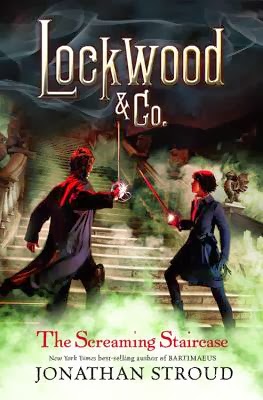
The Screaming Staircase

Lockwood & Co, Book 1
by Jonathan Stroud
First sentence: “
Support your local independent bookstore: buy it there!
Review copy snagged from the ARC shelves at my place of employment.
Content: It’s a ghost story and pretty scary at times, which means, while it’s on a middle grade reading level (and it’s shelved in the middle grade — 3-5th grade — section of my library), I’d be pretty wary about giving this to a Sensitive Child. There’s also a handful of mild swear words.

Even though I saw the rave reviews and the gushing praises, I put off reading this one for much too long. Even though I’ve loved Stroud’s books in the past, I was wary of the rave reviews: it couldn’t be THAT good, could it?

Well, yes. Yes, it was.

Set in a London where there is a Problem with ghosts — they’re everywhere, infesting the buildings and graveyards  — and where only the young can see, and subsequently fight, them. Usually, those with the Talent to see/hear the ghosts, are supervised by adults, but at Lockwood & Co. there’s no such oversight. It’s just Anthony Lockwood, George, and Lucy, teenagers and ghost fighters extraordinaire.

Okay, so it’s not that simple. Lucy and George constantly bicker, and Lockwood is more optimistic about the future of his company than actually capable of running it. But the three of them are talented ghost fighters (hunters? I wasn’t quite sure what to call them), and even though they’re not exactly careful, they get the job done.

Then, on a routine clearing, Lockwood and Lucy stumble on a particularly fierce ghost. It turns out that it was Annabel Ward, a socialite and actress who was murdered and shoved into a chimney. This captures the imagination of our narrator, Lucy, and she ropes the boys into helping her figure out what, exactly, happened to Annabel 50 years ago. One of the best things about this book is the way Stroud handles the mystery: he gives us enough clues as we go along to make a good guess, but it also isn’t the only element to the book. Neither is the ghost Problem. There’s enough layers and depth in this book to keep even the most reluctant of readers interested.

And even though it takes a good 2/3 of the book to get to where the title came from, it all comes together splendidly (fantastically, I might add) at the end.

Additionally, Stroud knows how to do atmosphere. It’s creepy, it’s funny, it’s haunting. It’s eloquent. One passage that stuck out (it’s near the end, but it doesn’t give anything away):

All around us rose the scream, issuing directly from the steps and stones. Its volume was appalling — as painful as repeated blows — but it was the psychic distress it carried that made it so unbearable, that made your gorge rise and your head split and the world spin before your eyes. It was the sound of the terror of
death, drawn out indefinitely, extending on forever. It spiraled around us, clawing at our minds. 

It’s not just good. It’s brilliant.

(Just for the record: because this is a Cybils nominee, I’ve been asked to make sure y’all know this is my opinion only, and not that of the panel.)

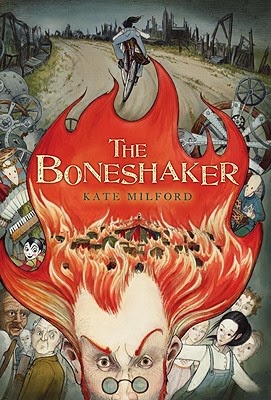
Audiobook: The Boneshaker

by Kate Milford
Read by: Erin Moon
Content: some intense moments (the Devil’s pretty scary), some violence, some disturbing images (if it were a movie). Language is probably suitable for someone reading on a 5th grade level. Has the feel of an older Middle Grade book, so I’d probably put it in the YA section (grades 6-8) at the bookstore.
Support your local independent bookstore: buy it there!

It’s 1914, and 13-year-old Natalie Minks has a pretty good life. Her father is the local mechanic — bicycle, mostly, but he’ll tinker with cars — and her mother tells the most amazing stories about their town, Arcane. Natalie herself has a predisposition for both: she loves tinkering with her father as well as listening to her mother’s stories.

Then one day Dr. Jake Limberleg’s Nostrum Fair and Technological Medicine Show comes to town. It was a fluke — their front wheel came off at the crossroads, and they decided to set up shop while they waited for Mr. Minks to fix their wagon. And that’s when the Trouble starts. Natalie, for better or for worse, is tuned into it and with her frienemy Miranda (I think that’s what her name was; I can’t look it up in the book!) and her trusty Chesterlane Eidolon bicycle (a bone shaker of an old thing that would be the fastest in the world, if Natalie could ever ride it), she decides to take on Limberleg and solve the mystery, saving her town. If she can.

I don’t know how I can write about the way this captured my attention. Sure, I was on a long drive to Austin, and it had my full attention anyway, but I didn’t want to stop listening. Milford has taken the idea of a Faustian Bargain — you know: those stories where a character meets the Devil and then outsmarts Old Scratch? — and elevated it. Not only is there two elements to this bargain, but we get historical elements thrown in as well. The traveling medicine show (I loved the Paragons of Science, even though they were Evil), the bicycles, the references to the “war” (which took me a minute to realize they meant the Civil War): it all added Atmosphere, which made the fantasy element, the bargains with the Devil at the Crossroads, that much creepier.

(It also helped that I kept thinking about this song:)

In short: a winner of a book.

Rose Under Fire

by Elizabeth Wein
First sentence: “I just got back from Celia Forester’s funeral.”
Support your local independent bookstore: buy it there!
Content: there were a lot of f-bombs (I didn’t count them) that came up once at the concentration camp (understandable) and other mild swearing throughout. Also a number of disturbing images and content (Nazi concentration camps don’t make for Light Reading). It is most definitely one I wouldn’t hand to a kid under the age of 13 or 14 (depending on their maturity handling Difficult Situation), whether or not they were on the reading level, so it’s shelved in my Teen section (grades 9-12) at the bookstore.

I don’t quite know where to start with this one. Once I discovered it was a Holocaust novel (as opposed to just a WWII novel), I put off reading it. I don’t like Holocaust novels, mostly because I don’t like being confronted with the evil things the Nazis did. But, because it was Elizabeth Wein, and because it’s a companion to Code Name Verity, I bravely gave it a shot.

And I found myself sucked into the world of women pilots, of strong, resilient women who know how to survive. It’s odd to say this about a Holocaust book, but I loved it.

Rose Justice is an American who has pulled strings to get enlisted as a transport pilot for the RAF. She’s doing her duty, blissfully unaware of the evils of the Nazis. Sure, they’re the Enemy, but the can’t be as horrible as they all say, right? Then, on a mission, she chases after a flying bomb (German pilotless planes loaded with bombs), gets lost over enemy territory, and ends up in Ravensbrück.

Even I, who actively avoids anything Holocaust, know about the horrors of Ravensbrück.

And yet, even though Wein captures the horrors, and the crimes, and the terribleness (I can’t seem to find a word strong enough) of Ravensbrück, it isn’t a hopeless, dark book. Even though Rose is changed permanently by her six months (only six measly months! How did people survive years there?), she retains her will to survive. And Wein has created a cohort of strong, amazing, wonderful (again, there is no word strong enough) women who do just that: survive. It’s amazing — and inspiring — to read.

I’m so glad I did.

Untold

by Sarah Rees Brennan
ages: 12+
First sentence: “Welcome to Sorry-in-the-Vale.”
Support your local independent bookstore: buy it there!
Others in the series: Unspoken
Review copy greedily stolen from the package the publisher sent to the bookstore, then hoarded on my shelves until I finally devoured it.

To catch up (spoilers for Unspoken, obviously.):
1. Kami’s imaginary friend, Jared, is real.
2. He’s part of an old sorcerer family.
3. Who used to rule Sorry-in-the-Vale
4. His uncle, Rob, is more than slightly batty, and is killing people because blood gives him power.
5. Kami wants to stop him.

In many ways, this is very much a second book in a trilogy. The first was a brilliant set up. This one, while still interesting and laugh-out-loud funny at times,  had the feel that everything is building toward some grand conclusion. Though we never quite get to it in this book.

That’s not to say that it’s a bad book. On the contrary, it’s actually quite good. Even though I felt like I was spinning my wheels — will Kami and Jared get together? Will Lillian ever stop being a Royal Snob?  Will Angela and Holly work out their differences? Will Ash ever grow a backbone? — it was done in a way that I didn’t mind the spinning. At all. It was also because I adore Kami. I hate to call her plucky, but she really is. She’s smart, and determined, and bossy, and willing to do ANYTHING for her family, friends, and town. I love her.

And the ending? Oh. My. Gosh.  If I wasn’t already convinced that endings can make or break a book, I would be now. The ending is brilliant. And painful. Because now I have to WAIT for the next book.

It was worth it, though.

The Blue Sword

by Robin McKinley

ages: 12+
First sentence: “She scowled at her glass of orange juice.”
Support your local independent bookstore: buy it there!

I first read The Blue Sword ages and eons ago. No, not when I was a kid, though I could have. It was soon after I first read Beauty by Robin McKinley (the book a friend gave me that I credit with my current love of YA). While I liked Beauty well enough, it was Harry Crewe and the country of Damar that I fell hard for.

Since I read this pre-blog, when I started it up, I wrote a couple sentences about my favorites. This one went like this: “The Blue Sword is full of adventure, magic, romance, swordplay… it would probably make a pretty good movie if anyone ever thought of it. It was an engaging book, well-written and the heroes were believable and interesting (there’s a lot of believable tension and chemistry between the two lead characters, which makes it fun).”

That doesn’t even begin to sum up the awesomeness that is The Blue Sword.

Harry Crewe is an orphan who has been shunted out to Damar, which lies on the outer reaches of the empire. She’s a ward of the regional head there, and is not happy about that. At all. Partially, it’s because she misses her parents, but mostly it’s because she’s unsettled. Unsatisfied. She never was the type of girl to sit still; she preferred riding and climbing to sitting and sewing. But, she’s supposed to be “proper” now, which means she looks wistfully out at the mountains, and wishes she could just do something.

Then Corlath, the king of the Hillfolk, shows up at the settlement. Nominally to try and make some sort of agreement with what they call the Outlanders, but that fails. Instead, he sees Harry, and his kelar — which is a kind of magic — demands that she come with him. So, he kidnaps her. Yes, it’s unsettling at first, but eventually she learns that the Hillfolk is where she belongs. She has the kelar, too, as strong as Corlath’s. And it becomes her Fate to be Harimand-sol, the lady Hero, and the first one since Lady Aerin to wield the Blue Sword in battle.

That’s the basic gist of it, but not the whole thing. McKinley, when she’s at her best, knows how to weave a good story. She pulls in amazing characters — my favorites are Jack Dedham, the career military guy with a soft spot for Hillfolk; and Narknon, the hunting cat that adopts Harry — and creates a vivid and detailed world but without all the exposition. She’s such a tight writer, such a gifted writer, that she’s able to do all this with a minimum of words, or without making it seem inaccessible or difficult.

In short: it’s brilliant. (And it’s more than 30 years old, without being dated in any way. That counts for a lot.)

Unspoken

by Sarah Rees Brennan
ages: 12+
First sentence: “Every town in England has a story.”
Support your local independent bookstore: buy it there!

Kami has an imaginary friend.  She has had him in her head, talking to her, keeping her company for as long as she can remember. She’s learned not to talk about him, because people in her small English Village, Sorry-in-the-Vale, tend to think she’s a bit crazy, but he’s there and she’s learned to live with it.

Not for one moment did she ever think that 1) he was really real and 2) he’d show up in her village.

Kami is also an aspiring investigative reporter, something which won me over immediately. I loved her spunk and her gumption, and her Nancy Drew/Veronica Mars/His Girl Friday determination to get to the bottom of the story. Because in Sorry-in-the-Vale there are a LOT of secrets that no one is willing to tell.

To be honest, that kind of bugged me for a lot of the book: the fact that Brennan hinted at secrets, and hinted at secrets, and hinted at secrets, but the reader was as CLUELESS to understanding them as Kami was. I wanted more information, but it wasn’t enough of an annoyance to make me throw the book across the room. No, what kept me reading was the witty writing — the balance between humor, romance, and suspense — and the characters. I adored the girls: Kami, of course, but also her friends Holly and Angela. And the guys weren’t that bad either.

And when the secrets were finally revealed, I understood why Brennan approached it the way she did. She has a way of keeping me engaged, turning pages, until her satisfying-yet-frustratingly-open conclusion.

I can’t wait for the next one!