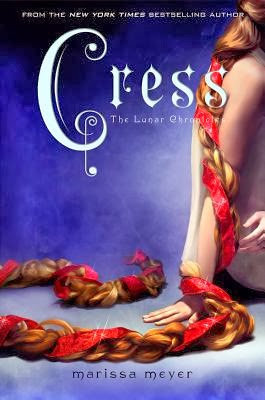
Cress

by Marissa Meyer
First sentence: “Her satellite made one full orbit around planet Earth every sixteen hours.”
Support your local independent bookstore: buy it there!
Content: Some violence, none of it gruesome. It’s shelved in the YA section (grades 6-8th), but I’d have no problems giving it to a capable younger reader.
Review copy given me by our MPS rep, who likes to enable my addictions.
Others in the series: Cinder, Scarlet

Obviously: If you haven’t read the other two, there will be spoilers.

So, our fearless (of sorts), rag-tag crew of a cyborg, a scruffy-looking nerfherder of a pilot, a disembodied android, a human girl, and a Lunar wolf-man operative are on the run from the Commonweath government. What are the most-wanted on Earth supposed to do? Especially when there’s an insanely evil queen who’s trying to take over the world by marrying the super-hot emperor? (“Tyrone, you know how much I love watching you work, but I’ve got my country’s 500th anniversary to plan, my wedding to arrange, my wife to murder and Guilder to frame for it; I’m swamped”) Well, hang out in space, of course. And then go rescue Rapunzel in her tower. Or Cress in her satellite, that is.

Except the rescue operation goes wrong, and our group of rag-tag outlaws are split up. Scarlet ends up on Lunar (and doesn’t figure much in the story), Cress and Captain Thorne end up in the satellite, crashing in the Sahara desert. And Cinder, Wolf, and the New Guy end up looking for the crazy Dr. Erland. As the plot thickens….

C’s biggest complaint with this one was that there were too many plot lines. Which is true, to an extent. Meyer is juggling a LOT of balls here. And there are at least 5 (if not more) story threads running through the book. BUT. I thought she managed all her threads well. With the exception of Scarlet, who really wasn’t interesting until nearly the end of the book (oh, but then her story line is tantalizingly interesting, setting up the last book in the series, Winter, well), I thought what all the characters were doing were fascinating. My favorites — probably goes without saying — are the two MAIN main characters in this one, Cress and Thorne. I adored Cress as a character: she’s a bit insecure around people, having been trapped in a satellite for 7 years. And she’s a total fangirl. But she’s also a smart hacker, and a resourceful and determined (if a bit naive) girl. And Thorne, well, let’s just say Thorne is that perfect mix between all the roguish bad good guys in all the books and movies I’ve ever loved. (It’s hard NOT to have a crush on him.)

And even though Cinder’s finally coming into her own, and there are some brilliant moments, it’s still a middle book in a series. It doesn’t stand as well on its own as Scarlet did, but I wasn’t disappointed with where the story is going. Meyer has created a terrifically interesting world, and is doing some fun things mixing the fairy tales in with the cyborg/futuristic elements. I can’t wait to see how it all ends.

Allegiant

by Veronica Roth
First sentence: “I pace our cell in Erudite headquarters, her words echoing in my mind: My name is Edith Prior, and there is much I am happy to forget.
Others in the series: Divergent, Insurgent
Content: There’s violence, some swearing, and a whole lot of kissing. In the first half, anyway. It’s in the Teen (grades 9-12) section of the bookstore, but I wouldn’t have an issue giving it to someone younger.

I’m going to get hate for this.

This is how my opinion on the series has gone (without looking at my reviews): Divergent is a unique dystopian idea, with some cool action scenes. The movie might be good. Insugent I don’t remember a thing about. Not a thing. Except that I don’t remember liking it all that much. And I had no interest in reading Allegiant. I only picked it up because I succumbed to the hype and stuck my name on the hold list at the library.

So, if I gathered right, after the events of Insurgent, Four’s mom has taken over things, deciding that the factions are to be done away with. Except that’s not working. And she’s executing people right and left. So, there’s an underground movement to fight against the Man (still) and to get people out to explore the world outside the fence. Tris and Four are part of that group. And when they get out they discover that 1) their life is an elaborate experiment by a government bureau in order to make people’s genes “normal” again after a gene war (or something like that) and 2) I was so over it.

I was. I didn’t care that Four was angsting about not being a true Divergent. I didn’t care Tris stressing about Who She Was. Their hallway snogging did nothing for me. I found the world to be trite and simplistic. I was over caring about government conspiracies or parental abuse or revolutions.

So I bailed. I admit I’m a little curious to know why the whole fandom was up in arms about the book, but I have so many other books to read, that I honestly don’t care if I don’t finish this one. Ever.

There’s just not enough time to waste it on things that I’m so over.

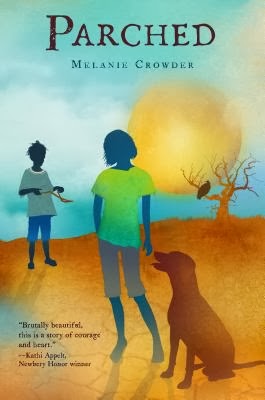
Parched

by Melanie Crowder
First line: “Sniff-sniff.”
Support your local independent bookstore: buy it there!
Content: There’s some harsh situations — a character was kidnapped and brutally treated, another character is shot and killed — but there’s no swearing at all. It’s not an action-packed book, so even though it’s on a 3-5th grade writing level, I’d be picky about which kid to give this to.

The world has turned to dust. Water is hard to find. And that makes anyone with water — or who can find water — valuable. Sarel’s family had water, until the gangs came through and killed Sarel’s parents and burned the compound to the ground. All that’s left is Sarel and the dog pack her father trained. It’s not a good thing; Sarel is running out of the little water she has left. Musa has a talent for dowsing, and has been kidnapped (or sold; I was never quite sure) to the gangs to find water. One night, Musa escapes, and finds his way to Sarel’s compound. It’s up to the two of them to work together to survive.

As you can tell, there isn’t much to this slim (seriously: it’s 152 pages.) novel. It’s highly introspective, more narrative than anything else. Even with the tension mounting to the end, it’s a quiet book about survival. I liked it, but I never really connected with it. Some of that was the quietness of it all. But it was also that I wanted more. I am not saying I needed a 300 page action-filled book, but I finished this one feeling like there was something missing. There wasn’t quite enough to it. I wanted more about how the world ended up parched. More about Sarel and her past. More about Musa and his talents. (Though I didn’t want more dog.) I wanted more connection between the characters. And the ending kind of came out of nowhere to me: I wanted answers as to how the book got to that point.

That said, the writing was gorgeous. And I have to give Crowder props for setting a dystopia book in an African-feeling setting. But it just wasn’t all I wanted it to be.

(Just for the record: because this is a Cybils nominee, I’ve been asked to make sure y’all know this is my opinion only, and not that of the panel.)

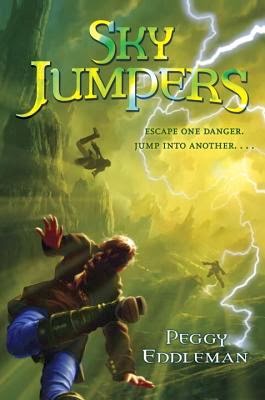
Sky Jumpers

by Peggy Eddleman
First sentence: “You would think I’d never jumped off a cliff before, based on how long I stood there.”
Support your local independent bookstore: buy it there!
Review copy snagged from the ARC shelves at my place of employment.
Content: There are some intense moments, but other than that, it’s pretty tame. It’s shelved in the middle grade (3-5th grade) section of the bookstore.

It’s a future after World War III, which devastated the world. The scientists thought they were doing good in creating “green” bombs, but (because, you know, BOMBS) it still wiped out many cities and destroyed most of the population. In addition, they changed the properties of metal and magnets, and while they made some ground more fertile, it made other places toxic. And — perhaps worst of all — it created the Bomb’s Breath: pockets of air that if you breathe, it’ll kill you.

This is the world that Hope has grown up in.

Living with her adoptive parents in White Rock, a town in a fertile valley, she has discovered that the thing that is most highly prized is Inventing. Since the war destroyed all our technology, it’s up to everyone, really, to invent gadgets and come up with ideas to make life less, well, primitive. Except Hop is terrible at it. What she’s good at is being daring: she’s figured out that if you hold your breath in the Bomb’s Breath you won’t die and that the thicker air has a slowing quality to it. She has taking to jumping off cliffs (sans parachute) through the Bomb’s Breath for fun. (No, she didn’t ask permission.)

Then, one day in winter, some bandits infiltrate their previously safe town and take hostages, demanding access to the town’s one true commodity: the antibiotic they’ve developed. The only hope for the town — since their guard and the weapons are guarding the next town over — is to go fetch the guard back. And the only way to do this is to go over the mountain and through the Bomb’s Breath. And the only one who can do this is Hope.

I’m a bit torn on this one.

On the one hand: I love Eddleman’s take on the dystopian genre. It’s so overdone that it really needs something unique to grab my interest. And Eddleman did just that. I also liked how Hope was a fierce girl, taking the initiative in spite of her misgivings, and using her strengths to not only get the guard but also help outwit the bandits.

On the other hand: I’m not sure. It’s not something I can pinpoint, but I felt disconnected from the book the entire time. Like I was on the outside, looking in, rather than being grabbed and immersed into the world. Perhaps I was turned off  by the BOOK ONE on the back of my ARC. I don’t know if it’s truly going to be a series — this one wrapped up just fine — but the idea of that just set me on edge. I really am so tired of series books.

I shouldn’t let that prejudice interfere with my reading of this one, though. It was a good book. One that I think will appeal to both genders. And there’s a lack of “magic” that was refreshing as well; Hope got by on her wits and her ingenuity and her reliance on her friends. I can get behind that.

(Just for the record: because this is a Cybils nominee, I’ve been asked to make sure y’all know this is my opinion only, and not that of the panel.)

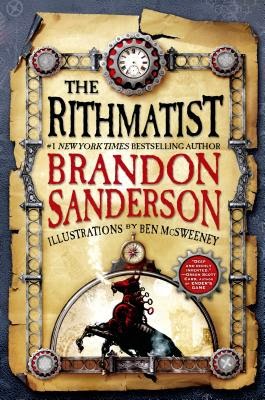
The Rithmatist

by Brandon Sanderson
First sentence: “Lilly’s lamp blew out as she bolted down the hallway.”
Support your local independent bookstore: buy it there!
Content: It’s pretty mild; there is some talk of murders, and some intense situations by the end and a mild romance. It’s only upper middle grade because of the length. I’d give it to my 10 year old, if she showed interest. It’s shelved in the YA section (grades 6-8) at the bookstore because of the length. That, and the publisher’s recommendation was 15+, which I disagree with.

Imagine a future where some unforseen disaster splits the US into several island country/states. Imagine a future where there are people — Rithmatists — who can draw with chalk and make it come… alive. Imagine a future where wild chalkings — two-dimensional chalk drawings that are sentient, somehow — can attack and kill a person. It’s in this world that Joel, a chalkmaker’s son, exists. His father used to be the chalkmaker for a prestigious Rithmatist training school, before he died. Now, Joel and his mom are scraping by. Joel would love to be a Rithmatist, but they’re chosen at age 8, in a mystical/religious ceremony, and Joel wasn’t Chosen. That hasn’t stopped his passion for Rithmacy and the history. He’s pretty much shunned until one of the top professors, Fitch, is toppled from tenure by a young upstart. And then, top students start disappearing. With another not-so-great student, Melody, Joel works at figuring out just what is threatening the students.

This was slow-going at first. I didn’t quite grasp the idea of the world, or the importance of the illustrations. Which, in many ways, is a drawback: if you can’t grab a kid in the first chapter or two, then in many ways you’ve failed as a book. But this one is worth the slog in the first couple of chapters. It takes a while, but as the mystery develops, and things become more intense, and more about the Rithmastist world is explained, Joel — and especially Melody — come into their own. The final couple of battles are quite intense and very much worth the while. And even though I kind of called the mystery, there is a bit of a twist that I didn’t see coming, which was very satisfying. And as I came to understand the illustrations — which admittedly were off-putting at first — I found them at least as fascinating as the story. If Sanderson wants to write a guidebook for the Rithmatist world, I’m sure there’d be a market for it.

I do wish — and I know that I’ve said this before — that people would stop writing series books. This one worked quite well as a stand-alone, even with a few threads hanging. I do appreciate that (even though the last three words are “To Be Continued.” ARGH). But overall, it was a fascinating world to immerse myself in.

(Just for the record: because this is a Cybils nominee, I’ve been asked to make sure y’all know this is my opinion only, and not that of the panel.)

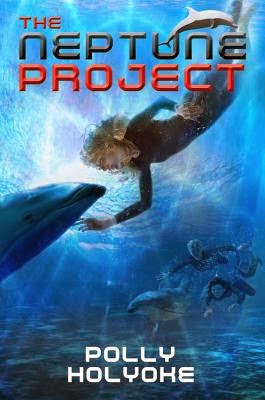
The Neptune Project

by Polly Holyoke
ages: 10+
First sentence: “I wake to an urgent tap at my window.”
Support your local independent bookstore: buy it there!

Nere Hanson (a terrible name, that, as A pointed out) has never understood why she felt more at home in the sea, with the dolphins. Her parents are scientists who study the ocean, but that’s not the whole picture. Nere has problems breathing on land, and it’s just getting worse. Then the government of the Western Collective (roughly some futuristic dictatorship that came out of the US; this is set along the Pacific coast) demands that everyone who lives by the ocean move inland, to help with “food production.” So, Nere’s mom pushes forward her plans, breaking the news  to Nere and her friends Robry and Lena that the reason why they struggle to live on land is that they’re genetically altered to survive — like breathe seawater and everything — under the ocean.

I’m going to stop here for a minute. I’ve read books about exploring the ocean as an option for when global warming takes over and turns this planet into one gigantic mass of water, and I’ve read books that deal with genetic mutation of people (and I think I’ve read one that combines the two in some search for Atlantis, now that I think about it), but this one struck me as unique. Holyoke has done her research and this one felt, well, authentic. I appreciated that. I also enjoyed her use of dolphins; they weren’t props, but rather their own characters, which added another interesting layer to the story.

After they make the change, and get away from the Marine Guard (read government thugs), Nere, Robry, and Lena have to figure out how to survive in their new environment. They meet up with another group of kids who have had this change done to them — Nere is resentful for a good part of the book because her mother did this to her, without her consent, and didn’t give her the time to adjust to this. I love Bad Mom Decisions in Middle Grade books — and set out for the rendezvous point. From there, they head north to Vancouver to the colony that Nere’s father is setting up.

Even though it’s a first in a series — I really would love a stand-alone speculative middle grade fiction book sometime — and it’s just an elaborate set-up, Holyoke does a fantastic job creating her world. And I liked the dynamics she created in the group. It wasn’t as middle school-ish as the jacket flap led me to believe, but a genuine portrayal of kids thrown in a new situation and forced to survive. And Holyoke isn’t afraid to kill characters off or have characters betray one another. It was complex, and I enjoyed that.

I only wish I had more of a sense of closure with this one; I’m not sure I’m all excited to read further adventures of Neve and the Neptune Project. But this one was definitely enjoyable.

(Just for the record: because this is a Cybils nominee, I’ve been asked to make sure y’all know this is my opinion only, and not that of the panel.)

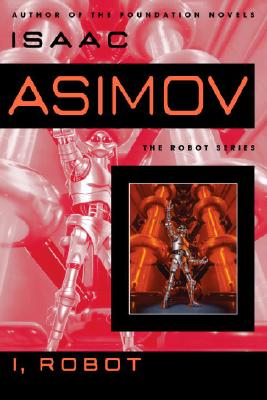
I, Robot

by Isaac Asimov
ages: adult (ish)
First sentence: “I looked at my notes and I didn’t like them.”
Support your local independent bookstore: buy it there!

This is one of those books that I’ve always heard of but never had gotten around to reading. I can’t really tell you why; it just never seemed like something I’d be interested in.

Thank heavens for book groups.

Framed as an interview with retiring robopsychologist, Dr. Susan Calvin, it’s a series of interconnected short stories detailing the evolution of robotics in the “future”. It’s an interesting look into what Asimov thought our future would be like, and the prevalence of robots in society.

I’m not quite sure what to say about the book other than I really, really liked it I thought it was fascinating to read about what Asimov though the future would be like. I liked the character of Dr. Calvin; she was an interesting person to frame the book around, smart and capable (if a bit cold), and gave the book a good grounding. In fact, the stories went down better for me than short stories usually do, mostly because they seemed like chapters in something larger.

That said, two of my favorite stories were “Liar”, in which a mind-reading robot just tells humans what they want to hear; and “Little Lost Robot,” in which a robot goes missing, hiding in the midst of a bunch of other robots that look exactly like it. I found it fascinating the things the psychologists and scientists go through to figure out which one is the missing robot.

But my favorite was one near the end, “Evidence,” where a man is running for mayor of the region, but there are allegations against him: he’s a robot. The point is to prove he’s not. It’s a fascinating look at the line between robotics and humanity, and the issues about whether or not it’s ethical for a robot to actually “act” human.

It’s a good work, one that stands up to the test of time, even if there were moments when I cringed at the 1950s-ness of it all. Even so, I’m glad I had the chance (finally!) to read it.

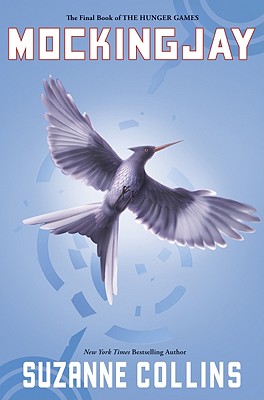
Mockingjay

by Suzanne Collins
ages: 14+
First sentence: “I stare down at my shoes, watching as a fine layer of ash settles on the worn leather.”
Support your local independent bookstore: buy it there! (Though you probably already have.)

NO SPOILERS. Promise.

Like Hunger Games and Catching Fire, this book is very unputdownable. Thankfully, I set aside the day to sit and read, otherwise I’d have been biting my nails and obsessing over the book. Better to get it all over with in one sitting.

And, for the most part, I really really liked the book. I liked what Collins did with Katniss, and the rebellion, and Gale, and especially Peeta. I liked the direction Collins was taking the books, the whole Katniss-as-Mockingjay thing. There were touching moments, some kick-butt moments, she kept me guessing as to where the plot was going, and she generally laid foundation work for something absolutely incredible to happen. There’s a lot of good anti-war stuff in there, how rebellions don’t always work right, how killing ourselves isn’t always the answer.

There are some things I wished she would have done: I missed Cinna, I wished Haymitch had more to do, I wished she had done something more with the District 13 government. Those were minor quibbles, though.

Because, the book fell apart for me. Completely and totally by the last 45 pages. There’s a moment near the end — and if you’ve read the book, you know where it is — where I was on the edge of my seat, disbelieving. However, in the pages that followed, Collins made choices — with characters, with the plot, with narrative — that completely derailed the rest of the book. It would have been so much better if… but it wasn’t. The whole ending was anticlimactic, and took the book in a direction that felt forced. I ended up feeling dissatisfied with the whole book, in the end. I’m not sure what I wanted, really, but it wasn’t the ending that Collins gave me.

Which, unfortunately, left me with a less-than-stellar reaction to the book overall. (And am I the only one?) And that’s too bad. Because it’s a great series: thought provoking and intense. I just wanted something better to end with.

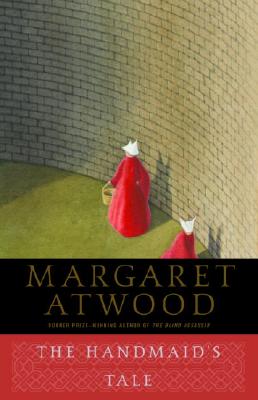
The Handmaid’s Tale

by Margaret Atwood
ages: adult
First sentence: “We slept in what had once been the gymnasium.”
Support your local independent bookstore: buy it there!

I read this book in my early 20s, sometime soon after I finished college. I remember thinking that this was a Great Warning; plausible enough to become true, and thus making it that much more powerful to me. I was moved to anger by the treatment of women as objects, and considered this one of the Best Books I’ve Ever Read.

This time around — 15 years later — I am still moved by it, but in a completely different way. The basic plot, for those who are unfamiliar with this dystopian classic, is that the U.S. falls apart after an attack which kills the president and Congress. The country is put into a state of emergency, which evolves into this warped religious state. Offred, our main character, is a handmaid: a woman whose sole purpose in life is to have babies for the Commanders. She is told that it is her religious duty to do so; the Wives and Marthas (the maids and cooks) tolerate her presence because her “duty” is so important. Offred — we never learn her real name — longs for her former life: the one where she had a job, money, husband, child. And it’s all she can do to put one foot in front of the other in her life.

I found this all monstrous. I’m thinking of it in a different light — I could very easily be Offred — and it’s monstrous what Attwood has dreamt up. Not only for the handmaids, but for the wives and commanders, too. (Maybe those books on polygamy are influencing my reading of this, too, because there are definite parallels there.) And I was depressed by it. I don’t think we — as a country — would ever head that way (though there was this one passage that struck me because of its similarities to 9/11 and the Patriot Act), but it’s depressing that there is that awful potential in people to control other people in that way. There are also Taliban similarities, as well — something which wasn’t even on the radar when I read this the first time around — that saddened me.

I can’t imagine — more like, don’t want to imagine — a world where women are treated as nothing more than the sum of their bodies, where men get excused for their behavior because of their position, where women hate and loathe each other because of their roles. Wait… that, too much, describes what our world is like now. Without the religious framework, without the robes, without the martial law, there are elements of this world around us.

And that really depresses me.

Specials

I finally got around to reading the third in the Uglies Trilogy by Scott Westerfield. And, like Pretties, I didn’t enjoy it nearly as much as I did Uglies, though I thought Westerfield did a good job tying up all loose ends and giving the story a decent punch at the end. (At least there’s no cliffhanger at the end of this one.) I’m not even going to try and review this book without spoilers. So if you are even remotely interested in reading this one, and you have a problem with spoilers… stop now.

I really disliked Tally for a great deal of the book. Like at the beginning of Pretties, she was completely controlled by what she had become, in this case, one of the Special Circumstances. At one point, though, I realized that I was supposed to dislike Tally. Or rather, I was supposed to dislike what Tally had become, what Dr. Cable had made her in to. Once I made this realization, I could deal with Tally: her snobbery, her insecurity, her need to be “icy”. (Though she did get better as the book went on.) But, I also disliked Shay. Was it just me, or did anyone else see parallels to drug use in this book? Shay was addicted (like a drug user) to cutting herself and very controlling of the people and situations around her. (She’d get really mean if things didn’t go her way.) Her friendship with Tally was superficial and controlling as well. The problem was that I disliked her so much that I wasn’t entirely convinced by her change and remorse in the end. Why would Tally even consider giving Shay yet another chance? How do we know that Shay’s change is real, complete? We don’t; and because of that, I distrusted it.

Speaking of change and remorse, Dr. Cable completely threw me for a loop. I’d been expecting some of it; she’s been the “bad guy” all along — controlling the town to extreme ends. I didn’t expect her to attack another city, though I suppose it wasn’t completely far-fetched. (I did like the line which went something like — I couldn’t find it to get it exactly — “All cities had given up war; it’s just that some cities had given it up more than others). But, I found it really hard to hate her because she had been lurking in the background for most of the books. As a result, the final confrontation between Tally and Dr. Cable at the end just completely fell flat. And after that… well, I understand it, but just because I understand it doesn’t mean I thought it made sense.

Which brings me to the ending. It was… okay. I guess I couldn’t have expected much better; how do you fully resolve a story like the one Westerfield created here? But, it kind of fell flat. After all the struggling Tally did in all three books — against the way she was brought up and against the subsequent operations — what more did I want from her? I don’t know. So, to quietly slink off into the wild with her first love is probably the best ending anyway. I just wasn’t fully satisfied by it.

All that said, though, Westerfield has created a very interesting and very compelling world. Uglies is a brilliant book, and the other two are still good, if flawed, reads. And since I did enjoy myself with these three, I’ll be picking up Extras as soon as the library gets a copy.