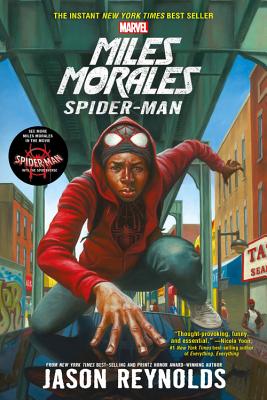
Miles Morales Spider-Man

by Jason Reynolds
First sentence: “Miles set the good dishes on the table.”
Support your local independent bookstore: buy it there!
Content: There’s violence, but not graphic and some mild swearing. It’s in the YA section (grades 6-8) but I’d give it to a younger kid who was interested.

Yes, I did pick this up because I adored Into the Spider-Verse. I liked Miles Morales as a character, and I wanted to spend more time with him. Aside from the movie, I have no knowledge of Miles’s backstory or comic history, so I’m pretty much operating blind.

The basic plot is that Miles is kind of tired of being Spider-Man, and mostly just wants to focus on school. Except he keeps getting called into the office, first for leaving class (his Spidey sense was tingling) and then for a minor theft, for which he was totally framed. And it feels like his history teacher is super antagonistic toward him. And maybe it’s not an evil plot to take over the world, but maybe it is.

And on top of all that, he’s struggling with school and friends and fitting it. Not to mention the crisis about being Spider-Man; maybe he’s just not cut out for this.

My first reaction? It was fun, but heavy on the social justice. Not that that’s a bad thing. I liked the book well enough; Reynolds is a great writer and Miles is a great character. But… perhaps I would have liked it more had I been more invested in Miles Morales as a superhero. Coming in with as little knowledge as I did, I kind of felt like I was missing something. I caught similarities between the book and the movie, but it wasn’t enough or deep enough for me to truly love this book.

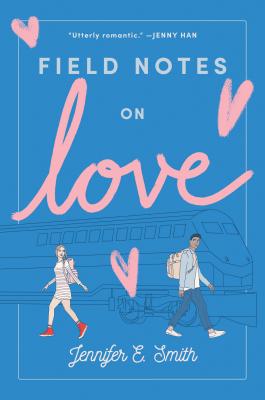
Field Notes on Love

by Jennifer E. Smith
First sentence: “Mae wakes, as she does each morning, to the sound of a train.”
Support your local independent bookstore: buy it there!
Content: It’s a romance, but there’s really nothing objectionable. Some mild swearing and a lot of kissing. It’s in the YA section (grades 6-8) of the bookstore.

Hugo is one of a sextuplet, and so he’e never really been alone. He’s never done anything extraordinary (unless you count being born) and he’s never really had an adventure. So, when his girlfriend Margaret breaks up with him, and begs off of their planned American cross-country train trip, Hugo is left aimless. That is, until he hatches a plan: find another Margaret Campbell and still make the trip.

Mae (aka Margaret Campbell) has applied to the USC film school, but when they reject her, she’s left aimless. That is, until she sees Hugo’s advertisement for someone named Margaret Campbell to go on this train trip with him. She jumps at the chance: why not go on a bit of an adventure before school starts? Maybe, then, she can find her direction again.

Since this is a romance, of course Hugo and Mae fall in love. Of course there is a falling out moment. Of course they (kind of) (mostly) end up together in the end. Of course it’s sweet and wonderful and all that.

Smith is excellent at writing charming, sweet, lovely romances, though. And this hit all the notes. Hugo and Mae were endearing and sweet, and I loved the cross-country train trip, which was something a little different. It’s completely unobtrusive and utterly delightful.

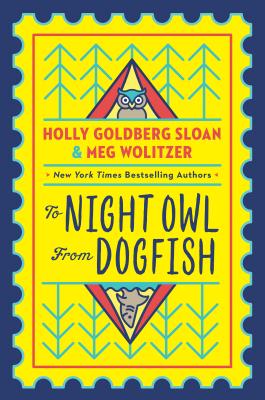
To Night Owl from Dogfish

by Holly Goldberg Sloan and Meg Wolitzer
First sentence: “
Support your local independent bookstore: buy it there!
Content: There’s some frank talk about periods, so maybe for the older end of the spectrum? Still, it’s in the Middle Grade (grades 3-5) section of the bookstore, though I think older readers would like it as well.

Bett and Avery are happy with their respective lives. Bett lives with her dad in Southern California, surfing and collecting feathers and shells. Avery lives in New York City with her dad and is happy with their super structured life. But when their dad’s meet, everything changes. They arrange for Bett and Avery to attend the same summer camp, hoping that they’ll become best friends. And Bett and Avery are determined to stop them.

Except… they do become best friends. (And have adventures!) But their dads? Well, it doesn’t work out. But don’t worry: Bett and Avery have a plan.

This was a super adorable book! Seriously. Written entirely in emails — between Bett and Avery with ones from the adults in their life every once in a while — it’s oozing charm and delight and just plain fun from every pore. Sure it’s a bit Parent Trap-y, but I think it manages that (it has a nice twist ending that’s quite sweet) without being too cloying. I adore both Bett and Avery, and I loved how their individual voices and personalities came through in the letters. It’s just a super charming book.

(I do have to note that Bett is a bi-racial character, though both the authors are white. Take that for what you will.)

At any rate, I did enjoy it a whole bunch.

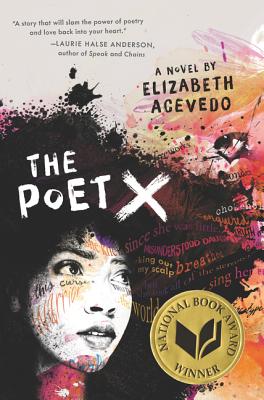
The Poet X

by Elizabeth Acevedo
First sentence: “The summer is made for stoop-sitting and since it’s the last week before school starts, Harlem is opening its eyes to September.”
Support your local independent bookstore: buy it there!
Content: There’s some mild swearing, a tasteful almost-sex scene, and some talk of smoking weed. It’s in the Teen section (grades 9+) of the bookstore.

Xiomara is many things: a daughter, a poet, a twin. But she feels like she doesn’t quite fit. It doesn’t help that her parents — both from the Dominican Republic — don’t really get along, or that her mother is super religious. Or that her twin, Xavier, is super smart, and goes to a magnet school, while Xiomara is stuck going to the not-really-great neighborhood one. And on top of everything, as she starts her sophomore year, her mother is insisting that she go to classes so that she can be confirmed (I think that’s how it is in Catholic churches?). But Xiomara has questions about God, and religion, and the way her parents treat her.

On the one hand, I can see where Xiomara’s mother is coming from. She wants her daughter to have all the things she didn’t have. She wants her daughter to follow in her footsteps, and to have the faith she did. What she doesn’t take into consideration — and this is the conflict at the heart of this elegant novel in verse — is that Xiomara’s feelings and desires might be different than her own. It’s often the conflict at the heart of young adult books: parents who believe they know better and don’t stop to listen to the desires of their kids. I loved getting to know Xiomara through her poetry, to understand her feelings and the tensions she perceived in her family. And I’m glad that, in the end, there was a resolution that didn’t involve someone dying. That Xiomara realized her parents loved her, even if they didn’t always show it in a way she could understand it.

Acevedo’s writing is gorgeous and her storytelling exquisite. This is definitely worth the hype.

Audiobook: Finding Yvonne

by Brandy Colbert
Read by Maya Barton
Support your local independent bookstore: buy it there!
Listen at Libro.fm
Content: There is swearing, including multiple f-bombs, pot smoking by an adult, some teenage drinking and off-screen sex. It’s in the Teen section (grades 9+) of the bookstore.

Yvonne is a senior at an LA prep school, and has been putting her heart and soul into her violin playing ever since her mother left when Yvonne was seven. Now, though, she’s at loose ends: her violin teacher dropped her because she wasn’t “good” enough, and she feels like she has lost her passion for playing. But, without playing, who is she?

On top of that, Yvonne hardly sees her father, a successful chef. And she’s wanting to take the next step with Warren, who’s hesitant because of their age difference and because he works for her father. And so, when Yvonne meets a street musician, she explores a relationship there, mostly to see if it can help her figure things out.

I liked this one, but mostly because I think the narrator was really good. She kept me engaged in the story, and helped propel the narrative — which is super complicated, but then again, so are many senior kids’ lives — forward. I liked that Yvonne was a musician and a cook, and that she was looking for connection anywhere. It’s not the best book I’ve read, but it wasn’t terrible either.

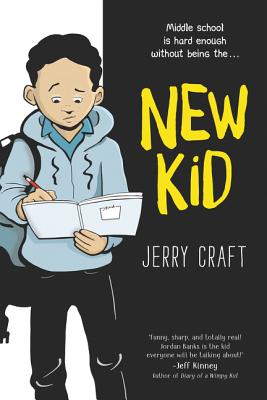
New Kid

by Jerry Craft
Support your local independent bookstore: buy it there!
Release date: February 5, 2019
Review copy provided by the publisher.
Content: There is some bullying, and it’s a bit on the longer side. It will be in the middle grade graphic novel section of the bookstore.

In the letter that accompanied the ARC, Craft wrote that he wanted to draw a graphic novel that featured kids who looked like him because he didn’t find any when he (or his sons) were growing up. He wanted to feature a kid of color, having some of the experiences — that were not just “gritty” — that kids of color have. And I think, with this graphic novel, he succeeded.

It’s the story of a kid — Jordan Banks — who wants to draw and go to an art school but whose parents have decided that a fancy (white and rich) prep school will give him better opportunities in life. Problem is Jordan doesn’t want to go to a fancy prep school, especially one where he’s in the minority.

The book follows the school year — my favorite thing was the chapter titles that referenced movies (Upper, Upper West Side Story; Straight Out of South Uptown were a couple that made me smile) — as Jordan learns the ins and outs of making friends, standing up for himself and others, and the ways in which well-meaning white people just Don’t Get It.

It’s funny, it’s sweet, it’s honest, and it’s eye-opening, and Craft is definitely a graphic novelist to keep an eye on.

On the Come Up

by Angie Thomas
First sentence: “I might have to kill somebody tonight.”
Support your local independent bookstore: buy it there!
Release date: February 5, 2019
Review copy provided by the publisher.
Content: There is a lot of swearing, including multiple f-bombs, and some violence. It’s in the Teen section (grades 9+), but if you read The Hate U Give, then this will be good for you.

Bri has one goal in life: to be a rapper. She’s a talented poet, she’s good at thinking on her feet, and she has a killer beat. However, that’s not what her mother — especially after Bri’s father, a semi-famous rapper, was killed in a gang war — wants for her. She wants Bri to be like her older brother, focusing on school, getting into a good college, and Be Something. But, things are rough for their family: sometimes they go without heat or electricity because it’s tough making ends meet, and when Bri’s mom loses her job, Bri’s determined to make a go of being a rapper.

But things backfire: at the expensive (white) prep school that Bri attends, she’s apprehended by the security guards for carrying contraband (in this case, candy she sold to make a few dollars) and it spirals into a referendum on racism and profiling that Bri doesn’t want to be stuck in the middle of.

Bri’s story is one of heart and hopefulness — is she really “on the come up”? Can she make it with just talent, and not by succumbing to the racist whims of studio executives? — with an underlying look at the everyday racism and trials that Black people go through. It’s not as heart wrenching as THUG was, but it is eye-opening, especially for a middle-aged white woman who is trying to see the world through a different pair of eyes. Thomas is a talented writer, telling stories that not only are representative for the world around her and accessible to her target audience, but are also Important for everyone to read.

Excellent.

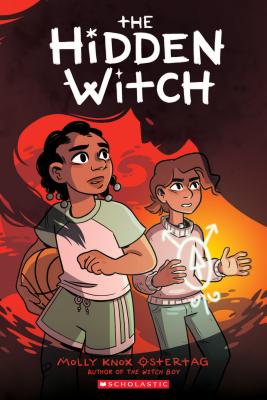
The Witch Boy and The Hidden Witch

The Witch Boy
by Molly Knox Ostertag
Support your local independent bookstore: buy it there (Witch Boy and The Hidden Witch)!
Content: There are some intense images of violence. It’s in the middle grade graphic novel section of the bookstore.

I’d been seeing this one on a LOT of the best-of 2018 lists and I realized I knew NOTHING about it (I had gotten it in, but really paid no attention to it), so I realized I needed to get this one and read it. And since it looked up K’s ally, I decided to buy both it and the sequel as well.

Aster is part of this old magical family, where the girls are all witches and the boys are all shape-shifters. But Aster, at 13, has realized that his talents lie with being a witch rather than a shape-shifter. Except, because that’s what GIRLS do and he’s obviously not a girl, he’s forbidden. Like actively. Every time they find him sneaking around trying to learn witchcraft, the women shame him and shun him. Especially since the last time a boy tried to be a witch — Aster’s grandmother’s brother — he turned into a monster and was never seen again.

(Yes, I do think this is meant to be a feminist allegory for gender roles and toxic masculinity and how silly they are. If a boy wants to be a witch, then LET HIM BE A WITCH.)

Things get complicated when Aster’s cousins — all of whom embrace the traditional male role and become shape-shifters — start disappearing. And Aster — because he’s both male and a witch — is the only one who can save them.

The story continues in The Hidden Witch; Aster’s family has (kind of sort of) accepted him as a witch and is trying to teach him, when his non-magical friend, Charlie, gets attacked by a bit of dark magic called a “Fetch”. It turns out that there’s a rogue witch in town, and the family has to figure out how to take care of them.

This one, honestly, wasn’t as good as Witch Boy, which I adored. She did wrap up the story of the grandmother’s brother, which was left hanging in the first book, but I’m not sure how much I cared about that. I did like seeing Aster use his witchcraft to help Charlie figure out where the Fetch was coming from, but it just didn’t have the larger conflict that Witch Boy had. Even so, it’s delightful series, expertly drawn (Ostertag worked on Star vs. the Forces of Evil, and her art style fits that). I adore the friendship between Aster and Charlie, and I liked how Ostertag worked in diversity without making it a huge “look at me, I’m diverse” issue.

She’s a solid graphic novelist, and someone I’m excited to see more from.

Beasts Made of Night

by Tochi Onyebuchi
First sentence: “I make sure to sit where they can’t see me.”
Support your local independent bookstore: buy it there!
Content: There are a couple of mild swear words, some violence, and a bit of kissing. It’s in the YA section (grades 6-8) of the bookstore.

The world that Onyebuchi created is fantastic: purity means everything to the people of this city, and so to remain pure from sin and wrongdoing, the rich and powerful hire Magi to call the sin from them, in the form of shadow beasts. Then sin-eaters, called aki, destroy the beasts, and swallow the sin, which appears in the form of a tattoo on their bodies. The aki are considered the lowest of the low, because their impurity is visible on their bodies, and so they are shunned and cheated and die early.

But, unfortunately, that’s as far as the book got. There isn’t much of a plot — first our main character, Taj, is in the slums, and then he’s in the palace, and then he’s sent to train new aki — and it never really seemed to go anywhere. There’s a rebellion and a resistance and who is really the “bad guy” (was it the head Magi? Or the royals?) and the princess Taj was kissing HAD to be at least old enough to be his mother, which just creeped me out.

So, while I adored the world that Onyebuchi created, the book just didn’t do it for me.

Friday Black

by Nana Kwame Adjei-Brenyah
First sentence: “Fela, the headless girl, walked toward Emmanuel.”
Support your local independent bookstore: buy it there!
Content: It’s violent and there is some strong language, including a lot of f-bombs. It’s in the adult fiction section of the bookstore. 

I picked this one up after hearing the author on the New York Times Book Review Podcast. I’m not usually a short story sort of person — and this one took me a while to get through — but it sounded fascinating enough that I felt compelled to pick it up. 

It’s a set of mostly unconnected short stories (though there are three about working in retail that take place in the same store) about what it’s like to be black in America. It’s nominally speculative fiction: the shoppers in the title story are forms of zombies, made that way by consumer greed, literally killing each other on the way to get the Product They Need. Or, in the final story, “Through the Flash”, Adjei-Brenyah imagines a future where technology and climate change has stuck us all in this terrible time loop, doomed forever to repeat the same day and the effects that would have on people, for good and ill. 

But my favorite story — “favorite” meaning “the one that suck with me the most” is “Zimmer Land”, an “amusement” park where white people get to pay for the opportunity to extract “justice”: stop a terrorist, solve a bomb threat, or stop a “thug” from invading their streets. If, by the end, you haven’t realized that it’s a pretty damning telling of the way white people deal with crises, whether real or perceived, then I think you read it wrong. 

I didn’t get all the stories — part of my problem with short stories, usually — but that could be because I’m a white person, and I just don’t understand black life or experience. Even so, I found this to be incredibly powerful. He’s definitely a voice in fiction I’ll be watching out for more from.