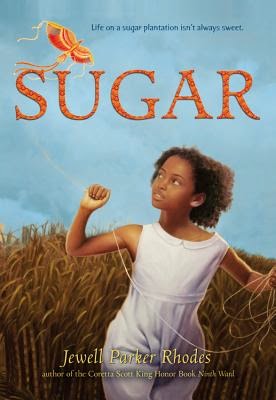
Sugar

by Jewell Parker Rhodes
First sentence: “Everybody likes sugar.”
Support your local independent bookstore: buy it there!
Bought and signed by the author at KidLitCon 2014
Content: This one would be appropriate (and probably okay, difficulty-wise) for kids third grade and up. It’s in the middle grade section (grades 3-5) of the bookstore.

It’s 1871, and slavery is supposed to be over. However, for ten-year-old Sugar, on a sugar plantation in Louisiana, it doesn’t feel like it. Sure, the former slaves are free to go if they can, but they’re paid so little that it’s almost impossible for them to leave. And then the plantation owner, Mr. Wills, decides that he needs more workers, so he hires some Chinese to come and supplement the former slaves.

For Sugar, her life revolves around sneaking out to play with Billy, the owner’s son, and trying not to get under Mrs. Beale’s feet. And planting and cutting sugar cane. Once the Chinese arrive, however, Sugar’s world is expanded: one of them speaks English and she befriends them. In fact, she is the bridge that gets the whole working community to work together rather in competition. There’s a passage about halfway through that pretty much sums up what I think Rhodes was getting at in this book:

“How come I ca’t decide who I can see? How come I can’t decide my friends?”
“We don’t trust these men, Sugar.”
“I like Chinamen. Reverend, don’t you preach ‘Treat folks like you want to be treated’?”
“Well, now,” says Reverend, not looking at me, twiddling his thumbs.
“Sugar,” says Mister Beale, “folks get along best with folks like them. Always been that way.”
“Seems cowardly.”

Of course, things aren’t easy for Sugar and her friends: it is 1871 in the South, and white people — especially the former Overseer — are reluctant to change and adapt. There is some tragedy in this book, but it is a middle grade book, after all, and the tragedy is kept simple and appropriate.

It’s the overall message of friendship and inclusion that made this slim historical fiction book worth reading.

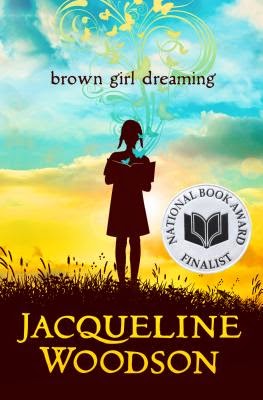
Brown Girl Dreaming

by Jacqueline Woodson
First sentence: “I am born on a Tuesday at University Hospital Columbus, Ohio, USA — a country caught between Black and White.”
Support your local independent bookstore: buy it there!
Content: There’s nothing objectionable. And it’s even an easy-ish read. Sure, it’s poetry, but it’s not difficult. Hand it to anyone with an interest in writing, kids, and history. It’s in our middle grade biography section at the bookstore.

I’m not quite sure where to start on this one. It seems We’ve (the collective we, here) been inundated by memoirs and biographies of celebrities, People of Note, and at first glance Jacqueline Woodson’s new book just falls into that pit of “celebrity” (of a sort) biographies.

Except, it’s not so much a biography or memoir as it is a reflection upon a childhood. Woodson makes her childhood an Everyperson experience, something that the reader can readily identify with, even if they didn’t have her exact same experiences.

Her childhood begins in Ohio, but mostly it’s spent in South Carolina, with her grandparents, and in Brooklyn, where her mother finally settled with Jacqueline and her brothers and sister. I kept trying to figure out the timeline (if she was born in 1963, then it must be…) but eventually, I just gave up and let myself get absorbed in the story.

And absorbed I was. Woodson wove historical elements into her story — sit-ins in the South; the way her grandmother felt about the way she was treated in stores by white people; music that was playing on the radio — all of which helped put her personal story in a larger framework. I could easily forget I was reading a memoir; it felt so much like a novel.

Part of that, too, was the form. Written in free verse, the memoir took on a lyrical quality. There were moments, especially toward the end, where I was moved by her insights not only in her life, but for Life in general.

One more thing: I appreciated her portrayal of religion. I get the sense she’s not a practicing Jehovah’s Witness anymore, but she portrayed the religion of her grandmother and her own childhood with respect. It was neither good nor bad; it was just a part of her life. And I found that refreshing.

Highly recommended.

The Misadventures of the Family Fletcher

by Dana Alison Levy
First sentence: “Eli sat on the wooden porch steps, crammed in with his brothers, while Pap fiddled with the camera.”
Support your local independent bookstore: buy it there!
Review copy given to me by our Random House Children’s rep.
Content:  The typeface is pretty big and the words are simple without being simplistic. Also, there’s a hint of liking girls, but no real romance. I’d say it’s pretty happy in the Middle Grade (grades 3-5) section of the bookstore.

I’ve been sitting here thinking about how to pitch this one (especially in conservative Kansas), and I think I’ve come up with it: it’s The Penderwicks, but with boys.

The similarities are there: a classic, homespun feel; a family of four siblings ranging from the cute young one (Frog, age 6, in this case) to the wise, older one (Sam, just starting 6th grade); simple, true-to-life challenges, rather than huge conflict; and a charming, whimsical feel that just makes you smile when you’re done reading.

The book follows the Fletcher family — Dad, a history teacher; Papa, who stays at home and does consulting work while the boys are at school; and their sons, Sam and Frog (who is Indian, by the way), but also Jax (age 10 and African American) and Eli (also age 10, but Jax is older by some months) — through the course of a year. As I said, none of the conflicts are huge and overarching, (except, perhaps, their grumpy neighbor Mr. Wilson) but rather small, realistic ones. Eli deals with a starting a new school for “scholarly minded” students and realizes pretty early on that he hates it. Jax deals with a best friend who is growing up and whose interests are changing. Sam is dealing with being on the cusp of teenager hood as well as the idea that something he discovered he likes — acting — may not be “cool”. And Frog has to deal with his family not believing him when he says he has a new friend whose name is Ladybug.

It’s a charming, sweet little book, one that I think will be able to reach a number of readers. In fact, the diversity of this one is my second favorite thing about it (my first favorite being the old-fashioned feel). I loved how Levy had a hugely diverse cast and showed how everyone is just. like. me. (Duh.) But she did it in such a way that wasn’t preachy. And I loved that.

In fact, I want to hand this one to all the kids and say: “You know that person who is different from you? This will help you understand them.” I’m not sure that will sell this book, so I may just have to stick to “Penderwicks with boys.” I just hope kids read this one.

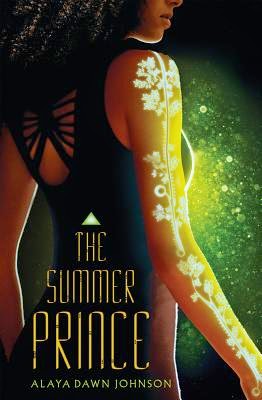
The Summer Prince

by Alaya Dawn Johnson
First sentence: “When I was eight, my papai took me to the park to watch a king die.”
Support your local independent bookstore: buy it there!
Content: I was initially thinking that this would be good for those who like Uglies; there’s about the same amount of swearing. But the reason it’s in the Teen section (grades 9+) is because there’s a lot of allusions to sex, including a couple (tasteful) sex scenes.

June Costa is the best artist in Palmeres Três. Or so she thinks; she just hasn’t had a chance to prove it yet. And in this, a moon year in which her futuristic, matriarchal society chooses a one-year Summer King to “rule”, she will have that chance. It starts innocently: her best friend, Gil, falls in love with the summer king, Enki. And she does, too, though she tells herself that it’s mostly about the art. And what art June and Enki create. Ever more elaborate, they end up sparking a revolution of sorts between the technophiles and the isolationists; the government, made up of women they call “Aunties”, has placed strict regulations on what kind of tech can be in the city.

It was this tech element that reminded me so much of Uglies. But, I think Johnson was pointing out the value of art and the power of love, even in a futuristic (and while not dystopian, certainly not perfect) society. It’s a very thought-provoking novel, one that winds and unfurls instead of proceeding in a linear fashion. And it was this winding that kept me most interested. Johnson chose to build her futuristic Brazilian society in bits and chunks throughout the entire book, dropping hints and clues about what happened to get the world to this point along the way. And the society she built was equally as fascinating, with all its machinations and political scheming.

But, ultimately, it was June and Enki and Gil (and June’s competition/friend, Bebel) that kept me reading in the end. I cared about what happened to them, how this year played out for the summer king and his newfound friends. I found myself moved by the ending, and thinking about the book long after I turned the last page.

Audiobook: Randi Rhodes Ninja Detective: The Case of the Time Capsule Bandit

by Octavia Spencer
Read by the author.
Support your local independent bookstore: buy it there!
Content: There wasn’t anything objectionable. I don’t know how it’d be reading it, but my 8-year-old followed the story pretty well while listening to it. We did have to stop the audio a few times to explain some things, however. It’s in the middle grade (grades 3-5) section of the bookstore.

I threw this in the audiobook pile mostly because I’ve seen it at the store and wondered if it was any good. (I know: celebrity authors. Ugh. But, sometimes they surprise me. Not often, though.)

Randi Rhodes is a die-hard city girl. She’s grown up in Brooklyn and loved every minute of it. Her family summers in Deer Creek, Tennessee, which is just about the right length of time for a city girl to spend in a boring, dull, small town. But the year after her mother dies (I called that pretty early on; I do get so tired of dead parents), her father, a mystery writer, packs the two of them up to live full-time in Deer Creek. Randi is not happy about this.

But, once there, she falls head-first into a mystery: the 200-year-old time capsule for the town’s Founder’s Day has been stolen. And they have 72 hours to get it back. Much against her over-protective father’s wishes, Randi (and her two new friends, D. C. and Pudge) decide that they are the only ones to solve the mystery.

It’s a pretty run-of-the-mill middle grade mystery book. Nothing too fantastic or brilliant; in fact, as an adult, I’ve seen all the tropes before. The banker is a Bad Guy, as is the power-grabbing Mayor. There’s a grumpy old man with a heart of gold, and a woman sheriff who’s a bit bumbling. (Though — spoiler — this isn’t a true middle grade novel, because by the end, you discover that the sheriff isn’t bumbling at all, but has instead figured out the mystery WAY before the kids ever did.) The best parts of the book are when Randi and her friends are out being detectives; the worst are the angsty tensions between her and her overprotective dad. I got extremely tired of the rants Randi went on about not being “understood.” (But that’s a parent speaking. I did appreciate that Randi was a non-girly girl; she was often ranting about how she wasn’t a princess and didn’t need protection. She’s a black belt in Tae Kwon Do, after all.)

In the end, it wasn’t anything special, though A and K enjoyed listening to it. But, it wasn’t absolutely horrible, either, and Spencer did an admirable job of narrating her book (which I would expect, with her being an actress and all).

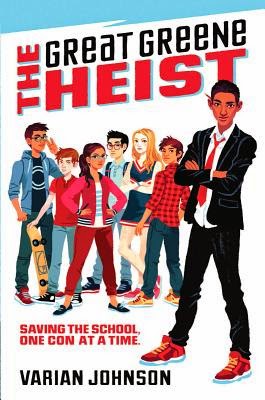
The Great Greene Heist

by Varian Johnson
First sentence:
Support your local independent bookstore (actually, just support mine!) and buy it there! (Before the end of June, PLEASE.)
Review copy sent to me by the author, upon my request. Also, I’ve met him a couple of times and I think he’s fantastic.
Content: There’s no swearing, and only hints at romance. It’s in the middle grade section (grades 3-5) at the bookstore, though older kids would like the con aspects of it, I think.

Jackson Greene is going clean. He got ratted out (and caught) four months ago, in what he calls the “Kelsey Job” but what the school has come to know as the “Mid-Day PDA”. It cost him a certain amount of freedom (he can no longer have a cell phone, and he has weekly meetings with the principal, Dr. Kelsey) and one of his best friends, Gaby de la Cruz. Fast-forward to the fall of 8th grade, and student elections. Gaby’s running for president, and Jackson’s not going to get involved. That is until her opponent suddenly drops out, and Jackson’s nemesis, Keith Sinclair, enters the race. Jackson knows something fishy is up, and sets out to prove it. Of course, that means a long con. Which means he needs a crew.

Jackson assembles a memorable one: reminiscent of great heist movies (Oceans 11 is referenced more than once) and books (Heist Society!), Johnson weaves in not only every stereotypical element (there’s the right-hand-man, the tech guy, the runner, the money) but also plays against stereotype. My favorite is with the beautiful cheerleader Megan Feldman, who is a tech and programming genius. But there’s also Hashemi who is a budding inventor (my favorite: the MAPE, a beta cellphone the size of a brick); Bradley, a sixth-grade artist who’s mostly in awe of being included; Victor, the money behind the operation; and Charlie, twin brother to Gaby, and Jackson’s right-hand-man. And the cool thing? Only two of the crew is white.

It was refreshing that race rarely comes into play; for the most part characters were just that, and not the “Asian kid” or the “Black kid” or the “White girl”. Yes, one of the older secretaries is subtly racist, mixing up the names of the Asian kids and saying “Boys like you are always up to something or other.” It’s probably over-the-top, but in the context, it works. And the principle is a certified jerk (he was the one I wondered about: how did he ever get to be in charge of a school and not challenged?). But then again, this is all an elaborate fantasy: how many 13-year-old boys are capable of running a long con?

It was a ton of fun, though.

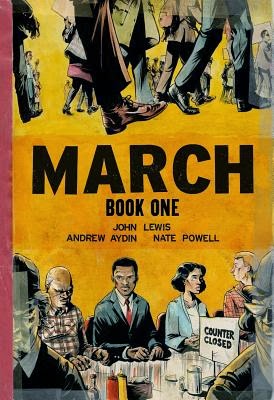
March (Book One)

by John Lewis, Andrew Aydin, and Nate Powell
First sentence: “John, can you swim?”
Support your local independent bookstore: buy it there!
Content: The only objectionable thing in the book is the use of the “n” word (which doesn’t make the white Southerners look good at all). The library has it filed under adult graphic novels, but I think I’d put it with the teen ones. I’m sure even a curious 10- or 11-year-old would get something out of this one as well.

I picked this up because it made the SLJ’s Battle of the (Kids) Books contenders list and I like to (try to) read as many as I can before the competition starts. Like every year, I found a wonderful book I’d have never picked up otherwise.

This is a slim graphic memoir, telling the first part of Congressman John Lewis’s story. (For the record, Hubby knew who Lewis was; I did not.) This volume starts with his childhood in Alabama, and goes through the Nashville sit-ins that he participated in. My favorite thing about this memoir was the framing: It opens with Lewis waking up the morning of Obama’s first inauguration, and the story unfolds as Lewis is remembering his path to D.C. as he tells it to a couple of constituents who have stopped by his office.

It’s your pretty typical Civil Rights story: sharecropper parents save money for their own farm. After an exposure to a different way of doing things (he visited his uncle and aunt in New York City for a summer), child wants an education, rather than be stuck at home doing what his parents do. (I loved the bits about raising chickens, though.) He feels a call to be a preacher, and ends up at American Baptist Theological Seminary in Nashville. There is an interesting aside here: Lewis wanted to go to college in Alabama, closer to home, and actually met with Dr. Martin Luther King, Jr. and his lawyers to talk about segregating Troy State. In the end, though, Lewis’s family didn’t want to chance the backlash, so he stayed in Nashville.

He was very influenced by the school of non-violent protests, and he got involved with a group that organized the sit-ins in Nashville in 1959. I think this was the most moving part of the book; the abuse and hurt that Lewis and his friends endured just so they could have the same services as the white people in Nashville was pretty brutal. This volume ends just after the Nashville mayor decrees that all businesses should be integrated. I’m quite interested to see where Lewis’s story goes from here.

I loved the format as well: there aren’t enough non-fiction graphic novels (at least that I’ve read), and the art — done in stark black and white — adds to the intensity of the story. I’m glad I picked this one up.

The Real Boy

by Anne Ursu
First sentence: “The residents of the gleaming hilltop town of Asteri called their home, simply, the City.”
Support your local independent bookstore: buy it there!
Content: Some intense moments — both physically and psychologically — and the language and pacing are a bit slow, especially for a struggling reader. Still, it fits in the middle grade (3-5th grade) section of the bookstore.
Review copy snagged from the ARC shelves at my place of employment.

After I finished reading this, A took a look at it and said,”Huh.’The Real Boy’? Is that like Pinocchio?”

Well, yes. Yes it is.

The island of Aletheia is full of magic, even though there are no wizards anymore. There are magic smiths, and Oscar is the hand to one. Which means, he collects and chops the herbs and basically stays out of the way. That is, until the apprentice turns up dead and the magic smith go missing. That’s when Oscar’s world starts unraveling: everything he thought Aletheia was built on, everything he thought his master was turns out to be built upon a lie. And it’s up to Oscar and Callie, the healer’s apprentice, to figure out what the truth is, and how to set everything right. And, because I alluded to it, yes, the Pinocchio story does play a small role.

This was a lovely, lyrical book; Ursu is a magnificent, quiet writer. She knows how to evoke a feeling and a place — the forest is dark and magical and calming. And even though it’s never explicitly said, Ursu makes it obvious through little words and phrases that Oscar has some form of autism. That simple fact upped the tension when it was up to Oscar become the Hero of this story. How — if he doesn’t know how to interact with people — is he supposed to figure everything out? Enter Callie, who was a remarkable character. (In fact, all the characters, from the magic smiths to the bullies, to the people in the city who were Indulged and Coddled, were remarkably written.) She is the healer’s apprentice, magicless in a world where magic is everything, and yet she’s smart and plucky and brave, but most of all caring.

In addition to all that, and refreshingly, it’s not a start of a series! Hooray for stand-alone books! My only detriment is that I’m not sure this will appeal to many kids. But for the ones who are daring enough (or quiet enough) to pick it up, they’re in for a real treat.

(Just for the record: because this is a Cybils nominee, I’ve been asked to make sure y’all know this is my opinion only, and not that of the panel.)

Flygirl

by Sherri L. Smith
ages: 12+
First sentence: “It’s a Sunday afternoon, and the phonograph player is jumping like a clown in a parade the way Jolene and I are dancing.”

Ida Mae Jones has always wanted to fly. Ever since she was put behind the wheel (is it a wheel?) of her daddy’s Jenny and taught how, she knew that this was what she was born to do. Except, she’s an African American (yes, I am being politically correct here), and lives in the outskirts of New Orleans. Not only can she not get a pilot’s license because she’s a woman; she can’t get one because she’s the wrong color.

It’s only when her younger brother spies and article about the Army’s WASP program (that’s Women’s Airforce Service Pilots), and that there was a Chinese-American woman in it, that Ida gets an inkling of an idea. She forges her daddy’s pilot’s license, and since she’s light enough skinned to pass for white, she applies. And gets in.

The part in the program is what interested me the most about Smith’s book. I thought that while the conflict between black and white, and Ida’s internal conflict about lying about who she really is, was interesting (and probably worth some thought), I really liked Ida learning how to fly military planes. I liked the challenges posed by the program, the obstacles she had to surmount in order to succeed in a man’s world. It was not only historically interesting, but had a universal appeal: what woman hasn’t faced the “you can’t do it because you’re a girl” and fought her way to success in whatever that is?

It’s books like these that make one grateful for the pioneers, the women who were courageous enough to break the race, sex, or whatever barrier, and achieve their dreams. And it’s good to have a book like this to remind us of it. As well as being a cracking good story.