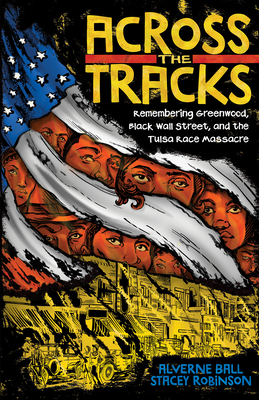
Across the Tracks

by Alverne Ball and Stacy Robinson
Support your local independent bookstore: buy it there!
Content: There are depictions of violence, including lynching. It’s in the graphic novel section of the bookstore.

In the early 1900s, due to Jim Crow, the Blacks in Tulsa developed their own community. They had stores, libraries, doctors, and were a thriving community. Of course, because of white supremacy, the white people in town couldn’t have the Blacks getting all successful. They invented a reason to arrest and lynch a Black kid, and then, when the Black families rose up in defense, burned the Black part of town, killing and unhousing families. The Black people built things back, but it wasn’t ever the same, and the white people swept history under the rug.

This is a very good history of that moment in time, highlighting the achievements of the Black people — doctors, lawyers, businessmen, educators — as well as the maliciousness of the white people. The text is pretty frank, and the art reflects that: it’s realistic and descriptive.

I think this is an important graphic novel and one that everyone should read. But, I’m not sure it was a great graphic novel It was lacking something to bring me into the story – perhaps because it was history and not really a story. it lacked a personal element, something to make me really care when the Black part of town burned. (That sounded harsh; I mean I care that white people were awful and racist and destructive. I just meant the story lacked an emotional core, if that makes sense.)

Recommended for the history.

Goliath

by Tochi Onyebuchi
First sentence: “Before his flight to Earth, they had warned Jonathan about the “gangs”.”
Support your local independent bookstore: buy it there!
Content: There is swearing, the use of the n-word, violence, and references to sex. It’s in the Science Fiction/Fantasy section of the bookstore.

Let’s see if I can figure out a plot: It’s the future, and white people have ravaged the Earth and left it to rot while taking refuge in space. Then one of them, Jonathan, decides that life in space is not worth living and comes back. There he finds that a sort-of community has built around what little there is left. There are still haves and have-nots, but for the most part, people are living.

And honestly, that’s all I’ve got. I was thinking, when I started, that this feels a lot like Octavia Butler’s future, just farther along – the people have left the earth for dead and have gone into space, but it’s just the white people. Like in all good science fiction, Oneybuchi is taking the problems of gentrification and climate change and projecting into the future. It’s a bleak one, too. But, then, he takes a left turn at the section titled “Fall” and he lost me. Up to that point, I was, maybe not really enjoying, but rather, getting, what he was doing and I respected it. But Fall takes the book off the rails. It moves from thirst to first person with a bunch of found documents that are supposed to be news stories (?), and I just didn’t get it. This book is definitely for someone smarter than me, and one who is more willing to follow where Onyebuchi leads. He’s a good writer, but maybe not one for me.

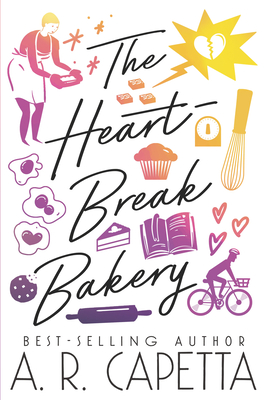
The Heartbreak Bakery

by A. R. Capetta
First sentence: “The splintered crack of my egg of the counter sounds like an ending.”
Support your local independent bookstore: buy it there!
Content: There is talk of sex, and a couple of f-bombs with some mild swearing It’s in the YA section (grades 6-8) of the bookstore.

This book hits all my buttons: it’s a book about food and baking — Syd our main character, loves to bake as self-expression; it’s a book about Austin (which I really do love to visit); it’s a book about friendships and finding love; it’s a book that truly embraces the entire rainbow of LGBTQIAP+ life and culture.

The plot is simple: Syd goes through a bad breakup, and bakes heartbreak into brownies, which get sold at the bakery, and which cause everyone who eats them to break up. Syd, feeling guilty and miserable — the owners of the Proud Muffin bakery where Syd works are one of the couples — sets about with Harley, the delivery person at the bakery, setting things right. There are lessons Learned and Love along the way, along with a smattering of magical baked goods.

Syd doesn’t have pronouns, and identifies as agender, which to be honest, has made writing this really difficult. One doesn’t consider how much pronouns are a part of life until one tries to write a review not using them.

But the book is still cute and light and frothy, following the paces of a foody romance, with an LGBT+ spin. I did like that this one felt Queer in incredibly inclusive ways (I think the only cis/het characters were Syd’s parents); I felt like (as an outsider) that the whole rainbow was represented. As a baker, I love the idea of magical baking, and some of the recipes Capetta includes sound amazing.

I don’t think tis is going to be my favorite book this year, but I am so happy that a book like this exists in the world.

Bingo Love Volume 1: Jackpot Edition

by Tee Franklin, Jenn St-Onge, Joy San, and Cardinal Rae
Support your local independent bookstore: buy it there!
Content: There is some mention of sex. It’s in the Graphic Novel section in the bookstore.

It’s the 1960s, and Hazel has met and fallen in love with (over the course of four years) Mari. The problem, it’s the 1960s, and being a Black lesbian isn’t the most accepted thing. So Mari and Hazel break up, go their separate ways. And marry men, have children and grandchildren. But 50 years later, when Mari shows up back in Hazel’s life, they both realize that being true to who they really are is the choice they need to make. They get divorced from their husbands — their families aren’t terribly happy about that — and end up marrying each other, living out their days together.

I really appreciated a positive portrayal of Black lesbians. I appreciated the historical aspect of this: LGBTQ+ people have never had an easy time being out in public, and this was especially true in the past. I appreciated the positive portrayal of someone who was overweight her weight was never an issue, and it was something that contributed to making her beautiful.

I just didn’t particularly like the story. Perhaps it’s because I’m cis/het, but the whole story fell kind of flat for me. Let’s just say I wanted to like thi one more than I actually did.

Cinderella is Dead

by Kalynn Bayron
First sentence: “Cinderella has been dead for two hundred years.”
Support your local independent bookstore: buy it there!
Content: There are illusions to domestic abuse. It’s in the YA section (grades 6-8) of the bookstore.

In the kingdom of Lille, the story of Cinderella is not just a fairy tale, it’s fact. It’s the book by which every young woman is to live their life. Serve their family. Prepare for the ball, which happens every fall, where they are to be Chosen by one of the eligible men in the kingdom, and then live out their lives happily ever after. There are problems with this, of course: there are rules — curfews, limits on autonomy — that work to keep women and girls in line. Our main character, Sophia, isn’t interested in being chosen — she’s in love with another girl, which is strictly forbidden — and doesn’t want any part of the ball. Unfortunately, that’s not allowed. But, at the ball, she can’t take any more, so she runs off — which is a crime. She hides out in the woods, finds Cinderella’s mausoleum, and meets one of Cinderella’s only living descendants, and discovers the story that everyone in Lille is told is actually built upon a lie.

On the one hand, I’m always down for a new telling of a fairy tale. I adore retellings, and this one does have a unique spin. I liked that Sophia, in the end, was able to begin to fix the country — with help of course — and find her own version of happiness. What didn’t sit right with me was the way she got there. I didn’t like that all the men (except for the gay one) were complete assholes on one level or another. I get that you’re drilling down the misogynistic rules, but “not all men”? It sounds bad saying that, but that’s what I felt reading it. I also felt like Bayron felt she needed to have Sophia be gay because to have her in a hetero relationship would be Bad for the Message. (I just didn’t feel like this book was Queer in the way books written by LGBTQ+ authors are.) It’s not a bad book, but in the end, I didn’t love it.

When I Was the Greatest

by Jason Reynolds
First sentence: “‘Okay, I got one.'”
Support your local independent bookstore: Buy it there!
Content: There is swearing, including multiple f-bombs, and talk of teenage drinking. It’s in the Teen section (grades 9+) of the bookstore.

Allen — call him Ali — lives in Bed Stuy in Brooklyn, and while it’s not the best place to grow up, it’s not the worst, either. He has a mom who works hard and cares a lot about Ali and his sister Jaz. And even though his dad is a bit of a loser, he also cares. The next-door neighbor kids — Needles and Noodles; Jazz game them the nicknames — not so much. They’re brothers, and Needles as Tourettes Syndrome, which makes Noodles simultaneously super protective and incredibly dismissive of his brother.

It’s basically a slice of life story; this is Ali and Noodles and Needles and their lives and interactions. The only conflict that happens is when they invite themselves to a party they are not suposed to be at, and then Needles’ has a spasm and inadvertantly starts a fight.

It’s not my favorite of Reynolds’ books, to say the least. I disliked his portaryal of Tourettes, and while i think he was trying to deal with acceptance of disabilites in the Black community, I think he fell short of the mark. It was good enough to finish, but not good enough to really like.

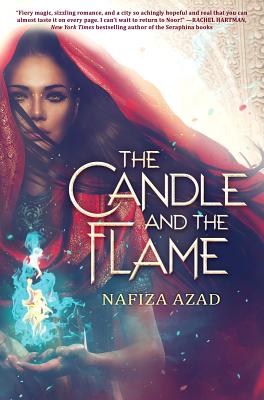
DNF: The Candle and the Flame

by Nafiza Azad
First sentence: “The desert sings of loss, always loss, and if you stand quiet with your eyes closed, it will grieve you too.”
Content: There was some flirting and talk of marriage in the parts that I finished. It’d probably be in the YA (grades 6-8)section of the bookstore if we had it in.

On paper, this should hit all my “really like” buttons: an orphan that survived a massacre and is trying to make ends meet, a city ruled by djinn, magic, fierce girls, sweeping desert vistas, a diverse city on the edge of destruction.

But in actuality? It kind of fell flat. There was WAY too much telling, not nearly enough showing. So much exposition and it was just moving along at a plodding pace (the opener was really good, though). I wanted to like it, but more than 100 pages into it, I realized that I don’t have enough time in my day to spend on a book that I”m not enjoying. Even if it is for a class.

Oh, well. Maybe there’s a djinn book with a fierce girl as the main character out there that is better than this one.

Audiobook: Crying in H Mart

by Michelle Zauner
Support your local independent bookstore: buy it there!
Or listen at Libro.fm
Content: There are some swear words, including a few F-bombs It’s in the biography section of the bookstore.

This is basically Zauner’s homage to her Korean mother, who passed away from cancer in 2014. She goes through her childhood, how her relationship with her mother developed and struggled, and through her mother’s sickness and her death to the year or so afterward. The thing that ties everything together is Korean food. Her mother’s home cooking, the tastes and smells that accompanied Zauner all through her childhood trips to Seoul to see her mother’s family, and through to watching Mangchi on YouTube after her mother’s death, in order to learn the food traditions that she didn’t want to be lost.

It wasn’t a gad book, and Zauner wasn’t a bad narrator. But, I didn’t quite love it either. At times, Zauner felt like a whiny brat, and I just wanted to shake her. I suppose she was just being honest, and so I can admire her for that. The things I liked best were near the end when she starts learning how to cook Korean food. The chapter where she learns to make kimchee was fascinating. And I understood her pain (sort of? I haven’t lost anyone I was incredibly close to, really) or at the least, I understood that this was how she was processing her pain.

I can respect this book, at least, even if I didn’t love it.

When Dimple Met Rishi

by Sandhya Menon
First sentence: “Dimple couldn’t stop smiling.”
Support your local independent bookstore: buy it there!
Content: There is talk of sex, and a tasteful on-screen sex scene. It’s in the YA section (grades 6-8) of the bookstore, but it should probably be in the Teen section (grades 9+).

Dimple has one goal: go the the Insomnia Con, win, get her app idea out in the world, and go to college and be a successful developer. Her parents (her mother, really) has one goal: to get Dimple married to an Ideal Indian Husband. Rishi has one goal: to be a Good Son, and uphold the traditions of his family and culture. Therefore, he’s asked his parents to arrange a marriage for him (yes, he’s 18). The person they’ve picked? Dimple.

Rishi goes to Insomnia Con with the sole purpose of meeting Dimple and getting their relationship going. The problem? Dimple has no idea that her parents set this up. Needless to say: Dimple and Rishi don’t get started on the best foot. But, then, over the course of the six weeks of the con, they get to know each other, bring out the best in each other, and yes, fall in love.

It’s a silly Bollywood movie as a book: light, refreshing, fun (with musical numbers!), but with a serious underside that makes you think a little. I like how Menon is exploring and subverting Indian-American culture, all the the guise of a romcom. Both Rishi and Dimple are delightful characters, and their descent into love is a quick, but believable one. I’ve enjoyed Menon’s other books, and this one is no exception.

Just Be Cool, Jenna Sakai

by Debbi Michiko Florence
First sentence: “Heartbreak is for suckers.”
Support your local independent boosktore: buy it there!
Content: There is some talk of first romance and divorce. It’s in the middle grade section (grades 3-5) of the bookstore. But it’d be good for 6-7th grade as well.

Jenna Sakai has sworn off relationships. First, her parents got a messy diverse and her dad “abandoned” her by moving to Texas from California. Then her boyfriend, Elliot, who she thought she was super compatible with dumped her right before Christmas. After a very lonely winter break at her dad’s house, she’s back in California, at her school, determined to make a fresh start. No more relationships. No more Elliot (except he keeps popping up in places where she thought were Elliot-free). Just focus on the things she’s good at: journalism. Then she discovers a cute diner, and takes to going there as an escape from all the other stress in her life. It’s a great place, until she discovers that Rin Watanabe also uses the diner as a refuge, specifically what she’s come to think about as “her booth”.

Thus begins a tumultuous friendship between Jenna and Rin, as Jenna writes an article digging into a donation his family made to their school. It’s a bit more complicated than that, but that gets the gist of things.

I thought it was cute. I was a little “meh” at the beginning — boyfriends/girlfriends in 7th grade kind of turns me off, but Florence kept it pretty age-appropriate with just hand holding. But it was a really good story about a girl learning to trust other people again, after a couple of very big heartbreaks, first with her parents’ divorce, and then with the breakup with someone she thought was super compatible with her. I liked that it showed that middle school romances aren’t always great (thought there was an example of a good, healthy relationship as well). I also think that Florence does a good job capturing the complicated emotions and friendships that middle school has while not making everyone super annoying (which is easy to do). My only complaint is that I didn’t know this was a companion book to another one, and I kind of felt like I didn’t quite have the whole picture sometimes. But that was more my problem than the wriring.

It was a fun book, overall.