Deacon King Kong

by James McBride
First sentence: “Deacon Cuffy Lambkin of Five Ends Baptist Church became a walking dead man on a cloudy September afternoon in 1969.”
Support your local independent bookstore: buy it there!
Content: There is swearing, including many f-bombs, and the use of the n-word. It’s in the adult fiction section of the bookstore.

The plot of this one is almost incidental: Deacon Cuffy “Sportcoat” Lambkin (who also gets called Deacon King Kong for the amount of hooch he drinks) shot (but did not kill) a local drug dealer, who used to be a kid that played on a baseball team Sportcoat coached and umpired in the projects in Brooklyn. And, because of this, Things Happen. What the Things are doesn’t really matter: this is a novel that is propelled by the characters. And there’s a whole mess of characters. So many that when I tried to listen to this on audio, I got lost with who was who. But, reading it helped keep some of them straight. It’s a whole neighborhood full of characters, their wants and needs and desires and connections to each other. And McBride truly captured a moment in time, and a place, as the people of this Brooklyn neighborhood lived their lives and tried to keep things together as much as they could.

I didn’t absolutely love this book, but I didn’t dislike it either. It’s funny at times, and always interesting, if you like charioteer-driven novels.

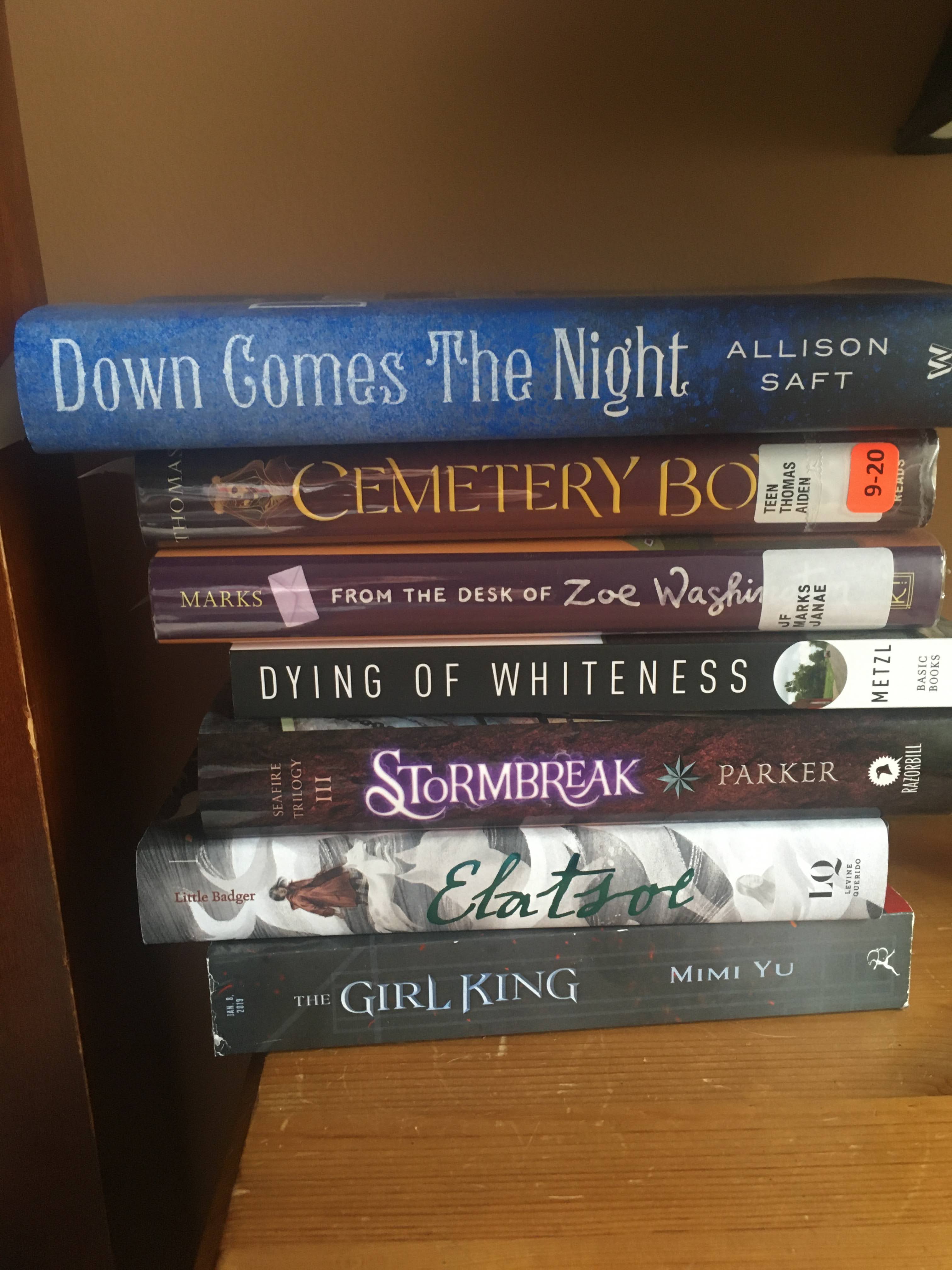
Concrete Rose

by Angie Thomas
First sentence: “When it comes to the streets, there’s rules.”
Support your local independent bookstore: buy it there!
Review copy provided by the publisher.
Content: There swearing, including f-bombs, some tasteful sex, and talk of drug use. It’s in the teen section (grades 9+) of the bookstore.

Maverick Carter is just trying to live his life. He’s got a girlfriend he adores, and friends — including a cousin, Dre — that have his back. But then, his life is upended: a girl he had a one-night stand with (the condom broke) got him to take a DNA test to see if her baby was his. And sure enough, it was. Then she dumped the baby in Maverick’s lap and left (she was suffering from postpartum depression, so I get it). Which meant, all of a sudden, Maverick has to take stock of his life. Does he want to be involved in the King Lords and sell drugs, even though the money is good? How can he help his mom out (especially since dad’s been in prison since Maverick was eight). And then after a tragedy happens where Dre is killed, how can Maverick just go on?

In this prequel to The Hate U Give (you don’t have to have read that one first), Tbomas explores what it’s like to be a Black man in the inner-city in the late 1990s/early 2000s. When really all anyone expected of Maverick was for him to be a part of a gang, and to get a couple of girls pregnant. It’s all about Maverick finding it within himself to not be a stereotype, to not fall into the life his father lived, to be something — and someone — different. And, because Thomas is a gifted writer, she is able to bring life to this world and this character without making it seem preachy or trite. It really is an excellent story, and one that makes you feel for Maverick and his struggles and situations.

Thomas’s not just an important writer doing important work, though. She’s an excellent writer telling good stories. And that’s what really matters.

Monthly Round-Up: January 2021

January just flew by this year! Not sure if it’s because I am working more (or at least every day) or if it’s because I signed on to do (and actually did) the Yoga With Adriene 30 day Yoga Journey, or if it just wasn’t as horrible a month. Whatever the reason, January wasn’t too bad.

I am reading less, though. And that’s okay. Time/Place/Season/Etc.

My favorite this month:

It was just so much fun! And highly highly recommended on audio.

As for the rest:

Middle Grade Fiction

King and the Dragonflies

YA Fiction

Sia Martinez and the Moonlit Beginning of Everything (audio)
Super Fake Love Song
Felix Ever After

Adult Fiction

Piranesi

Non-fiction

24 Hours in Ancient Athens
We the Corporations

What were your favorites this month?

Felix Ever After

by Kacen Callender
First sentence: “We push open the apartment building’s glass door, out into the yellow sunshine that’s a little too cheerful and bright.”
Support your local independent bookstore: buy it there!
Content: There’s some teenage drinking and pot smoking, swearing — including multiple f-bombs — and some tasteful making out. It’s in the Teen section (grades 9+) of the bookstore.

Felix is a trans young man who is struggling. Not just with his father — who won’t say his name, just calling Felix “kid” — but fitting in at St. Catherine’s, an elite art prep school in New York City. Felix has one friend, Ezra, who is totally and completely accepting of who Felix is. However, not everyone on campus is. When one day during the summer term, an “installation” of Felix’s dead self complete with his deadname shows up, Felix is determined to find out who did that, and exact revenge. But things don’t go as planned.

I’ve not read a lot of trans fiction, especially for young adults, but I adored the way Callender handled this (one expects it would be handled beautifully, considering Callender identifies as non-binary). I adored Felix and felt his struggles to be accepted as his true self, even though he’s still kind of questioning his identity. I am glad Callender reminded readers that gender is a spectrum and perhaps labels aren’t always the best thing. But beyond that, I loved Felix and Ezra together, and the tension between Declan (who was a former boyfriend of Ezra’s) and Felix. I loved the emphasis on art, and how art can express inner feelings the way words sometimes can’t. And I still think Callender is a beautiful writer. They capture things on the page about being trans and black and queer and trying to fit into this world that doesn’t want them. It was powerful and challenging and wonderful all around.

I am definitely a fan of Callender’s now.

We the Corporations

by Adam Winkler
First sentence: “In December 1882, Roscoe Conkling, a former senator and close confidant of President Chester Arthur, appeared before the justices of the Supreme Court of the United States to argue that corporations like his client, the Southern Pacific Railroad Company, were entitled to equal rights under the Fourteenth Amendment.”
Support your local independent bookstore: buy it there!
Content: It’s long and dense. It’s in the history section of the bookstore.

I heard about this book when it came out a few years back and thought that it’d be interesting to pick it up, just to see what Winkler meant by the subtitle: How American corporations won their civil rights. I reminded myself of this a few months back when discussion at a (virtual) book group lent itself to Citizen’s United and how people trust corporations more than government.

It took me a month to read this, not only because I was busy, but because it’s a lot more scholarly than I was expecting, and because there’s a lot of leagalese. That said, it’s a fascinating look at the history of the relationship between corporations and the Supreme Court, and how, over 200 years, corporations and corporate lawyers won corporations many of the same rights that individual citizens have, and how Citizens United and the Hobby Lobby birth control case are natural outgrowths of that.

Winkler leaves no stone unturned. He begins at Jamestown, which was essentially a corporate town, and how corporations of some sort have basically been part of US history since the beginning. He even calls the Constitution basically a corporate charter. And from the beginning, corporations have been pushing against government regulations and trying to exert their “right” to do as they please.

It’s dense, but it’s fascinating. I came away with a couple of thoughts: 1) the Supreme Court was never apolitical. If you think it’s apolitical, then you’re mistaken. They have always been influenced by outside sources, and since corporations have the money to be influential, then they have done much of the influencing. While the Supreme Court has done good things (enforcing desegregation, gay marriage, Roe v. Wade) they are also very much a problematic branch of government. Ordinary citizens have no say (as seen by the confirmations of Gorsuch, Kavanaugh, and Barrett) in who gets to sit on the court, and yet the court wields an undue influence over the laws in our country. (I”m not sure that’s a take-away everyone would get from the book; Winkler does a good job of being balanced. I don’t know for sure he’s against Citizen’s United; he just sets out to prove that it’s a logical outgrowth of 200+ years of Supreme Court rulings.)

And, in spite of number 1, there are some interesting justices who understood, over time, what might happen. For me, the most interesting one was Louis D. Brandeis, in the early 1900s, who basically predicted Amazon and Walmart in a dissent in 1933. Winkler writes:

Brandeis argued that the law [a Florida law designed to limit the spread of chain stores] should be upheld because the rise of nations chains. “by furthering the concentration of wealth and power” and reducing competitions was “thwarting American ideals; that is making impossible equality of opportunity; that it is converting independent tradesmen into clerks; and that it is sapping the resources, the vigor, and thee hope of the small cities and towns.”

He went on to write that the “great captains of industry and finance” were “the chief makers of socialism.” All of which I found fascinating. Later in the book, another dissenting justice basically predicted what we have now: drug companies putting out advertisements for individual prescription drugs in the hopes that consumers would ask their doctor for them by name.

Anyway. I’m not sure how much of this will retain, and at one point I was complaining to R that it all felt hopeless: how does one change something that’s been embedded in the system since the beginning. I guess the answer is: one step at a time. And knowing that the system is this way — pretty rigged in favor of corporations having “rights” and against regulation — is a step in the right direction.

Audio book: Fable

by Adrienne Young
Read by Emma Lysy
Support your local independent bookstore: buy it there!
Or listen at Libro.fm
Content: There is some violence and some off-screen, implied sex near the end. It’s in the YA section (grades 6-8) of the bookstore.

It’s been four years since Fable watched her mother die in a storm that sank the ship that they, along with Fable’s father, were on. And four years since Fable’s father dumped her on a god-forsaken island, abandoning her to her fate. Now, she’s found a way off the island on a ship captained by West, a young trader who has bought her gems for the past couple of years. And Fable is determined to take her place in her father’s crew.

But things are not what they seem in this cutthroat world of trading and selling. And West is not everything he seems. Can a girl — even one who was raised the daughter of a captain and who has special gifts — make her own way in this world?

I really enjoyed the world that Young built here. It’s rich and lush, and very Pirates of the Caribbean-y. Which, in my book, is a good thing. There’s magic, of a sort, but it’s very slight. I liked Fable’s journey getting off the island, and the slow reveal of her past and her place in her father’s empire (of sorts). The romance was a bit out of nowhere (all of a sudden they were kissing, and while I don’t mind that, it did feel a bit, well, unearned.) but it wasn’t the focus of the book, which was a relief. I did feel Young did a bit too much telling rather than showing, but it’s the first in a duology, and she needed to set up the world, and I’d rather some telling all along than a big infodump at the beginning.

Lysy was good as a narrator, even if she did over-emphasize her Ts at the end of sentences. (Once I noticed it, I couldn’t unhear it.) She kept me engaged and kept the story moving forward. I think I enjoyed this a lot more on audio than I would have otherwise.

And the book ended on a bit of a cliffhanger (there got to a be a point about 3/4 of the way through where I kept expecting something bad to happen. And it did. In the last chapter.) so yes, I’ll be checking out the sequel.

24 Hours in Ancient Athens

by Philip Matyszak
First sentence: “Welcome to Athens in 416 BC.”
Support your local independent bookstore: buy it there!
Content: There’s some frank talk about sex. It would be in the History section (I think) of the bookstore, if we had it.

This little book is a quick, accessible, peek into what life was (probably) like in ancient Athens. Beginning at midnight and going for 24 hours, each chapter (which is an hour on the clock) highlights a different person, from slaves to merchants, soldiers to priestesses, doctors to smugglers. There are “famous” people, like Sophocles and Hippocrates, but most people are invented by Matyszak, based on the research he’s done into Athens.

So, it’s not really history, because most of the people are fictionalized. But it’s also not really fiction, because the information is based in fact. It’s this weird grey area.

It’s also not something I’d usually read, but a friend of mine teaches a class about Ancient Greece and she picked it for our book group. I ended up finding it fascinating though. It’s not one that needs to be read straight through (the stories don’t really build on one another), but can be dipped into on occasion. It’s very readable and accessible, even though there are a lot of names of places and people that I had to let wash over me.

I’m not sure who I’d recommend it to, though. If you have an interest in the daily lives of the people who lived in Athens, then this is the book for you.

Piranesi

by Susanna Clarke
First sentence: “
Support your local independent bookstore: buy it there!
Content: There’s some talk of murder, it’s pretty intricate in its writing and there are about a dozen f-bombs at one point. It’s in the Science Fiction/Fantasy section of the bookstore.

I’ll be honest here: I wasn’t going to read this one. I remember reading Jonathan Strange & Mr. Norrell when it first came out and thought it was a bit overblown. But, I have to admit, my interest was piqued when Maggie Stiefvater said she loved this one. And then M read it and suggested I give it a try (after I picked it up for her to take back with her).

And… the less said about the plot, the better, I think. Know Piranesi is a person who lives in a labyrinth a House full of Statues, and who is mostly alone. There is a mystery of sorts, and perhaps the less you know about that, the better. But know that the mystery really isn’t the point of the book (if you do think it’s the point then you are bound to be disappointed at the Big Reveal like I was). The point, as M pointed out when we were talking about it, is that it’s an homage to curiosity and to resistance. And it’s a meditation on being alone versus being lonely. It’s a charming little book with a completely engaging main character.

It’s probably not going to be my favorite book ever, but I’m not sorry I read it.

Super Fake Love Song

by David Yoon
First sentence: “Every superhero has an origin story.”
Support your local independent bookstore: buy it there!
Content: There’s some mild swearing and in the older brother has a drinking problem. It’s in the YA section (grade 6-8) of the bookstore.

Sunny Dae (yes, that is meant to be punny) is a Nerd. Not only self-declared, but declared by the student body of his super rich California high school. Which is fine with Sunny. He and his friends Jamal and Milo have their own thing: a DIY FX YouTube channel for people who want to make their own cosplay outfits. It’s a perfectly fine existence, and aside from the fact that Sunny’s older brother Gray won’t talk to him and his parents are always working, one that Sunny is happy with.

Then Sunny meets Cirrus Soh, who accidentally thinks that Gray’s old room — full of guitars and “cool” things — is Sunny’s. And Sunny leans into that lie: yes, he plays guitar. Yes, he fronts a band. Yes, he’s “cool”. And all of a sudden, he has to make good on his lie. He ropes his friends into it, and gets the girl. The problem is: he’s kind of liking the “new Sunny” but he’s letting his friends down. Can he find a way to balance everything?

This book was super fun! Okay, so the romance part of this book wasn’t the best; Sunny and Cirrus were a bit forced and their romance never really felt real to me. What I did love, though, was Sunny. I loved his grappling with being nerdy and realizing that not everything or everyone fits neatly into boxes. I loved his family and their relationship to each other. For me, that was where the most interesting drama took place. I adored Milo and Jamal, and thought the three friends were brilliant together. And loved passages like this:

“My two best friends wore what they normally wore, which was to say a combination of low-performance joggers and blank polos that were so normcore, they went though dadcore and into weekend dadcore beyond.”

And this:

“The cynic would say Sunset [Boulevard] was like any other street in the godforsaken post-apocalyptic wonderland. But it wasn’t. It was a twenty-some-odd-mile-long serpent behemoth whose head had no idea what its tail was doing.”

No, it’s not brilliant fiction. But it is a lot of fun! And right now, that’s what really matters.

Audio book: Sia Martinez and the Moonlit Beginning of Everything

by Raquel Vasquez Gillliland
narrated by Inés del Castillo
Support your local independent bookstore: buy it there!
Or listen at Libro.fm
Content: There’s swearing, including many f-bombs and description of sexual assault as well as almost-sex. It’s in the Teen section (grades 9+) of the bookstore.

It’s been three years since Sia’s mom disappeared in an ICE raid that sent her back to Mexico, a place where she had never been, having been brought to the US by her mother when she was young. Sia’s mom since disappeared, and was presumed to be dead. By everyone. So, for three years, Sia has been harboring grudge and aching for revenge on the sheriff who turned her mother in.

And… here’s where everything gets a little weird. I was enjoying this book about a girl who was dealing with her mother’s death, with the inherent racism in her town, with trying to keep her best friend together, with liking a new boy who just happens to turn out to be the estranged son of the sheriff. And then the book slants sideways and there are aliens? An Sia’s mom is not dead, but instead has spent the past three years being tested on in a secret government conspiracy? And it took half the book to get there?

I don’t know. I wanted to like this one more than I did. I adored the narrator; I think, in the end, she is what kept me listening (that, and I wanted to see just how far this alien thing would go) because I was annoyed. Annoyed that the jacket blurb gave away the aliens. Annoyed that they didn’t show up until halfway, and yet were so vital to the plot. Annoyed because it was a good book about a girl who was dealing with grief and loss and moving on, and all of a sudden: ALIENS AND YOUR MOM ISN’T DEAD.

I know there are people out there who liked this one. I’m just not one of them.