


You’re Bella Swan – You are intelligent and kind but not quite sure what you want out of life yet. You have a feeling there’s something more out there for you. You’re attracted to those who are real and avoid the fake. Sometimes you’re a bit accident prone, but your true friends will always be loyal to you and come to your aid when you need it.
Take this quiz!
A to Z: A list meme
I found this one via Iliana. The object to to come up with an alphabetical list of favorite authors and books. I tried to do this without looking anything up, just what came out off my fingertips first. (Honestly, I didn’t get very far… and I gave up trying to find Q, X, and Z.) Some of which kind of surprised me. Why Douglas Adams and not Jane Austen or Lloyd Alexander?? I don’t know. That’ s just what came out.
- Adams, Douglas — Long, Dark Teatime of the Soul
- Bryson, Bill — I’m a Stranger Here Myself
- Card, Orson Scott — Speaker for the Dead
- Dreher, Rod — Crunchy Cons
- Estes, Eleanor — The Hundred Dresses
- Forester, E.M. — The Room with a View
- Gaiman, Neil — Stardust
- Hale, Shannon — Austenland (though it’s really hard to pick ONE)
- Irving, John — A Prayer for Owen Meany
- Jacobs, A.J. — The Year of Living Biblically
- Konigsburg, E.L. — The Mixed-up Files of Mrs. Basil E. Frankweiler
- Lewis, C.S. — Lion, Witch and the Wardrobe
- McKinley, Robin — The Blue Sword
- Nafisi, Azar – Reading Lolita in Tehran
- O’Brien, Robert — Mrs. Frisby and the Rats of NIMH
- Pattou, Edith — East
- Q
- Rowling, JK — Harry Potter and the Half-blood Prince
- Smith, Dodie – I Capture the Castle
- Tolkien, J.R.R. — The Hobbit
- Urban, Linda — A Crooked Kind of Perfect
- Voight, Cynthia — Jackaroo
- Westerfield, Scott — Uglies
- X
- Yolen, Jane — the Merlin trilogy (Passager, Hobby, Merlin)
- Z
So, what’s your list look like?
An Invitation
My bloggy friend Tricia has set up a Book Blogs network over at Ning. We’re mostly using it as a catchall site, kind of a glorified Wiki where everyone can put their book reviews. Anyway, it’s free, it’s fun, and it’d be wonderful to have as many book bloggers as possible in one spot. So, consider yourself invited. Especially if you’re looking for a place to stick all those pesky reviews, ones you just can’t seem to write and post on your blog… or if you’re like me and you blog nothing (almost nothing) but reviews, then you can use it as a cross-posting, a way to get more readers reading your stuff. Or you can join because it’s fun to join things.
At least come by and say hi. 🙂
2008 Challenge #1: Expanding Horizons
Only one more week… I figured I should probably put this up sooner rather than later.
I had a fun time with this one, not just reading — though I’m not sure my list was terribly stellar — but also as host. I think it’s the first time I’ve done a challenge where I’ve read every single review that was posted. I should do that more often; there’s a lot of interesting books that are being read out there.
 1. Kira Kira, by Cynthia Kadohata (Asian-American)
2. The Hummingbird’s Daughter, by Luis Alberto Urrea (Hispanic)
3. The Painted Drum, by Louise Erdrich (Native American)
4. My Life as a Furry Red Monster, Kevin Clash or Song of Solomon, Toni Morrison (African-American)
5. Mistress: A Novel, by Anita Nair (India) [Read Interpreter of Maladies, instead]
6. The Saffron Kitchen, Yasmin Crowther (Iran)
Booking around the World
A fellow ER writer left a comment asking for some help with an article she’s putting together. Since you’re all nice, friendly folks, I thought we could help her out. Especially since we did this (sort of) for a drawing last month. 🙂 Here’s what she’s asking for:
I’m popping around various international reading challenges and asking the organisers to tell me what are the best books they have encountered so far in their challenge experience. I would love it if you could let me know what some of your favourite challenge reads have been for the ‘Expanding Horizons’ challenge have been and perhaps provide a short sentence about why you have enjoyed them so much.
If you’d like to be a part of it, you can either a) leave a comment here, and I’ll forward it on to her or b) email her directly at bakerjodie at googlemail dot com by April 24th. Thanks much!!
Serving Crazy with Curry
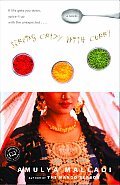 I had originally picked this up to finish off my Expanding Horizons Challenge list because the review by CdnReader made me curious, but then Sarah gave me Interpreter of Maladies and I read that one instead. Still, it was sitting on my dresser, not due yet, and so I picked it up. I thought it was interesting, but like CdnReader, I wasn’t overly impressed by it.
Devi — a late-20s Indian woman — decides to commit suicide. Her life is terrible, especially in comparison to her father’s and her older sister’s, and there’s nothing left to live for. But, her mother saves her, and as a result, Devi moves in with her parents, stops talking and begins cooking. It also causes a chain reaction, causing everyone in her family to reevaluate whether or not their life is worth living.
I liked that there was a lot about decisions and comparisons. Everything everyone does in this book has some sort of consequence, whether it was a recent decision, or something more in the past. I liked that; I liked that people had to deal with the consequences of their own lives. I thought the observations that Amulya Malladi made about sisters and family and comparisons and parenting were good ones. I even liked Devi as a character, though the rest of her family took a bit of getting used to. The prose felt a bit clinical at times, but that’s possibly due to the switching of the narratives; you get portions of the story from different points of view, and it didn’t really work as well as I hoped it would.
But, I think one of my biggest disappointments was the lack of food. Yeah, it was there, hanging out in the background with Devi’s experimental fusion Indian cooking, but it wasn’t as delicious or as sensory as I hoped it would be. I wanted to get a feel for the Indian food, and I felt that I was missing something because I didn’t know what half the dishes were. I wanted this book to make me desire to eat Indian food, but it fell flat. I was even disappointed by “mouthwatering recipes”. They were mostly just lists of ingredients and ways to throw them together, not the how of it all. Which I found disappointing.
So, in the end, it’s a decent novel — kind of soap-operaish, but with interesting people — but nothing to jump and shout about.
Into the Wild
 Fairy tales are supposed to have a beginning, a middle and a happily ever after for the heroes and a bad ending for the witches, step-family, and other assorted “evil” characters. And that’s the way it’s always been, and no one’s really thought much about it.
Except for Sarah Beth Durst. The Wild, in her first book, is a living thing, a place where fairy tale characters are caught, trapped, forced, into living their stories over and over again. Until they escape, and Rapunzel becomes the guard of the wild. For five hundred years, everything is fine, and Rapunzel even has a child, Julie. Then one day, someone wishes the Wild free, and it begins taking over their town, trapping the characters (and other people) into endings and beginnings and it’s up to Julie to rescue her mom and save everyone from the Wild.
This was a fabulous book. I think I knew it would be; so many people have absolutely loved it. But it’s hard to convey in a review how wonderfully clever it is, how enjoyable it is to read. Durst takes every single fairy tale character and uses them in new and unexpected ways, making the old stories come alive again. I loved the struggle for free will and how the Wild uses character’s choices; I loved how Julie used the Wild against itself, in order to make it through her story; and I loved how endings and beginnings were used.
And the ending was so perfect. It was both unexpected (though I had an inkling) and made perfect sense.
I can’t wait to read the sequel. I hear it’s just as good (if not better).
Spreading the Word
 I didn’t put in anything, but there’s some good reviews and recommendations over at this month’s Bookworms Carnival at In the Louve. Drop in and pay a visit when you get the chance.
Next month’s carnival is hosted over at Scooter Chronicles. The theme is Contemporary/Urban Fantasy and the deadline for submission is May 9. Any submissions can be sent to srf at soundchaser dot org.
American Gods
 Forgive the bad Asian food metaphor. I thought of it early on while reading American Gods, and I liked it so much that I had to use it.
See, Stardust is fried rice. It’s nondescript. Everyone likes it. Sure, it may have elements that you don’t like, say watercress, or things that you wonder why it’s in there — broccoli or celery — but pretty much, everyone likes fried rice. It’s good. It’s simple. It’s tasty.
But, American Gods is kim chee. (Hubby took issue with this; he likes Korean food. I have to admit that I do too.) It’s loud. It’s obnoxious. It’s spicy. It’s not easily accessible. It takes some real getting used to. Not many people eat kim chee for the first time and say “Wow! This fermented spicy cabbage is THE BEST THING OUT THERE!” (I know I didn’t. I thought, when Hubby and I were dating and he took me to a Korean restaurant that he was eating one of the grossest things I’ve ever seen.)
American Gods is one weird book. As I thought about it, I’m not sure if it’s awful weird or brilliant weird. While I was reading, it was kind of awful weird. It’s incredibly vulgar and basically without a plot until the last 1/4 of the book. I felt like I was a car stuck in the mud, wheels spinning. Shadow, as a main character, is interesting, but actionless. He’s just a drifter, someone who moves from story to story within the book. I skipped whole sections, wondering about the point of that particular weird encounter or story. (Especially the interludes. They were really weird, and pretty pointless.)
But, after finishing it (at the end I thought, “REALLY! That’s it? That’s the whole point?!”), and thinking about it, and talking to Hubby about it, I began to realize the brilliance of the whole thing. You’re supposed to feel like a car spinning in the mud. The main character’s supposed to be a ruse, a distraction. That’s because (sorry, can’t avoid the spoilers) it’s all one big con. Not just for the characters, but for reader as well. Sure, if you’re a close reader (which I’m not), you would have picked up on the clues (brilliant foreshadowing), and figured it out way before I did. But, even so, when it’s all said and done, I think it’s a brilliant concept.
See? It’s Korean food. It takes some getting used to, but once you do, it just might be some of the best stuff you’ve eaten. (It just might not be for everyone.)
So B. It
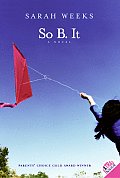 I liked this book by Sarah Weeks. It’s a slight book, well-written, and at first glance, not that interesting or profound. Yet, it gets under your skin, and you feel for the characters in unexpected ways. Perhaps that’s why, a day after I finished it, I’m still thinking about it.
Heidi is a 13-year-old girl, living in Reno, whose past is a mystery. Her mom is mentally disabled, and can only say about 23 words. She calls herself So Be It. And 13 years previously, she shows up mysteriously with Heidi at Bernadette’s door. Bernadette is an interesting character, too: an older woman, who has agoraphobia, and therefore can’t leave their apartment. Heidi’s been home schooled by Bernadette, comfortable with her mother and her family, until… until she gets old enough to realize that she should have some sort of past. And to be curious about a word her mother only says: soof.
It’s a journey book — Heidi goes across the country to New York in search of answers. It’s a finding book — Heidi finding her past, and some answers anyway. It’s a loss book — there isn’t anyone in this book who hasn’t lost something. It’s powerful, in its own, slight, way. It’s one that stays with you for its humanity, for it’s love and for the journey that Heidi goes on.
 The Book Nut