After I put up the other post, I thought to myself that I should have probably explained a bit. But, by the time I got out of the shower and back to the computer, people had already commented, so I figured I’d just leave it the way it was. But then, Julie (well, I’m assuming it’s you, Julie) asked for more information in the comments, and that gave me the push I needed to write the explanation I should have written in the first place.
So. How we came about our decision to (try to) buy local:
 1. Back in 2001, Michael Pollan wrote an article for the New York Times magazine about how corn was taking over the world. Or, more specifically, corn syrup. I was impressed with the article, and as a result started looking at labels on the food I was buying. I was shocked (I shouldn’t have been): corn syrup really WAS in EVERYTHING (still is). I changed some of our buying habits then; most notably, I started making my own bread. Still do. Every week, three loaves from scratch. I worried that my girls would reject it (after all, we’d been eating store bought and homemade isn’t nearly as “nice” as store bought) but they took to it. A and K haven’t ever eaten store bought bread. And honestly, I think it tastes like sawdust. (And people are always impressed that I make my own bread, but honestly, it takes like a half hour and then 2 1/2 hours of waiting and baking. Not hard at all.)
I put Omnivore’s Dilemma here, even though I didn’t actually read it until earlier this year because that original article ended up being a couple chapters in the book.
 2. Fast forward to 2005. We’d lived in Arkansas for three years, and while I tried to keep corn syrup out of my diet (hard!), we didn’t do much else. Arkansas is, of course, Wal-Mart land, and that’s where we shopped. We didn’t have much choice: there was only one other grocery store in town, and we were on such a tight budget that Wal-Mart is pretty much what we could afford.
That year, Hubby got a job at Western Illinois University, and the book for the first-year experience was Fast Food Nation. I remember him reading it the summer before we moved (I’ve never gotten around to it, though Hubby says I really should someday); he read portions out loud, and we talked about it a lot. And I can honestly say I don’t think I’ve walked into a McDonald’s in three years. (I’ve eaten very rarely at Wendy’s and Subway, but that’s it. Truly. And since we’ve moved here our fast food of choice is Jason’s Deli. Organic, and fairly local.) Again, I thought our kids would rebel (one of the main sticking points people tell me when I give them this lecture), but they haven’t. And (again) A and K have never eaten there, so they don’t miss it.
Also, when we moved to Illinois, we discovered that there was a farmer’s market and started utilizing it. Oh, we’d gone to farmer’s markets before, but it was mostly a Saturday morning lark sort of thing, not some place to buy your food. But, in Illinois, we were blessed to find a local farmer who had chickens, pigs and cows. We started buying fresh meat and eggs, and were blown away with the difference. Honestly, I’ll never buy store-bought bacon again. There is no comparison.
 3. Rod Dreher, in this book, sets out to convince die-hard Republicans that their big business, big home, two-income lifestyle is not conservative. It grated on me in some parts, and felt like he was a bit self-righteous, but it did two things for me: it gave me the confidence to actually try to opt out of the big agriculture system and it let me know I wasn’t alone in doing so. (I probably knew that already, but sometimes that little reinforcement is what you need to keep going.)
We moved to Wichita the summer I read this, found another farmer (several actually) to get our eggs and meat from. (all my meat is “local”, meaning within 100 miles of my house. They come to the farmer’s market each Saturday and Hubby usually goes and picks up what we need there. We’re also blessed in that one of the farmers comes out bi-weekly all winter, so we can continue to have farm eggs and meat then, too. Though we’re considering going in with some families to buy half a cow this winter.) We also planted a garden (last summer and this summer) with the goal of growing and canning much of what we use during the winter.
A side note: growing up we canned fruit and jam. Again, I’ve been blessed/spoiled: I can’t eat store-bought canned peaches; they taste horrible. So, every summer, I pick local strawberries (off on Monday to do that) to can jam (won’t buy them: my kids need to work for their jam, and it just tastes better); peaches to jar; apples for applesauce; blackberries and raspberries for jam; and tomatoes for salsa and jarred tomatoes. (We’re hoping that we can get tomatoes, corn, zucchini, peppers, pumpkins and cantaloupe out of our garden this year. Wish us luck.) I also have an herb garden, where I grow all the herbs we use (except for a few exotic ones) and then dry/freeze them for the winter. All this is a big part in our buying local effort.

 4. Honestly, Wendell Berry didn’t do much for our journey toward buying local food, but I do think he’s an important person to read. He’s a very influential persona in the local movement, and for good reason. He’s a big local booster, someone for whom working on and with the land is an important part of life. He’s a difficult person to read — very labor intensive — but, worth it in the long run, if only to give you an ideal to work toward. (Not that we can all live on a self-supporting farm in Kentucky.) Of the two, I’d suggest Sex, Economy, Freedom and Community: it’s slightly more accessible to read, though The Art of the Commonplace has some beautiful moments.

 That’s pretty much our journey. We’re not perfect at it. I still feel like we buy too much food that’s supplied by big agriculture. I haven’t made the leap off of breakfast cereals, or even chicken nuggets (though I tried after reading Omnivore’s Dilemma) as lunch food for my girls. It’s about making small changes, though. Which is why I chose these two books… I do need to get around to reading the Barbara Kingsolver one, if only to get more ideas about how to go about buying and eating local food. I do know some things, though: growing a garden, knowing where your meat comes from, buying at a farmer’s market are all important.
I don’t know what we’d have done if we were still living in Arkansas, or somewhere else where there just aren’t the resources — especially with the meat — to do this. But I do know that it would still be worth the effort to try.


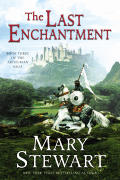 It occurred to me fairly early on in this book that it would make a pretty good stand-alone. There’s a lot of exposition up front, which I found tedious, but which would make The Last Enchantment a book that would hold up pretty well by itself. The only downside is that you’d be reading the least enjoyable of the three books.