 This year, for reasons unfathomable to me, I found that the holidays snuck up on me. (Then again, I think I’ve been a bit off since April…) I’ve been wracking my brain trying to come up with something witty, or interesting, or sentimental, or just plain fun, and I’m coming up short. It’s not that I don’t have any memories to share, it’s just that I lack faith in my ability to adequately share them. (At least to my satisfaction.)
So, to add one more list to what has become a year of lists, I’m sharing my top ten things I love about Christmastime. Since — even though they were sneaky this year — I do love the holiday season. It really is, as that song says, the most wonderful time of the year!
10. Shopping. Okay, so I’m crazy, but I love Christmas shopping. In December. Sure, the crowds are nuts, and the stores are crowded, but it’s so much fun choosing gifts and being part of all the excitement.
9. The advent calendar. Not just this book blogger one (which I do look forward to), but our own family one. When I was little, my mom had a calendar and every day there was a note with what we were going to do that day. Sometimes is was simple like “get out the pine cone wreath”, others more adventuresome, like “Tonight we will go to the Nutcracker.” I’ve kept this tradition with my girls. It’s a lot of fun for them, and (honestly) it keeps me organized!
8. The Nutcracker. It’s the first ballet I remember seeing. It’s the ballet that I share with my girls every holiday season: when they turn four, they get to go and see all the wonders that the Nutcracker has for them. We’re blessed to have a halfway decent one in town (I’ve been to some pretty lame ones), but the best, if you’re ever in Salt Lake City at Christmas time, is Ballet West‘s. I know I’m biased, because it’s the one I remember best from my childhood, but, really, it’s perfect.
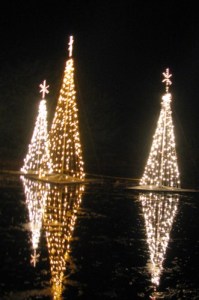
7. Christmas lights. I love driving around, as the world slowly turns to the darkest time (at least here in the U.S.) and seeing all the light displays in the neighborhoods. Bonus points if they’re glowing in the snow. There really is nothing prettier than Christmas lights on the snow.
6. The music. I whine and moan and complain about Christmas songs being played before Thanksgiving, but honestly, I love the stuff. Whether it’s carols, or classic songs, or the poppy songs, I love it. And I love singing along. Which brings me to…
5. Caroling. Love it. Yeah, it’s cold. But, really, the most fun I’ve had at Christmas time is going around with a group singing carols at random (or not so random) houses.
4. The goodies. I’ve mentioned I love to cook, haven’t I? Well, Christmas brings out the best in my cooking. I’m pretty sure that when my friends see me coming with my plates of cookies, they groan and moan… but you want to know a secret? I give away the food because I want to make it for myself, and I don’t want to eat it all. And what’s on the plates? Sugar cookies (lovingly cut and decorated by the girls), fudge, Christmas Bark, mint bars, Divinity, toffee, Lizner cookies, lemon bars, and whatever else I can think of. (What do you want a recipe of?)
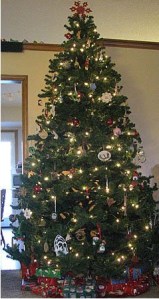
3. The decorations. I go all out at Christmas time: the house gets a makeover. On November 30th we get out the boxes (all dozen or so of them) and unpack all the Christmas decorations (except the tree). Perhaps the best part is being surprised at what is in the boxes (“Oh, I bought that last year?!”) and telling the stories about the items and how they ended up in the boxes. We film the tradition for the grandparents, so they can share in with the chaos and the silliness of it all. Then, on December 6th, we put up our 9 foot, artificial (M has allergies) tree. Again, there’s silliness and chaos, but the end result — of it all — is wonderful. One of my favorite things to do during the holidays is sit in the living room with the lights off, except for the tree, and the candles lit. It’s peaceful.
 2. Christmas Eve. When I was in high school, I had several friends who were Catholic, and they went to Midnight Mass. This idea intrigued me — my church doesn’t have any Christmas Eve services at all — and so when I got married, I told Hubby that was what I wanted to do on Christmas. We don’t always go to a mass (though we have been to a couple over the years), but we do drag the girls to a service. We have a small, simple, candlelit dinner beforehand, and we always watch It’s A Wonderful Life after. It really is a perfect way — for us — to celebrate the holiday.
1. My girls faces on Christmas morning. There really is nothing more special than seeing the wonder and excitement in a child’s eyes on Christmas morning. It really is the best part. 😀
What’s your favorite part of the season?
I’m not the only stop on the calendar today. Be sure to check out the others:
Chris @ Stuff As Dreams Are…
Stephanie @ Stephanie’s Confessions of a Book-a-holic
Lilly @ Reading Extravaganza


 by Barbara O’Connor





 The Book Nut