Darius Bell and the Glitter Pool

by Odo Hirsch
ages: 10+
First sentence: “Darius Bell walked through the grass.”
Support your local independent bookstore: buy it there!
Review copy provided by the publisher.

The Bell ancestors were showered with gifts for various heroic (and other) deeds. In return, once a generation they are required to present the town with a Gift. It doesn’t have to be spectacular, but they always are: a statue, a fountain, stained glass. However, it’s time again, and this time the Bells are broke. See, after all the inheritance, no one bothered to work. And while they have a situation with their land and mansion — people who live there and agree to do some upkeep and housekeeping and cooking in exchange for room and board — they have no money left for a gift.

Enter Darius. He’s just a kid, and his parents and older brother seem to think that he really doesn’t need to be a part of the whole gift thing. But after a random earthquake, he discovers something wonderful (not useful or even worth anything) that would be absolutely perfect for the gift. And all it takes is a little coordination to get it done.

It’s a perfectly sweet little book. Nothing grand or great or horrid or earth shattering. It’s a pleasant story, in a pleasant little town, and although there are worries, they are Overcome in a pleasant little way. It’s a reminder to enjoy the simple things in life, and to look beyond the Grand and the Great. And that not-so-big people can do big things, too.

All served with a smile and a slice of cake.

(Just for the record: because this is a Cybils nominee, I’ve been asked to make sure y’all know this is my opinion only, and not that of the panel.)

More Christmas Goodness

Coming on the heels of the Book Blogger Holiday Swap (last day to sign up!) is the Virtual Advent Tour. YAY!!!

From the blog:

Each day anyone who wants to participate takes turns sharing a treat with our friends here in blogland. For example it could be something about your family traditions, recipes, your country’s holiday traditions, or a favourite Christmas memory, movie, book, song…anything you like. Even if you don’t celebrate Christmas we would like to hear about what your family does during the holiday season, whether it be celebrating Hanukkah or Kwanzaa or whatever it is that you do during this time.

I’ve participated all four years (I think), and it’s been a blast. The only trick is coming up with something new to talk about this year…

Bamboo People

by Mitali Perkins
ages: 12+
First sentence: “Teachers wanted.”
Support your local independent bookstore: buy it there!

The senselessness of war. The brutality of commanders and oppressive governments. The lives of the soldiers — willing or not — that are caught up in political games. The propaganda that confuses and misleads. The families that are torn apart. It could be any war; in fact there are many books like this that exist about the Civil War, World War II, and Vietnam. But, it’s almost too easy to dismiss those as history, as irrelevant. But, Mitali Perkins brings the same themes to the current day, with the conflict in Burma. This is not history, people.

We follow the story of Chiko, the son of a political prisoner, and someone whose only aspirations in life are to be a teacher. He’s not cut out for being a soldier, and does what he can to avoid being captured and drafted. Unfortunately, that doesn’t last; the government tricks him by advertising for teachers, and then pulls a bait-and-switch. The camp where he’s being trained to be a soldier is not a pretty or nice place; the commander in charge is one of the worst kinds of despots: an insecure bully. It’s only through the wits of a street boy, Tai, that Chiko befriends that Chiko is even able to survive. It’s harsh and brutal to read about the inhumanities that men perform on boys; even as watered down as this is (it could have been much worse), it still makes one flinch. How can people treat others this way?

He does find uses for his talents, though: he becomes a scribe for one of the seconds in command, and teaches Tai and some of the other soldiers to read. He even secures a spot with the army back in the city where his mother is. However, once the commander finds out, he threatens to send Tai off on a dangerous mission as punishment. Chiko, noble person that he is, offers to trade spots with Tai; he’ll go on the mission and Tai will go to the city. Your heart bleeds for Chiko; there’s a definite sense of foreboding, and you know that the mission won’t go well. It’s war, after all, and there are casualties.

Enter Tu Reh, a Karenni refugee who cannot forgive the Burmese army for the way they’ve oppressed his people. He finds Chiko wounded in the jungle, and — understandably — wants to leave him to die. Or at least perform a mercy killing. And yet, something in him is moved by the Burmese boy, and he carries him to a nearby healers hut, and eventually to the refugee camp, saving Chiko’s life. A friendship slowly develops, and perhaps even a little, perspectives are softened, and minds are changed.

It’s difficult to juggle two perspectives, and give each their due, but Perkins balances this admirably. You understand and empathize with Chiko’s position and you can feel Tu Reh’s anger and uncertainty. It’s a friendship that develops slowly, one that surpasses political borders and ideas, one that reminds us all that no matter what we are, where we sit, or even really what we believe, we are human beings and should be treated with respect. It’s a book of hope: if only people could make such friendships then maybe, just maybe, the world could be at peace.

The only sad thing is that the people who really need to read this probably never will.

Zora and Me

by Victoria Bond and T.R. Simon
ages: 11+
First sentence: “It’s funny how you can be in a story but not realize until the end you were in one.”
Support your local independent bookstore, buy it there!
Review copy sent to me by the publisher

It’s an interesting idea: take a famous, respected novelist — in this case, Zora Neale Hurston — who had a unique childhood — in this case, living in the all-black town of Eatonville, Florida in the early 1900s — and turn it into a middle grade mystery. The “me” part of the title, is one of Zora’s fictional friends, Carrie (the other being Tom) and we see Zora and the adventures through her eyes.

It all begins one night when Carrie and Zora see a giant alligator maul a local man. The alligator disappears, and Zora — who was always one to spin a story — decides that another man, this one a bit of a recluse — is actually the Gator King, half-man, half-alligator, and can morph between the two. It’s a bit far-fetched, but in pursuit of the story, they inadvertently stumble upon something deeper and darker in their town.

It’s a story about the power of stories, and belief in stories. But it’s also a story of race, and acceptance, and — to a much lesser extent — justice. As far as historical fiction goes, the book captures you and sweeps you away to a town where, on the surface, it doesn’t matter what color you are. But as the layers are peeled away, it’s much less rosy. My only real quibble comes with the use of the n-word: on the one hand, that it’s in the book at all speaks towards historical accuracy. It is the early 1900s, after all. But, the first time it was used, I did a double-take and chalked it up to historical fiction. The fourth and fifth times, however, I went searching for an authors note explaining the use. There was none. This really bothered me: I feel that that word, especially, should not be used lightly, or in passing, without some sort of explanation or disclaimer. I found it disturbing, and it took away from the enjoyment I had reading the book.

The mystery was interesting, the use of Zora Neale Hurston as a character was clever. The racial issues, however, overran the book, and while there was resolution at the end, there was a bitter taste left over. Perhaps this is what the authors intended when writing, or perhaps I’m overreacting. Either way, I was left torn: I liked the book, but I didn’t feel I could recommend it.

It’s amazing what one little word can do.

(Just for the record: because this is a Cybils nominee, I’ve been asked to make sure y’all know this is my opinion only, and not that of the panel.)

Library Loot 2010-40

The number of books on hold for me today? Nine. I suppose it could be worse. But I’m sure the librarians are glad they have this new system where I have to get the holds off the shelf myself, instead of them hauling out the stack to me.

The question is: will any of them be good??

(Oh, and yes, there’s Christmas books in the pile. Don’t shoot me; I’m feeling Christmasy already.)

Picture Books:
The Little Drummer Boy, Illus. by Kristina Rodanas
It’s Christmas, David!, by David Shannon
Boo Cow, by Patricia Baehr and Margot Apple
Too Busy Marco, by Roz Chast
Crash Bang Donkey!, by Jill Newton

Middle Grade:
Jellaby, Volume 1, by Kean Soo
Moon Over Manifest, by Clare Vanderpool
Out of My Mind, by Sharon M. Draper
The Summer Before (Baby-Sitter’s Club), by Ann M. Martin
What Happened on Fox Street, by Tricia Springstubb
How I, Nicky Flynn, Finally Get a Life (and a Dog), by Art Corriveau
President of the Whole Fifth Grade, by Sherri Winston
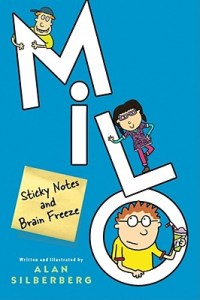
Milo: Sticky Notes and Brain Freeze, by Alan Silberberg
Betti on the High Wire, by Lisa Railsback

The roundup is either at Adventures of an Intrepid Reader or The Captive Reader. Obligatory FTC note: the links are provided through my Amazon Associates account. If you click through and actually purchase one of these books, I’ll get a teeny, tiny payment. But, since no one ever does, and it’s SO much easier using the associates account to put up these links, I’m going to keep doing it.

Squirrel Seeks Chipmunk

A Modest Bestiary
by David Sedaris
ages: adult
First sentence: “The cat had a party to attend, and went to the baboon to get herself groomed.”
Support your local independent bookstore: buy it there!

The number one rule in reviewing is never start a review saying you don’t like the genre. You do that and people will discredit everything you say after. Except… it’s really true in this case. Satire and I, we don’t get along. I am not a fan of the literary technique, I usually don’t “get it”, and I rarely find it funny.

And yet. I “got” this book, or at least most of it. It helps that Sedaris — again, whom I’ve had a bit of a rocky relationship with; I find him hilarious in person, but I don’t think his humor translates in writing for me — is poking fun at people we all know: hairdressers, complainers, obsessive parents, liberals, conservatives, intellectuals, vigilantes; no one is safe from the Sedaris’s caricaturization.

That’s not to say that every story works equally well, and truthfully, that may have been me. I really liked the ones I “got”, especially “The Cat and the Baboon,” “The Toad, the Turtle, and the Duck,” “The Parenting Storks” (an excerpt of which I heard on NPR, which led me to pick up the book in the first place), and “The Grieving Owl”. Each of these I found hilarious in their own way; possibly because the are the most accessible, and possibly because I found them funny, knowing people like that (though don’t we all).

Sedaris also balances between humanizing these animals and keeping them in the animal world: nothing really has a happily ever after, and the viciousness is often due to the nature of the animal: a baby stork falls from its nest presumably to its death, a bear is captured and forced to be a part of a circus, the crow eats the baby lamb’s eyeballs. It’s a reminder that, no matter how pretty we try to make it, nature is a cruel, vicious place. And the moral? Nobody’s exempt, no matter what you think.

It’s a weird little collection of stories, and not for everyone. But as far as satire goes, it’s quite good.

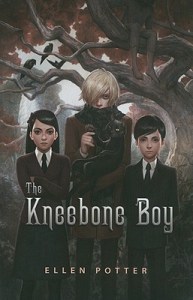
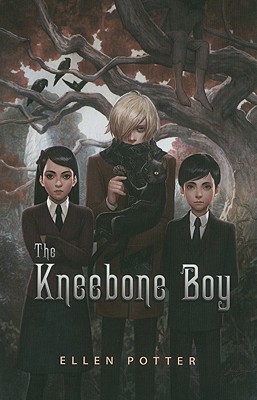
The Kneebone Boy

by Ellen Potter
ages: 10+
First sentence: “There were three of them.”
Support your local independent bookstore: buy it there!

To say that the Hardscrabble children — Otto, Lucia (Lu-CHEE-ah, thank you very much), and Max — are a bit odd, is an understatement. Max is one of those brilliant know-it-alls who drive people nuts, Lucia is hopelessly, shamelessly candid, and Otto hasn’t talked since their mom disappeared several years ago. They live in Little Tunks, which is about as exciting as its name, with their slightly absent-minded artist (he specializes in portraits of fallen royals) father.

Their existence is fairly boring, partially due to everyone in town avoiding them like the plague (and partially due to the fact that Little Trunks is just a boring place). And yet, one eventful afternoon, their father sends them down to London to stay with their aunt… who turns out isn’t there. (Gone on holiday to Germany, it seems.) Thus begins their adventure. There’s some mystery, a lot of close scrapes, some new friends, and a few new relations as well. At any rate, they become a lot less of whatever they were, and a lot more interesting.

The book reads much like a Lemony Snickett one — a comparison which is probably inevitable considering the cover — but without all the “oh, and what next?!?” feeling that went along with the adventures of the Baudelaire children. It helps that there’s a meta element going on here: often our narrator (whose identity isn’t revealed, but we are invited to guess at) pops out of the story to give us, as readers, asides about the action and plot, and pass along advice that their teacher, Mr. Dupuis, has give them in writing this. It’s not that the plot wasn’t enough to carry the book; the adventure of the Hardscrabble kids is actually quite interesting, especially with the mystery of their lost mother overshadowing it. But the asides add that little something that makes the book that much more fun.

It’s a dark little story, but with the right balance of dark and funny to make it truly enjoyable, and it’s fascinating how the mystery unravels at the end. Just about perfect, I would say. (But don’t tell the Hardscrabble kids that. They might not like it.)

(Just for the record: because this is a Cybils nominee, I’ve been asked to make sure y’all know this is my opinion only, and not that of the panel.)

It’s Holiday Time Again!

I’ve been musing lately about Christmas, what to get the girls, what to get the siblings we’re giving to this year (any ideas?), and considering just bagging it all and saving for the trip to Hawaii in January. In the midst of all this musing, I did start to wonder: is the Book Blogger Holiday Swap going to happen this year??

Of course it is! (Thanks, Charlotte, for the heads up…)

I’ve always had a grand time with this (though I can’t remember how many years I’ve signed up… three? four?), meeting new bloggers, the excitement of picking out something and the fun of seeing where and what I’m sent (mmm… chocolate…). It’s part of what makes the whole book blogging thing so much fun. (And the holidays.)

The deadline for signing up is November 14th, so hurry…. (You know you want to.)

Linger

by Maggie Stiefvater
ages: 14+
First sentence: “This is the story of a boy who used to be a wolf and a girl who was becoming one.”
Support your local independent bookstore: buy it there!

Linger picks up where Shiver left off (so if you’re one of the few people on this planet who’ve not read that, then be forewarned, there’s no getting around spoilers): Sam and Grace are an item, since it seems Sam has been cured of werewolfism. Or so they think. As winter slowly turns into spring, Grace is sick for the first time in her life. Her parents have (finally, however unbelievably) decided to be parents, and are clamping down on their relationship. And, in order to complicate things, the new wolf that Beck turned last winter, Cole, is adding his own problems, especially considering that he used to be the famous, yet self-destructive, lead-singer of the hip band, NARKOTIKA.

Told in the same evocative prose as her first book, Steifvater takes us to some of the same places that Shiver did. But not always with the same results. Falling in love is always more interesting than being in love, and for that reason Sam and Grace felt stale, while Cole and the attraction he holds for Isabel took front-and-center in my book. It really didn’t matter that both characters were very unlikable; their attraction was immediate and one of those destined to destruction. It was fascinating to watch. Granted, Cole is also brilliant, and may have figured out the trick with the whole werewolf thing. That always helps any relationship, I think.

I didn’t find it as compelling as Shiver, but it was still good. Stiefvater knows how to turn a phrase, a way to evoke a setting that makes you believe you are there. (Someday, books will come with smells and tastes, too.) And for that (and because it’s the next book in the trilogy), it’s worth reading.

I Shall Wear Midnight

by Terry Pratchett
ages: 13+
First sentence: “Why was it, Tiffany Aching wondered, that people liked noise so much?”
Support your local independent bookstore: buy it there!

Tiffany Aching has discovered that she was a witch, gone through training, accidentally joined a dance she shouldn’t have and had to kiss the winter as a result. Now, she’s back at the Chalk, a sixteen-year-old girl, trying to manage her stead as a witch. It’s not going too horribly: she’s managing to get the things done that need doing. Until one day, things start to unravel. It began with a beating of a young girl by her father, and the rough music started. Then it morphed into something grander: Roland’s engagement to Letitia, daughter of an uppity Duchess, the Baron’s death, and a growing resentment and fear of witches. It turned out that Tiffany had accidentally let out something quite evil, something which, if left to roam, will result in the demise of all the witches. And it’s up to her to make things right again.

I know it sounds dark, and there are some dark moments, but this book is so wonderfully affirming, so incredibly hopeful, that it isn’t the dark bits that stand out. While it’s not as hilarious as some of the other books in the series, it’s still quite amusing. And Tiffany really, truly grows into her own. She has to give up some things, and learn some things, and make some difficult decisions, but she does it all. And she makes some new friends, looking past prejudice and bad first impressions to see that everyone is wonderfully more complicated and interesting that we give them credit for at first.

A perfect ending for an excellent series.