The Golem’s Eye

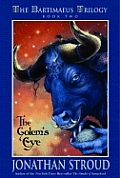
Bartimaeus is back. He doesn’t really want to be, but Nathaniel (now 14, and known publicly as John Mandrake) is a bit over his head. The Resistance (which we learn more about) is causing trouble, and Nathaniel is responsible for tracking them down but it’s more than that: there’s a strange entity out there wreaking havoc on London. And, only Nathaniel (with Bartimaeus’s help) can track it down.

Sounds a bit pretentious doesn’t it?

It is… a 14-year-old magician and a 5,000 year old djinn have the power to stop whatever-it-is (a golem) from destroying London. But it works, mostly because Bartimaeus is such a fun narrator. Like the the first book, the chapters flip back and forth between narrators: Bartimaeus, Nathaniel, and this time we include Kitty, a member of the Resistance. Nathaniel is still clueless and arrogant (perhaps even more so), caught up in the pomp and politics of London magic. But Kitty is the real find here. She adds depth and detail to what I felt was a bit of a whim in the first book (there were a couple of times when I wished I had read the two closer together, but it wasn’t often). She was interesting, and her exploits with the Resistance group had some emotional pull. It added a perspective to the whole magical world that was missing in Amulet.

Given all that, though, this book has a really slow start. (As did the first one, if I remember right.) Bartimaeus doesn’t show up until 10 or more chapters in, and the story really doesn’t get really interesting until Part Four. All of which is a detriment to keeping readers, especially younger ones, interested. (M, for all her enjoyment of the first one, bailed on this, and has no interest in picking it up again.) But once it gets interesting, it gets really interesting. There’s a mystery (who’s the government traitor — I guessed it…), there’s a devious plot (but having guessed the traitor, there’s a deeper mystery: the traitor’s a puppet, who’s holding the strings?), the mysterious people that figured in the first book show up again. How on earth is Nathaniel (and Bartimaeus, for you know he’ll show up yet again) going to unravel the underlying plot within a plot? Or is he going to fall prey to it, too? How does Kitty figure into all of this?

I suppose I’ll just have to read the next one to find out.

Dragon’s Keep

I’m not sure what to say about this book, by Janet Lee Carey. For the record, M really really liked it. She was drawn to it because of the cover (Even A, who’s not quite 4 was drawn to the book because of the cover. I don’t blame her; it’s beautiful.) and she devoured it. Raved about it; said it was one of the best books she’s read.

And the story is truly original; a mix between historical and fantasy, tapping into not only 12th-century English history, but Arthurian legend. Princess Rosalind Pendragon is preparing to be the 21st queen of Wilde Island, and she’s got a prophecy (by Merlin!) to live up to. Ending war, reclaiming her family’s good name, and restoring Wilde Island to better days. A lot to live up to. Unfortunately, she’s got a slight problem: her ring finger on her left hand is a dragon’s claw. It’s a secret she and her mother have kept from everyone since Princess Roslind’s birth. It’s also the key to unlocking Rosalind’s fate. It has dragons, romance, mystery, murder, adventure, and a happy ending. What more could we want?

Well… something. I don’t know what. I finished the book last night and… nothing. I enjoyed aspects of the book — Rosalind is one of those great heroines, and I liked her friend Kit — but there just wasn’t enough for me. The romance was too fleeting. The evil bad guy lurked until the ending and then his big moment wasn’t enough. The ethical questions too subtle. Even Rosalind’s relationship with her mother didn’t do anything for me. The deaths and murders too numerous The only relationship I really liked was between Rosalind and Lord Faul, the dragon. But, in the end, that was too fleeting for me. I think what I really wanted out of this book was more. More of everything. More romance. More dragon. More detail of Rosalind’s mother. More of the evil bad guy. More pathos before the climatic conclusion. I could have read at least another 200 pages of this book (it was only 320 pages) and it still might not have been enough.

I guess what I’m saying is that, in this case, I felt like it was an adult story, and I wanted an adult book. Instead I got a (albeit good) young adult story. And this left me very unsatisfied.

The Amulet of Samarkand

I first heard of this trilogy, by Jonathan Stroud, last year when the third book (Ptolemy’s Gate) won the Cybil for Science Fiction/Fantasy. I thought that it sounded interesting, then promptly forgot about it. (Such is the story of my life; I’m trying to rectify it. The forgetting, I mean.)

I remembered about it again, when a bunch of people over at the Nook read the trilogy and raved about it, saying that it was better than Harry Potter. I thought, amazing, I ought to read it. And then… well… you know… I forgot about it.

But, when I happened to be at the house of a member of my in-person book group, and was admiring her library (she’s got the floor-to-ceiling shelves that Hubby’s always wanted. The only downside is that there wasn’t a sliding ladder…), I noticed the Bartimaeus trilogy. And I asked to borrow it.

That was back in August.

I’m pathetic, I know.

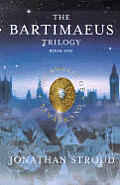
Because, you know, this is an amazing book. I can only imagine that the trilogy will get better. (I’m going to have to put the other two off, since I have a small pile of “have to” reads that are due at the library…) But this one was a great start. Nathaniel is a 12-year-old magician’s apprentice in London. His master, Arthur Underwood, is a Minister, but an incompetent one, and he severely underestimates Nathaniel’s ability. Simon Lovelace is the magician — young, talented, ambitious, up-and-coming. And ruthless. He embarrasses Nathaniel, for which Nathaniel vows revenge. He learns to summon and control a djinn — Bartimaeus — who then steals the Amulet of Samarkand from Lovelace, setting in motion events beyond Nathaniel’s control.

It had a slow-ish start… I read the first four chapters in August, and picked it up on chapter five two days ago without missing a beat. But once I hit chapter 25, I was hooked. I couldn’t put it down. Literally. I was breezing through all the mom-stuff I had to do (which was made more challenging with Hubby out of town this weekend), just so I could get to the book. It’s funny — Bartimaeus is a very witty narrator — and Stroud writes action superbly. He kept me hanging from chapter to chapter, propelling me — and the story — forward. I was also impressed that the story moved as well as it did, because both Nathaniel and Bartimaeus aren’t exactly sympathetic characters. Nathaniel is prideful, arrogant, ambitious and reckless. He does have a couple of redeeming qualities, but mostly he’s a bit of a jerk. And Bartimaeus spends the whole book loathing Nathaniel and his servitude (which I suppose is reasonable). They’re not exactly what you’d call a happy partnership. Yet, it works. Extremely well. In fact, I think it’s the tension between Bartimaeus and Nathaniel that makes the book as compelling as it does. How do these two solve the problems they keep getting themselves in to, especially when the problems keep escalating? It kept me reading, wanting to know what happens next.

And, yes, the other two books are sitting on my floor calling to me. Maybe I’ll even listen sooner rather than later.

Specials

I finally got around to reading the third in the Uglies Trilogy by Scott Westerfield. And, like Pretties, I didn’t enjoy it nearly as much as I did Uglies, though I thought Westerfield did a good job tying up all loose ends and giving the story a decent punch at the end. (At least there’s no cliffhanger at the end of this one.) I’m not even going to try and review this book without spoilers. So if you are even remotely interested in reading this one, and you have a problem with spoilers… stop now.

I really disliked Tally for a great deal of the book. Like at the beginning of Pretties, she was completely controlled by what she had become, in this case, one of the Special Circumstances. At one point, though, I realized that I was supposed to dislike Tally. Or rather, I was supposed to dislike what Tally had become, what Dr. Cable had made her in to. Once I made this realization, I could deal with Tally: her snobbery, her insecurity, her need to be “icy”. (Though she did get better as the book went on.) But, I also disliked Shay. Was it just me, or did anyone else see parallels to drug use in this book? Shay was addicted (like a drug user) to cutting herself and very controlling of the people and situations around her. (She’d get really mean if things didn’t go her way.) Her friendship with Tally was superficial and controlling as well. The problem was that I disliked her so much that I wasn’t entirely convinced by her change and remorse in the end. Why would Tally even consider giving Shay yet another chance? How do we know that Shay’s change is real, complete? We don’t; and because of that, I distrusted it.

Speaking of change and remorse, Dr. Cable completely threw me for a loop. I’d been expecting some of it; she’s been the “bad guy” all along — controlling the town to extreme ends. I didn’t expect her to attack another city, though I suppose it wasn’t completely far-fetched. (I did like the line which went something like — I couldn’t find it to get it exactly — “All cities had given up war; it’s just that some cities had given it up more than others). But, I found it really hard to hate her because she had been lurking in the background for most of the books. As a result, the final confrontation between Tally and Dr. Cable at the end just completely fell flat. And after that… well, I understand it, but just because I understand it doesn’t mean I thought it made sense.

Which brings me to the ending. It was… okay. I guess I couldn’t have expected much better; how do you fully resolve a story like the one Westerfield created here? But, it kind of fell flat. After all the struggling Tally did in all three books — against the way she was brought up and against the subsequent operations — what more did I want from her? I don’t know. So, to quietly slink off into the wild with her first love is probably the best ending anyway. I just wasn’t fully satisfied by it.

All that said, though, Westerfield has created a very interesting and very compelling world. Uglies is a brilliant book, and the other two are still good, if flawed, reads. And since I did enjoy myself with these three, I’ll be picking up Extras as soon as the library gets a copy.

Uglies

Typically, I shy away from books with pictures of girls on the front that have tag lines, especially if those tag lines read: “In a world of extreme beauty, anyone normal is ugly.” I’d seen this book around, but every time, I looked at it and thought “Ugh. Chick book. Not my thing.” And walked on.

And then Inkling read the trilogy and was fascinated by it. And usually, when Inkling takes something seriously, it has to be good. (Since, as I’ve discovered over the years, she and I have similar tastes in books.) Still, it took me a while to get around to it, because every time I looked at it, I couldn’t get past the cover and the tag line.

Well, I’m glad it did, finally. Scott Westerfeld has written not only a good sci-fi/dystopian story, but a smart and thought-provoking one as well. The basic plot (the back cover blurb makes it sound like some dumb chick book): in the future, there are three types of people: littlies (those under 12), uglies (12-16), and pretties. When a person turns 16, it’s assumed that you’ll leave Uglyville (both literally and figuratively), and get the surgery that will turn you into a fun-loving, free-wheeling, extremely beautiful Pretty. Tally, with all her heart, want that. Until she meets Shay. Who doesn’t want to be pretty. She knows of a place — the Smoke — where you don’t have to become pretty, where you can stay ugly. Tally doesn’t understand this: who doesn’t want to be pretty?! But, Shay runs away, and then Tally is forced to make decisions that will change her life.

Really, it sounds silly, typed out like that, but if you knew the whole plot, it would ruin the point of the book.

Still, in addition to romance and adventure and typical end-of-the-world stuff (I loved all the descriptions of the Rusties), Westerfeld has some interesting observations about beauty and society. In fact, the whole book plays with our notions of what is and is not beautiful.

There was a certain kind of beauty, a prettiness that everyone could see. Big eyes and full lips like a kid’s; smooth, clear skin; symmetrical features; and a thousand other little clues. Somewhere in the backs of their minds, people were always looking for these markers. No one could help seeing them, no matter how they were brought up. A million years of evolution had made it part of the human brain.

Or this:

Back in the days before the operation, Tally remembered, a lot of people, especially young girls, became so ashamed at being fat that they stopped eating. They’d lose weight too quickly, adn some would get stuck and would keep losing weight… Some even died, they said at school. That was one of the reasons they’d come up with the operation. No one got the disease anymore, since everyone knew at sixteen they’d turn beautiful. In fact, most people pigged out just before they turned, knowing it would all be sucked away.

Fascinating stuff.

Still, it’s probably a bit predictable, and maybe even a bit done-before (when I was telling Hubby about it, he said it reminded him of Lois Lowry’s Gathering Blue). But for all that, it really was an excellent book.

Now I’m off to read Harry Potter. One week left…

Wildwood Dancing

I was supposed to get this one done before June 21st, for the Once Upon a Time challenge, but I didn’t, thanks to the library. But, better late than never, right?

This book, by Juliet Marillier, has gotten mixed reviews across the blogosphere. Some people love it. Some people not so much. I think I fall in the not-so-much category.

It’s not that the book was bad. In fact, it was a quick read. (For plot summaries, you can check out Becky’s and/or Erin’s reviews.) But, for me, it just didn’t sit well. For one, it just seemed too long. Even though it went quickly, I kept checking to see how much more left to go. Usually not a good sign. For two, I have little patience for “true love”. Especially when characters waste away because of it. I’m not terribly romantic (as my hubby often remarks), and I don’t have much tolerance for the heartbreak and heartsickness of true love. So when Tati, the oldest sister, lay dying because she couldn’t see her true love — an almost-Night Person (I totally missed that there were vampires in this book. Vampires are the in thing, aren’t they?) — I just gritted my teeth and plowed through. Please. Girls wasting away because they can’t be with someone they love? Not my idea of a good time. (Maybe having four girls has warped my sense of romance. I wouldn’t want them to think this was an acceptable way of handling disappointment or longing. Eating cake, however….)

And, I have to admit, I didn’t really care for the main character, Jena. I liked her a bit — she was feisty and quite capable, but she was just so practical. So sensible. The opposite of Tati. Which isn’t bad. (Ah! I’ve hit upon it here: Tati and Jena were opposites, both with their loves but not knowing how best to obtain that.) But she had to have EVERYTHING spelled out to her before she was able to act. It seemed for someone as capable as Jena, she ought to be able to do something without waffling about everything. Especially the important things.

The only thing I really enjoyed was loathing Cezar. He was a good villain — one of those that just give you the creeps. Not evil because he’s a monster, but because he’s a man who went wrong. (He didn’t get a good end, though; he just kind of petered out.)

The one redeeming factor is the absolutely beautiful cover. But then, we’re not supposed to judge a book by it’s cover, are we?

East

I had a hard time finishing this book by Edith Pattou. Not because of the book, though. Because my life wouldn’t let me sit down and just savor this book like a wanted to. I finally did, about 3/4 of the way through, because it was just too compelling. So, I let the home and Christmas stuff wait for a night. 🙂

The story is a retelling of the old fairy tale East of the Sun and West of the Moon. When I first read about this book in Chinaberry, I had no idea about the fairy tale, so we checked it out from the libarary as well. It’s a simple Norweigan fairy tale, one I think I’ve heard before. A white bear takes a girl from a poor family in exchange for wealth. He then takes her to live with him in his enchanted castle. It’s a fairly uneventful time, except that every night, someone comes to sleep with her in the bed. After a while, she aches to go home, and the white bear relents, with one condition: she must not be alone with her mother. She breaks this condition, tells her mother about the stranger in the bed, and her mother gives her a candle. Back at the castle she lights the candle and sees that it’s a man in the bed with her. Unfortunatly, though, with this act, she seals his fate: he’s taken away to marry the troll queen in the castle east of the sun and west of the moon. The girl then sets out to search for the man (whom she realized, too late, was the white bear). She walks for ages, picks up a golden spinning wheel, loom and harp, until the north wind takes her to the castle. There she trades the wheel, loom and harp for visits to the prince, finally succeeding in waking him up and breaking the troll queen’s curse.

East follows the basic fairy tale fairly well, but since I wasn’t attached to the original tale, I had no problems with Pattou’s changes to the story. She fleshes out the family, giving them reasons and motivations behind the departure of the girl (Rose, in the book). The relationship between Rose and the white bear is fleshed out. And the whole journey to find the bear is completely different. Rather than relying on magic, Rose relys on friends, common sense, and plain old inginuity. And, yes, she finally succeeds in the end, and it’s a completely satsifying success. Even the little (mostly unecessary) epilogue in the end doesn’t detract from the great ending to the story.

It was a wonderful book. Perhaps it was good that it took me so long to read. Maybe I enjoyed it more that way.

My take on Orson Scott Card

My general opinion on Card is that his earlier stuff is better. I find that these days, he gets too preachy and philosophical (if you can call it that) in his writing for my taste. Give me straight-up storytelling without the moralizing, please.

My favorites:

Folk of the Fringe

I really liked his take on the post-apocalyptic world, and the Mormon religion’s place in it. The best stories (it’s a book of short stories) were the first (the name escapes me now), Pageant Wagon and America, all of which were based on intriguing ideas, well-developed and just plain enjoyable to read.

Rebekah

I set out to dislike this one; I’m really not one who likes “retelling” of Biblical stories. But the storyteller I like in Card came out and he told a really good story about a strong woman and the choices she makes in her life. It’s a really good book. I’d like the chance to read Sarah and Leah and Rebekah, but as the library here doesn’t have them, I’ll have to track down someone who does.

Ender’s Game

It was more violent than I remembered, but it’s still an excellent science fiction story. Though Speaker for the Dead (posted here) is the better book.

Ones that are just “okay” (not bad, but not great):

Enchantment

An interesting take on Sleeping Beauty, though I was often frustrated with the storytelling. (I often found myself yelling at the book to get back to the story and stop the moralizing!)

Ender’s Shadow

This was fascinating, not because it was well-written (Card’s writing has gotten overly prolific as he’s aged) but because it was a different take on an already told story. It was worth it to read just to get another “perspective” on Ender and his whole saga. A good companion book to Ender’s Game.

Shadow of the Hedgemon

A good book, if you don’t mind it not being about Peter Wiggin. Card doesn’t moralize as much as he usually does and the way Bean goes about rescuing Petra I found quite fascinating.

Ones I wouldn’t read again:

Shadow Puppets

There was too much moralizing not enough storytelling. And the story that was told wasn’t interesting.

Xenocide

It needs to be read, if only to finish off the Ender story. Otherwise, it has no use. I didn’t even bother re-reading Children of the Mind to confirm I hated it when it first came out.

(I think there’s a general trend here… his series tend to deteriorate; the latter books are generally worse than the earlier ones.)

I have read the first three books of the Alvin Maker series, but it’s been a while. I remember liking them, but since the library here doesn’t have them, I haven’t had the chance to re-read them and see if I still think they’re worth the time. I have also read — and would recommend on the basis of what I remember — Card’s collection of short stories, Maps in the Mirror. While, like all of his writing, it’s not consistently good, there are some very good short stories. Granted, it’s been a while since I read it last.

My King Arthur Fixation

I don’t know where it came from, or really even how long I’ve been interested in Camelot and the whole King Arthur story. But it seems that I’m drawn to books that are set in and deal with the whole King Arthur myth.
First off, there are (at least) two big holes in this list. I have never gotten around to reading T.H. White’s The Once and Future King. Actually, I think I tried to read it once and found it frightfully dull and have never attempted it since. The second hole is Sir Thomas Mallory’s King Arthur and the Round Table. (At least I think that’s the title.) No excuses on that one.

That being said, the King Arthur books I have read and my thoughts on them:

Ladies of the Lake, Caitlin and John Matthews: I bought this on a whim; it turned out to be an equal balance between new-agey hippy stuff (full of meditations on this line: “Imagine you’re Guenievere. You’re wandering through the garden, about to meet the love of your life…”) and decent scholarship on the women in the Arthur story: Guinevere, Morgan/Morgause, Nimue and Vivian. Kind of silly, but an interesting book overall.

In the same New Age vein, there’s… Mists of Avalon, Marion Zimmer Bradley: A heady piece of feminist fiction. The first time I read this, I was enraptured by the way she tells the story from the women’s point of view. Granted, I was 20-something at the time, and very much into the whole feminine power thing. This time through, it wasn’t as good as I had remembered. Perhaps it’s because I have children now that I just found it to be a bit heavy-handed. Anyway, maybe it’s a great book for 20-somethings. In addition, there’s Lady of Avalon. It’s Bradley’s “prequel” to Mists of Avalon. I had a hard time getting into the story for all the New Age Goddess schlock. If you choose to read either, read Mists. It’s better.

As for youth fiction, try…

The Lost Years of Merlin series (The Lost Years of Merlin, The Fires of Merlin, The Seven Songs of Merlin, The Mirror of Merlin, and The Wings of Merlin), T.A. Barron: I really wanted to like this series, since Barron is dealing with Merlin’s backstory. But, in the end, it was just okay. I think I had to start and re-start the first book just because I wasn’t interested in the story Barron was trying to tell. I did really like the Seven Songs of Merlin, though, so it wasn’t all a waste.

or…

Passager, Hobby, Merlin, Jane Yolen: Another look at Merlin’s backstory. Usually Yolen is a great writer; I’ve enjoyed many of her picture books. But I found this series to be a bit forced and choppy.

And, my favorite look at the King Arthur legend:

The Merlin Trilogy (The Crystal Cave, The Hollow Hills, The Last Enchantment), Mary Stewart: It’s a good trilogy, though it drops off by the last book (and the fourth, The Wicked Day, is abominable). Mary Stewart is obviously more interested in Merlin, and by the end when Arthur is playing a more prominent role, she (and as a result the book) is less interesting. But the first book and most of the second are quite compelling.