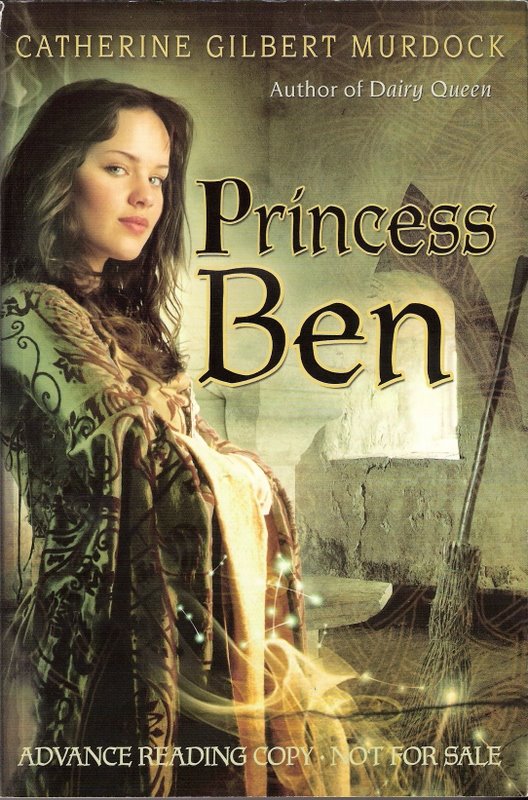
Princess Ben

This is another one of those my-gosh-I-can’t-believe-my-library-FINALLY-has-it-in books. I know I’ve seen reviews of this one popping up around; though for the life of me, besides Sarah Miller, Em, and Abby, I can’t think of where I found them…. at any rate, I heard about it, I wanted it, and I was super happy to get it.

It’s a great princess book. I loved Catherine Gilbert Murdock’s other books (Dairy Queen and Off Season), but this one is nothing like her other books. It’s deliciously different. Benevolence (that’s Ben for short, thank you very much), is a princess who doesn’t want to be one. She’s raised by a loving mother and a prince father, but they mostly let her do what she wants. Until one day, Ben’s left an orphan. She’s taken in by Queen Sophia, who tries, mostly against Ben’s will, to change Ben into a princess. It’s not pretty. Accidentally, Ben discovers a wizard room, with a book of spells, and sets to learning them. And, because she finds it unbearable, she ends up escaping the castle and Sophia’s regiment. Unfortunately, that only gets Ben into more trouble. Then again, that may not have been an unfortunate thing.

I really liked this book, as princess tales go. I liked that Ben’s not your typical princess, not just being a fiesty, head-strong (though spoiled) girl, but in other ways. She’s not thin. She has issues with food and comfort. She’s not perfect; her imperfections aren’t even remotely endearing. She has to endure (grumpily) trials in order to learn. In short, she’s a heck of a lot like me. I liked that. M said that she didn’t like that Murdock made a big deal about Ben being fat, but I think it was a necessary element to the story… it was something that Ben had to learn to deal with and accept, and it didn’t define who she was.

I also liked the world building, and use of magic. I liked that I felt the world supported the characters, rather than overwhelming them, as it can do in fantasy novels. I liked Queen Sophia; sure she was supposed to be mean and evil, but I felt more that she was overwhelmed and inexperienced (at being a parent, mostly), and I empathized with her, even while I was rooting for the grumpy and stubborn Ben.

However, I do think that Murdock slighted her other ones, Prince Florian and his father especially. Actually, the romance in the book was a bit uneven… it putters along at a 3 and then rockets to a 10 in the last chapter. (I liked the rocketing; I just wish there was more build-up.) I wanted to know more about Prince Florian than his glower. (Granted, it’s written from Ben’s point of view, so that may not have been possible…)

Most of all, though, I liked that what I liked outweighed what I didn’t like. It’s always nice when that happens.

Court Duel: The Crown and Court Duet, Book 2

If you haven’t noticed yet, I have a (rather large) soft spot for YA romances. Good — by that I mean satisfying, swooning, take-you-away — ones anyway. And this one is a good, thoroughly satisfying, definitely swooning, often amusing book. I loved it. (That’s an understatement: it’s one of those books where I put the rest of my life on hold and let the kids watch more TV than is good for them and stayed up late so I could finish it. That’s how much I loved it.)

It picks up where Crown Duel left off… I had to buy a copy of the two of them together (which is the only way you can get it these days) because my library only has the first half of the story. While the first have was great, I needed to know what happens to Melaria and Vidanric, mostly because the seeds of romance were planted in the first half, and I wanted to know how (or if) they end up together.

Melaria, who is slowly educating herself banishing the ignorance that haunted her in Crown Duel, is avoiding going to Remalna city and to Court, even though she should (she’s a countess after all). It’s only when her brother, Branaric, shows back up in Tlanth with his fiance (and Vidanric) that Mel finally consents to go see what Court is about. There, she learns to navigate the intricacies of flirting and courtship, of politics, and eventually learns not only about a plot to undo all that she’s worked for, but also her own heart.

(And that doesn’t nearly do the book justice.)

I liked this book immediately because I recognized that it’s a similar story to Pride and Prejudice. Mel and Danric spent much of their time arguing, and it’s he who first realizes what their relationship could be. She, of course, throws it back in his face (though it’s not as bad as what Lizzy did to Darcy), and so he resorts to, um, other methods (mostly leaving her alone). The whole middle section of the book, where Mel’s trying to figure things out, and she takes up writing letters with an “unknown” (at least to her) suitor, I found to be wonderful reading. And it all builds to one of the most perfect first-kiss scenes that I’ve read. (I could go on about how it’s much more satisfying to me to read a romance where the characters are at odds with each other than ones who have True Love from first sight, but I’ll spare you.) I could go on with my gushing, too, but I’ll spare you that, too. It’s still a fantasy book, still light on the magic, and yeah, I suppose if I were nit-picking, there are one-dimensional characters, and the bad guy really does come out of nowhere and the climax of the book really wasn’t all that climatic, but hey: it’s a great romance.

And I didn’t really care about the rest.

Crown Duel: Crown and Court Duet, Book 1

Melaria is a Countess who doesn’t act like one. Not only does she run around barefoot wearing old horse blankets, but she loathes everything about court: from the clothes and the people and the intrigue to the tyrannical King Galdran. So, after her father’s death, when she and her brother Branaric decide to go to war against the king — for various offenses, not the least of which was intending to break the Covenant with the Hill People not to chop down the colorwood trees — she’s all for it. In fact, Mel’s in the thick of it. That is, until she gets her foot caught in a trap, and ends up in enemy hands. From there, her life becomes more interesting and more complicated, especially after she’s thrown into the hands of the Marquis of Shevraeth, who keeps popping into her life at the most inconvenient (well, not always) of times.

This was an absolute blast to read. A terrific fantasy (light on the magic, heavy on the world-building, but not so much that the characters were slighted), and a terrific adventure. M read this one before I got to it, and her comment was that “Mel has anger management issues. But then, she’s a red head.” I didn’t quite agree: up until near the end, I thought her rage and anger were pretty much justified. Close to the end of the story, you kind of want to smack her upside the head, but she does figure things out. Thankfully. I do like how she becomes bookish at the end, too. That was a nice touch.

I’m also glad I liked it enough to actually buy it and the second one, Court Duel, because the library doesn’t have that one, and I don’t think I could live without knowing the rest of Mel’s story…

Breaking Dawn

Well. I got around to reading this over the weekend. I’m not going to weigh in on the controversies. (Though I do have to say that people who get all worked up over a work of fiction are a bit uptight. And, yes, I know I get lumped in that. I got all upset about Eclipse, after all.) I’m also not even going to try for a spoiler-free review. You’ve been warned.

Initially, I wasn’t excited about reading the book, but I actually became curious about it after Andi’s review . I kept reading reviews though, and I have to admit that I knew more than my fair share going in. So, I can’t say if my reading experience is entirely fair: I was bored. Honestly. For about 3/4 of the novel. I think part of is that Meyer needs a long break from writing. This horrid writing schedule Little, Brown — at least one book a year! — is keeping her on is showing. The stories are lame, the writing is bad, the editors are lazy. Either that, or intimidated. Because there was an awful lot of unnecessary passages in here. Did we really have to have all that leading up to the wedding? Did we really have to have all that with the pregnancy? Did we really really have to have all that waiting?? It seemed so pointless. Cut a good two to four hundred pages out and this might — MIGHT! — have been a decent novel.

I complained about this in the Host, and it fits here: Meyer has pacing problems. Just when the book starts to pick up, she grinds it to a halt with pages and pages of description (really? Khakis and a sweater pullover? How quaint!) that do nothing for the plot. It was frustrating.

Speaking of the plot, I didn’t think it was all that great, either. I kept rolling my eyes. It just felt so over the top. From the super vampire sperm (okay, I can accept that; Meyer is inventing her own vampire lore, after all) to the super half-vampire baby (and I agree: the name is horrible) , to Jacob imprinting on the baby (oh, puh-lease. What a consolation prize. Can’t have Bella? Here, have her baby instead. Ugh.), to Alice conveniently arranging the entire ending. Bah.

I liked it better than Eclipse, but that’s not saying much. I think Twilight’s the best, though, and I have to say that I’ll keep recommending that one. But with one caveat: don’t bother reading the rest. They’re not nearly as good.

The reviews that I read:
Heather’s review
Corinne’s review
Tricia’s review
Becky’s review
Leila’s review
Julie at Best Books’ review

The Adoration of Jenna Fox

My Geek-inspired review…

Is this as good as people keep saying? (Alessandra)
Yes. It’s very, very good, and deserves all the gushing it’s getting. Different from what I was expecting, but powerful and thought-provoking and as good as I had been led to believe.

Does this book seem typically YA, or could it be classified as a novel for adults with a younger protagonist? (Bybee)
Hmm… I think it depends on the adult. It’s not as detailed or as developed as an adult book. Pearson was very careful with her word choice; it reads much like a book of poetry — every word carries multiple implications. As a result, though, there’s a lot missing that I think a “typical” adult might want out of a novel. On the other hand, it deals with issues and themes that I think are interesting (as an adult) and could spark interesting discussions among adults. It would be a good book group book.

Is this a book that you would recommend to the average 13+ teenager? Or would you say that it depends on the maturity level of the child? (Book Zombie) I would recommend to the average teenager. (M — she’s not quite 12) wants to read it and I think she’d be interested in it.) There’s nothing “inappropriate”, and it might spark some interesting discussion.

When Jenna struggles with the ethical issues she faces, did you find yourself strongly taking one side or another, or did you find yourself unable to really put yourself in that position, or how did you react if in neither of the ways I’ve suggested? (Dewey) I think I often came down on the side of the grandmother. I understand the moral and ethical dilemmas that Jenna had to face, but I also agreed with Lily: it was wrong, it should have never had happened. Granted, it was too late, and I don’t believe it would have been morally right to undo it. Did that make sense without giving too much away?

What are some of the qualities you liked or disliked in the grandmother character? The boyfriend character? The neighbor character? (Dewey) Oh, I loved the grandmother — the fact that while she was torn between what she felt was right and who she loved. I also liked that she was straightforward, telling Jenna what she needed to know (rather than what she wanted to hear). The boyfriend was so-so. I appreciated that he was accepting of Jenna, but I felt like their relationship lacked chemistry — more a friendship, rather than a relationship. I did wonder if the only reason she ended up with him is because she’s the first person who believed in her. As for the neighbor, I liked that he had re-invented himself, which is a primary reason for him being interested in, and friendly to, Jenna. I liked that he was sympathetic to her situation, especially when she needed someone to be understanding and not judging.

Can you sum up the life lesson to be learned from this book in a sentence or two? (Suey) No. I can’t. Not without giving too much away — and I think it’s better if you don’t know much going in. It makes the revelation that much more surprising (though I have to admit that I had an inkling) and the second half more powerful. But I will say that it touches on issues of humanity and ethics and love (parent to child and the other way around) and expectations we have for each other. It’s an excellent read.

I’ll add more if I get more questions.

Sword of the Rightful King

I have mixed feelings about this book by master storyteller, Jane Yolen. It’s not so much a retelling of the Arthurian legend, but rather a rethinking of the tales. She takes elements of the original legend — most specifically the sword in the stone — and turns it upside down and inside out. I liked what she did with it, but there was a part of me that felt dissatisfied in the end.

Arthur’s been king for four years, and still there’s unrest in the country. Not everyone — most notably, Morgause (in her typical role of North Witch, master of the black arts) — is convinced that Arthur should be High King. So his mage, Merlinnus, devises a plan: put a sword in a stone, with some writing on it that declares that the person who draws the sword will be king, and challenge anyone to pull it out. Of course, only Arthur can, since Merlinnus put a spell on it so that would be the only possible solution.

Yet this book isn’t so much about Arthur, as it is about Gawen. He shows up near the beginning, desiring to become one of Arthur’s knights. He gets shuffled off — because of his size and quick wit — to be Merlinnus’s assistant instead. There’s something puzzling about Gawen… how he knows so much, his observations, his becoming one of Arthur’s trusted advisors.

I liked Gawen… I liked him even more at the end, even though I felt the ending was a bit rushed. (Yes, there is a secret there, but I had my suspicions about a third of the way through, and figured it out a little more than halfway, so it’s not really that big of a secret.) It had the elements of everything I like: intrigue; magic; Merlin as his old cranky self; Arthur as a loveable, bear-like king; and I admit I didn’t even mind this Morgause too much. I really liked Gawen. But maybe that was it: Gawen was too perfect, to pert, too right, too observent, too… too much. And in the end, I thought it just was a bit unbalanced. Maybe a little less would have been more here.

Still, it’s a interesting — if imperfect — interpretation of the Arthurian legend.

The Fall of the Kings

I have to admit this up front: I was burned out when I read this book. Burned out on fantasy, burned out on reading so much in a row, burned out from lack of sleep (and activity). So, that may have affected what I thought of it.

Because I thought it was dull, boring, poorly written, with uninteresting characters and plot. It didn’t get truly interesting until the last 100 pages, and even then, I was dissatisfied with the ending.

Set 60 years after Swordspoint, The Fall of Kings deals with a noble and a scholar who are lovers, but also a scholar who comes to think he’s a wizard from the ancient ages and his lover is the new King of the Land. It has shadows of Arthurian legend, but done somewhat clumsily. I was bored with the history, I was bored with the myth (told you I tended to skip those parts…), I was bored with the machinations of the main characters.

I think what I really missed was the sword fighting. And the chess game of the first novel. I was dissatisfied with the ending, but at least I enjoyed the journey. That’s much better than loathing the journey and being mildly interested in the ending.

The King of Attolia

M and I were talking about the Attolia series (or whatever the name of this trilogy is) to Hubby over lunch today, and it occurred to me that not only are they kind of difficult to explain, they actually end up sounding a lot lamer than they really are.

So, I got to thinking (after I finished the third book) why did I love these so much? It’s the writing: Turner is a superb storyteller, creating worlds and characters with as good a talent as Robin McKinley or Shannon Hale. But, I realized (especially after finishing the third book), that it was also because of Gen. He’s a wonderful hero — the true anti-hero, someone who is but doesn’t want to be — but he’s also the bad boy, the thief, the one who can’t be tamed. Which makes him infinitely alluring.

After being moody for all of the second book, Gen is back in almost as good of form as he was in The Thief. The only reason it’s not as good is because Gen’s, um, king and is required (for the most part) to act the role. Except the people of Attolia don’t want him there, and to be honest he doesn’t really want to be there either. Yet, he manages to rise to the occasion, with (of course) various intrigues and adventures along the way. And a myth story thrown in.

Reading these three books in quick succession made me aware of all the faults — that they’re essentially the same story three times, that Turner has some tried-and-true tricks to use. But I didn’t care. I was in love with Gen, with the world, with the story Turner was weaving.

Which is why I now want to go out and buy these three books. And it’s why — in spite of the fact that I think any reasonable person would say that this is a perfect trilogy and please leave it at that — I’m hoping that Turner doesn’t leave this world behind and will write a fourth book so she can wrap up some of the loose ends that she left hanging. Because I want to know what happens to them all.

And that’s a hallmark of a really good series. (Either that, or I’m just really tired. 🙂

The Queen of Attolia

I’ll try to do this without giving anything away from The Thief. Though it may be hard.

As befits the middle book in a trilogy, The Queen of Attolia is a long, dark book. It begins oh, so pleasantly with Gen getting a hand cut off in punishment. While the plot doesn’t exactly go down the proverbial hill from there, that one event sets the rest of the book in motion. You can surmise the mood for yourself.

While it’s a war book, a political book — and couldn’t be otherwise, since Attolia’s queen isn’t exactly the nicest person around — it’s also a growing story, a learning story, and even a love story.

It’s not as captivating as The Thief was (I would say I was just tired, but M — who’s read all these already… sigh — agrees with me), it has it’s delightful moments, lots of thrilling adventure, as well as expert manipulation (which I saw coming, but didn’t mind). And I really loved the love story. Thought that, while it wasn’t a beautiful, soaring one, it was honest and sweet.

Just like the characters I’ve come to love.

The Thief

I have a problem with this book. More specifically, I have a problem with reviewing this book. The problem is that the ending of the book is so good, so perfect, so right, and so marvelous, and yet it’s so crucial that I not tell you what it is that I really have no idea what to write.

Gen is a thief. One that landed in the king’s prison, with no way out. Until the king’s magus — his highest advisor — decides that Gen is the person he needs, for only Gen can steal the item the magus wants. They’re off on an adventure of the highest proportions, full of daring deeds, grand myths, and wonderful wit.

I loved it, almost from page one (though it was probably more like page 7). Well-written, engaging — I even loved the stories of the gods, something I have a tendency to skip over — and winning. And, as I already said, one of the best endings I’ve read in a long time.

I can’t wait to see what happens to Gen next.